Choosing the right decentralized exchange on Solana can make or break your trading experience. Raydium and Orca are two of the biggest names in the game, but they serve very different types of traders. Whether you’re chasing freshly launched memecoins or looking for the cleanest swap experience on blue-chip pairs, one of these two DEXs is probably your daily driver.
In this head-to-head comparison, we’ll break down everything that matters: liquidity, fees, features, security, and user experience. By the end, you’ll know exactly which Solana DEX deserves your volume in 2026.
Quick Verdict: Raydium vs Orca
Raydium wins for memecoin traders, new token hunters, and power users who want the deepest liquidity and the widest token selection on Solana. With $1.4B+ in TVL and over 3,300 trading pairs, it’s the default liquidity venue for tokens graduating from pump.fun. Visit Raydium.
Orca wins for DeFi-focused traders and liquidity providers who value capital efficiency, a clean interface, and the best execution on established pairs. Its Whirlpools concentrated liquidity system returns 100% of swap fees to LPs, making it the go-to for yield-conscious providers. Visit Orca.
What Is Raydium?

Raydium launched in February 2021 and quickly became the backbone of Solana’s DEX ecosystem. It’s an automated market maker (AMM) that offers multiple pool types, including standard AMM pools, concentrated liquidity (CLMM) pools, and constant product pools. In July 2025, Raydium crossed $1 trillion in cumulative trading volume, a milestone that cemented its position as Solana’s dominant exchange.
Today, Raydium holds roughly 20.8% of all DEX trading volume across all chains and consistently ranks as the #1 DEX on Solana by daily volume. It’s also the primary liquidity destination for tokens launched through pump.fun, which means almost every new memecoin on Solana sees its first real trading action on Raydium.
Beyond swaps, Raydium offers perpetual futures trading with 0 bps maker fees and tiered 2 to 4.5 bps taker fees, plus the AcceleRaytor launchpad for new token launches.
What Is Orca?

Orca is a concentrated liquidity DEX that has carved out a reputation for clean design and capital efficiency on Solana. While it doesn’t match Raydium’s raw volume, Orca’s Whirlpools technology is widely regarded as one of the best concentrated liquidity implementations in DeFi.
Whirlpools allow liquidity providers to deposit capital within custom price ranges rather than spreading it across the entire price curve. This approach can increase capital efficiency by 100x to 4,000x compared to traditional constant product AMMs. Each LP position is represented as an NFT, which can be composed with other DeFi protocols.
With roughly $250M to $290M in TVL, Orca is the third-largest DEX on Solana by volume. It’s particularly strong on established pairs like SOL/USDC, where its concentrated liquidity pools often deliver better execution than competitors. If you’re already exploring the Solana ecosystem, check out our Solana (SOL) Price Prediction 2026 for more context on the chain’s trajectory.
Fees Compared
Fees are where things get interesting. Both exchanges use tiered fee structures that depend on the pool type and pair volatility, but there are key differences in how those fees are distributed.
Raydium charges swap fees ranging from 0.01% to 1% depending on the pool type (CLMM pools can go as low as 0.01%). Of those fees, 84% goes to liquidity providers and 12% funds RAY staking incentives. For perpetual trading, makers pay 0 bps while takers pay 2 to 4.5 bps depending on their tier.
Orca charges fees ranging from 0.01% to 0.3% depending on the pool tier. The big difference? 100% of swap fees go directly to liquidity providers. There’s no protocol cut from swap fees, which makes Orca more attractive for LPs looking to maximize yield on their positions.
For most swaps on common pairs, both exchanges will cost you roughly the same in fees. The real difference is in fee distribution: if you’re providing liquidity, Orca’s 100% LP share is a meaningful advantage. If you’re just swapping, the difference is negligible.
Features Deep Dive
Raydium Features
- Three pool types: Standard AMM, Concentrated Liquidity (CLMM), and Constant Product pools give traders and LPs maximum flexibility
- Perpetual futures: Trade perps with leverage directly on the platform, with competitive maker/taker fees
- AcceleRaytor launchpad: Participate in new token launches and IDOs
- Farm rewards: Earn additional RAY token rewards on top of trading fees for select pools
- 3,300+ trading pairs: The widest token selection of any Solana DEX, including nearly every memecoin that launches
- pump.fun integration: Tokens graduating from pump.fun automatically get Raydium liquidity pools
Orca Features
- Whirlpools: Best-in-class concentrated liquidity with customizable price ranges and fee tiers
- NFT LP positions: Each liquidity position is an NFT, composable across DeFi
- Fair Price Indicator: Built-in price comparison tool that helps you avoid bad trades
- Custom fee tiers: Pool creators can set fee tiers that match the volatility profile of their pair
- Clean, beginner-friendly UI: Orca’s interface is consistently praised as the most approachable on Solana
If you’re into fast-paced trading and want tools like bots, take a look at our comparison of Photon vs BullX for the best Solana trading bots in 2026.
Pros and Cons
Raydium Pros
- Deepest liquidity on Solana with $1.4B+ TVL
- Widest token selection (3,300+ pairs including fresh memecoins)
- Perpetual futures trading with competitive fees
- Primary liquidity venue for pump.fun token launches
- Farm rewards provide additional yield for LPs
Raydium Cons
- Only 84% of fees go to LPs (12% to protocol)
- Interface is more complex and less beginner-friendly
- Standard AMM pools are less capital efficient
- No built-in swap aggregation
Orca Pros
- 100% of swap fees returned to liquidity providers
- Best-in-class Whirlpools concentrated liquidity (100-4,000x capital efficiency)
- Clean, intuitive interface that beginners can navigate easily
- Excellent execution on blue-chip pairs (SOL/USDC, etc.)
- NFT LP positions composable with other DeFi protocols
Orca Cons
- Significantly lower TVL (~$250-290M vs $1.4B+)
- Fewer token pairs (mostly established tokens, limited memecoin coverage)
- No perpetual trading or launchpad features
- Concentrated liquidity requires active position management
- No DCA or limit order functionality built in
Comparison Table
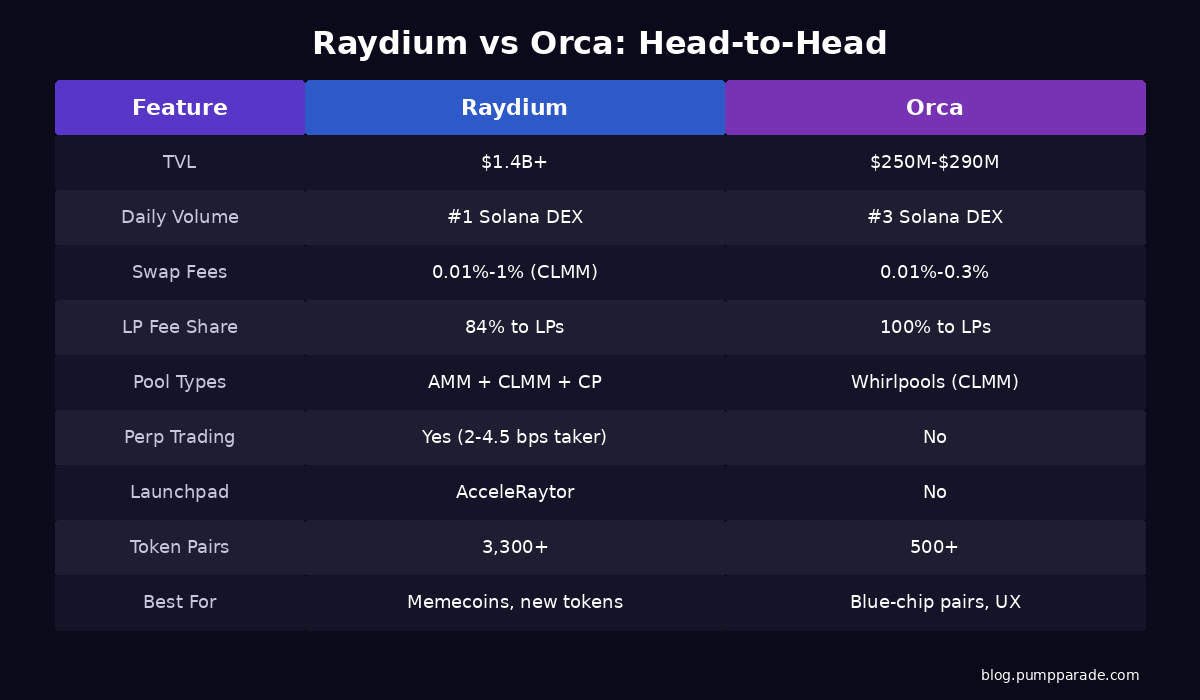
| Feature | Raydium | Orca |
|---|---|---|
| TVL | $1.4B+ | $250-290M |
| Solana Rank by Volume | #1 | #3 |
| Swap Fees | 0.01%-1% | 0.01%-0.3% |
| LP Fee Share | 84% | 100% |
| Pool Types | AMM + CLMM + Constant Product | Whirlpools (Concentrated Liquidity) |
| Perp Trading | Yes | No |
| Launchpad | AcceleRaytor | No |
| Token Pairs | 3,300+ | 500+ |
| Security Audits | Cyberscope + Immunefi bounty | Kudelski + Neodyme audits |
| Best For | Memecoins, new tokens, power users | Blue-chip pairs, LPs, beginners |
Security and Trust
Raydium has been audited by Cyberscope and maintains a $505K bug bounty program on Immunefi. The protocol has processed over $1 trillion in cumulative volume without a major smart contract exploit, which is a strong track record in DeFi. The team has also rolled out enhanced security measures throughout 2025 and 2026 as TVL grew.
Orca has undergone multiple security audits from Kudelski Security and Neodyme, two well-respected firms in the Solana security space. The protocol also maintains an active bug bounty program. Orca’s Whirlpools contracts have been live since 2022 and have handled billions in volume without incident.
Both protocols are non-custodial, meaning your funds stay in your wallet until you execute a swap. Neither requires KYC. That said, concentrated liquidity pools on both platforms introduce additional complexity (tick mechanics, price range logic) that expands the potential attack surface compared to simpler AMM designs.
For secure wallet options to connect to either DEX, read our Phantom vs Backpack wallet comparison.
User Experience
Raydium’s interface is functional but dense. It packs a lot of information onto the screen: pool stats, fee tiers, LP positions, farm rewards, and perps trading all share space. For experienced DeFi users, this is great because everything is accessible without clicking through multiple pages. For newcomers, it can feel overwhelming. There’s no mobile app, but the web interface works on mobile browsers.
Orca’s interface is the opposite: clean, minimal, and focused. The swap experience is straightforward, with a Fair Price Indicator that shows how your trade compares to market price. The Whirlpools LP interface clearly visualizes your price range and current position. Orca consistently gets praise from the community for having the best UX of any Solana DEX. Like Raydium, it’s web-only with mobile browser support.
If you value simplicity and spend most of your time swapping established tokens, Orca’s UX is noticeably better. If you need access to every new token and advanced features like perps, you’ll end up on Raydium regardless of the learning curve.
Verdict: Which Solana DEX Should You Use?
The answer depends on what kind of trader you are:
Choose Raydium if: You trade memecoins, hunt new token launches, want perp trading, or need access to the widest possible token selection on Solana. Raydium’s dominance in volume and liquidity depth makes it the unavoidable hub for anything new or speculative on the network. It’s also the better choice if you’re already using tools like Photon or other trading bots that route through Raydium pools.
Choose Orca if: You primarily trade established pairs (SOL/USDC, SOL/USDT), want the cleanest trading experience, or plan to provide liquidity and want to keep 100% of your earned fees. Orca’s Whirlpools technology delivers superior capital efficiency, and the interface is genuinely a pleasure to use.
The best approach? Use both. Most active Solana traders use Jupiter as their swap aggregator (check out our Jupiter Exchange Review 2026), which automatically routes trades through both Raydium and Orca to find the best price. For direct DEX interaction, keep Raydium bookmarked for new tokens and Orca for LP positions.
Overall winner: Raydium, by a narrow margin. Its combination of deepest liquidity, widest token selection, and additional features like perp trading make it the more complete platform. But Orca remains the better choice for specific use cases, particularly LP yield optimization and everyday swapping.
FAQ
Is Raydium or Orca cheaper for swapping?
Both are very similar in cost. Raydium’s CLMM pools start at 0.01%, and Orca’s Whirlpools range from 0.01% to 0.3%. For most common pairs, you’ll pay roughly the same. The real cost difference comes from slippage, where Raydium’s deeper liquidity often means less price impact on large trades.
Which DEX is better for providing liquidity?
Orca has the edge for LPs because it returns 100% of swap fees to liquidity providers (Raydium keeps 16%). Orca’s Whirlpools also offer cleaner concentrated liquidity management. However, Raydium offers additional farm rewards on select pools that can offset the fee difference.
Can I trade memecoins on Orca?
Orca supports some popular memecoins, but its selection is much smaller than Raydium’s 3,300+ pairs. If you’re hunting newly launched tokens or pump.fun graduates, Raydium is your only realistic option among these two DEXs.
Do I need a specific wallet for Raydium or Orca?
Both DEXs work with all major Solana wallets, including Phantom, Backpack, and Solflare. Simply connect your wallet and start trading. No KYC or account creation required.
Should I just use Jupiter instead?
Jupiter is a swap aggregator that routes trades through both Raydium and Orca (among other DEXs) to find the best price. For simple swaps, Jupiter is often the smartest choice. But if you want to provide liquidity, use perp trading, or access Raydium’s launchpad features, you’ll need to interact with the DEXs directly.