Backpack started as a scrappy wallet from ex-FTX engineers and quietly turned into one of the most interesting products in crypto. A self-custody wallet, an on-chain-friendly exchange, a perps venue, and a mini app store all live inside one interface. The question in 2026 is not whether Backpack is credible. It is whether it deserves to replace Phantom on your desktop and your phone.
This review breaks down exactly what Backpack does well, where it still lags, what it costs, and who should actually switch. Fair warning: I have used Backpack for over a year across Solana, Ethereum, and Sui, and I run some perps positions on the exchange side. So this is a real review, not a marketing pass.
TL;DR: Backpack Wallet Verdict
Rating: 4.5 / 5. Backpack is the best all-in-one Solana wallet in 2026. If you live inside the Solana ecosystem, trade perps, and want a single app that handles self-custody, cross-chain swaps, and a proper exchange, this is now the default. If you never leave EVM and rarely touch Solana, Rabby or MetaMask still make more sense.
Best for: Active Solana traders, perps users, xNFT collectors, and anyone tired of stitching together Phantom plus a centralized exchange plus a bridge.
Not for: EVM-only DeFi power users, US residents (perps are restricted), and anyone who needs deep Bitcoin-native or Cosmos support.
What Is Backpack?
Backpack is a self-custody crypto wallet and companion exchange built by Armani Ferrante and Tristan Yver, engineers who worked on Anchor and Serum before FTX collapsed. They rebuilt the project from scratch and turned it into a full crypto stack: wallet on one side, spot and perps exchange on the other, with the same login connecting both.
By mid-2026, the Backpack ecosystem has crossed 100,000 monthly active users and the exchange has processed more than $400 billion in cumulative trading volume since launch. Backpack Futures trades roughly $100 million to $2 billion per day depending on market conditions and carries a medium (8) trust score on CoinGecko. That puts it firmly in the mid-tier of credible venues, well above pop-up perps DEXs and inside the same conversation as Bybit-lite competitors.

Supported Chains and Networks
This is where Backpack quietly beats Phantom. It ships native support for a serious list of chains without asking you to install add-ons or import extra wallets. As of 2026, Backpack supports:
- Solana (primary focus, fastest UX)
- Ethereum mainnet plus Base, Arbitrum, Optimism, Polygon, BNB Chain
- Sui and Aptos (Move-based chains)
- Monad, Sei, Berachain, HyperEVM, Plasma (newer L1s and L2s)
That is 14 networks under one seed phrase. For comparison, Phantom covers Solana, Ethereum, Base, Polygon, and Bitcoin natively. Backpack goes wider on Move chains and next-gen L1s, which matters if you farm points campaigns or trade on newer venues.
Features Deep Dive
1. Native Exchange Integration
The killer feature is not a wallet feature at all. It is the fact that your Backpack wallet is also your Backpack Exchange account. One click moves funds between self-custody and the order book without a KYC-then-deposit dance every time. You can trade spot, perps up to 50x, and earn yield on collateral without leaving the app.
This collapses a workflow that normally requires Phantom plus Binance plus a bridge into a single interface. For active traders that is genuinely valuable, not just a marketing bullet.
2. xNFTs and In-Wallet Apps
Backpack pioneered xNFTs, executable NFTs that behave like installable mini apps inside the wallet. Developers publish trading terminals, portfolio trackers, and DeFi UIs as xNFTs that users install with explicit permissions. Because the app runs inside Backpack instead of on a random domain, phishing sites cannot mimic the interface, and users grant permissions per-app rather than per-website.
This is a real security upgrade. The dominant crypto hack vector in 2025 and 2026 has been signature phishing on lookalike sites. xNFTs neutralize a good chunk of that surface.
3. Cross-Chain Swaps and Bridging
Backpack bakes in bridge routing across all supported networks. There is zero wallet-level markup on swaps or bridges. You pay only the underlying network gas and whatever the bridge protocol charges. That is a meaningful difference from wallets that add a 0.5% to 0.85% “wallet fee” on top of every swap.
4. Native Staking
Stake SOL, ETH liquid staking tokens, and select other assets directly from the wallet. APY is displayed in-app so you can compare validators or LSTs before locking. It is not as deep as a dedicated staking dashboard, but it is fine for set-and-forget positions.
5. Hardware Wallet Support
Backpack pairs with Ledger and other hardware devices for cold storage. You can hold high-value positions on a hardware key and still use the Backpack UI to sign transactions across chains. This closes the security gap that used to force serious users toward MetaMask by default.
6. Mad Lads and NFT Handling
Backpack was built by the team behind Mad Lads, one of the highest-conviction Solana NFT collections (about 2.38M SOL in lifetime volume). Unsurprisingly, NFT display and management inside Backpack is genuinely good. Collections load fast, floor prices show in the sidebar, and you can lock specific NFTs to prevent accidental listing or transfer.
Backpack Fees Breakdown
Backpack separates its fee stack into two buckets: wallet and exchange. Here is what you actually pay in 2026.
Wallet Fees
- Base wallet fee: $0. Backpack does not charge you to hold or send crypto.
- Solana transaction cost: typically under $0.01 per transaction (network gas only).
- Swap markup: 0%. You pay only the DEX or aggregator quote plus network gas.
- Bridge markup: 0% wallet fee. Bridge protocol fees and gas apply.
- Staking: No wallet fee. Standard validator commissions apply (typically 5% to 10% of rewards).
Exchange Fees
- Spot maker: 0.08%
- Spot taker: 0.10%
- Perp maker: 0.02% (competitive with Bybit and Binance perps)
- Perp taker: 0.06%
- Deposit: free from your own Backpack wallet
- Withdrawal: network gas only for on-chain withdrawals
The perps rates are the standout number. 0.02% maker and 0.06% taker undercuts most centralized venues and matches the leaders. If you run size on perps, that fee compression compounds fast.
Comparison: Backpack vs Phantom vs MetaMask
| Feature | Backpack | Phantom | MetaMask |
|---|---|---|---|
| Primary chain | Solana (multi-chain) | Solana (multi-chain) | Ethereum / EVM |
| Chains supported | 14+ | 5 | All EVM chains |
| Exchange built in | Yes (spot + perps) | No | No |
| Swap markup | 0% | 0.85% | 0.875% |
| Hardware wallet | Yes | Yes | Yes |
| xNFT apps | Yes | No | No (Snaps instead) |
| NFT locking | Yes | Partial | No |
| Mobile app | iOS + Android | iOS + Android | iOS + Android |
| Wallet fee | $0 | $0 base | $0 base |
Security and Trust
Backpack has a few advantages here that are hard to fake:
- Self-custodial by design. Private keys are stored locally or on hardware. The team cannot recover your seed phrase and cannot freeze your wallet.
- Real-time scam protection. Backpack maintains an in-app risk engine that flags known malicious contracts and drainer signatures before you sign.
- xNFT sandboxing. Third-party apps run in a permissioned sandbox, not on arbitrary domains, which reduces phishing exposure.
- NFT collection lock. One tap freezes an NFT so it cannot be listed or transferred, useful for high-value assets that live in a hot wallet.
- Exchange trust score. CoinGecko rates the exchange at medium (8), and reserves are audited on a rolling basis.
The one honest caveat: Backpack Exchange is registered in the British Virgin Islands, and Backpack does not currently service US customers for its perpetual futures product. If you are a US-based trader, you can use the wallet, but not the perps side.
User Experience
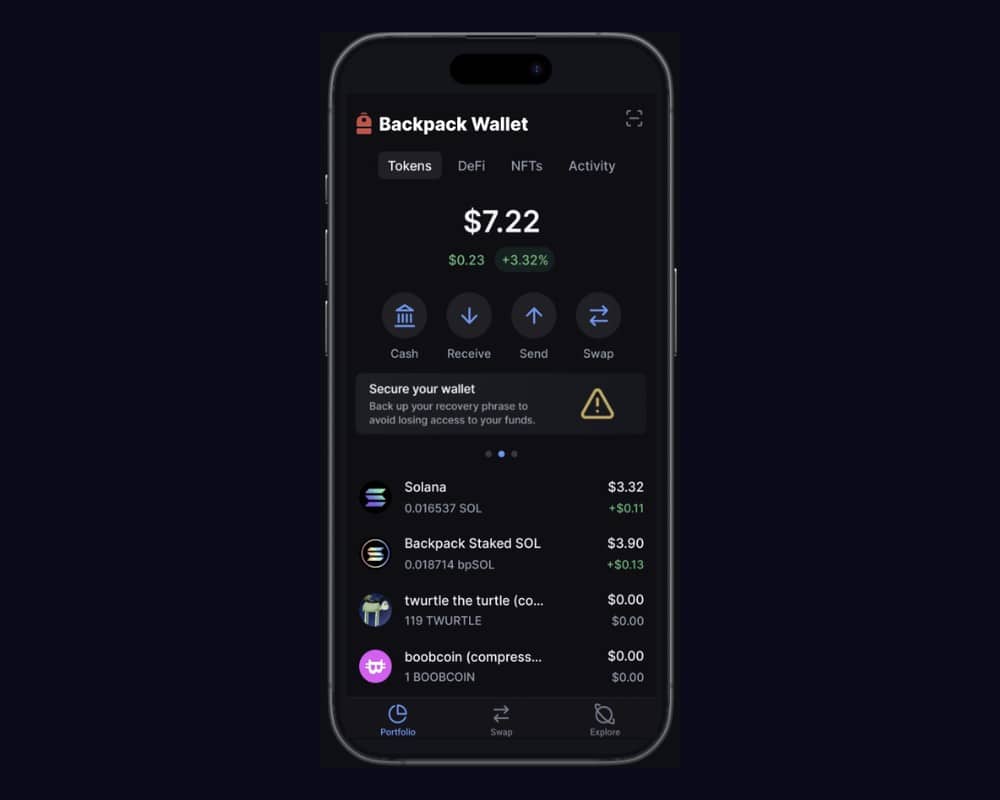
The UX is where Backpack has quietly overtaken most competitors. The desktop extension and mobile app share the same visual language: dark theme, generous whitespace, real-time balance updates, and a persistent switcher that lets you flip between the wallet and Backpack Exchange with one click.
Onboarding is fast. New users can create a wallet, back up a seed phrase, and buy their first SOL in under three minutes. Advanced users get a token search that actually works, a transaction simulator that previews signature impact, and per-app permissions that read like an actual permissions system rather than a scary popup.
The mobile app is now feature-parity with the desktop extension, which was not true a year ago. Cross-chain swaps, perps trading, and xNFT installation all work on iOS and Android without falling back to a webview.
Pros and Cons
Pros
- Best-in-class Solana experience with real cross-chain support (14+ networks)
- Native exchange integration means one interface for self-custody and active trading
- Zero wallet markup on swaps and bridges, so you keep the alpha you generate
- Competitive perps fees at 0.02% maker / 0.06% taker
- xNFT security model reduces phishing risk in a real, structural way
- Beautiful UX across desktop and mobile with true feature parity
- Hardware wallet support and per-collection NFT locking for cold-storage users
Cons
- No US access to the perps exchange (BVI-registered, geo-restricted)
- Bitcoin support is limited compared to wallets built around BTC first
- Ecosystem still smaller than Phantom, so some Solana dapps default to Phantom flows
- xNFT app store is still thin. The pipeline is real, the current shelf is not
- If you never touch Solana, you are paying an opportunity cost by not using Rabby or MetaMask for EVM-native flows
Who Should Use Backpack in 2026?
Active Solana traders. If you spend real time on Raydium, Jupiter, or Meteora, Backpack is now the sharpest tool. The zero-markup swaps alone pay for the switch.
Perps traders outside the US. Backpack Futures at 0.02% / 0.06% is one of the cheapest venues to run size. Compared to Kraken and Bitget, Backpack’s edge is that your collateral stays with you until you actively route it into the exchange.
Multi-chain farmers and points campaign chasers. Native support for Monad, Sei, HyperEVM, Berachain, and Sui in a single wallet is genuinely rare. If you rotate across new L1s and L2s, this is a category leader.
NFT collectors, especially on Solana. Between the Mad Lads pedigree and the collection lock feature, Backpack treats NFTs like a serious asset class, not an afterthought.
Skip Backpack if: you never leave EVM, you need deep Bitcoin native staking or Ordinals workflows, or you live in the US and specifically want perps.
Final Verdict
Backpack in 2026 has done something rare: it has become the default answer for a specific category (multi-chain Solana-first users who also trade), while quietly being credible for everyone else. The wallet is polished, the exchange is real, and the fee stack is aggressive in favor of the user.
If you have been running Phantom plus a centralized exchange plus a bridge, replacing that stack with Backpack removes real friction and real fees. If you are EVM-only, stay with Rabby or MetaMask. Everyone in between should install it and see.
Rating: 4.5 / 5.
Try Backpack Wallet or explore Backpack Exchange.
FAQ
Is Backpack Wallet safe?
Yes. Backpack is a self-custody wallet, meaning your private keys never leave your device (or your hardware wallet if you connect one). It also includes real-time scam detection and an xNFT sandbox that reduces phishing risk. As always in crypto, your seed phrase is the single point of failure, so back it up offline.
Does Backpack charge fees?
The wallet itself is free with zero markup on swaps and bridges. You pay only network gas. The Backpack Exchange charges 0.08% maker and 0.10% taker on spot, and 0.02% maker and 0.06% taker on perpetual futures.
Can US users use Backpack?
US users can use the Backpack wallet freely for self-custody, swaps, staking, and NFT management. However, Backpack Exchange (spot and perps) is not available to US residents because the exchange is registered in the British Virgin Islands and geo-restricts US IPs.
What is an xNFT?
An xNFT is an executable NFT, essentially a mini application that installs directly inside your Backpack wallet. Instead of visiting a website and connecting your wallet, you install the app once and it runs in a permissioned sandbox. This design was pioneered by Backpack to reduce phishing risk and give users granular per-app permissions.
Backpack vs Phantom: which is better in 2026?
For active Solana traders who also want perps and cross-chain support, Backpack is now the stronger choice. Phantom is still excellent for casual Solana users and has a slight edge in dapp compatibility because it has been around longer. If you want everything (wallet plus exchange plus perps) in one interface, choose Backpack. If you want the simplest possible Solana wallet, Phantom is still a fine default.
Does Backpack support Bitcoin?
Backpack has limited Bitcoin support compared to wallets built around BTC. If Bitcoin is your primary chain, dedicated wallets like Xverse or Sparrow are stronger. For a small BTC allocation alongside Solana and EVM assets, Backpack is workable but not category-leading.