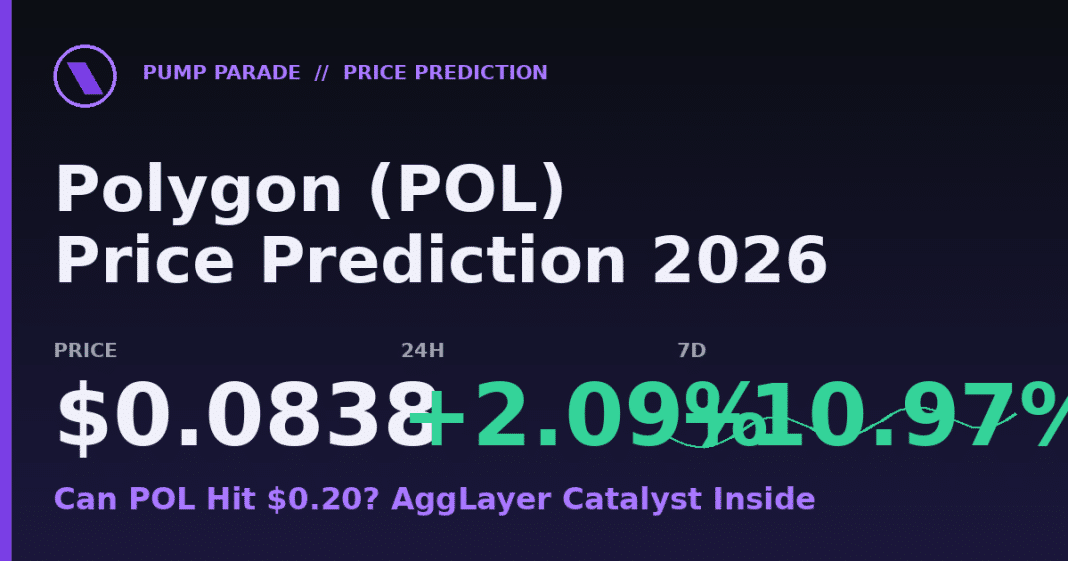
Polygon’s POL trades at $0.084 today, up nearly 11% over the past week but still 93% below its 2024 all-time high. The disconnect is real: the network just processed $80 billion in monthly stablecoin volume, burned 107 million tokens this year, and locked up 3.6 billion POL in staking. Yet the token sits within touching distance of its July 1 all-time low near $0.068.
So which side wins? This Polygon POL price prediction 2026 breaks down what would push POL toward $0.20 by year-end, what could keep it stuck under $0.10, and what a serious analyst actually needs to watch. Bear, base, and bull cases inside, with real on-chain data and cited targets from Cryptopolitan, Coinbase, and Changelly.
Key Takeaways
- POL trades near $0.084, up 11% in 7 days but down 93% from its March 2024 ATH of $1.29.
- Bull case: $0.20 to $0.28 if AggLayer v0.3 lands, stablecoin flywheel accelerates, and POL burns keep outpacing emissions.
- Base case: $0.10 to $0.14, a modest re-rating as the market waits for fee capture and validator economics to become visible.
- Bear case: $0.06 to $0.08, if L2 competition intensifies and network usage fails to translate into token value.
- Watch the daily burn rate. Polygon now burns roughly 1 million POL per day, projecting a 3.5% annual supply reduction if the pace holds.
- Key catalysts: AggLayer v0.3 rollout, Gigagas roadmap execution, sPOL liquid staking adoption, Visa and Modern Treasury payment partnerships.
Where Polygon (POL) Stands Today
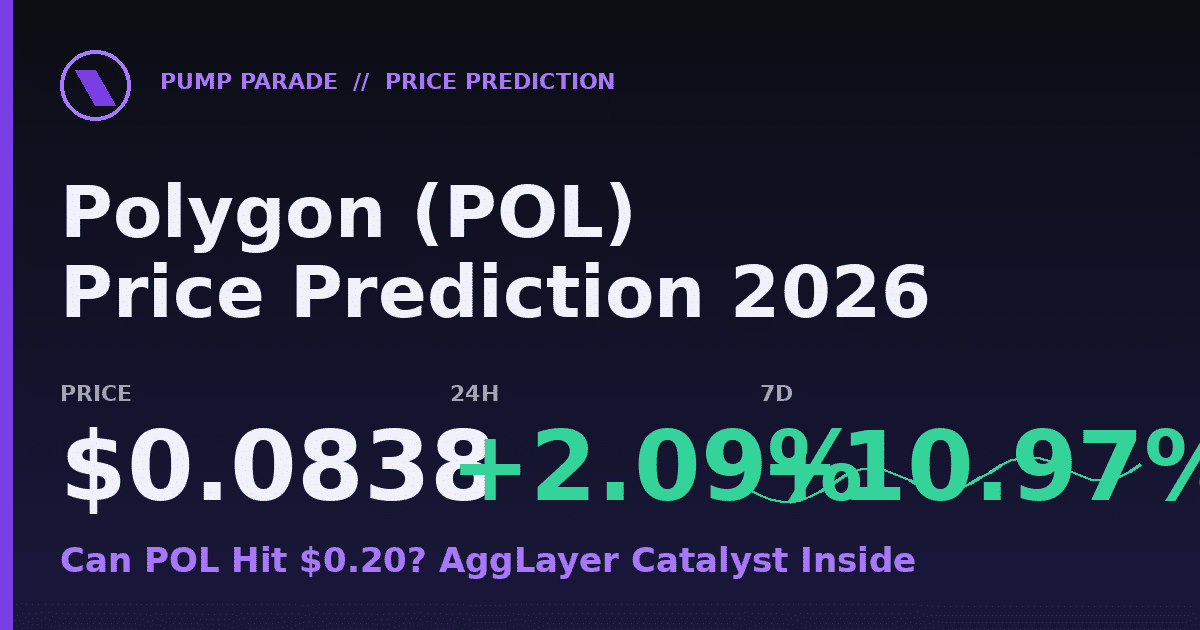
Let’s start with the numbers. POL currently trades at $0.0838 with a market capitalization of $895 million, ranking 71 on CoinGecko. Circulating supply sits at 10.68 billion tokens against an effectively uncapped max supply, though annual emissions have been offset by aggressive burns since the AggLayer upgrade path began.
Here’s the snapshot every analyst starts with:
| Metric | Value |
|---|---|
| Current Price | $0.0838 |
| 24h Change | +2.09% |
| 7d Change | +10.97% |
| 30d Change | +11.49% |
| Market Cap | $895 million |
| 24h Volume | $55.3 million |
| Rank | #71 |
| All-Time High | $1.29 (Mar 2024) |
| % From ATH | -93.5% |
| All-Time Low | $0.068 (Jul 1, 2026) |
Two things stand out. First, POL just printed a fresh all-time low two weeks ago, then bounced roughly 23%. Second, that bounce is not showing up on major volume, which suggests accumulation from believers rather than a full narrative flip. Both matter for how you read the next 90 days.
Why Is POL Range-Bound Right Now?
The Polygon story has a strange split between usage and price. On the network side, things look excellent. Polygon processed roughly $80 billion in stablecoin transaction volume during May 2026 across 198 million transactions, topping Solana and BNB Chain that month, according to network data cited by CoinMarketCap. Cumulative stablecoin volume on the network has crossed $2.4 trillion.
On the token side, POL has been treated like it doesn’t exist. Sell-side liquidity from long-time MATIC holders who migrated but never wanted to hold has weighed on price for months. Add competition from Base, Arbitrum, and Solana for developer mindshare, and you get a token that keeps testing new lows even as the underlying network hits new highs.
The question for the next six months is whether the flywheel Polygon Labs has been building, payments plus staking plus AggLayer routing, finally translates into fee capture that flows to token holders. If it does, the re-rating case gets loud. If it doesn’t, POL stays a network story with a poor token story.
The Bull Case for Polygon POL
1. AggLayer v0.3 as a Real Product Moment
The AggLayer is Polygon’s cross-chain routing layer, and v0.3 targets unified liquidity across ecosystem chains with ZK-verified messaging. Once it lands and starts routing serious volume, POL becomes the fee asset and staking collateral for a network of networks, not a single L2. That’s the pivot bulls have been waiting on since the 2.0 rebrand.
2. Deflationary Supply Dynamics
Sandeep Nailwal, Polygon co-founder, has publicly confirmed that 107 million POL have been burned in 2026, exceeding tokens newly minted through staking rewards. The daily burn now runs around 1 million POL, projecting a roughly 3.5% annual supply contraction if the pace holds. For a token this beaten down, a shift from inflation to deflation is a real structural change, not just narrative.
3. Institutional Payment Rails
Visa integration, Modern Treasury partnerships, and the broader Open Money Stack pitch position Polygon as the settlement layer for regulated stablecoin payments. If even a fraction of the $80 billion monthly stablecoin volume starts producing fees that route back to POL stakers, the “network story, poor token story” critique dies.
The Bear Case for Polygon POL
1. L2 Fragmentation Is Real
Ethereum’s own roadmap keeps making L1 cheaper, and Base plus Arbitrum have absorbed most of the DeFi liquidity that used to flow to Polygon PoS. If Polygon can’t defend its stablecoin niche against Solana and Tron, the growth story stalls.
2. Emissions Overhang Persists
Even with 107 million burned, POL still emits tokens for validator rewards. Analysts covering the token, including those at AMBCrypto, note that until the market can price the net supply change with confidence, POL trades like an inflationary asset regardless of the burn headline. Watch the net supply metric monthly, not just the burn.
3. Weak Correlation to Network Usage
The base bear case is not that Polygon fails. It’s that Polygon succeeds and POL still doesn’t capture the value. If AggLayer fees route to a fee router that pays validators without materially reducing float or driving demand, the token can stay pinned. Investors should ask: does POL win when Polygon wins, or only when the market cap catches up to a specific fee-capture story?
Polygon POL Price Prediction 2026: Targets by Timeframe
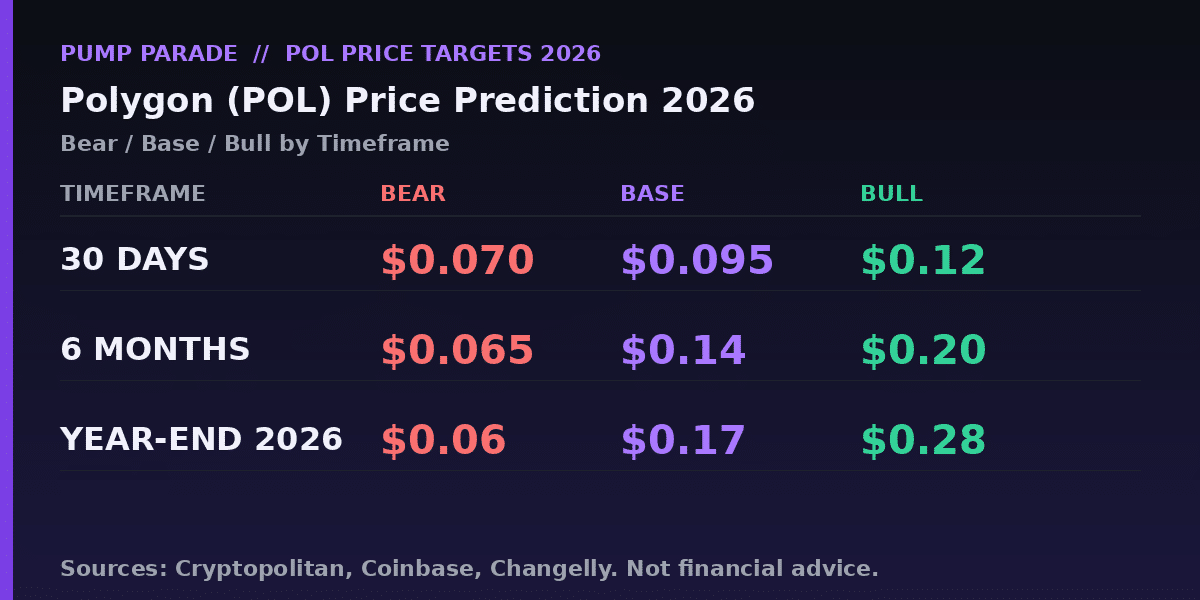
Here is our timeframe view, cross-referenced against forecasts from Cryptopolitan, Coinbase, and Changelly. The base case assumes no dramatic macro shift and a partial AggLayer product win. Bull requires the flywheel actually turning. Bear requires L2 competition winning and burn narrative failing to hold.
| Timeframe | Bear | Base | Bull |
|---|---|---|---|
| 30 days | $0.070 | $0.095 | $0.12 |
| 6 months | $0.065 | $0.14 | $0.20 |
| End of 2026 | $0.06 | $0.17 | $0.28 |
Short-Term Outlook (30 Days)
POL cleared $0.075 support and the 20-day EMA over the past week, which historically opens the door to $0.09 and $0.10 as first resistance zones. A reclaim of $0.10 with volume expansion, ideally above $80 million daily, would confirm a trend change. Failing to hold $0.075 puts $0.068 back in play.
Medium-Term (6 Months)
The six-month window is where AggLayer v0.3 execution and the payments narrative do their work. Base case has POL working toward $0.14 as fee capture becomes visible and the burn maintains a 1 million per day pace. The bull case at $0.20 requires the flywheel to actually turn, meaning stablecoin volume, staking growth, and AggLayer routing all compounding.
Long-Term (End of 2026 and Into 2027)
Cryptopolitan’s model targets a $0.28 maximum for 2026 with a $0.22 average, which lines up with our bull scenario. Coinbase’s more conservative approach sits at $0.08, effectively pricing zero re-rating. Changelly hovers near $0.09. Standard Chartered has not published a POL target, but their broader L2 thesis suggests upside surprise if unified liquidity across chains becomes real. The honest read: the range of credible outcomes for December 2026 sits between $0.06 and $0.30.
How Does Polygon Compare to Arbitrum?
The closest peer for POL is Arbitrum, both are Ethereum-aligned scaling stories with big brand recognition, both have suffered token underperformance despite strong usage, and both face the “network wins, token doesn’t” critique.
| Metric | Polygon (POL) | Arbitrum (ARB) |
|---|---|---|
| Price | $0.084 | $0.19 |
| Market Cap | $895M | $960M |
| Token Utility | Gas, staking, AggLayer collateral | Governance only |
| Emissions | Deflationary via burn | Ongoing unlocks |
| Stablecoin Volume | $80B monthly | $18B monthly |
| Cross-chain Layer | AggLayer | Orbit stack |
| Down From ATH | -93.5% | -91% |
POL’s edge is token utility. Gas, staking, and AggLayer collateral give POL three fee-capture pathways that ARB simply does not have. If unified liquidity actually forms, POL is the better relative bet from here, though ARB retains a stronger DeFi ecosystem today.
What Would Change Our View?
Three scenario triggers would force a rewrite of this thesis.
First, if AggLayer v0.3 slips past Q4 2026 without a clear public timeline, the bull thesis has to be pushed out by six to nine months and base case drifts toward $0.10.
Second, if net POL supply flips from deflationary back to inflationary for two consecutive months, the “structural change” argument dies and we’d cut the year-end target by 30%.
Third, if a Tier-1 exchange launches a POL staking product with real yield tied to AggLayer fees, that would be an accelerant, not a required trigger, but it would raise the bull target toward $0.35.
Frequently Asked Questions
Will Polygon POL reach $0.20 in 2026?
POL reaching $0.20 in 2026 is credible but not the base case. It requires AggLayer v0.3 to ship on time, the daily POL burn to keep outpacing emissions, and stablecoin fee capture to become visible on-chain. Cryptopolitan’s 2026 model targets $0.28 as an upper bound, so $0.20 sits below their max and represents a plausible bull scenario if catalysts stack.
Is Polygon POL a good investment in 2026?
Polygon has strong network fundamentals, $80 billion in monthly stablecoin volume and a deflationary supply trend, but the token has consistently lagged the network’s performance. Whether POL is a good investment depends on whether you believe upcoming catalysts like AggLayer v0.3 will finally translate usage into token value. Sizing should reflect the wide bear-to-bull range of roughly $0.06 to $0.28.
What is the Polygon POL price prediction for 2026?
Our year-end 2026 range is $0.06 in the bear case, $0.17 in the base case, and $0.28 in the bull case. Cryptopolitan projects a similar range with a $0.22 average, while Coinbase and Changelly sit closer to $0.08 to $0.09. The wide dispersion reflects real uncertainty about AggLayer execution and fee capture.
Why did MATIC change to POL?
MATIC was rebranded to POL as part of the Polygon 2.0 upgrade to enable multi-chain staking, AggLayer cross-chain routing, and unified value capture across Polygon’s expanding ecosystem. Token holders migrated at a 1-to-1 ratio, and POL now serves as gas, staking collateral, and the base asset for the AggLayer settlement layer.
Can Polygon POL reach $1 again?
POL revisiting $1 would require roughly a 12x from current prices and a full return of speculative capital plus proven fee capture at the AggLayer level. That’s a 2027 to 2028 story at the earliest, contingent on successful Polygon 2.0 execution and a broader crypto bull cycle. It’s on the table, but not the near-term thesis.
What is the biggest risk to POL in 2026?
The biggest risk is that Polygon keeps winning at the network layer while POL fails to capture value. If AggLayer fees route through mechanisms that don’t materially benefit stakers, or if L2 competition erodes the payments moat, POL can stay range-bound near recent lows even in a rising crypto market.
The Honest Take
Polygon is one of the few L2 stories where the network fundamentals genuinely justify a serious re-look. Eighty billion in monthly stablecoin volume is not a narrative, it’s a number, and it’s a number that beats Solana and BNB Chain. The burn dynamic is real. The AggLayer roadmap is credible.
The catch is the same catch it’s always been: POL has to prove that Polygon’s success shows up on the token. The next 90 days will be the market’s first real look at whether AggLayer v0.3 delivers a mechanism that actually routes value back to holders. If it does, $0.20 is a floor, not a stretch. If it doesn’t, we’re back to arguing whether $0.10 is support or resistance.
The setup that would flip us fully bullish: AggLayer v0.3 shipping in the second half of 2026, monthly net POL supply staying negative for three consecutive months, and stablecoin fee capture appearing in on-chain dashboards. That’s a specific, testable thesis. Watch for it, and let the data update your view instead of your priors.
For traders and investors looking at the broader L2 landscape, our Arbitrum ARB price prediction and Stellar XLM price prediction cover the two closest peers on the L2 scaling and payments narratives.
Disclaimer: This article is for informational and educational purposes only and should not be construed as financial, investment, or trading advice. Cryptocurrency markets are highly volatile, and past performance does not guarantee future results. The price predictions and analyses presented here are based on AI models, technical indicators, and available data at the time of writing, they are not guarantees. Always conduct your own research (DYOR) and consult with a qualified financial advisor before making any investment decisions. Pump Parade and its authors do not assume liability for financial losses incurred based on information provided in this article.