Choosing the right trading terminal can make or break your on-chain trading experience. For Solana traders, two names keep coming up in every conversation: Photon and BullX. Both promise fast execution, real-time charts, and MEV protection, but they take very different approaches to getting you from token discovery to trade execution.
So which one deserves a spot in your trading workflow? We spent weeks testing both platforms across memecoin sniping, DeFi token swaps, and active chart trading to find out. Here’s our honest, data-backed verdict.
Quick Verdict: Photon vs BullX
Short on time? Here’s the bottom line: Photon wins for pure speed and visual trading on Solana. BullX wins for multi-chain coverage and advanced order automation. If you only trade on Solana and want the fastest possible execution with clean charts, go with Photon. If you trade across multiple chains and want sophisticated automation tools like grid trading and DCA, BullX is your pick.
What is Photon?
Photon is a web-based trading terminal built exclusively for Solana. It focuses on speed above everything else, offering real-time candlestick charts, one-click trading with preset SOL amounts, and private node infrastructure with Jito bundle integration for reliable transaction landing. Since its launch, Photon has become the go-to terminal for memecoin traders who need to react to price action within seconds.
The platform supports trading on Pump.fun, Raydium, Jupiter, and other Solana DEX protocols, all from a single browser-based interface. There’s no Telegram bot and no mobile app. Photon is purely a web trading dashboard, and it does that one thing exceptionally well.
What is BullX?
BullX (including its upgraded version, BullX Neo) is a hybrid trading terminal that combines a web dashboard with Telegram bot functionality. Unlike Photon’s Solana-only approach, BullX supports five chains: Solana, Ethereum, Base, TRON, and Blast. This makes it appealing to traders who want one interface for their entire on-chain portfolio.
BullX’s standout feature is Pump Vision (upgraded to “Neo Vision” in the latest release), which provides real-time chart previews for every new token hitting the market. The platform also offers a broader range of order types, including grid trading and dollar-cost averaging (DCA) strategies that go beyond what most trading terminals provide.

Features Deep Dive
Charting and Interface
Both platforms use TradingView-style charts with drawing tools and technical indicators. Photon’s charts update faster, with a UI refresh rate that visibly outpaces BullX during high-volatility moments. The color-coded transaction history in Photon makes it easy to track your P&L in real time without switching views.
BullX counters with a more feature-dense interface. The TradingView integration includes a wider selection of drawing tools and indicators. BullX Neo’s dashboard also surfaces market analytics alongside your trading view, so you can monitor new token launches while managing existing positions.
Order Types and Automation
This is where BullX pulls ahead significantly. While Photon offers basic market orders, limit orders, and DCA orders, BullX provides a full automation suite: rule-based swaps, stop-loss, take-profit, DCA, and grid trading strategies. For traders who want to set up complex entries and exits without watching charts 24/7, BullX is the clear winner.
Photon is designed for active, hands-on trading. Its one-click preset buttons (configurable in settings for amounts like 0.1, 0.25, 0.5, or 1 SOL) make rapid-fire trading smooth, but you need to be at your screen to use them effectively.
Token Discovery
Photon includes a trending feed that aggregates the highest-volume tokens sorted by volume and launch recency. It’s functional but basic. You can paste any token contract address and start trading within seconds.
BullX’s Pump Vision / Neo Vision is a major differentiator here. It categorizes new tokens based on their lifecycle stage and provides real-time chart previews without requiring you to navigate to each token individually. For traders focused on catching new launches early, this feature alone could justify choosing BullX. If you want to learn more about the tools Solana traders use for token discovery, check out our Axiom Review 2026 for another popular option.
Multi-Chain Support
Photon is Solana-only. Full stop. If you trade exclusively on Solana, this isn’t a limitation. If you also trade on Ethereum, Base, or other chains, you’ll need a second tool.
BullX supports Solana, Ethereum, Base, TRON, and Blast from a single interface. Switching between chains is seamless, and your portfolio view aggregates holdings across all supported networks. For traders who move between ecosystems, this is a significant convenience advantage.
Fees and Pricing
Both platforms follow a simple fee model with no monthly subscriptions:
Photon charges approximately 1% per swap on the initial token amount. When you factor in Solana base gas (under 0.000005 SOL) and priority fees/Jito tips (0.001 to 0.01 SOL, user-adjustable), the realistic total cost per trade is roughly 1.1% to 1.5% under normal network conditions.
BullX charges a flat 0.9% transaction fee on all executed trades across all supported chains. This slightly lower base fee adds up for high-frequency traders. BullX also offers a 10% fee discount through referral signups, bringing the effective rate down to approximately 0.81%.
On pure fee comparison, BullX has the edge at 0.9% vs Photon’s 1%. Over hundreds of trades, that 0.1% difference becomes meaningful. However, Photon’s faster execution can sometimes offset this through better fill prices during volatile moments.
Pros and Cons
Photon
Pros:
- Fastest UI refresh and execution speeds among web-based Solana trading terminals
- Excellent visual feedback with real-time color-coded transaction history and live charts
- Quick setup: you can be trading within minutes of your first visit
- Non-custodial wallet with immediate private key export
- Token safety indicators (mint authority status, liquidity locks, holder distribution) displayed before every trade
Cons:
- Solana-only, with no multi-chain support
- Limited automation compared to BullX (no grid trading or rule-based swaps)
- No Telegram bot or mobile interface
- Requires active screen monitoring rather than “set and forget” strategies
BullX
Pros:
- Multi-chain support (Solana, ETH, Base, TRON, Blast) from one interface
- Advanced order types including grid trading, DCA, and rule-based automation
- Pump Vision / Neo Vision for real-time new token monitoring
- Lower base trading fee (0.9% vs 1%)
- Both web dashboard and Telegram bot access
Cons:
- Slightly slower execution than Photon on Solana specifically
- Steeper learning curve due to feature density
- 1% (or 0.9%) fee accumulates quickly for high-frequency traders
- No free tier or trial period
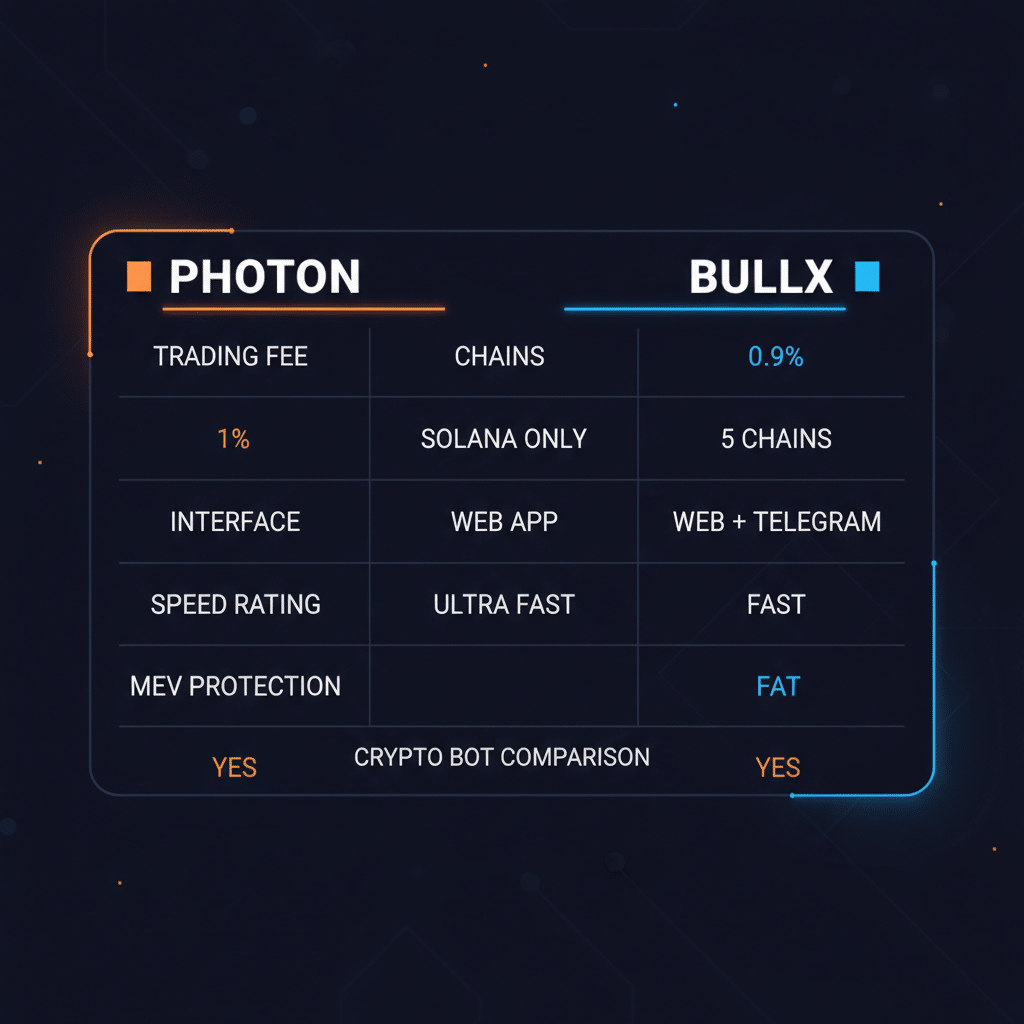
Comparison Table
| Feature | Photon | BullX |
|---|---|---|
| Trading Fee | ~1% | 0.9% |
| Supported Chains | Solana only | SOL, ETH, Base, TRON, Blast |
| Interface | Web app | Web app + Telegram bot |
| Execution Speed | Ultra-fast (private nodes + Jito) | Fast (JITO MEV bundling) |
| MEV Protection | Yes (Smart-MEV toggles) | Yes (JITO bundling) |
| Order Types | Market, Limit, DCA | Market, Limit, DCA, Grid, Stop-Loss, Take-Profit |
| Token Discovery | Trending feed | Pump Vision / Neo Vision |
| Wallet | Built-in (non-custodial) | Connect external wallet |
| Mobile Access | Browser only | Telegram bot on mobile |
| Best For | Speed-focused Solana traders | Multi-chain traders & automation fans |
Security and Trust
Both Photon and BullX take a non-custodial approach, which means your private keys remain under your control. However, they handle this differently.
Photon generates a built-in wallet when you first connect. You’re encouraged to export your private key immediately and store it offline. The platform displays token safety indicators before every trade, showing mint authority status, liquidity lock details, and top holder percentages. This is a useful safety net for traders dealing with new and potentially risky tokens.
BullX connects to your existing external wallets (Phantom for Solana, MetaMask for EVM chains). This approach means your keys never touch BullX’s servers, which some traders prefer from a security standpoint. Both platforms offer MEV protection through Jito infrastructure to shield trades from sandwich attacks.
Neither platform has published third-party security audits of their trading infrastructure, which is worth noting. As with any on-chain trading tool, it’s wise to only deposit active trading capital and keep the bulk of your holdings in a hardware wallet. For more on the Solana ecosystem’s evolving security landscape, see our Solana price prediction and ecosystem analysis.
User Experience
Photon’s learning curve is shorter. The interface is clean and focused: charts on top, trading controls below, transaction history on the side. You can be executing trades within minutes of your first visit. The one-click preset buttons remove friction for rapid trading, and the overall design feels purpose-built for speed.
BullX has a steeper initial learning curve because there’s simply more to learn. The Neo Vision dashboard, multi-chain switching, advanced order configuration, and Telegram bot integration all add layers of complexity. Once you’re past the setup phase, the additional features become second nature, but expect to spend 30 to 60 minutes getting comfortable with the full feature set.
For mobile access, BullX has a clear advantage through its Telegram bot. You can monitor positions and execute trades from your phone without opening a browser. Photon is browser-only, which means trading on mobile requires navigating the full web interface on a smaller screen.
Verdict: Which Should You Choose?
Choose Photon if: You trade exclusively on Solana, you prioritize execution speed above all else, you’re a visual/chart-driven trader who actively monitors positions, and you want the simplest possible path from token discovery to trade execution. Photon is the best Solana-specific trading terminal available in 2026 for active, hands-on traders.
Choose BullX if: You trade across multiple chains (not just Solana), you want advanced automation like grid trading and DCA strategies, you need mobile access through Telegram, or you’re focused on catching new token launches early through Pump Vision. BullX is the better all-around trading terminal for traders who value versatility and automation.
Our overall pick: For most Solana-focused traders, we’d recommend starting with Photon for its speed advantage, and adding BullX when you need multi-chain coverage or more sophisticated order management. Many experienced traders use both.
FAQ
Is Photon safe to use?
Photon uses a non-custodial wallet model, meaning you control your private keys. However, as with any hot wallet trading tool, you should only deposit funds you’re actively trading with and export your private key to offline storage immediately after setup.
Does BullX support Solana?
Yes. BullX supports Solana alongside Ethereum, Base, TRON, and Blast. You can trade Solana tokens through both the web dashboard and the Telegram bot.
Which has lower fees, Photon or BullX?
BullX has a slightly lower base fee at 0.9% compared to Photon’s approximately 1%. With a referral discount, BullX’s effective fee drops to around 0.81%. However, total trading costs also depend on network gas fees and priority tip settings.
Can I use Photon on my phone?
Photon doesn’t have a dedicated mobile app or Telegram bot. You can access it through a mobile browser, but the experience is optimized for desktop. BullX offers a Telegram bot for mobile trading.
Which is better for memecoin trading?
Both are popular among memecoin traders. Photon’s speed advantage makes it slightly better for sniping new launches on Solana. BullX’s Pump Vision feature is better for discovering and evaluating new tokens before committing to a trade. Your choice depends on whether you prioritize execution speed (Photon) or discovery tools (BullX).