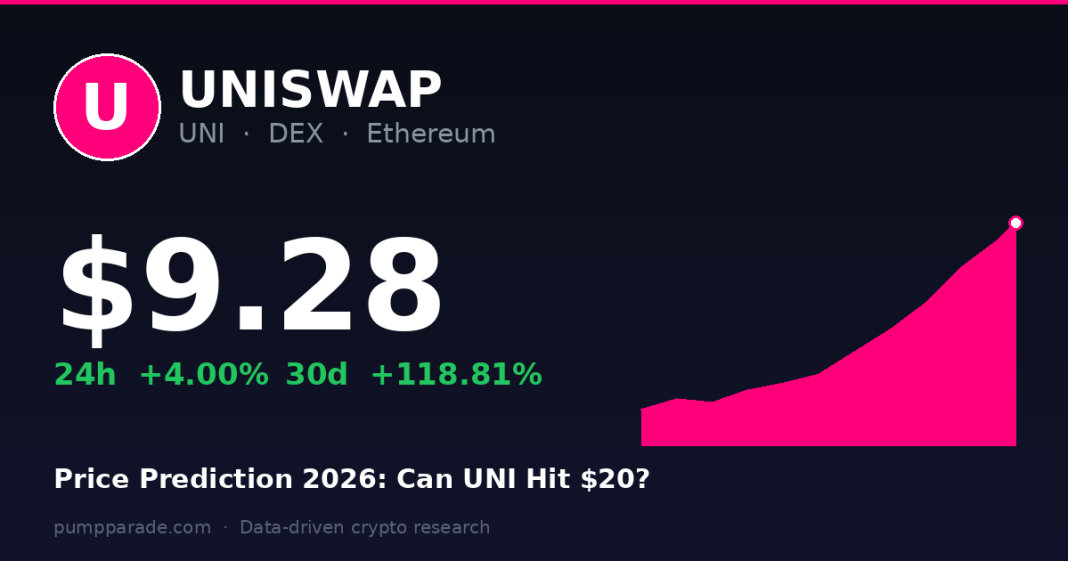
Every serious Uniswap price prediction 2026 model has to answer one question right now: how much of the recent 119% rally is priced in, and what’s left to run? UNI trades at $9.28 at time of writing, up 4.0% on the day and a staggering 118.8% over the past 30 days. The rally has one obvious catalyst: on December 25, 2025, UNI governance passed the UNIfication proposal with 125.3 million votes in favor and just 742 against, activating the long-awaited fee switch and authorizing a one-time burn of 100 million UNI from the treasury.
That single vote rewired Uniswap’s economics from “protocol without cash flow” to “protocol with retained fees and a shrinking supply.” UNI holders spent years waiting for it. Now they have it, and the market is pricing the change in real time.
This piece breaks down where UNI stands right now, the bull and bear cases you’ll want to weigh, our 30-day, 6-month, and long-term targets, and how Uniswap stacks up against its biggest DEX competitors. No hype, no shilling. Just the setup as we see it.
Key Takeaways
- Price snapshot: UNI at $9.28, +4.0% 24h, +118.8% over 30 days, still 79% below the May 2021 all-time high of $44.92.
- Catalyst: The UNIfication proposal passed on December 25, 2025, activating protocol fees and burning 100 million UNI, roughly 11% of total supply.
- Base case for 2026: $14 by mid-year, driven by fee-switch cash flow to holders and continued Unichain growth.
- Bull case: $22.50 by mid-2026 and $35 by 2027-2028 if Uniswap defends 24% DEX market share and monthly volumes stay near the record $116B pace.
- Key risks: The burn may already be priced in, Ethereum weakness could drag the token, and DEX competition from Aerodrome, Jupiter, and PancakeSwap is real.
Where Uniswap Stands Today
Before we get to the forecast, here’s the current market snapshot for UNI, pulled from CoinGecko and cross-checked with Birdeye at time of writing.
| Metric | Value |
|---|---|
| Price | $9.28 |
| 24h change | +4.00% |
| 7d change | +1.84% |
| 30d change | +118.81% |
| Market cap | $5.76 billion |
| 24h volume | $783 million |
| Market cap rank | #23 |
| Circulating supply | 620.58 million UNI |
| All-time high | $44.92 (May 2021) |
| % from ATH | -79.3% |
The chart is doing something UNI has not done since 2021: it is trending, not chopping. A 118% move in a month, followed by a week of sideways consolidation above $9, is the profile of a token that has attracted fresh buyers and is now looking for a reason to continue. The catalyst that pulled those buyers in is now on-chain and permanent.
Why Is UNI Rallying Right Now?
The short answer: UNIfication. For the first time in Uniswap’s history, protocol-level trading fees flow to the treasury instead of only to liquidity providers, and 100 million UNI have been removed from circulation.
Numbers help. Uniswap processes roughly $88 billion in trading volume every 30 days across 36 chains, and monthly volume set a record at $116.6 billion in October 2025 according to CoinLaw’s protocol data. Even a low single-digit fee take on that flow generates hundreds of millions in annualized protocol revenue. That is not speculative future value. It is cash flow the protocol can now capture, starting today.
Layer that against a supply schedule that just shrank by ~11%, and you understand the setup. The market spent years asking “when do UNI holders actually get paid?” On December 25, 2025, that question got a concrete answer. The move from $4.25 to $9.28 is the initial repricing.
The Bull Case for UNI
1. The Fee Switch Turns UNI into a Cash-Flow Asset
UNIfication is not a marketing event. It is a change in what the token represents. Before the vote, UNI was a governance token with optional future revenue. After the vote, it is a claim on a protocol that generates real fee revenue and burns supply. Traders and long-term holders price these two versions of the asset very differently. Historically, protocols with active fee accrual (think Ethena, Hyperliquid, Aave) trade at multiples of protocols without it. The data suggests UNI is in the early innings of that re-rating.
2. Unichain Is Winning L2 Share
Uniswap’s own Layer 2, Unichain, contributes over $532 million in TVL and handles nearly 50% of v4 transaction volume. Layer 2 networks account for over 65% of daily volume on Uniswap according to SQ Magazine’s DEX statistics. Every trade that migrates from Ethereum mainnet to Unichain captures more of the fee stack for the Uniswap Foundation, and every dollar of TVL that lands on Unichain is one less dollar of liquidity for competing L2s like Arbitrum. The Unichain flywheel is the medium-term growth story.
3. DEX Volumes Are at Record Highs
Uniswap holds about 24.1% of total DEX spot volume across all chains. That share is defended, not eroding. If crypto sees a broader risk-on move in late 2026, DEX volumes historically compound faster than centralized exchange volumes because on-chain traders rotate more aggressively into new tokens. UNI is the highest-liquidity way to express that thesis.
The Bear Case for UNI
1. The Burn Might Already Be Priced In
A 118% move in 30 days is not a “quiet accumulation.” It is repricing. If the fee switch delivers protocol revenue that beats expectations, the rally continues. If it disappoints (because volumes soften, or because the fee take is smaller than the market modeled), the reaction could be sharp. Bitget Research already flagged that the fee switch is live and 100 million tokens are burned, but the price still hit a cycle low earlier in the process. Narrative timing and price timing rarely line up cleanly.
2. Competition Is Not Standing Still
Aerodrome dominates Base. Jupiter aggregates Solana. PancakeSwap holds BSC. Every one of these DEXs is fighting for the same fee dollars. Uniswap’s mainnet dominance is unquestioned, but the highest-volume chains of 2026-2028 may not be Ethereum mainnet. If Base or Solana grow faster than Unichain, UNI’s fee capture caps out even in a good market.
3. Ethereum Weakness Drags UNI
ETH trades near $2,696, well below its 2021 highs. Historical correlation between UNI and ETH sits above 0.75 on weekly returns. A prolonged period of ETH underperformance versus SOL, BTC, and stablecoin yield is a headwind UNI cannot fully escape, no matter how well the protocol executes. For context on ETH’s own setup, our Ethereum price prediction 2026 lays out where the base layer needs to be for altcoin beta to work.
Uniswap Price Prediction 2026: Targets by Timeframe
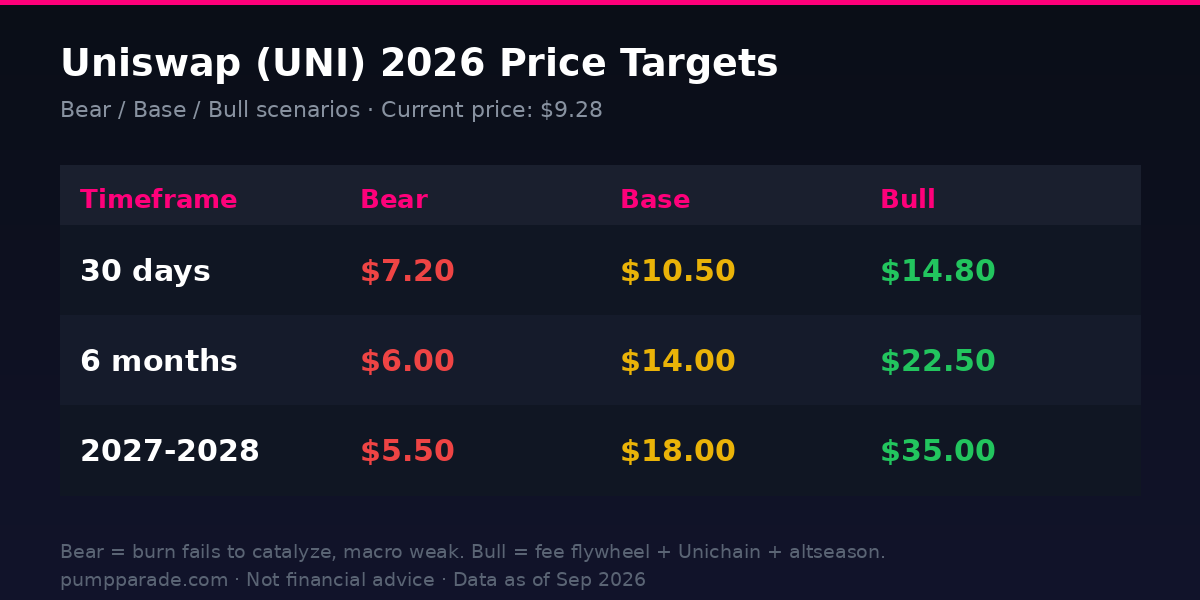
Here is how our AI model, blended with technical and on-chain signals, breaks out the next several timeframes. Every target is a scenario, not a promise. Predictions come with conditions attached, and we specify each one.
30-Day Outlook
Short-term, UNI has to hold the $8.50 support zone. That was the breakout level in early September and it now sits as reclaimed resistance turned support. Momentum indicators are cooling off from overbought after the 118% run, so a period of sideways-to-slightly-lower price action is the base case.
- Bear: $7.20 if the $8.50 level breaks and momentum unwinds toward the pre-catalyst range.
- Base: $10.50 as the market digests the burn and volume tapers into a healthy consolidation.
- Bull: $14.80 if fee revenue prints strong in the first full month post-activation and momentum traders pile in.
6-Month Outlook (Mid-2026)
By mid-2026, the fee switch will have generated at least two quarters of on-chain revenue data. That is when the market moves from pricing the narrative to pricing the actual cash flow. This is also the window most SERP competitors are targeting with their “2026 forecast” ranges (Changelly, Coincheckup, Binance research all cluster their base-case 2026 targets between $10-$20).
- Bear: $6.00 if the burn fails to translate into meaningful protocol revenue and ETH slides toward $2,000.
- Base: $14.00 as Uniswap prints its first full “fee-earning” quarter and Unichain TVL crosses $1 billion.
- Bull: $22.50 if DEX volume compounds, altseason kicks in, and UNI re-rates as a top-5 DeFi cash-flow asset.
Long-Term Outlook (2027-2028)
Longer term, UNI’s ceiling depends on two variables: how much of global spot volume moves on-chain, and how much of that on-chain volume Uniswap keeps. If the answer is “a lot” and “most,” a return toward the $30-$40 zone (still below the 2021 ATH) is not unreasonable.
- Bear: $5.50 in a prolonged DeFi bear market with CEX consolidation.
- Base: $18.00 assuming steady fee accrual and defended market share.
- Bull: $35.00 in a full altseason with Uniswap as the flagship DeFi cash-flow trade.
How Does Uniswap Compare to Aerodrome and PancakeSwap?
Uniswap is the DEX benchmark, but it is not the only game in town. Here is how UNI stacks up against two of its most credible competitors on the metrics that matter for a 2026 investment thesis.
| Metric | Uniswap (UNI) | Aerodrome (AERO) | PancakeSwap (CAKE) |
|---|---|---|---|
| Primary chain | Ethereum + Unichain | Base | BNB Chain |
| Market cap rank | #23 | Outside top 100 | Outside top 100 |
| 30d DEX volume | ~$88B (36 chains) | ~$8B (Base only) | ~$15B (multi-chain) |
| Fee switch active | Yes (Dec 2025) | Yes (ve-token model) | Yes (auto-burn) |
| Own L2 | Yes (Unichain) | No | No |
| Institutional pipeline | Deep (Foundation, VCs) | Native to Base | Retail-heavy |
| Token supply direction | Deflationary (100M burn + fees) | Emission-heavy | Deflationary (auto-burn) |
Translation: Uniswap has the deepest liquidity, the biggest institutional footprint, and now the strongest tokenomics story. Aerodrome wins on Base-native positioning, PancakeSwap wins on BSC. If you want the pure “DeFi cash flow” trade in 2026, UNI is the highest-conviction expression. If you want higher beta on a specific ecosystem, the smaller DEX tokens can outperform in bursts.
What Would Change Our View on UNI?
Three things would force us to move our targets, and we watch these weekly.
1. Protocol revenue underperforms expectations. If the first two quarters of live fee-switch data come in at less than $100 million in annualized protocol revenue, the “cash-flow re-rating” thesis weakens and the base case moves toward the bear scenario.
2. Unichain TVL stalls below $750 million. The flywheel needs Unichain to compound. If TVL plateaus, competing L2s will chip away at Uniswap’s fee capture and the bull case gets much harder to defend.
3. A major regulatory action against DEX front-ends. The SEC has not been quiet on DeFi. A meaningful enforcement action or restrictive rule could trigger a rerating for every DEX token, UNI included, regardless of protocol fundamentals.
Frequently Asked Questions
Will UNI reach $20 in 2026?
Our base case for mid-2026 is $14, with a bull case at $22.50. Reaching $20 by end of 2026 requires two things: the fee switch generating strong protocol revenue that the market is willing to capitalize at DeFi multiples, and a broader altcoin rally that lifts DEX-token sentiment. The probability favors that range being tested, not guaranteed to hold.
Is Uniswap a good investment in 2026?
UNI has a clearer investment thesis in 2026 than at any point since launch. Protocol fees now accrue to the treasury, 100 million tokens were burned, and the protocol dominates DEX market share. The risk is that a 118% one-month rally already prices much of that in. For long-term holders, the setup is credible. For short-term traders, wait for confirmation of a healthy consolidation before adding.
What is the UNIfication proposal and how does it affect UNI price?
UNIfication is the governance proposal that activated protocol fees and authorized a 100 million UNI burn from treasury. It passed on December 25, 2025 with 125.3 million UNI voting in favor. For price, it converts UNI from a governance token into a cash-flow asset, which historically commands higher valuation multiples. It also permanently reduced supply by roughly 11%.
How does Uniswap make money now that the fee switch is on?
Uniswap now retains a portion of trading fees at the protocol level, in addition to fees flowing to liquidity providers. On roughly $88 billion in 30-day volume across 36 chains, even a small fee take generates hundreds of millions in annualized revenue. Uniswap Labs discontinued frontend fees as part of the same proposal, consolidating value capture at the protocol layer.
What is the highest UNI has ever been?
UNI’s all-time high is $44.92, set on May 2, 2021. At the current price of $9.28, UNI is 79.3% below that peak. Returning to the ATH would require a further 384% move from here, which is possible in a full altcoin bull cycle but not the base case for the next 12-18 months.
The Honest Take
UNI is the cleanest DeFi cash-flow trade in the market today. The fee switch is not a promise anymore, it is on-chain reality. The 100 million UNI burn is done. Unichain is compounding. Volumes are at record levels. That is the bull case, and it is a real one.
The counter-argument is equally honest. A 118% move in 30 days is a lot of “front-run the narrative” buying. Real cash-flow data will not print for another quarter. Competition is patient and well-capitalized. Ethereum’s own struggles cap UNI’s beta.
The risk-reward favors a base case in the $14 range by mid-2026 with meaningful upside to the low-$20s if the fee switch executes cleanly. Position size accordingly, respect the $8.50 support level, and remember that the best DeFi trades come from patience, not chasing.
Disclaimer: This article is for informational and educational purposes only and should not be construed as financial, investment, or trading advice. Cryptocurrency markets are highly volatile, and past performance does not guarantee future results. The price predictions and analyses presented here are based on AI models, technical indicators, and available data at the time of writing, they are not guarantees. Always conduct your own research (DYOR) and consult with a qualified financial advisor before making any investment decisions. Pump Parade and its authors do not assume liability for financial losses incurred based on information provided in this article.