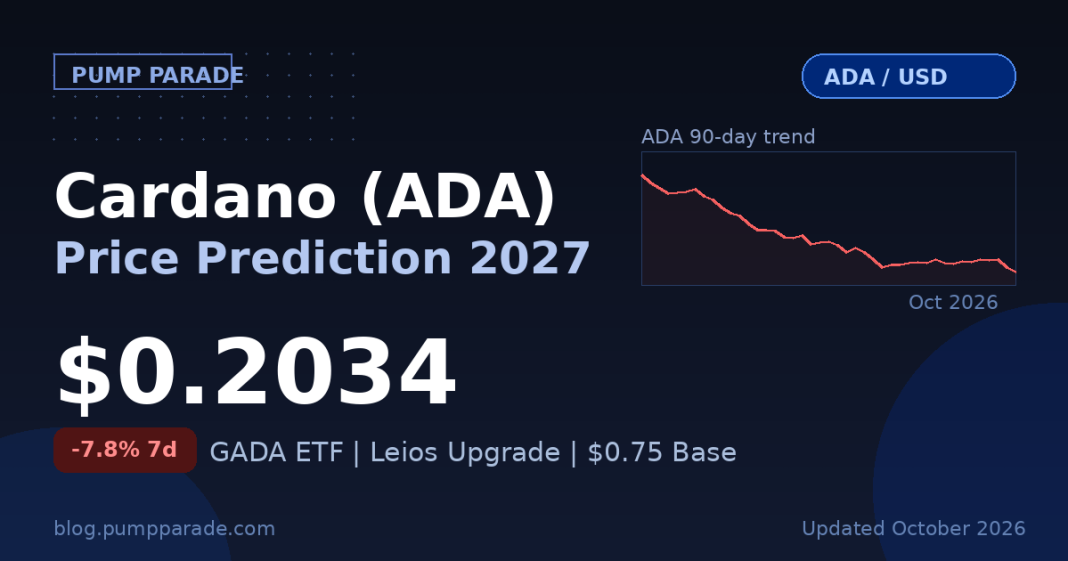
Cardano (ADA) is trading at $0.2034 at time of writing, down 7.8% on the week and 19.5% over the past month. The 1-year return is uglier: ADA is off 68.7% versus October 2025, and it sits 93% below its September 2021 all-time high of $3.09. Not exactly the setup most “to-the-moon” headlines reach for.
And yet, this is one of the more interesting Cardano price prediction 2027 setups we’ve seen in two years. The Grayscale Cardano ETF (ticker GADA) is tracking its final SEC statutory deadline, Ouroboros Linear Leios code is targeting completion by the end of 2026, and the Midnight sidechain’s phased rollout is now live after a bruising NIGHT token debut. Three real catalysts, one battered price. Let’s break down whether ADA at $0.20 is a value opportunity or a value trap, and what our price targets look like through 2027.
Key Takeaways
- ADA trades at $0.2034 with a $7.64B market cap, rank 18. It is down 68.7% over the past year and 93% from its all-time high.
- Three near-term catalysts: Grayscale’s spot ADA ETF (GADA) tracking a late-2026 launch window, Leios upgrade code completion targeted for Q4 2026, and the ongoing Midnight NIGHT token rollout.
- Bear case: Cardano DeFi TVL sits near $178M, far behind Solana and Ethereum. Developer activity has slowed, and the first NIGHT drop sold off hard.
- Our base case Cardano price prediction 2027 is $0.75 by year-end, with a bear case at $0.18 and a bull case at $1.50.
- Watch three triggers: GADA inflows in month one, Leios testnet mainnet vote outcome, and whether DeFi TVL on Cardano crosses $500M.
Where Cardano Stands Today
Here are the numbers behind the Cardano price prediction 2027 debate, straight from CoinGecko at time of writing.
| Metric | Value |
|---|---|
| Price (USD) | $0.2034 |
| 24-hour change | -2.5% |
| 7-day change | -7.8% |
| 30-day change | -19.5% |
| 1-year change | -68.7% |
| Market cap | $7.64B |
| 24-hour volume | $241M |
| Market cap rank | #18 |
| All-time high | $3.09 (Sep 2021) |
| % from ATH | -93.4% |
| Circulating supply | 37.57B ADA |
| Max supply | 45.00B ADA |
Two things jump out. First, ADA is deeply oversold on multi-month timeframes but hasn’t printed capitulation volume on the daily, so the floor isn’t obviously in. Second, with 83% of its max supply already circulating, future inflation isn’t the overhang it used to be. The dilution story is largely behind ADA, and that matters when forward demand picks up.
Why Is Cardano Falling Right Now?
Four forces are driving the current ADA drawdown, and all of them matter for our Cardano price prediction 2027.
Macro liquidity has tightened. Altcoin beta has broken down since late September, and ADA has a higher-than-average correlation to the long-tail altcoin index. When BTC drops 5%, ADA tends to drop 10 to 15%. That is simply how this cycle has behaved.
Second, the Midnight debut was ugly. The NIGHT token launched in December 2025 across OKX, Bybit and MEXC. It approached a near $1B valuation, then fell about 90% within two days as Glacier airdrop recipients took profits. ADA dropped more than 7% on December 11, and the halo effect kept weighing on it into Q1 2026. That overhang is only now clearing.
Third, developer activity has softened compared with 2022 to 2023 highs. GitHub commits are still meaningful, but they are no longer the sector leader IOG once pointed to. Narrative counts in crypto, and “most active developer community” was a core piece of the ADA bull thesis for years.
Fourth, and this is the most honest one, Cardano DeFi TVL sits around $178M. For context, that is less than a mid-tier Solana lending protocol. Capital follows apps. If the apps are not there, the capital isn’t either.
What’s the Bull Case for Cardano in 2027?
Catalyst 1: The Grayscale Cardano ETF (GADA) is at the finish line
Grayscale filed its amended S-1 for the GADA spot Cardano ETF on August 29, 2025, after NYSE Arca’s original 19b-4 in February 2025. Polymarket odds for approval hit 87% in August 2025 after dipping to 75% earlier that month. The product would hold ADA directly, track the CoinDesk Cardano Price Index, and use Coinbase Custody. KuCoin’s research team flags a late-2026 launch window tied to the SEC’s final statutory deadline under the 240-day review clock. If GADA goes live with real demand, it is the first time institutional allocators get regulated spot ADA exposure at scale.
The honest caveat: spot altcoin ETFs have had wildly mixed first-month flows. VanEck’s AVAX ETF debuted to zero inflows and roughly $330K in volume. Grayscale’s structure, distribution and brand are different, but assuming BlackRock-style ETF inflows for an altcoin product is wishful thinking until the data comes in.
Catalyst 2: Leios code completion targets Q4 2026
Ouroboros Linear Leios (CIP-164) is the throughput upgrade Charles Hoskinson has described as Cardano’s most urgent. It adds supplementary Endorser Blocks so the network can process more transactions in parallel. Phase one is bundled into the Dijkstra hard fork and also contains CIP-118 (nested transactions, letting apps sponsor user fees), CIP-112 (guard scripts), CIP-159 (account-address improvements) and CIP-181 (simpler staking-reward withdrawals). Phase two brings Ouroboros Peras (CIP-140), a stake-pool voting layer that cuts finality delays, with a Q2 2027 target.
Why this matters: Cardano’s biggest critique has been that it ships upgrades slowly. A Q4 2026 code completion with a credible 2027 mainnet activation is the clearest counter-argument IOG has had in years. If Leios ships on time, the technical narrative shifts fast.
Catalyst 3: Midnight’s mainnet rollout and RealFi
The Midnight federated mainnet launched in Q1 2026 for developer dApp testing, with full mainnet deployment set for later this year. Twenty-four billion NIGHT tokens were distributed across eight blockchains including Bitcoin, Ethereum, Solana and Cardano. Hoskinson has also publicly discussed Tier-1 stablecoin integration conversations with Ripple executives around RLUSD, and he has hinted at possible collaboration with Coinbase’s Base. Neither is confirmed, so count them as optionality, not thesis.
What Could Push ADA Below $0.15?
Risk 1: DeFi activity isn’t there, and it may never arrive
$178M in Cardano DeFi TVL versus roughly $70B on Ethereum and $8B on Solana is not a competitive gap, it is a different league. The eUTXO model has theoretical advantages, but seven years in, developer mindshare still clusters on EVM chains and Solana. If Leios ships and the apps still don’t come, Cardano becomes a settlement layer with no settlement to do.
Risk 2: ETF demand may underwhelm
Spot BTC and ETH ETFs set a bar that altcoin ETFs are struggling to meet. VanEck’s AVAX product reportedly debuted to zero net inflows. Grayscale’s structure also would not pass native ADA staking rewards to shareholders, which blunts one of the main value propositions versus holding spot ADA directly. If GADA launches to muted demand, the “ETF catalyst” trade unwinds fast.
Risk 3: Technical breakdown below $0.20
ADA is testing the $0.20 psychological level, and a weekly close below $0.18 opens the door to the May 2023 low near $0.15. If that gives way, the next real support zone sits in the $0.10 to $0.12 band. The chart isn’t offering reassurance here, and traders know it.
Cardano Price Prediction 2027: Targets by Timeframe
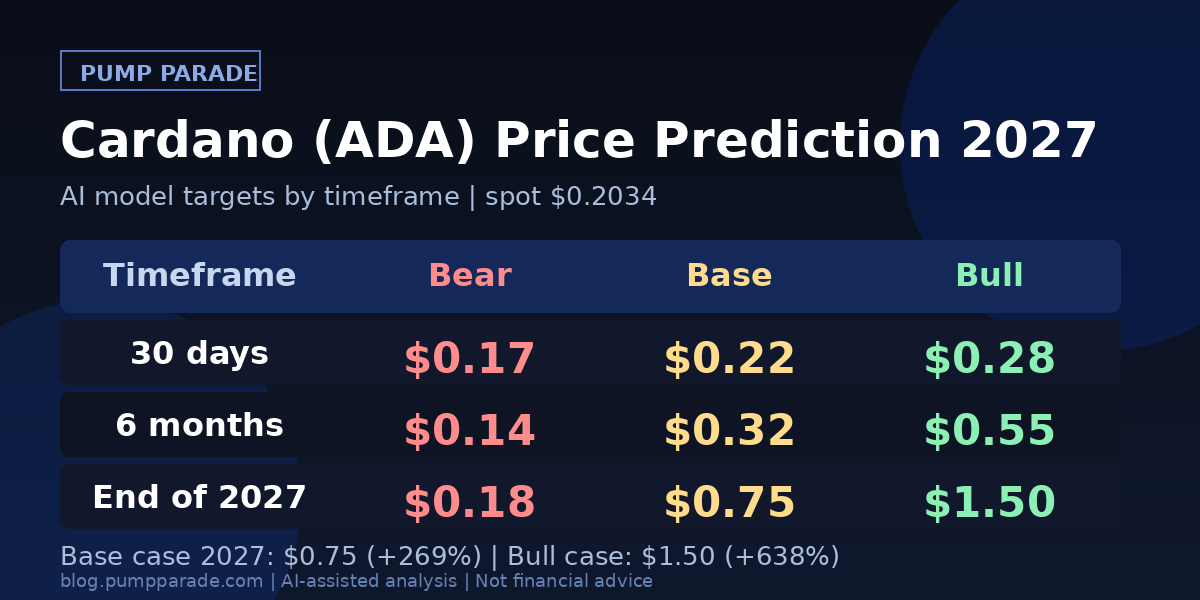
Our hybrid model combines on-chain activity trends, ETF flow probability-weighting, macro liquidity regime and Leios activation odds. Here is what it puts out across three timeframes.
| Timeframe | Bear | Base | Bull |
|---|---|---|---|
| 30 days | $0.17 | $0.22 | $0.28 |
| 6 months | $0.14 | $0.32 | $0.55 |
| End of 2027 | $0.18 | $0.75 | $1.50 |
30-day outlook
In the short term, ADA price action tracks BTC and liquidity more than anything else. Our base case has ADA chopping between $0.19 and $0.24 as GADA headlines accelerate. Any clean break above $0.24 opens $0.28. A weekly close below $0.18 cracks the floor and $0.14 is in play.
6-month outlook
The six-month window is where GADA inflows will or will not materialize, and where Leios goes from “code complete” to “testnet live.” Our base case puts ADA at $0.32 by Q2 2027, which assumes modest but real ETF demand and successful Leios testnet voting. The bull case at $0.55 requires the AI-and-tokenization narrative to lift Cardano along with it. The bear case at $0.14 assumes GADA disappoints and macro stays tight.
End of 2027 outlook
By year-end 2027, Peras should be shipping and Midnight should have real on-chain activity to point to. Our base case Cardano price prediction 2027 of $0.75 implies a 269% move from spot and still leaves ADA 76% below its all-time high. For comparison, PrimeXBT’s 2027 average is $7.95 (wildly bullish), Cryptoticker’s base is $12.68 (even more so), and DappRadar’s model projects $0.24 (deeply bearish). We land in the middle of that spread.
How Cardano Compares to Solana
The L1 battle isn’t just a meme. It is where developer capital and user transactions actually flow. Here is the honest side-by-side.
| Metric | Cardano (ADA) | Solana (SOL) |
|---|---|---|
| Price | $0.2034 | $100.66 |
| Market cap | $7.64B | $59.37B |
| Market cap rank | #18 | #7 |
| DeFi TVL | ~$178M | ~$8B |
| Consensus | Ouroboros PoS | Proof-of-History PoS |
| Peak TPS target | ~1,000+ (post-Leios) | 65,000 theoretical |
| Spot ETF | GADA (pending) | Multiple approved |
| % from ATH | -93.4% | -80.3% |
SOL is the market’s incumbent choice for high-throughput smart contract L1s. Cardano’s pitch is that formal verification, peer-reviewed research and the eUTXO model will matter more as institutional usage scales. That pitch has not won market share yet. Leios is the first upgrade in a while that could change that equation on the technical side. If you want the comparable Solana setup for 2027, we broke down the Solana price prediction 2027 case last week.
What Would Change Our View on ADA?
Three triggers would push us materially more bullish or more bearish, and they are concrete enough to track.
More bullish: GADA logs more than $150M in cumulative inflows in its first 30 days of trading. That level would signal real institutional appetite for spot ADA and reset our 2027 base case toward $1.00+. For reference on how altcoin ETF narratives interact with price, see our NEAR Protocol price prediction 2027 coverage.
More bearish: Leios misses its Q4 2026 code completion target, or the testnet mainnet vote fails in early 2027. Both would erode what is currently Cardano’s cleanest “shipping again” narrative, and our 2027 base case would compress toward $0.30.
Neutral but important: Cardano DeFi TVL crosses $500M before end of 2027. That is the level where the “no apps” critique materially weakens. Below $500M, the critique sticks regardless of how good the base layer gets.
Frequently Asked Questions
What will Cardano be worth in 2027?
Our base case Cardano price prediction 2027 is $0.75, with a bear case at $0.18 and a bull case at $1.50. These targets assume Leios ships close to schedule, the GADA ETF launches with modest but real inflows, and Cardano DeFi activity meaningfully expands. The base case implies a 269% gain from the current $0.2034 and still leaves ADA about 76% below its 2021 all-time high.
Can Cardano reach $1 in 2027?
Yes, in our bull case. ADA reaching $1 by end of 2027 would require GADA ETF inflows above $200M in the first 90 days, a successful Leios mainnet activation, and Cardano DeFi TVL crossing $1B. All three are plausible but not probable at today’s data. We assign roughly a 20% probability to ADA touching $1 within our 2027 window.
Is Cardano a good investment in 2026?
That depends on your timeframe and risk tolerance. At $0.2034, ADA offers asymmetric upside if Leios ships and the ETF performs, but genuine downside to $0.14 or lower if neither does. The current price is close to multi-year support, which is historically a decent entry zone, but there is no guarantee the support holds. Position sizing matters more than conviction here.
What is the Leios upgrade?
Leios (specifically Ouroboros Linear Leios, CIP-164) is Cardano’s throughput upgrade. It adds supplementary Endorser Blocks so the network can process more transactions in parallel. Code completion targets Q4 2026 as part of the Dijkstra hard fork, with testnet voting and mainnet activation expected in 2027. Hoskinson has publicly described it as Cardano’s most urgent upgrade.
Will the Grayscale Cardano ETF boost ADA price?
Possibly, but it depends entirely on inflows. VanEck’s AVAX ETF debuted to roughly zero net inflows and $330K in volume, which was a cautionary data point for altcoin ETFs. Grayscale’s distribution and brand are stronger, and GADA will be the first regulated spot ADA product in the US. If first-month inflows exceed $150M, ADA has a credible path toward our base case. If they come in near zero, the catalyst unwinds.
Is Cardano dead?
No, but the “most active developer community” narrative is clearly behind it. On-chain activity, DeFi TVL and developer mindshare have all lagged Solana and the EVM ecosystem for two years. Cardano is not dead. It is in a credibility rebuild, and Leios is the first upgrade in a while that could meaningfully reset that story.
The Honest Take
ADA at $0.20 is not a hype trade. It is a credibility trade. The catalysts are real: GADA is tracking a legitimate launch window, Leios is in code completion, and the Dijkstra roadmap has concrete CIPs attached to concrete milestones. The risks are also real: Cardano DeFi is a rounding error relative to competitors, developer activity has slowed, and the Midnight launch bruised the broader ADA ecosystem for most of 2026.
Our base case Cardano price prediction 2027 of $0.75 is not a moonshot. It is a reasonable return assumption if IOG executes on three measurable things. The bear case at $0.18 reflects how fragile the chart is here. The bull case at $1.50 is what happens if Cardano reclaims any meaningful share of the L1 narrative in 2027. For traders, the setup is a classic asymmetric altcoin bet with clear invalidation levels. For holders, it is a two-year patience test with real catalysts to track. For anyone looking for AI narratives to pair this with, our Chainlink price prediction 2027 write-up covers the tokenization narrative that would also lift ADA.
Disclaimer: This article is for informational and educational purposes only and should not be construed as financial, investment, or trading advice. Cryptocurrency markets are highly volatile, and past performance does not guarantee future results. The price predictions and analyses presented here are based on AI models, technical indicators, and available data at the time of writing: they are not guarantees. Always conduct your own research (DYOR) and consult with a qualified financial advisor before making any investment decisions. Pump Parade and its authors do not assume liability for financial losses incurred based on information provided in this article.
Data sources: CoinGecko, Coin Gabbar (Dijkstra roadmap), CoinCentral (Cardano 2026 outlook).