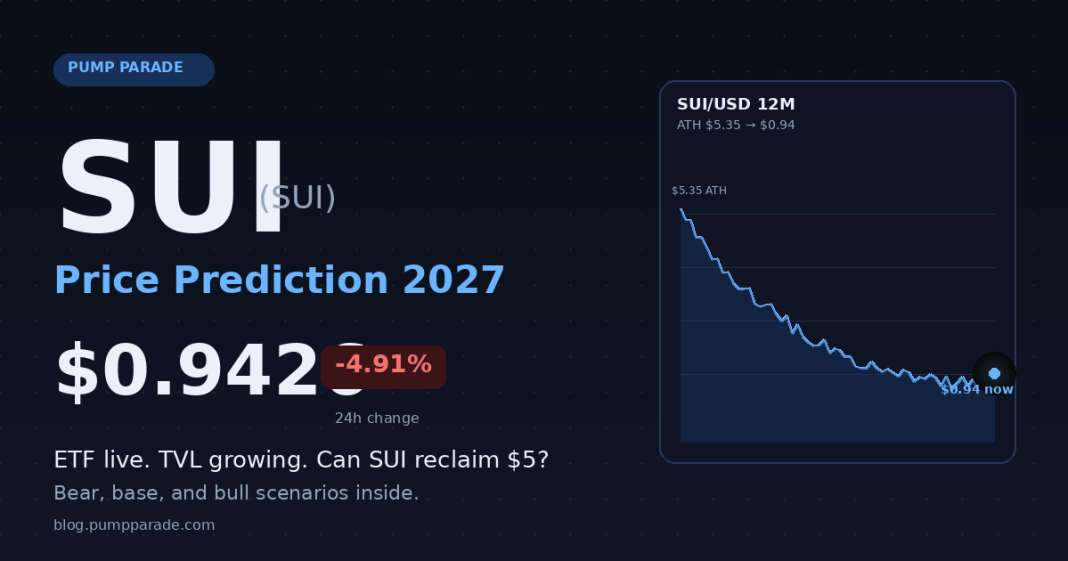
Sui price prediction 2027 starts with an uncomfortable number. SUI trades at $0.94, down 4.9% on the day, down 5.8% on the week, and down 82% from the $5.35 all-time high set in January 2025. That is a brutal 12 months for a chain whose fundamentals have, by most measures, gotten stronger.
The gap between price and progress is where this analysis lives. Since Sui’s last cycle peak, the ecosystem has shipped a spot ETF on Nasdaq (ticker TSUI, live since February 2026), crossed $2 billion in total value locked, pushed Walrus and DeepBook into Coinbase’s listing roadmap, and added Microsoft Fabric as a data partner. The chart has not reflected any of it yet.
So the question is not “will SUI pump.” The question is whether the 2027 cycle finally rewires price to catch up with the stack. Here is where SUI stands today, the honest bull case, the honest bear case, and the specific levels that would change our view.
Key Takeaways
- SUI trades at $0.94, roughly 82% below its $5.35 all-time high and down 62% year over year. The market cap sits near $3.9 billion with a rank of 30.
- The 21Shares Sui ETF (TSUI) has traded on Nasdaq since February 24, 2026. Canary Capital’s SUI ETF is still working through SEC review.
- Our base case for 2027 lands SUI in the $2.20 to $3.10 range, with a bull case to $5 contingent on sustained ETF inflows and Walrus traction.
- The bear case to $0.55 is live if token unlocks outrun real demand and ETF flows fade.
- Three triggers would move us: TSUI net inflows past $300 million, Sui TVL back above $3 billion, and a second ETF issuer getting approval.
Where Sui Stands Today
Before any forecast, the price context. Here is the live snapshot from CoinGecko and Birdeye at the time of writing.
| Metric | Value |
|---|---|
| Price (USD) | $0.9426 |
| 24h change | -4.91% |
| 7-day change | -5.82% |
| 30-day change | +0.13% |
| 1-year change | -61.99% |
| Market cap | $3.88 billion |
| Market cap rank | #30 |
| 24h volume | $316 million |
| All-time high | $5.35 (Jan 4, 2025) |
| % from ATH | -82.37% |
| Circulating supply | 4.12B SUI (41.2% of max) |
Two things jump out. First, SUI is a top 30 asset by market cap, which is relevant for institutional allocators who screen by rank. Second, roughly 59% of the max supply has yet to enter circulation. That is the single most important bearish variable in any SUI price model, and we will come back to it.
Our previous SUI call in 2026 argued the $5 reclaim required an ETF plus a return to top-10 TVL. The ETF arrived. The TVL growth did too, briefly. The price did not follow. That gap is instructive, and it shapes how we model 2027.
Why is Sui Price Range-Bound Right Now?
Three forces are pinning SUI near a dollar.
The first is supply pressure. Sui unlocks tokens on a scheduled vesting curve that releases to the Sui Foundation, early contributors, and investors. Those unlocks are mechanical and have hit roughly monthly through 2026. The amounts are modest relative to total market cap, but they are consistent, and in a weak tape they absorb buy-side pressure almost immediately.
The second is sector rotation. Capital that would normally flow into alt-L1s has gone to Hyperliquid, Berachain, and the memecoin layer. For a comparison on how that same rotation shaped another chain, our Solana price prediction 2027 walks through the SOL version. Sui and Aptos, the two Move chains, have both lost beta share to this rotation.
The third is ETF digestion. The TSUI launch in February 2026 was supposed to be the catalyst. In practice, early ETF inflows for mid-cap chains have been muted. The precedent from spot filings for other L1s suggests inflows take two to four quarters to build a self-reinforcing bid. We are in that lag now.
The Bull Case for SUI
Catalyst 1: TSUI ETF Flows and a Second Issuer
The 21Shares Sui ETF (TSUI) has been trading on Nasdaq since February 24, 2026. The structure is standard spot exposure with FTSE as the pricing benchmark provider as of late August 2026. Flows have been slow but positive. A second issuer, Canary Capital, filed with the SEC and is still working through the extended review process, with CBOE BZX submitting the listing application. If a second ETF comes online in 2027, it compounds distribution, broker access, and allocator comfort. VanEck has also published competitive analysis positioning Sui alongside Aptos in the Move-chain thesis, which is the kind of institutional coverage that precedes product.
Catalyst 2: Walrus and DeepBook as Ecosystem Multipliers
Walrus is Sui’s decentralized storage layer and DeepBook is the chain’s native central limit order book. Both have been added to Grayscale’s trust lineup as DEEP and WAL, and Coinbase has placed them on its listing roadmap. These are not price catalysts for SUI directly, but they drive gas demand and validator revenue, which flows back to staking yield and token sinks. Sui’s TVL crossed $2 billion in May 2025 and has oscillated around that level since. A sustained push above $3 billion with Walrus adoption would materially tighten the fundamentals-to-price gap.
Catalyst 3: Move Developer Momentum
Mysten Labs, the core team founded by former Meta engineers including CEO Evan Cheng, continues to ship. The Move programming language, originally built at Meta for the Diem project, is now the backbone of both Sui and Aptos. The talent base is small but concentrated, and the toolchain has matured in 2026. Developer activity does not translate linearly into price, but a chain with an active, differentiated builder base survives bear markets. Sui qualifies.
The Bear Case for SUI
Risk 1: Token Unlocks Through 2028
Only 41.2% of SUI’s 10 billion max supply is circulating. The remainder vests out over the next several years to the Foundation, contributors, and early backers. If the SUI price stays below cost basis for insiders, large tranches can hit secondary markets opportunistically. The Aptos unlock dynamics we broke down are a near-identical model, and APT has struggled with the same overhang.
Risk 2: Sector Share Loss to Monad, Berachain, Hyperliquid
The high-throughput L1 category is more crowded than it was in 2024. Monad launched with strong EVM compatibility, Berachain brought proof-of-liquidity and a mercenary liquidity base, and Hyperliquid has eaten the on-chain perps vertical. Sui’s technical edge, object-centric architecture and parallel execution, is real but no longer unique in positioning. If 2027 narratives favor EVM-aligned chains, Sui’s capital-attraction curve stays flat.
Risk 3: ETF Flow Disappointment
If TSUI inflows stall below $100 million cumulative through mid-2027, the ETF stops functioning as a price catalyst and becomes a liquidity-neutral product. That outcome is on the table. Avalanche, Litecoin, and several other spot filings have shown that an ETF is necessary but not sufficient. A chain still needs a narrative to pull discretionary capital, and the Move-chain thesis has not yet broken into retail consciousness.
Sui Price Prediction 2027: Targets by Timeframe
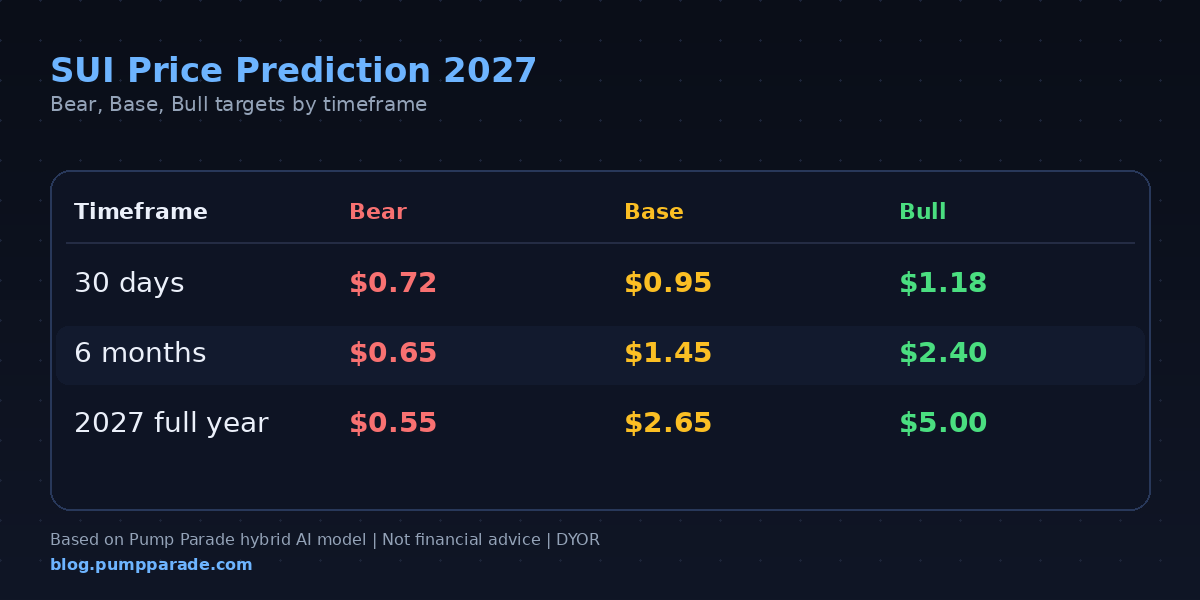
Our hybrid AI model combines on-chain metrics, token flow analysis, technical indicators, and sector-relative strength. These targets assume no black swan events and reflect probability-weighted ranges, not point estimates.
Short-term (30 days)
Bear: $0.72. Base: $0.95. Bull: $1.18. The 30-day picture is dominated by broader crypto beta. SUI’s correlation with Bitcoin remains elevated near 0.78, so a BTC retest of $75,000 drags SUI toward the lower bound. A clean bounce back above $82,000 for BTC and SUI likely reclaims $1.10. The $0.90 to $0.95 zone is acting as both a technical and psychological support, and a decisive break below $0.85 would open the trap door to the $0.70s.
Medium-term (6 months)
Bear: $0.65. Base: $1.45. Bull: $2.40. The six-month horizon lets ETF flows resolve. A base case assumes cumulative TSUI inflows of $150 to $250 million, modest TVL growth, and no new large unlock surprise. The bull case requires a second ETF issuer plus TVL back above $3 billion. The bear case is a world where unlocks outpace demand and Monad eats mindshare. For context, Standard Chartered has publicly favored BTC and ETH over alt-L1s in its 2027 outlook, which is a sentiment headwind worth naming.
Long-term (2027 to 2028)
Bear: $0.55. Base: $2.20 to $3.10. Bull: $5.00 to $6.50. The $5 reclaim is where this analysis started, and it remains achievable but conditional. Reclaiming the ATH requires three things in combination: broader altcoin tape strength tracking a 2024-style cycle, TSUI inflows past $500 million cumulative, and at least one breakout app on Sui that moves outside the crypto-native audience. If all three hit, $5 is in play by late 2027. If one is missing, the base case is the ceiling. Third-party analyst models at FXEmpire have projected $10 to $12 under extreme bull scenarios. We think those are possible but low probability, well under 15%.
How Does Sui Compare to Solana and Aptos?
The honest comparison matters. Here is how the three high-throughput L1s stack up on the metrics that actually drive price over a multi-year horizon.
| Metric | Sui (SUI) | Solana (SOL) | Aptos (APT) |
|---|---|---|---|
| Price | $0.94 | $101.31 | $4.12 |
| Market cap | $3.9B | $59.8B | $2.6B |
| Market cap rank | #30 | #7 | #52 |
| Language | Move | Rust | Move |
| Spot ETF live? | Yes (TSUI, Feb 2026) | Yes | No |
| TVL (approx) | $2.0B | $8.5B | $600M |
| Theoretical max TPS | 297,000 | 65,000 | 160,000 |
| Launch year | 2023 | 2020 | 2022 |
Sui’s claim to being faster than Solana is technically true in benchmarks, but Solana wins on the metric that counts for allocators: real-world throughput plus a four-year track record. Aptos shares Sui’s architecture at a smaller scale. For Sui to close the gap to Solana, the catalyst is not technology. It is distribution.
What Would Change Our View on SUI?
Specific scenario triggers that would move our 2027 base case:
Upgrade our view (bullish): TSUI cumulative inflows cross $300 million by mid-2027. Sui TVL breaks and holds above $3 billion for 30 consecutive days. The SEC approves a second SUI spot ETF (likely Canary Capital’s filing).
Downgrade our view (bearish): A Foundation or insider unlock tranche greater than 2% of circulating supply dumps on-chain in a single week. TSUI records net outflows for two consecutive quarters. A credible exploit, bridge failure, or validator incident on Sui mainnet.
Hold current view: ETF flows between $100 and $250 million cumulative through end of 2027. TVL oscillates between $1.8 and $2.5 billion. No new L1 category disruptor emerges.
Frequently Asked Questions
Will SUI reach $5 in 2027?
SUI could reach $5 in 2027, but it is not our base case. The $5 reclaim requires a confluence of ETF inflows above $500 million cumulative, TVL back above $3 billion, and broader altcoin cycle strength. Our probability-weighted model assigns roughly a 22% chance to $5 or higher by end of 2027. The base case range is $2.20 to $3.10.
Is Sui a good investment in 2027?
Sui is a credible top-30 asset with a live spot ETF, a growing DeFi ecosystem, and strong technical fundamentals. The risks are large token unlocks through 2028 and sector competition from Monad and Hyperliquid. For investors willing to size appropriately and hold through drawdowns, SUI offers asymmetric upside relative to its current price. It is not a short-term trade.
Will SUI reach $10?
Reaching $10 would require Sui to roughly 10x from current levels, implying a fully diluted valuation north of $100 billion. That is possible in a late-cycle 2028 melt-up with full supply dilution, but it is a low-probability outcome under current conditions. Analyst models at FXEmpire have cited $10 to $12 as extreme bull targets. We estimate the probability under 15%.
Is Sui better than Solana?
Sui is architecturally newer and benchmarks faster on raw throughput, with parallel execution and object-centric data. Solana is more battle-tested, has a larger developer base, far more TVL, deeper exchange liquidity, and a four-year head start on institutional adoption. Technically, Sui has edges. For capital allocation, Solana still wins on distribution.
Why is SUI price dropping in 2026?
Three main factors. First, token unlocks have added selling pressure each month. Second, capital has rotated to competing L1s like Monad and Hyperliquid, plus memecoins. Third, the TSUI ETF has not yet generated the inflow volume needed to offset supply increases. The underlying fundamentals have improved, but price has lagged because flows have not caught up.
What is Sui blockchain used for?
Sui is a layer-1 blockchain built by Mysten Labs for high-throughput applications. The main use cases are DeFi (Cetus, Navi, Scallop are leading protocols), gaming, decentralized storage via Walrus, order-book trading via DeepBook, and NFT infrastructure. The Move programming language makes resource-oriented asset management native to the chain, which is particularly useful for in-game economies and complex DeFi primitives.
The Honest Take
SUI at $0.94 is not a melt-your-face bull call. It is a reasonable asymmetric bet with specific conditions attached. The chain has shipped more product than its price reflects. The ETF is live and the ecosystem is building. The counter is that unlocks are structural, competition is real, and ETF flows have not yet proven the thesis.
If forced to summarize, the setup looks like late-cycle Avalanche in 2021: strong tech, strong team, long product roadmap, and a token price that will either be a 3x opportunity or a 50% drawdown trap depending on whether distribution catches up with development. The honest answer is we think the probability-weighted outcome favors modest upside over the next 15 months, with real optionality to $5 if the catalysts align.
Watch the ETF flows. Watch the TVL. Watch the unlock calendar. If two of those three turn green together, this analysis gets upgraded. Until then, position accordingly.
Disclaimer: This article is for informational and educational purposes only and should not be construed as financial, investment, or trading advice. Cryptocurrency markets are highly volatile, and past performance does not guarantee future results. The price predictions and analyses presented here are based on AI models, technical indicators, and available data at the time of writing, they are not guarantees. Always conduct your own research (DYOR) and consult with a qualified financial advisor before making any investment decisions. Pump Parade and its authors do not assume liability for financial losses incurred based on information provided in this article.