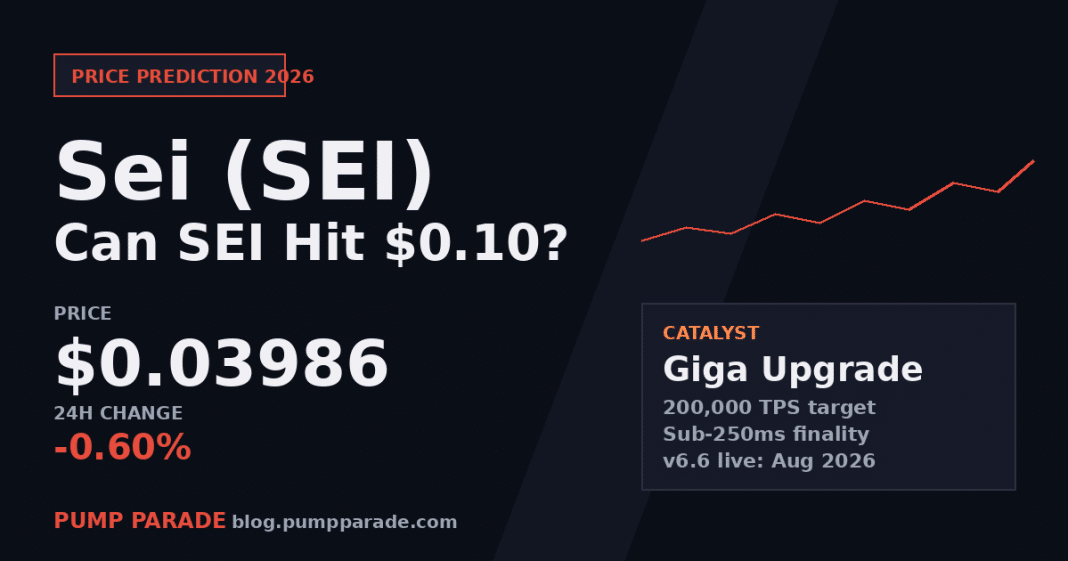
Sei just tapped a fresh all-time low. On August 16, 2026, SEI printed $0.03948, the deepest price the token has ever traded, capping a year in which it has bled roughly 88% and slipped 96.5% below its March 2024 peak of $1.14. At time of writing, SEI trades at $0.03986 with a market cap of $268 million, ranking #132 on CoinGecko.
That is not the setup most price prediction articles want to open with. But it is the setup that actually matters. Because sitting underneath that price chart is a network that just shipped the first mainnet components of its 200,000 TPS Giga upgrade, integrated Chainlink Equities Streams for 24/7 tokenized stock trading, and lined up Dinari to bring real U.S. equities onchain. The narrative and the price are pointing in opposite directions. That gap is the whole story.
This is our data-driven Sei (SEI) price prediction 2026. We walk through the current setup, the real catalysts, the equally real risks, and where analyst targets cluster for the short, medium, and long term.
Key Takeaways
- SEI trades at $0.03986 (August 17, 2026), fresh off an all-time low of $0.03948 hit yesterday.
- The Giga upgrade started mainnet rollout with the v6.6 Ares and Eidos deployments in early August 2026.
- Analyst 2026 targets cluster wide: bearish sub-$0.05, base $0.08 to $0.14, bullish $0.20 to $0.26.
- Real catalysts include Chainlink Equities Streams, Dinari tokenized stocks, and native USDC via CCTP V2.
- Biggest risks: supply overhang from a 10B max supply, competition from Monad and Solana, weak TVL versus 2025 peak.
- Our take: the setup is a high-risk, high-upside speculative bet on execution, not a defensive hold.
Where Sei Stands Today
Before we look at where SEI could go, here is where it actually is. All figures pulled from CoinGecko on August 17, 2026.
| Metric | Value |
|---|---|
| Price | $0.03986 |
| 24h change | -0.60% |
| 7d change | -3.80% |
| 30d change | -15.0% |
| 1y change | -87.6% |
| Market cap | $268.16M |
| 24h volume | $10.49M |
| Rank | #132 |
| Circulating supply | 6.73B (67% of max) |
| All-time high | $1.14 (Mar 15, 2024), -96.5% from ATH |
| All-time low | $0.03948 (Aug 16, 2026) |
Volume is thin. Depth is thinner. The token is trading like the market has already priced in another leg down, and any positive surprise from the Giga rollout is not yet reflected. That does not automatically mean SEI is a buy. It does mean the risk-reward has shifted from what it looked like at $0.15.
Why is SEI at an all-time low right now?
The plain answer: heavy scheduled unlocks combined with a rotation of capital toward faster-narrative L1s and AI-adjacent names have kept selling pressure on. Sei has been included in several “3 token unlocks to watch” pieces this month. With circulating supply now at 67% of the 10 billion cap and vesting still active for team, investors, and ecosystem buckets, dilution is a structural drag.
On top of that, the broader smart contract platform category is down about 2.5% on the week. Sei is down 3.8% in the same window. In plain terms, it is underperforming its own sector, which usually happens when supply-side pressure meets weak sentiment. The Giga narrative has not been enough to force short-covering because the market wants to see mainnet performance before it re-rates the token.
What is the bull case for SEI in 2026?
1. The Giga upgrade is actually shipping
Sei’s Giga upgrade is not a slide-deck promise anymore. In early August 2026, governance passed v6.6, which deployed two foundational Giga components to mainnet: the Ares execution engine and the Eidos storage engine. Eidos completed live migration four days ago, replacing the network’s storage database while the chain kept running. The Giga Whitepaper V2, published July 1, 2026, targets sub-250ms finality, over 200,000 TPS, and stronger MEV resistance. If the full stack lands cleanly through the rest of 2026, Sei becomes one of the fastest EVM environments in production, and that is a fundamentals re-rate trigger.
2. Real RWA rails are being built
Sei integrated Chainlink Equities Streams for 24/7 tokenized stock trading on August 6, and confirmed a Dinari integration to offer tokenized U.S. stocks natively. Chainlink’s expanding role in tokenized markets is a broader theme we cover in our Aave price prediction, which touches how oracle-driven liquidity feeds are reshaping DeFi. Circle is bringing native USDC and CCTP V2. Institutional partnerships with BlackRock, Apollo, and Hamilton Lane have been referenced for RWA rails. This is the same playbook Solana ran two years earlier, and it worked. For context on how RWA narratives translate into token price, see our Ondo price prediction, which covers the ONDO RWA thesis in detail.
3. Distribution channels no other L1 has
Sei announced stablecoin payments across more than 20,000 Xiaomi retail stores starting Q2 2026, initially in Hong Kong and the EU, with Sei Wallet and app discovery pre-installed on Xiaomi phones outside China and the U.S. That is a hardware-level distribution channel most competitor L1s cannot replicate. Even at low conversion rates, this is a materially different user-acquisition funnel than the standard “web3 dApp” flow.
What is the bear case for SEI in 2026?
1. Supply overhang is relentless
SEI is being unlocked on a fixed schedule against a 10 billion max supply, with about 3.27 billion tokens still to enter circulation. Every month the sell-side pressure resets. Until unlocks slow materially, price rallies face a natural ceiling from vesting cohorts marking gains. This is the single most consistent bear-case bullet in every serious 2026 SEI writeup.
2. The parallel EVM race is now crowded
Sei was briefly the first parallelized EVM chain. It is no longer alone. Monad is live. Neon, Reactive Network, and other high-throughput chains are chasing the same narrative. Sei’s differentiation now depends on Giga delivering on its performance claims and the ecosystem staying sticky. If Monad captures the “fast EVM” narrative in the market, SEI’s premium disappears.
3. TVL is a fraction of its 2025 peak
Total value locked sat near $105 million in February 2026, well below the mid-2025 peak above $600 million. Daily active users are respectable, but TVL is what capital allocators watch, and low TVL means low fee generation, which means the token has weaker fundamentals to price off. Fees on Sei were $5.33 in the last 24 hours per CoinGecko’s Token Terminal integration. That is not a typo. Real fee revenue is currently a rounding error, and that has to change for a durable re-rate.
Sei Price Prediction 2026: Targets by Timeframe
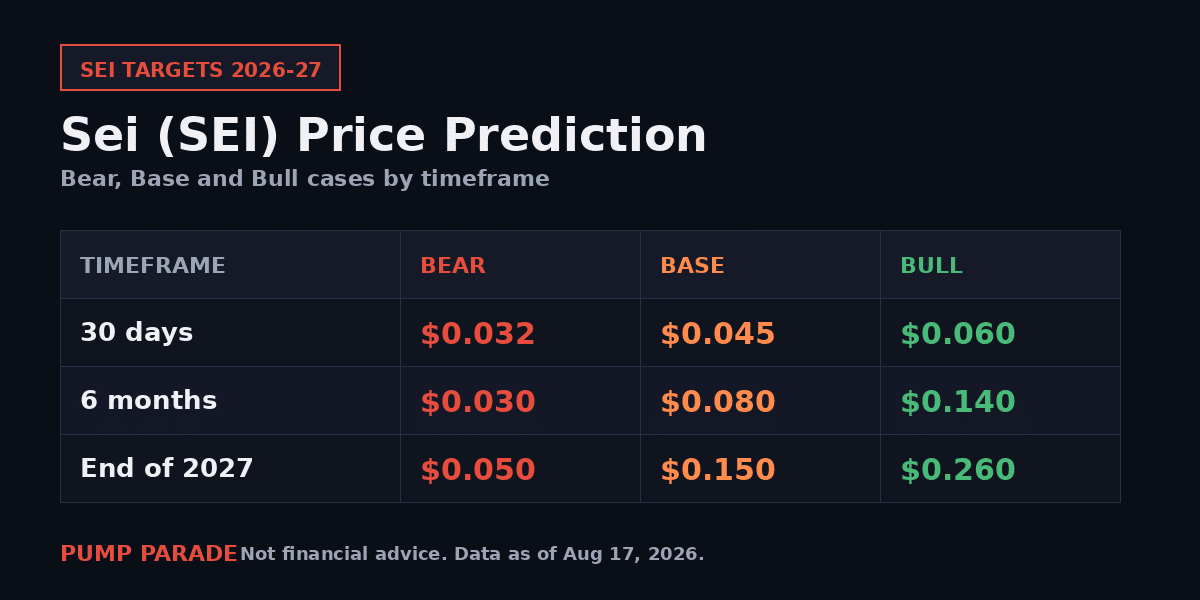
Below are our target ranges, synthesized from analyst forecasts at Changelly, CoinCodex, Cryptopolitan, and 99Bitcoins alongside our own read of the Giga rollout timeline.
| Timeframe | Bear | Base | Bull |
|---|---|---|---|
| 30 days (mid-September 2026) | $0.032 | $0.045 | $0.060 |
| 6 months (Q1 2027) | $0.030 | $0.080 | $0.140 |
| End of 2027 | $0.050 | $0.150 | $0.260 |
Short-term (30 days)
Sei just printed a new ATL. Technically, momentum favors continuation. If the $0.0395 level breaks and holds as resistance, the next real support is thin and $0.032 becomes achievable. The base case assumes Giga headlines and short-covering produce a bounce back into the $0.045 zone. A bull surprise (Xiaomi rollout headline, tokenized stocks going live at scale) could squeeze back to $0.06, but that requires an actual catalyst to hit the tape.
Medium-term (6 months)
By Q1 2027, the full Giga upgrade should be closer to production. This is where the biggest divergence in analyst outlooks lives. Bearish 99Bitcoins-style models put SEI near $0.03, base cases cluster at $0.08 to $0.09 (aligned with Coincheckup’s $0.09 average), and bullish scenarios that assume Giga ships plus RWA volume translates into fees push toward $0.14.
End of 2027
Longer horizons give the fundamentals more room to matter. If Sei captures a credible share of the parallelized-EVM RWA and payments market, an average price around $0.15 is defensible. Bull-case analyst targets from 99Bitcoins and Changelly reach $0.26 on the assumption of a broader alt-cycle plus successful Giga execution. Sub-$0.05 in that timeframe would essentially mean the ecosystem lost the narrative war, which is a real possibility, just not the base case.
For comparison, Standard Chartered and other institutional desks continue to prefer larger-cap L1s like Solana for RWA exposure. Our Solana price prediction lays out that parallel setup and is a useful sanity check on how much of the RWA opportunity a smaller L1 like Sei can realistically capture.
How does Sei compare to Solana?
The most useful comparison for SEI is not another Cosmos-lineage chain. It is Solana. Both are high-throughput L1s, both are targeting payments and RWA, and both trade off high-performance execution against decentralization tradeoffs.
| Metric | Sei (SEI) | Solana (SOL) |
|---|---|---|
| Price | $0.04 | ~$75 |
| Market cap | $268M | ~$40B |
| Rank | #132 | Top 10 |
| Target TPS | 200,000 (Giga) | ~65,000 (theoretical) |
| Target finality | Sub-250ms | ~400ms |
| EVM support | Native (post-Giga) | No (SVM) |
| Spot ETF (US) | None | None (filed) |
| Notable partnerships | Chainlink, Circle, Dinari, Xiaomi | Visa, Shopify, Franklin Templeton |
| Stage of adoption | Early, high risk | Established, mid-cycle |
The blunt read: SOL is a defensible mid-cap bet on continued adoption. SEI is a high-beta bet on Giga execution. SEI has more upside if things go right and materially more downside if they do not.
What Would Change Our View
Three specific triggers would move us from the current cautious base case to a more constructive stance:
- Giga full mainnet with real throughput. If Sei hits sustained 100k+ TPS on mainnet with sub-second finality, and third-party monitors verify it, that is a re-rate.
- Dinari and Chainlink Equities Streams doing measurable volume. Not headlines, actual daily tokenized-stock volume on Sei crossing $10M+ per day.
- Fee revenue turning into a real number. Current daily fees of about $5 need to become $500k+ for the token to have a defendable value accrual story.
If none of the three lands by Q1 2027, the base case likely resolves lower, not higher.
Frequently Asked Questions
Will SEI reach $1 in 2026?
No. Getting from $0.04 to $1 would require a 25x move against a heavy unlock schedule and a weakening chart. Even the most bullish analyst 2026 targets top out around $0.26. A push toward $1 is a multi-cycle scenario, not a 2026 one.
Is SEI a good investment in 2026?
SEI is a high-risk, high-upside speculative L1 bet. It is defensible as a small position for investors who accept volatility and believe the Giga upgrade will land. It is not a defensive or mature crypto holding, and it should be sized accordingly.
What is the Sei Giga upgrade?
Giga is Sei’s 2026 architectural overhaul that transitions the network to an EVM-only chain built on the Autobahn consensus. It targets over 200,000 TPS and sub-250ms finality. Mainnet rollout began with v6.6 in August 2026 via the Ares and Eidos components.
Can SEI hit $0.10 in 2026?
Possible, not probable. Base-case analyst forecasts cluster around $0.08 to $0.09 for late 2026. A $0.10 print would require Giga headlines to line up with a broader altcoin bid. If both happen, $0.10 is on the table. If either misses, it is not.
Why did SEI drop to an all-time low?
A combination of scheduled unlocks, weak sector-wide sentiment, and low TVL versus its 2025 peak has kept persistent supply on the market. The Giga rollout has not been enough to force a bid, because traders want to see verified mainnet performance before re-rating the token.
Where can you buy SEI?
SEI trades on major centralized exchanges including Binance, Coinbase, KuCoin, and Upbit. The most active pair is SEI/USDT on KuCoin. It is also available on decentralized venues via bridges, though liquidity is deeper on CEXs at current market cap.
The Honest Take
SEI is not the trade for anyone who wants clean, low-drama exposure to smart contract platforms. It is a levered bet on one specific thesis: that the Giga upgrade actually ships, the RWA rails actually attract volume, and the Xiaomi distribution actually converts. If that thesis plays out, a move from the current $0.04 back to $0.15 is a plausible 2027 scenario, and the upside case at $0.26 is defensible in the numbers. If the thesis breaks, sub-$0.05 is where the chart wants to go.
For most investors, the smart move is not a full-conviction position. It is a scaled entry with clear invalidation rules: buy some now, add on verified Giga milestones, exit if fee revenue and TVL fail to materially improve by Q1 2027. That is how a data realist treats a token trading at all-time lows with real catalysts and real risks stapled together. Not a moonshot. A framework.
Disclaimer: This article is for informational and educational purposes only and should not be construed as financial, investment, or trading advice. Cryptocurrency markets are highly volatile, and past performance does not guarantee future results. The price predictions and analyses presented here are based on AI models, technical indicators, and available data at the time of writing, they are not guarantees. Always conduct your own research (DYOR) and consult with a qualified financial advisor before making any investment decisions. Pump Parade and its authors do not assume liability for financial losses incurred based on information provided in this article.