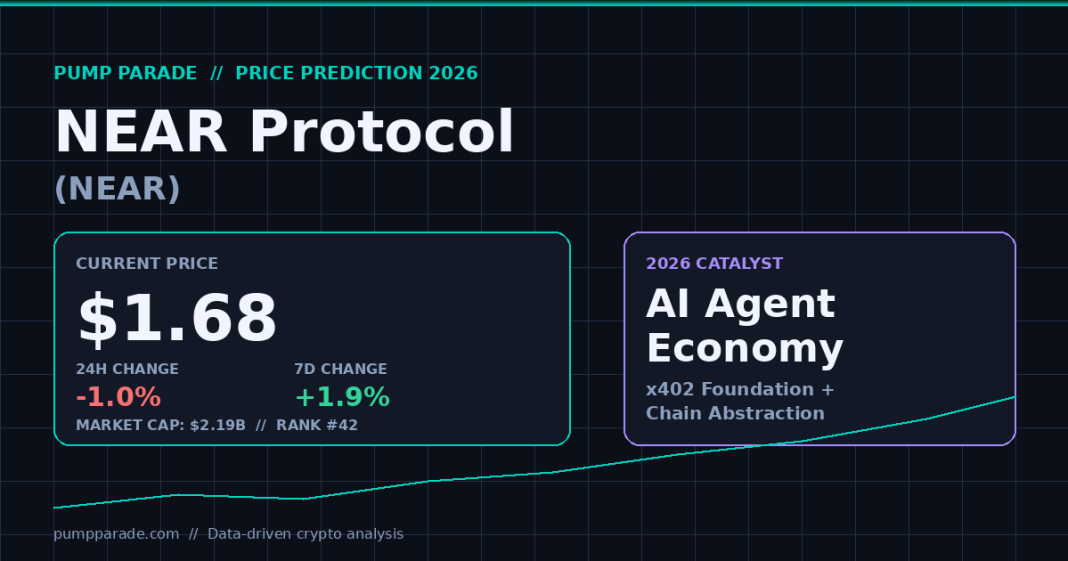
NEAR Protocol trades at $1.68 at time of writing, up 1.9% over the past week and holding above the $1.60 support that has caught every wick since late June. On paper, the chart looks like nothing much is happening. Under the hood, one of the busiest chain abstraction rollouts of 2026 is quietly turning NEAR into the AI agent economy’s plumbing.
That is the tension driving this NEAR price prediction 2026. The token still sits 91.8% below its 2022 all-time high of $20.40, so headline sentiment is muted. But the on-chain story tells a different one. NEAR Intents has processed more than $24 billion in cumulative swap volume and is running at an annualised gross fee rate near $40 million. Ledger just wired NEAR-powered swaps into 7.5 million wallets. And the NEAR Foundation joined the x402 Foundation in July to help build the payments layer for autonomous agents.
Here is what this article covers: current price context, why the tape looks calm while fundamentals ramp, the bull case, the bear case, our 30-day and 6-month and long-term targets, how NEAR compares with Solana on the same metrics, and the scenarios that would flip our view.
Key Takeaways
- Current price: $1.68, market cap $2.19B, rank #42, down 91.8% from the 2022 ATH.
- Base case for year-end 2026: $2.60, driven by continued NEAR Intents fee growth and the AI agent narrative.
- Bull case: $3.30 if Layer 1 AI infra flows accelerate and one large consumer app adopts Chain Signatures.
- Bear case: $0.80 to $1.00 if the broader L1 narrative unwinds and NEAR’s storage staking model fails to absorb supply.
- Primary catalysts: x402 Foundation integration, Confidential Intents general availability, Ledger native swap support, and the NEAR AI research pipeline.
- Primary risks: a 1.3 billion token uncapped supply, a 91% drawdown that has capped every rally since 2022, and Solana’s dominance in the same L1 AI conversation.
Where NEAR Stands Today
Here is the snapshot at time of writing. All numbers pulled from live market data on August 6, 2026.
| Metric | Value |
|---|---|
| Price | $1.6817 |
| 24-hour change | -1.03% |
| 7-day change | +1.86% |
| Market cap | $2.19B |
| 24-hour volume | $106M |
| Market cap rank | #42 |
| All-time high | $20.40 (Jan 2022) |
| % from ATH | -91.8% |
| Total supply | 1.30B (uncapped) |
Two things stand out. First, the 24-hour move is a rounding error. NEAR is compressing inside a tight $1.60 to $1.80 range that has held for most of July. Second, the ranking. NEAR sits at #42 by market cap. In the same L1 AI conversation, Solana is at rank #7 with a $42 billion cap. That gap defines both the risk and the opportunity here.
Why Is NEAR Range-Bound Right Now?
The short answer: the market has not decided whether NEAR is an AI infrastructure play or a stale 2021 L1 that missed its window. Both narratives have evidence, and neither has fully won.
The bull evidence keeps stacking up. Confidential Intents went generally available on July 7. That is the layer that lets agents execute cross-chain trades without exposing strategy, wallet balances, or counterparty. Ledger integrated NEAR Intents natively into its wallet update, which puts a chain-abstracted swap flow in front of 7.5 million hardware wallet users. And on July 14 the NEAR Foundation joined the x402 Foundation, a group focused on payment rails for autonomous agents.
The bear evidence is simpler. The token still trades at a 91.8% drawdown. The AI narrative has been running for two years, and NEAR has not broken $10 in that window. Every rally since Q1 2024 has been sold. That is not a story about fundamentals. It is a story about supply.
The Bull Case
Three catalysts underpin the constructive view.
1. NEAR Intents is turning into real revenue
The number that matters is $40 million. That is the annualised gross fee run-rate NEAR Intents is producing as of August 2026, based on cumulative swap volume of $24 billion. Fee revenue is the closest thing crypto has to a P&L. When protocol fees are real and growing, the token has a claim on something. NEAR’s staking model does not distribute fees directly, but sustained volume tightens the case for storage staking demand as more agents deploy on the network.
2. Chain Signatures is a genuine differentiator
Chain Signatures lets a NEAR-hosted agent sign transactions on Bitcoin, Ethereum, Solana, and other chains without a bridge. That is not incremental. It changes what an autonomous agent can do without asking a user to sign twenty times. If one of the big consumer wallets or exchanges builds on this before Solana or another competitor ships a comparable primitive, NEAR captures the developer mindshare that a decade of L1 wars have not produced.
3. The 91% drawdown means positioning is light
This one is technical. NEAR ran to $20 in early 2022 and has spent the past four years bleeding. Anyone who bought that top and has not capitulated is long gone. The wallets holding NEAR today are either recent buyers with a low cost basis or long-term believers. That structure sets up asymmetrically for upside if the narrative catches. There is very little overhead supply from bag-holders until roughly the $5 to $7 zone.
The Bear Case
1. The uncapped supply is a real weight
NEAR has 1.30 billion tokens in total supply against a market cap under $2.2 billion. The token model has no hard cap, and issuance funds validators and the ecosystem. As long as new supply enters the market faster than storage staking absorbs it, price faces a mechanical headwind. This is not a fatal flaw. Ethereum has the same shape. But at NEAR’s current fee base, the burn does not offset issuance.
2. Solana is winning the same fight
Every argument for NEAR as AI infrastructure is an argument Solana partisans can make with more revenue, more developers, and better retail distribution. Solana’s fee revenue and daily active addresses dwarf NEAR’s by an order of magnitude. If AI agents converge on one chain, the base case is that it is Solana or Ethereum, not NEAR. Chain abstraction is a smart response to that reality, but response is not the same as win.
3. The chart has taught traders to fade rallies
Every meaningful NEAR bounce since 2022 has failed at a lower high. Traders who have watched that pattern will sell strength until it stops working. Base-case forecasts of $1.70 to $2.20 for late 2026 from third-party analysts reflect this. If the range breaks down before it breaks up, momentum sellers will pile on and $1.20 becomes the next magnet.
NEAR Price Prediction 2026: Targets by Timeframe
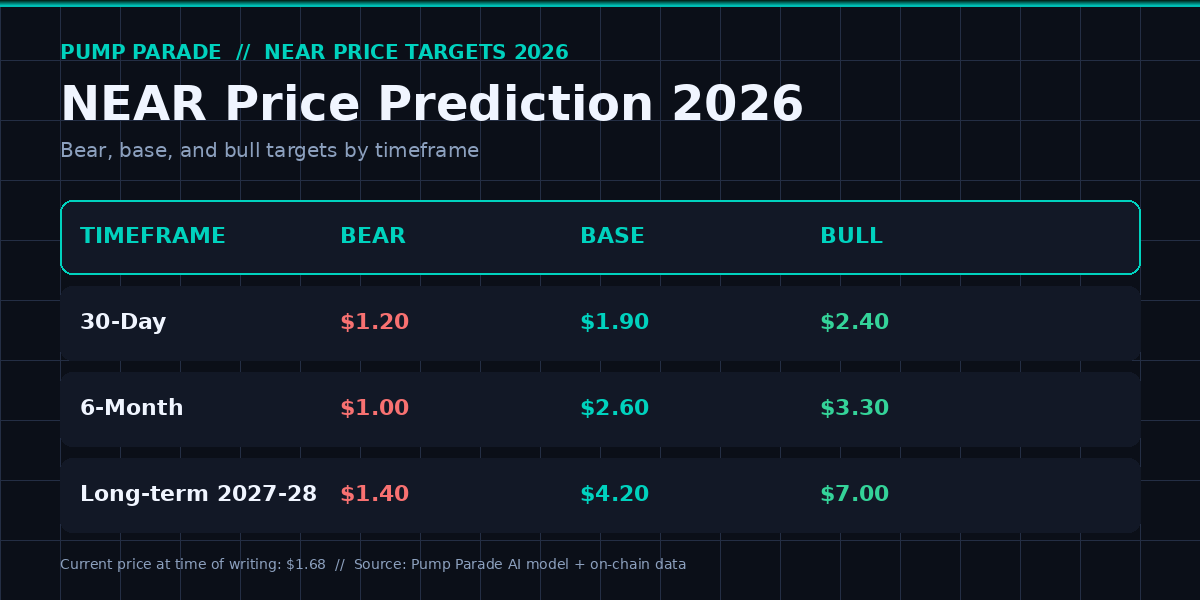
Here is how the Pump Parade hybrid model reads the setup across three horizons. The model blends technical structure, on-chain activity, tokenomics, and sector sentiment. Third-party targets from CoinGecko and independent research aggregators like Messari cluster in a similar zone, with base cases near $2.00 to $2.60 for year-end and stretch projections landing between $3.30 and $4.20 for the bull scenario.
30-Day Outlook: $1.20 bear / $1.90 base / $2.40 bull
The token is compressed. A 30-day base case of $1.90 assumes the range holds and one of the pending Intents or NEAR AI announcements gives buyers a reason to push. The bull case at $2.40 needs a broader crypto-wide risk-on move plus a specific NEAR catalyst. The bear case at $1.20 opens up if BTC dominance rips higher and altcoin liquidity dries out.
6-Month Outlook: $1.00 bear / $2.60 base / $3.30 bull
Six months out, the AI agent narrative should have a verdict. Either the x402 integration and Confidential Intents are producing measurable app adoption, or they are not. The base case assumes gradual growth. The bull case assumes a headline consumer partnership. The bear case assumes AI infrastructure narratives rotate into different tickers entirely.
Long-Term Outlook (2027 to 2028): $1.40 bear / $4.20 base / $7.00 bull
The long-term picture is the most interesting. If NEAR captures even 5% of the AI agent chain market by 2028, the base case of $4.20 is conservative. The bull case at $7.00 assumes a genuine ETF conversation opens for L1 AI tokens, similar to what happened with Solana. The bear case of $1.40 is what happens if the technology ships and the market simply does not care.
How Does NEAR Compare to Solana on AI Metrics?
Solana is the closest peer on narrative. Here is the side-by-side on the metrics that matter for the AI agent thesis.
| Metric | NEAR | Solana |
|---|---|---|
| Current price | $1.68 | $73.17 |
| Market cap | $2.19B | $42.53B |
| Rank | #42 | #7 |
| % from ATH | -91.8% | -75% |
| Signature primitive | Chain Signatures | Sub-second finality |
| Consensus | Nightshade sharding | Proof of History + Tower BFT |
| Retail wallet reach | Ledger, MyNearWallet | Phantom, Backpack, Solflare |
| Fee revenue (annualised) | ~$40M Intents fees | Billions in network fees |
Solana wins on distribution and current revenue. NEAR wins on the specific chain abstraction primitive. That is the trade a NEAR position expresses: you are paying much less market cap for a differentiated primitive that may or may not become the standard. If you want a broader view on the L1 competition, the Ethereum price prediction makes a useful anchor for how these narratives get priced when scale is proven versus promised.
Will NEAR Reach $5 in 2026?
Short answer: probably not in 2026, more plausibly in the 2027 to 2028 window.
For NEAR to sustain $5, market cap needs to run to roughly $6.5 billion at current supply. That is a triple from here. It has happened before in this cycle. It has not happened in a range this tight without a real catalyst break. The most realistic path is: base case $2.60 by year-end 2026, then a re-rating in the following cycle if agent economy adoption becomes obvious rather than theoretical. Standard Chartered has published bank-analyst targets for peers like Ethereum and Solana. They have not published one for NEAR, which itself tells you where NEAR sits on the institutional radar.
What Would Change Our View
Three specific signals would move us bullish or bearish beyond the ranges above.
- Bullish trigger: a top-10 exchange or a major consumer wallet integrates Chain Signatures as a default primitive. That would push AI agent developers to build on NEAR rather than route around it. Target revision: base case to $3.50, bull case to $6.00 for year-end 2026.
- Bearish trigger: NEAR Intents monthly volume declines for two consecutive months. Fee revenue is the load-bearing wall of the current thesis. If it cracks, targets compress. Target revision: base case to $1.40, bear case to $0.60.
- Regime change: a spot L1 AI ETF filing is accepted by the SEC for review. This is a low-probability, high-impact event. It would re-rate the entire AI token basket and NEAR would trade like a proxy. Bull case would extend to $10 in a 12-month window.
Frequently Asked Questions
Will NEAR reach $10 in 2026?
Reaching $10 in 2026 would require a market cap above $13 billion at current supply, roughly 6x from here. That is possible only in a full-cycle altcoin blow-off top combined with a NEAR-specific catalyst. The base case does not include it. A more plausible timeline for $10 is 2027 to 2028 if the AI agent thesis compounds.
Is NEAR Protocol a good investment in 2026?
NEAR is a high-variance bet on the AI agent economy adopting chain abstraction as the default. If that thesis plays out, the risk-reward from a $2.19 billion market cap is attractive. If it does not, NEAR looks like every other L1 that missed its shot. Position sizing should reflect that binary shape.
What is the NEAR Protocol used for?
NEAR is a Layer 1 blockchain built on the Nightshade sharding design, focused on account abstraction, low fees, and chain abstraction. Its flagship products in 2026 are NEAR Intents, a cross-chain execution API, and Chain Signatures, which lets NEAR-hosted logic sign transactions on other blockchains without bridges.
Why is NEAR price surging on some days but flat overall?
Individual green days come from partnership announcements or AI narrative rotations. The flat overall tape reflects heavy supply pressure from an uncapped issuance schedule plus persistent selling from traders who have watched every rally fail since 2022. The setup needs a durable narrative shift to break out.
How does NEAR compare to Solana for AI agents?
Solana has more developers, more revenue, and better distribution today. NEAR has a specific primitive, Chain Signatures, that Solana does not yet ship natively. The trade-off is scale-now versus differentiated-later. Diversifying across both is a common institutional stance if you want L1 AI exposure without picking one winner.
What is chain abstraction and why does it matter for NEAR?
Chain abstraction removes the requirement that users choose or understand which blockchain they are on. NEAR Intents and Chain Signatures deliver this: a user asks for an outcome, NEAR handles routing and signing across chains. For autonomous agents that need to trade or pay across ecosystems without user prompts, this is core infrastructure. If it becomes the standard pattern, NEAR captures a slice of that flow.
The Honest Take
NEAR at $1.68 is neither obvious upside nor an easy short. The fundamentals are moving in the right direction, and the token has been in penalty box for so long that positioning is clean. But the ranking says the market is not paying for it yet, and the uncapped supply is a real headwind.
The base case at $2.60 by year-end is a reasonable expectation, not a stretch. The bull case at $3.30 needs one specific catalyst to land. The long-term case above $4 depends on whether chain abstraction becomes a standard pattern or a footnote. NEAR is the highest-quality asymmetric bet in the L1 AI category right now, but asymmetric means the downside is real too. Position accordingly. For traders looking at how the AI narrative is playing out across smaller caps, our Fetch.ai price prediction covers a different corner of the same theme.
Disclaimer: This article is for informational and educational purposes only and should not be construed as financial, investment, or trading advice. Cryptocurrency markets are highly volatile, and past performance does not guarantee future results. The price predictions and analyses presented here are based on AI models, technical indicators, and available data at the time of writing, and are not guarantees. Always conduct your own research (DYOR) and consult with a qualified financial advisor before making any investment decisions. Pump Parade and its authors do not assume liability for financial losses incurred based on information provided in this article.