Two of the biggest non-US crypto exchanges have spent 2026 pulling in opposite directions. Bybit spent the year rebuilding after the largest exchange hack in history and pivoting into tokenized stocks, banking rails and a re-designed copy trading stack. OKX spent the year winning derivatives market share, tightening its Web3 wallet and pulling in strategic investment from ICE, the parent company of the New York Stock Exchange, at a $25 billion valuation. If you are choosing where to park capital or trade actively for the rest of 2026, the answer is not obvious anymore.
This head-to-head compares Bybit and OKX across trading fees, product depth, security, Web3 wallet quality and best-use cases, using 2026 data. If you are also weighing US-friendly options, our Binance vs Coinbase 2026 breakdown covers that lane, and our Kraken vs Bitget comparison looks at the value-focused mid-tier.
TL;DR: The Quick Verdict
OKX is the better all-round pick for most active traders in 2026. It has lower spot maker fees (0.08% vs 0.10%), a slight edge on futures taker fees (0.05% vs 0.055%), the deeper native token discount (up to 40% off with OKB vs Bybit’s 25% with BIT), and it overtook Binance in derivatives volume in Q3 2025 with over $1.3 trillion in monthly notional. Its Web3 wallet is arguably the best CEX-attached self-custody product on the market, and OKX Pay adds zero-fee stablecoin transfers that few competitors match.
Bybit still wins for a specific profile: traders who want tokenized stocks and IPO Express access alongside crypto perps, users who lean heavily on copy trading (Bybit’s Classic, Pro and TradFi copy programs are the most structured on the market), and anyone allergic to Binance-style KYC friction. Its recovery from the February 2025 Lazarus Group hack is genuinely impressive, but the hack itself is still a data point that a security-first user cannot ignore.
Winner: OKX for fees, derivatives and Web3. Bybit for copy trading, tokenized RWAs and product breadth.
Bybit in 2026: What Changed
Bybit has been on a two-year sprint to reposition itself as a full financial platform rather than a pure crypto exchange. The February 2025 hack, in which the Lazarus Group drained over 401,000 ETH (roughly $1.5 billion at the time) from a cold wallet through a spoofed Safe UI multisig phishing attack, forced that pivot to happen in public. Bybit reimbursed users in full from reserves and recovery loans, ran more than 30 external audits, and completely rebuilt its wallet infrastructure. As of 2026, Bybit reports over 60 million registered users and a 99.99% uptime track record with capacity of 100,000 TPS.
The bigger story is the product pivot. In early 2026, Bybit rolled out its “New Financial Platform” positioning with three concrete pieces:
- Bybit TradFi: Over 200 traditional finance instruments launched, with a stated Q1 target of 500 pairs including stock CFDs, forex, commodities and index products.
- IPO Express: One of the first crypto exchanges to offer tokenized IPO access, meaning users can gain synthetic exposure to upcoming public listings from the same account they use for BTC and ETH.
- MyBank: A retail banking layer targeting a February 2026 launch. Dedicated fiat accounts, on- and off-ramp simplification and cross-border everyday spending, all wrapped inside the exchange.
Bybit also formalized copy trading into three products in 2026. Classic charges a 10 to 15% weekly profit share depending on Master Trader tier. Pro lets Masters set custom rates against Net Asset Value. TradFi uses a High Water Mark model where fees only apply when cumulative equity hits a new all-time peak. That structure is more thought-out than what most competitors offer.
You can explore the platform directly at Bybit’s homepage.
OKX in 2026: What Changed
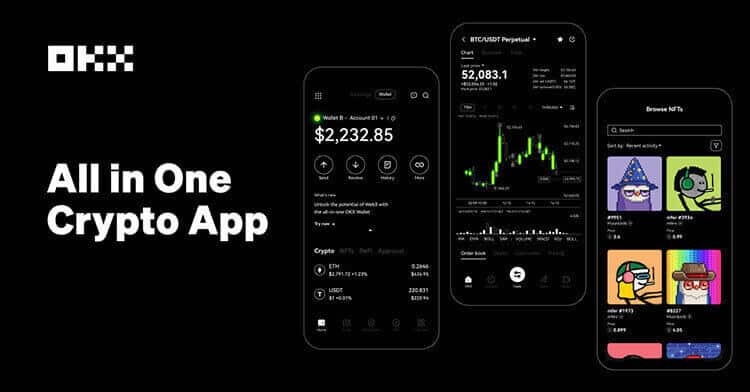
OKX had a quieter but arguably stronger 2026. The exchange took a strategic investment from ICE, the New York Stock Exchange’s parent, at a reported $25 billion valuation. It rolled out a BUIDL collateral framework in partnership with BlackRock and Standard Chartered, which lets institutional users post BlackRock’s tokenized money market fund as trading collateral. And in September 2025 it overtook Binance in derivatives, hitting $1.3 trillion in monthly derivatives volume with a 31% year-over-year jump in contract trading.
OKX’s product surface for 2026 covers:
- Spot trading across more than 500 pairs and 350+ tokens, with maker fees starting at 0.08% and dropping into negative-maker territory at high VIP volume.
- Perpetuals, quarterly futures, options and margin under a unified account that shares collateral across products. This is a serious edge for cross-product traders.
- Structured Earn products, copy trading and the Jumpstart launchpad for early token allocations.
- OKX Web3 Wallet: non-custodial, 100+ chains, built-in DEX aggregation, NFT management, cross-chain bridge and DeFi access. Continually cited as one of the best all-round CEX-linked wallets in the market.
- OKX Pay: launched April 2025 with zero-fee global crypto transfers in USDC and USDT, no limits, plus a “silent rewards” feature that generates yield on stablecoin balances without lockups.
Reported 24-hour spot volume sits around $5.7 billion with derivatives volume above $34.5 billion, and OKX cites 2.5 million monthly active traders on top of 60 million lifetime registrations.
The homepage is at OKX.
Trading Fees: Where OKX Pulls Ahead
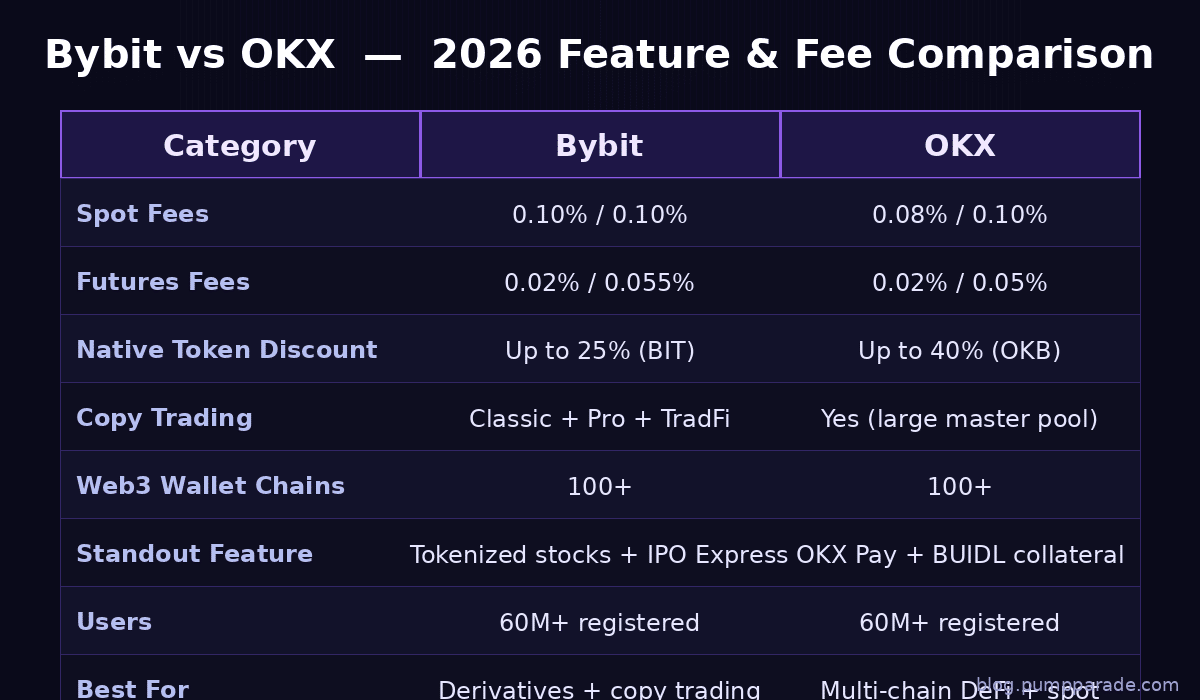
Fee schedules are the number one differentiator when the two products otherwise overlap heavily. Here is the standard-tier picture as of July 2026:
Spot
OKX charges 0.08% maker and 0.10% taker. Bybit charges 0.10% flat on both sides. On maker fills the OKX advantage is 20%, which is meaningful for anyone posting limit orders. Both drop steeply through VIP tiers, but OKX gets to zero or negative maker faster because it starts closer.
Futures
OKX is 0.02% maker / 0.05% taker. Bybit is 0.02% maker / 0.055% taker. The taker gap is small in isolation, but on a $500,000 monthly futures notional it saves about $25 per month, and it compounds fast for scalpers. Bybit did cut its USDC perp taker fees by up to 50% for Supreme VIP users in March 2026, bringing Supreme taker down to 0.015% on USDC pairs. If you are already in Supreme tier and trade USDC perps, that specific carve-out flips the fee winner for that pocket of activity.
Native token discounts
Paying with OKB earns up to 40% off on OKX. Paying with BIT earns up to 25% off on Bybit. Both require holding some volume of the token, and both discounts stack with VIP tiers. OKX’s discount is materially larger and the OKB token has been more actively supported through burns and utility upgrades.
Withdrawals
This is where the comparison gets nuanced. Bybit is materially better on stablecoin withdrawals – free USDT and USDC via specific networks and free ETH via Mantle. OKX is roughly 7x cheaper on Bitcoin withdrawals. If you are frequently moving stables to L2s or CEXs, Bybit’s structure is more attractive. If you self-custody BTC on cold storage, OKX saves you real money over time.
Derivatives Depth and Market Structure
Both platforms offer USDT-margined and coin-margined perpetuals, quarterly futures and options. OKX has the deeper options book by open interest, and it has been the biggest gainer in derivatives market share through 2025 and 2026. Bybit’s derivatives are still enormous (frequently second or third globally by open interest) but the momentum is with OKX.
The unified account model on OKX is a real edge for anyone running hedges across products. You post one pool of collateral and it covers spot longs, perp shorts, options and margin borrows simultaneously. Bybit has a unified trading account too, but the collateral sharing is not as clean, especially for options.
For pure copy trading, Bybit is the better platform. Its three-tier copy structure (Classic, Pro, TradFi) is the most polished on any major exchange in 2026. OKX has copy trading but the product tiers are less mature.
Web3 Wallets: OKX’s Big Advantage
Both exchanges bundle a non-custodial Web3 wallet, but the products are very different in ambition. OKX Web3 Wallet supports 100+ blockchains natively, has a built-in DEX aggregator that routes across major L1s and L2s, includes a cross-chain bridge, and manages NFTs and DeFi positions from the same UI. It is repeatedly ranked as one of the top three CEX-linked wallets alongside Binance Wallet and Coinbase Wallet.
Bybit’s Web3 wallet exists and covers major chains, but it is a much thinner product. It does not have the same depth of DEX aggregation or DeFi integration, and it has not been marketed as a core product the way OKX has done. If you plan to actually use the wallet for on-chain activity, OKX is the clear winner. If you’re weighing pure Solana wallets, our Backpack Wallet review and Phantom review are better starting points than either exchange wallet.
Security and Trust
This section requires honesty. Bybit suffered the largest CEX hack ever in February 2025, losing over $1.5 billion in ETH from a cold wallet through a Safe UI phishing exploit that targeted its multisig signers. Bybit reimbursed all affected users, rebuilt its wallet stack, and passed 30+ external audits. The FBI attributed the attack to North Korea’s Lazarus Group. As of 2026 the platform is arguably harder to breach than it was pre-hack, precisely because it was forced to re-engineer everything.
OKX has had regulatory issues but no comparable security incident at that scale. It went through a US settlement in 2024 related to historical KYC gaps, has since restructured global compliance, and now runs a licensed presence in the EU, Middle East and multiple Asian jurisdictions. Its Proof-of-Reserves reports are regularly published and its ICE strategic investment adds institutional oversight.
For a security-first user, OKX has the cleaner recent track record. For a user who values how a platform responds under fire, Bybit’s recovery is legitimately best-in-class. Neither should be treated as risk-free for large balances – self-custody remains the safest option for anything you are not actively trading.
Pros and Cons
Bybit pros:
- Free USDT and USDC withdrawals on select networks
- Tokenized stocks, IPO Express and TradFi CFDs alongside crypto
- The most polished copy trading product suite on any major exchange
- Aggressive USDC perp fee cuts for VIP tiers (Supreme taker to 0.015%)
- Full user reimbursement after the 2025 hack
Bybit cons:
- Higher standard spot maker fees than OKX
- Smaller native token discount (25% vs 40%)
- Web3 wallet is much thinner than OKX’s
- The 2025 hack, while resolved, is still on the record
OKX pros:
- Lower spot maker fees and slightly lower futures taker fees
- Up to 40% fee discount with OKB
- Overtook Binance in derivatives volume in 2025
- Best-in-class Web3 wallet with 100+ chains and full DeFi access
- OKX Pay: zero-fee USDC / USDT transfers with silent yield
- ICE strategic investment adds institutional credibility
OKX cons:
- Higher Bitcoin withdrawal fees than Bybit (for stablecoins the reverse is true)
- Copy trading is less mature than Bybit’s
- No tokenized stocks or IPO Express equivalent yet
- US access remains restricted to okx.com/us with limited product coverage
Which Exchange Should You Pick?
Pick OKX if: you trade spot or perps at any real volume, you want the deepest CEX-linked Web3 wallet, you plan to hold and use OKB for fee discounts, or you want a single account that spans CEX and on-chain activity.
Pick Bybit if: copy trading is central to your strategy, you want exposure to tokenized stocks and IPOs alongside crypto, you move stables constantly and value free USDT / USDC withdrawals, or you specifically want to bank inside your exchange via MyBank.
Use both if: you are running institutional-scale volume. The fee differences at Supreme VIP tiers between the two platforms mean routing specific pairs to the cheaper venue is worth the operational overhead.
Frequently Asked Questions
Is OKX cheaper than Bybit for retail traders?
Yes, at the standard tier. OKX’s 0.08% maker fee on spot beats Bybit’s 0.10% flat, and OKX’s futures taker fee is 0.05% vs Bybit’s 0.055%. Native token discounts also favour OKX (40% via OKB vs 25% via BIT).
Is Bybit safe after the 2025 hack?
Bybit passed 30+ external audits, rebuilt its cold wallet infrastructure and reimbursed all affected users after the February 2025 Lazarus Group breach. Operational security in 2026 is materially stronger than it was pre-hack. That said, no CEX is risk-free for large balances – self-custody is still the safest option.
Does OKX or Bybit have better derivatives?
OKX overtook Binance in monthly derivatives volume in September 2025 with $1.3 trillion, and it holds a slight fee edge on futures. Bybit remains a top-three derivatives venue by open interest and offers deeper USDC perp discounts for Supreme VIPs. Both are excellent – OKX has the momentum.
Which is better for copy trading?
Bybit. Its 2026 copy trading suite (Classic, Pro and TradFi) is the most structured on any major exchange, with clear fee models and a High Water Mark option for TradFi that only charges when cumulative equity hits a new peak.
Can US users access Bybit or OKX?
Neither exchange serves the full US market directly. OKX operates a limited okx.com/us presence with reduced product coverage. Bybit does not currently serve US retail users. US traders should check current availability and geo restrictions before creating an account.
This article is for informational purposes only and is not financial advice. Crypto trading is high risk. Always do your own research before choosing an exchange or placing capital.