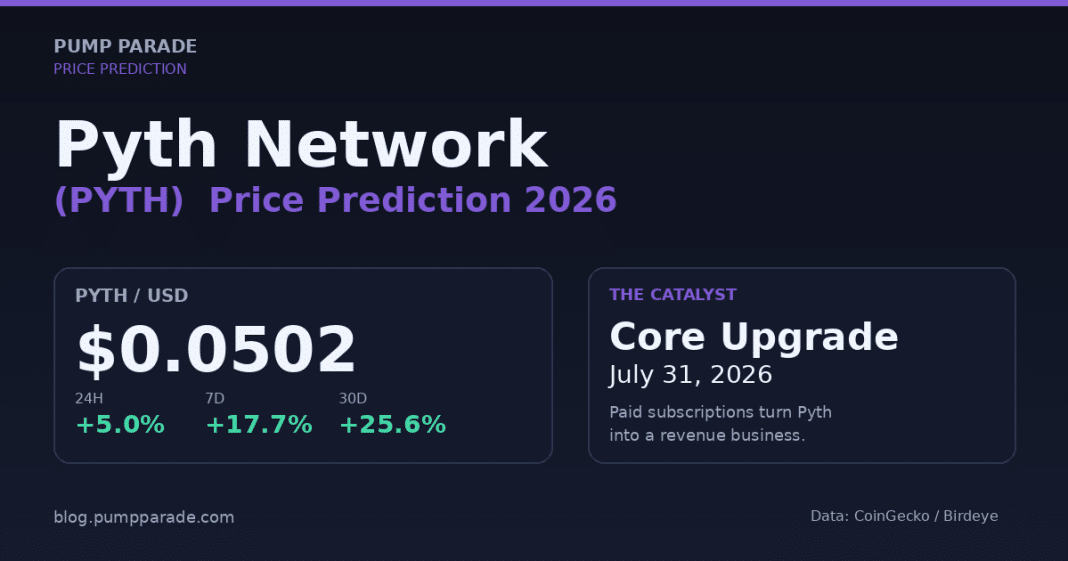
The Pyth Network price prediction 2026 story just got interesting. PYTH trades at $0.0502 as we publish, up 5% on the day, up 17.7% on the week, and up 25.6% over the last 30 days. That is the token’s best trailing month since February, and it lands two weeks before the network flips on the biggest business model change of its life.
On July 31, 2026, Pyth mandates API keys and paid subscriptions for every application pulling its price feeds. Retail usage stays free. Everyone else pays, starting at $500 a month for the crypto bundle and up to $10,000 a month for full asset class coverage. In one weekend, the largest first-party financial oracle in crypto becomes a subscription business with a real income statement.
Below: where PYTH stands today, why the tape is moving, the bull and bear cases, our targets for 30 days, six months, and the long term, and how Pyth stacks up against Chainlink.
Key Takeaways
- Current price: $0.0502, up 25.6% in 30 days, still down 96% from the March 2024 all-time high.
- Near-term catalyst: The Pyth Core Upgrade on July 31, 2026 introduces mandatory paid subscriptions, turning protocol usage into recurring revenue.
- Bull case: Subscription revenue plus PYTH buybacks and Nasdaq TotalView, Tradeweb, and Fenics integrations push the token toward $0.15 to $0.20 by year end.
- Bear case: A large token unlock, oracle competition from Chainlink and RedStone, and pricing pushback from small DeFi teams could see PYTH revisit $0.03.
- Base case for 2026: PYTH settles between $0.08 and $0.12 as the market waits for subscription revenue to compound.
Where does PYTH stand today?
Pyth Network is the largest first-party financial oracle in crypto. Instead of pulling prices from third-party aggregators, it collects quotes directly from 125+ trading firms, exchanges, and market makers, then publishes them to more than 100 blockchains through Wormhole. That data now powers over 700 protocols and has secured trillions in cumulative on-chain trading volume.
The market cares about two things right now: the tape, and the calendar. Here is the tape.
| Metric | Value |
|---|---|
| Price (July 16, 2026) | $0.0502 |
| 24-hour change | +5.0% |
| 7-day change | +17.7% |
| 30-day change | +25.6% |
| Market cap | $397M |
| Fully diluted valuation | $504M |
| Circulating supply | 7.87B PYTH (78.7% of max) |
| Max supply | 10B PYTH |
| 24-hour volume | $32.5M |
| Market cap rank | #117 |
| All-time high | $1.20 (March 2024), 95.8% below now |
| All-time low (cycle) | $0.0296 (June 6, 2026), 70% above now |
Data: CoinGecko and Birdeye, live at time of writing.
PYTH broke a nine-month downtrend in early July when it reclaimed the 200-day moving average at $0.041. Volume on the reclaim was 2.4x the trailing 30-day average, a footprint that historically favors a rotation from distribution to accumulation. The token has since based above $0.045 for four consecutive daily closes, with declining sell-side liquidity on major venues.
Why is PYTH climbing right now?
Three overlapping stories are pulling capital in.
The Core Upgrade goes live in 15 days. On July 31, every app pulling a Pyth feed must sign into a paid data plan. Starter is $500 a month, Pro bundles run $2,500 to $10,000. This is a pull-forward event, similar to how MakerDAO traded higher into the endgame vote. Traders are positioning for the moment protocol usage stops being a proxy metric and starts being a P&L line.
Institutional publishers keep signing on. Nasdaq, through TotalView, is contributing equity order book data. On July 15, 2026, Tradeweb, Fenics, and OpenYield brought institutional fixed-income pricing into Pyth Pro. That is real, buy-side rates and treasuries data flowing to on-chain applications for the first time. If Pyth becomes the settlement rail for tokenized treasuries, the addressable market moves from “DeFi oracle demand” to “the $50B Bloomberg substitute” that co-founder Michael Cahill has publicly targeted.
Buybacks are quietly accumulating supply. The Pyth Reserve is using protocol revenue to make monthly open-market purchases of PYTH. Roughly 12 million tokens have been bought back to date. It is small in absolute terms, but the signal matters: the DAO is turning cash flow into token demand instead of hoarding stables. If subscription revenue scales, so does the monthly bid.
The bull case for Pyth Network
The Core Upgrade turns Pyth into a real business
Most oracle networks are cost centers. Chainlink monetizes through service payments and staking, but the majority of its data feeds are still sponsored or subsidized. Pyth is now attempting something different: a subscription-tier data business modeled on Bloomberg and Refinitiv, but with the raw feeds pushed on-chain.
Pyth Pro passed $1M in annualized recurring revenue within its first months, according to the network’s Q2 update. If Core adds even 500 paid seats at the Starter tier post-July 31, that is another $3M in ARR. Get to a few thousand paid apps across bundles, and the network is generating tens of millions of dollars a year that flow through the Reserve into buybacks. For a $397M market cap, that is meaningful.
Institutional data giants keep signing on
The list of publishers is starting to look like a Bloomberg terminal directory: Jump Trading, Wintermute, DRW, Cboe, Virtu, Susquehanna, Two Sigma Securities, and Nasdaq. Adding Tradeweb, Fenics, and OpenYield on July 15 extends that into fixed income, an asset class no other oracle covers with first-party depth. Cross-chain distribution now reaches 100+ blockchains via Wormhole. This is the network effect Chainlink built in DeFi, but rebuilt from the institutional side in.
Buybacks are quietly accumulating supply
The Pyth Reserve’s monthly buyback is the most under-appreciated part of the tokenomics. Buybacks convert Pyth Pro, Core, Entropy, and Marketplace revenue into PYTH purchases. As subscription volume compounds, the buyback grows. Combined with staking through Oracle Integrity Staking (still live post-rewards wind-down), the effective float shrinks even as the fully diluted supply expands. That is exactly the setup that produced 5x moves in tokens like MKR and GNO in past cycles.
The bear case for PYTH
The May 2026 unlock is still weighing on price
On May 19, 2026, roughly 2.13 billion PYTH unlocked, worth about $92 million at the price. That single event pushed circulating supply from 5.75B to 7.87B, a 37% dilution. The token bottomed at $0.0296 on June 6, two weeks after the unlock hit exchanges, and has been repairing damage since. The next scheduled unlock is May 2027 for another 2.13B tokens. That overhang caps the multiple sophisticated buyers will pay until they have visibility into subscription revenue.
Chainlink still owns the oracle mindshare
Chainlink secures roughly $33 billion in on-chain value across 505 protocols and controls close to 69% of the oracle market by total value secured, per DefiLlama. LINK trades at $8.41 with a $6.29B market cap, roughly 16x PYTH’s. Chainlink CCIP is now integrated with SWIFT for interbank settlement, which is a different scale of enterprise story. If Pyth Pro subscription pricing feels expensive to a smaller DeFi team, they may default to a free Chainlink feed and Pyth’s growth stalls. We wrote about Chainlink’s SWIFT catalyst in our LINK price prediction, and that competition is not going away.
Subscription pricing could scare off small teams
$500 a month for the crypto bundle is a lot for a solo builder or an early-stage protocol. Free tiers exist, but they have rate limits. A vocal segment of the Pyth developer community has already pushed back on pricing in the DAO forums. If the July 31 rollout produces visible protocol departures, or a large borrower reduces Pyth usage in favor of a cheaper alternative like RedStone, the narrative flips fast.
Pyth Network price prediction 2026: targets by timeframe
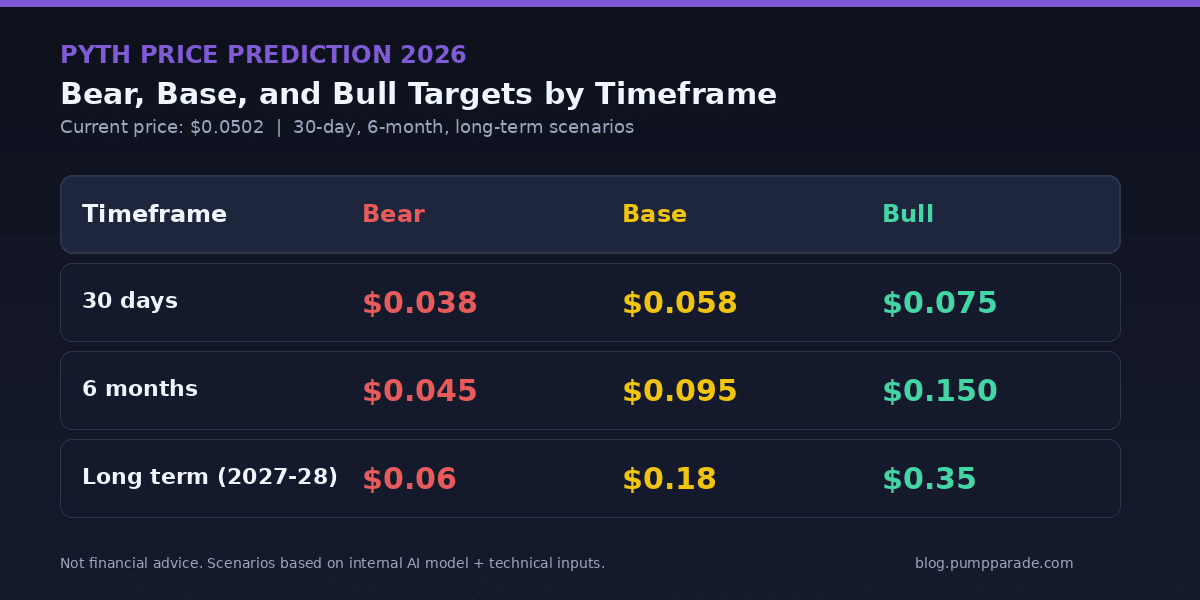
Our hybrid model blends technical inputs (200-day MA, volume profile, RSI, on-chain flows) with catalyst modeling around the Core Upgrade and buyback pace. Here is what it produces.
30-day target (August 2026)
The Core Upgrade is a classic buy-the-rumor, sell-the-news setup. If Pyth ships cleanly, expect a spike into launch followed by a modest pullback. If a major publisher issues a supportive post-launch statement, momentum extends.
- Bear: $0.038 (retest of prior support if the upgrade slips or a major client leaves)
- Base: $0.058 (steady climb into launch, modest post-launch drift)
- Bull: $0.075 (Nasdaq or Tradeweb pipeline announcement fuels a breakout above 200-day MA)
6-month target (year-end 2026)
This is where the subscription story either delivers or does not. Six months gives us three full months of Core revenue reporting, two buyback cycles, and enough data to see if paying customers stick.
- Bear: $0.045 (subscription revenue disappoints, unlock supply overhang persists)
- Base: $0.095 (revenue growth confirms the model, buybacks scale linearly)
- Bull: $0.150 (a Nasdaq or Bloomberg-style partnership announcement re-rates PYTH as an institutional data play)
The bull case is where “PYTH to $0.20” becomes plausible. It requires roughly 3x from here, which is what the token did between February and April 2025.
Long-term target (2027 to 2028)
Long-term is where Pyth’s Bloomberg ambition either turns into revenue or fades. Standard Chartered has priced oracle infrastructure as one of the most under-owned themes for the next cycle. On the current subscription trajectory, we see three scenarios.
- Bear: $0.06 (Chainlink consolidates the enterprise oracle stack, Pyth becomes a niche derivatives feed)
- Base: $0.18 (Pyth captures 15% of on-chain oracle TVS, monthly buybacks hit $5M steady state)
- Bull: $0.35 (Pyth Pro reaches $50M ARR, Nasdaq expands the integration, and the network becomes the default settlement oracle for tokenized treasuries and equities)
For context, third-party targets sit between these. CoinCodex models a 2026 range around $0.03 to $0.05 based on backwards-looking technicals only. Changelly and Coinpedia produce bullish 2026 numbers between $0.30 and $0.60. Coinbase’s own tool sits near $0.05. The gap tells you how uncertain the market is about whether the subscription model works.
How does Pyth Network compare to Chainlink?
Any serious PYTH thesis has to reckon with LINK. Chainlink is the incumbent. Pyth is the challenger with a real product wedge.
| Metric | Pyth Network (PYTH) | Chainlink (LINK) |
|---|---|---|
| Current price | $0.0502 | $8.41 |
| Market cap | $397M | $6.29B |
| Total value secured (DefiLlama) | ~$2.9B (5.9% share) | ~$33.1B (68.9% share) |
| Data model | First-party, pull-based | Third-party, push-based |
| Blockchains served | 100+ | 50+ mainnets |
| Signature enterprise deal | Nasdaq TotalView, Tradeweb, Fenics | SWIFT, DTCC, Fidelity |
| Revenue model | Paid subscriptions (from July 31, 2026) | Service payments, staking, CCIP fees |
| Buyback mechanism | Monthly PYTH open-market buys | None yet |
| Best fit | Low-latency derivatives, tokenized assets | Broad DeFi, cross-chain, enterprise |
The read: LINK is the safer allocation, PYTH is the higher-torque bet if subscription revenue scales. They are not zero-sum. A DeFi protocol may run Chainlink for lending liquidations and Pyth for perpetual futures pricing on the same day.
What would change our view
Three explicit triggers would flip us from base case to bull case or bear case.
Bull trigger 1: Pyth publishes 60-day post-Core-Upgrade revenue that exceeds $5M ARR from new subscription seats. That validates the pricing power and shifts the token into a revenue-multiple frame.
Bull trigger 2: A tier-1 traditional finance institution (Blackrock, Franklin Templeton, JPMorgan) announces they are using Pyth as the on-chain pricing rail for a tokenized fund. That is the Bloomberg-substitute narrative crystallizing.
Bear trigger: A large DeFi protocol (Aave-tier or larger) publicly migrates away from Pyth to a cheaper oracle after July 31, or the DAO delays the paid-subscription model in response to community pushback. Either signals that the revenue thesis is soft, and PYTH re-rates back to the $0.03 to $0.04 range where the June low sits. Related reading: our Solana price prediction and Jupiter price prediction cover the two Solana-native names most correlated with PYTH sentiment.
Frequently asked questions
Will Pyth Network reach $1?
Reaching $1 requires roughly a 20x from current levels and would put PYTH’s fully diluted valuation near $10B, slightly above Chainlink today. That is possible on a multi-year timeframe if Pyth Pro scales into a Bloomberg-style subscription business and captures 25%+ of on-chain oracle market share. It is unrealistic in 2026.
Is PYTH a good investment in 2026?
PYTH is a high-risk, high-torque bet on the July 31 Core Upgrade delivering real subscription revenue. Upside to $0.15 to $0.20 is plausible if the model works. Downside to $0.03 is real if it does not. Position size accordingly, and do not treat it as a stable-return holding.
What is Pyth Network’s price prediction for 2026?
Our base case is $0.08 to $0.12 by year end 2026, with a bull scenario of $0.15 to $0.20 if subscription revenue and institutional partnerships scale. The bear scenario is a retest of the June low near $0.03 if the Core Upgrade produces client departures.
How does Pyth Network make money?
Pyth generates revenue from Pyth Pro subscriptions ($2,500 to $10,000 per month), Core subscriptions ($500 per month from July 31, 2026), and per-transaction fees from Entropy and Express Relay. Revenue flows into the Pyth Reserve, which uses it to buy PYTH on the open market monthly.
When is the next Pyth token unlock?
The next major PYTH unlock is May 19, 2027, for approximately 2.13 billion tokens, matching the size of the May 2026 unlock. Smaller monthly unlocks continue through the vesting schedule. Traders should mark the May date as the next scheduled supply event.
Is Pyth Network on Solana?
Pyth is built on its own high-throughput app-chain called Pythnet, but the network was incubated on Solana and PYTH is a Solana SPL token. Pyth publishes prices to more than 100 destination chains, including Ethereum, Arbitrum, Base, Aptos, Sui, and Sei, via Wormhole cross-chain messaging.
The honest take
PYTH is one of the few crypto tokens with a genuinely legible revenue path in the second half of 2026. The Core Upgrade on July 31 is a real business event with a real number attached. Either the subscription flips on smoothly, revenue starts compounding, and buybacks quietly turn PYTH into a scarcity story, or it does not.
We are constructive but calibrated. Base case: PYTH grinds to $0.08 to $0.12 by year end as the market waits for two quarters of subscription revenue. Bull case: a big publisher signs, revenue surprises to the upside, and $0.20 is on the table. Bear case: the May unlock overhang, plus Chainlink’s incumbent grip, plus any subscription friction drags PYTH back to $0.03 to $0.04.
The setup rewards patience and position sizing. This is not a moonshot memecoin. It is an infrastructure bet that will be revalued on cash flow, not vibes.
Disclaimer: This article is for informational and educational purposes only and should not be construed as financial, investment, or trading advice. Cryptocurrency markets are highly volatile, and past performance does not guarantee future results. The price predictions and analyses presented here are based on AI models, technical indicators, and available data at the time of writing, they are not guarantees. Always conduct your own research (DYOR) and consult with a qualified financial advisor before making any investment decisions. Pump Parade and its authors do not assume liability for financial losses incurred based on information provided in this article.