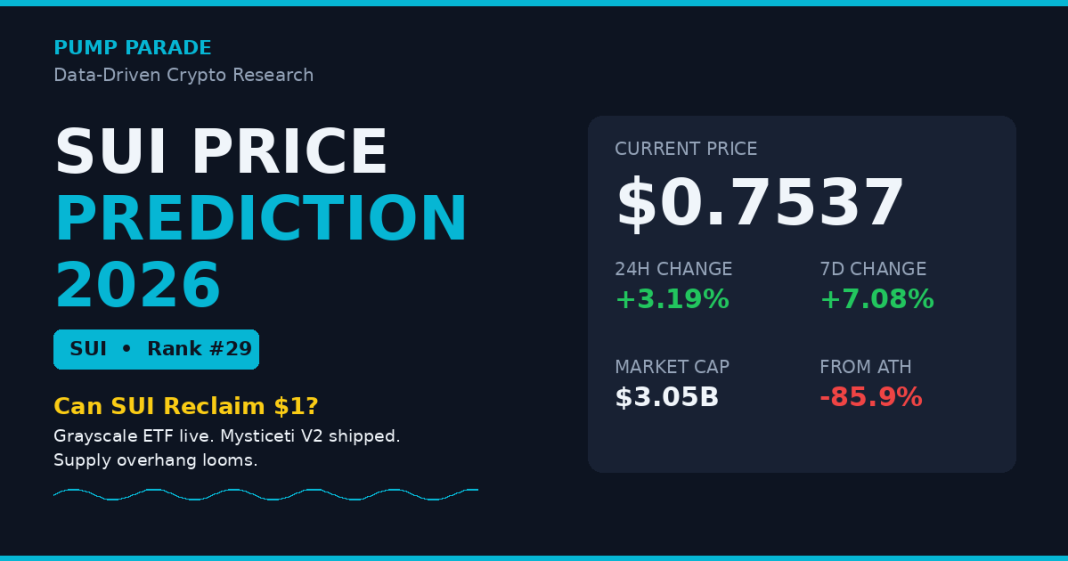
Sui (SUI) is trading at $0.75 as of writing, up 7% over the past week but still down 85% from its January 2025 all-time high of $5.35. The move looks small in dollar terms and big in psychology: SUI has spent most of 2026 pinned between a $0.70 floor and a $0.95 ceiling, and traders are lined up on both sides waiting for a resolution.
The question people keep asking (and typing into Google) is simple. Can SUI reclaim $1? Our Sui price prediction 2026 lays out the bear, base, and bull cases with real catalysts, real numbers, and none of the moon-math you get from the aggregator sites.
Here is what changed since our June take on SUI and the CME futures listing: Grayscale and Canary Capital both have live spot SUI ETFs, DeFi TVL on Sui has held above $2.6 billion, and the network is still shipping (Walrus mainnet, Mysticeti V2, SuiNS). Yet the token has gone nowhere. That gap between fundamentals and price is exactly where opportunity, and risk, lives.
Key Takeaways
- SUI trades at $0.75, up 7% in the past 7 days, but down 5% over 30 days and 85% off its all-time high.
- Base case for 2026: SUI reclaims the $0.95 to $1.30 zone if Grayscale GSUI inflows accelerate and DeFi TVL grows past $3.5B.
- Bull case: a $2.00 to $2.50 revisit is on the table only if the broader alt-L1 basket turns and SUI captures gaming or stablecoin market share.
- Bear case: a break below $0.70 opens $0.55 as the next real support, especially if 2026 unlocks meet weak demand.
- The real catalysts: ETF flows, Walrus adoption, SuiPlay 0X1 handheld launch, and the native Ethereum bridge.
- The real risks: supply overhang, competition from Solana and Aptos, and the alt-L1 attention war.
Where Sui Stands Today: Price, Volume, and Position
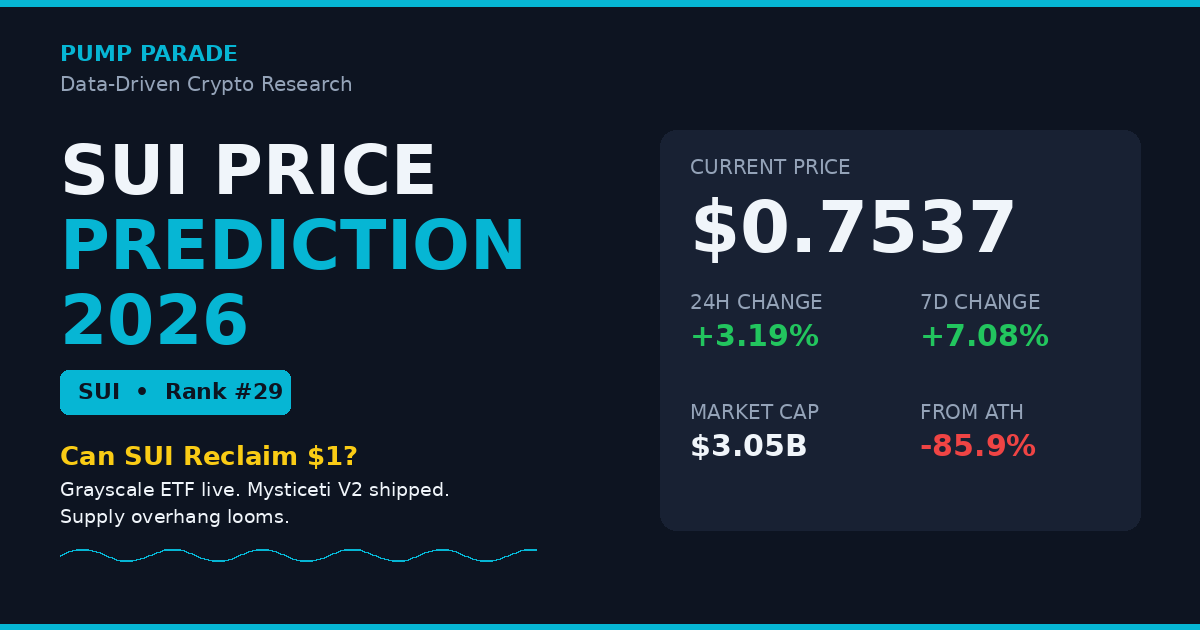
Before we get into what SUI could do, we need to be honest about where it is. The snapshot below is pulled from CoinGecko at time of writing.
| Metric | Value |
|---|---|
| Price (USD) | $0.7537 |
| 24h change | +3.2% |
| 7d change | +7.1% |
| 30d change | -5.3% |
| Market cap | $3.05B |
| 24h volume | $276M |
| Rank | #29 |
| Circulating supply | 4.05B SUI |
| Max supply | 10B SUI |
| All-time high | $5.35 (Jan 4, 2025) |
| % from ATH | -85.9% |
Two things jump out. First, SUI has round-tripped an entire cycle in 18 months. A token that was ranked in the top 10 by market cap in early 2025 is now knocking around at rank 29. Second, only 40% of the max supply is circulating, which is the single most important number for anyone trying to model where price goes next.
Why Is Sui Coiling Below $1 Right Now?
The short answer: institutional demand showed up, retail demand did not, and supply kept unlocking.
The Grayscale GSUI staking ETF launched on NYSE Arca in early 2026, and Canary Capital debuted the first US spot SUI ETF on Nasdaq in February. On paper, that is a template that worked well for BTC and ETH. In practice, alt-L1 ETFs have opened at a fraction of the flows their sponsors projected. GSUI is a real product with a real 7% staking yield attached, but it is not (yet) moving price on its own.
Meanwhile, roughly 152M SUI unlocks per month through 2026 from the community reserve, staking subsidy, and early-contributor tranches. At $0.75 that is over $110M of sell pressure a month competing with maybe $50M to $80M of ETF and organic accumulation. The math on that is the flat chart you see today.
The technicals confirm the range. SUI is compressing between the $0.70 to $0.72 demand zone (defended six times since March) and the $0.90 to $0.95 supply zone (rejected four times). Volatility is at multi-quarter lows. Coiling patterns like this resolve, and when they do they resolve fast. The direction is what matters, and that is what this article is really about.
The Bull Case for SUI in 2026
1. Institutional on-ramps are actually live
The Sui Foundation set out to make SUI an institutional-friendly asset in 2025 and mostly delivered in 2026. CME SUI futures are trading. Grayscale and Canary Capital have spot ETFs. The Grayscale GSUI product includes native staking, which is a first for a US spot L1 ETF outside of ETH. If GSUI net inflows compound at even a modest $30M to $50M per month by Q4, that alone can absorb 30-50% of monthly unlock pressure. That is the flip switch for price.
2. Walrus and Mysticeti are shipping tech, not slideware
Sui's Mysticeti V2 consensus is hitting sub-second finality with headline throughput around 297,000 TPS in benchmarks, and Walrus (Sui's decentralized storage layer) has moved out of testnet with a live WAL token. These are not vaporware milestones. They are the reason Sui gets picked over Aptos for AI and data-heavy workloads. Real developer traction on Walrus in H2 2026 is one of the few things that could re-rate the token independent of the wider crypto tape.
3. DeFi TVL and stablecoin flow are quietly rebuilding
Sui DeFi TVL has held above $2.6B all year, with Suilend, Cetus, and NAVI Protocol as the anchors. USDC on Sui crossed $700M in mid-2026 and Paga Group's $11B Nigerian fintech integration for USDsui payments points at emerging-market rails as a real use case. This is the kind of usage that survives bear markets. If it compounds, price follows on lag.
The Bear Case: What Could Sink SUI in 2026?
1. The supply cliff is real
Only 40% of SUI is circulating. Between mid-2026 and early 2027, another ~1.8B tokens unlock across community reserves, staking subsidies, and contributor allocations. If demand does not scale to match, that is roughly $1.3B in cumulative sell pressure at current prices. Every alt-L1 that has failed to hold ATH support has done so at least partly because of this dynamic. Sui is not immune.
2. The alt-L1 attention war is brutal
Solana has the retail brand, Base has the Coinbase distribution moat, Hyperliquid has the trading mind-share, and Aptos is fighting for the same Move-language developer pool. Sui is competitive on speed and cost, but attention is a zero-sum game and Sui is not obviously winning it. For a data-heavy comparison to a direct Move-language competitor, our Aptos price prediction for 2026 lays out how tight this race actually is.
3. ETF flows have underwhelmed
Standard Chartered projected several billion dollars of first-year inflows across alt-L1 ETFs. Reality is closer to a few hundred million so far. If GSUI cannot get to a real cadence of net inflows, the institutional thesis weakens and the token gets stuck as a beta trade on ETH and SOL. That is a $0.50 to $0.70 world, not a $1.50 world.
Sui Price Prediction 2026: Targets by Timeframe
30-day outlook: range trade until proven otherwise
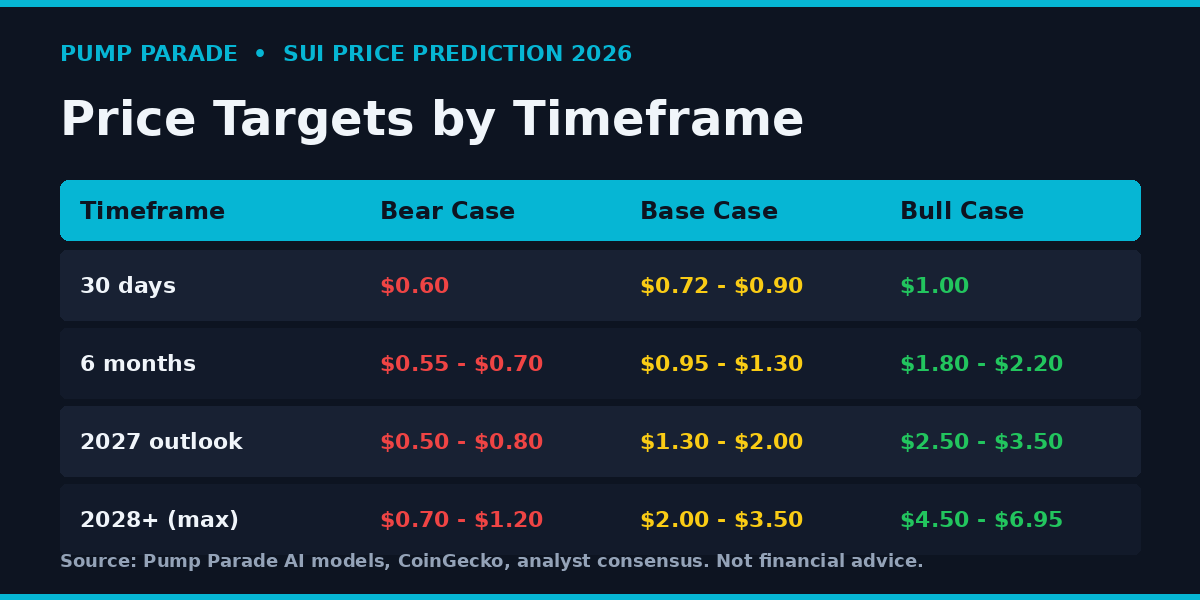
Base case: $0.72 to $0.90. The compressing range is the setup and range trades tend to persist longer than anyone expects. Bear trigger: a daily close under $0.70 opens $0.60 quickly. Bull trigger: a daily close above $0.96 on 2x average volume flips the range and puts $1.20 in play. Watch spot ETF net-flow data from CoinCodex's SUI data page as the tell.
6-month outlook (through January 2027): $0.85 to $1.60 base case
Our base case assumes ETF inflows normalize, Walrus adoption grows meaningfully, and macro liquidity stays neutral. Under those conditions, SUI settling in the $1.10 to $1.30 range by early 2027 is a reasonable expectation. Bull case: $1.80 to $2.20 on a full risk-on turn plus a SuiPlay handheld launch that captures gamer attention. Bear case: $0.55 to $0.70 if unlocks meet a flat tape and ETF flows stall.
Long-term (2027-2028): a wide fan
This is where analyst consensus splits hardest. Changelly, CoinCodex, and Coinpedia cluster around a $1.50 to $4.50 range for 2027, with more bullish outliers like 99Bitcoins projecting $6.95 as an average. The honest read: at max dilution of 10B tokens, SUI would need a $10B market cap to trade at $1, a $30B market cap to trade at $3, and a $50B+ market cap to challenge its ATH. Those are non-trivial numbers. Achievable, but not free.
How Does Sui Compare to Solana?
Sui is not trying to be Solana, but comparisons are inevitable because both are high-throughput L1s with retail user experience as a first-class concern.
| Metric | Sui (SUI) | Solana (SOL) |
|---|---|---|
| Consensus | Mysticeti V2 (DAG-based) | Tower BFT + PoH |
| Finality | ~400ms | ~12s (slot ~400ms) |
| Peak throughput (benchmarked) | ~297K TPS | ~65K TPS (real), 1M+ target with Firedancer |
| Programming language | Move (Sui variant) | Rust |
| Market cap | $3.05B | $45.2B |
| DeFi TVL | ~$2.6B | ~$9.4B |
| Spot ETF status | Live (Grayscale, Canary) | Live (multiple issuers) |
| % from ATH | -85.9% | -72.4% |
Translation: SUI is technically competitive but a fraction of the size, with a bigger drawdown to work through. That is what the market is currently pricing in.
What Would Change Our View
Three specific triggers would move us from base case to something more constructive (or destructive):
Bullish trigger: GSUI net inflows sustain above $50M/month for two consecutive months, AND Walrus daily active storage users cross 100K. That combination breaks the range on real demand.
Neutral-to-bullish trigger: A meaningful weekly close above $1.00 with expanding volume flips the psychological ceiling and opens the $1.20 to $1.40 zone quickly. Round numbers matter more than they should.
Bearish trigger: A weekly close under $0.68 with a break in DeFi TVL below $2.2B. That would signal the ecosystem is losing usage right as supply pressure peaks, and it puts $0.55 or lower on the table.
Frequently Asked Questions
Is Sui a good investment in 2026?
Sui is a higher-risk, higher-beta position on the alt-L1 category. If you believe institutional ETF flows will broaden past BTC and ETH and that Move-based L1s can carve out share in gaming and storage, it is worth watching. If you doubt those catalysts, Sui likely stays range-bound. This is analysis, not advice.
Will SUI reach $1 by year end 2026?
Reclaiming $1 requires SUI to break the $0.95 supply zone on real volume and hold it. That is achievable in our base case, especially if ETF inflows and DeFi TVL both improve into Q4. A reasonable probability, not a certainty. Watch weekly closes above $0.96.
What will SUI be worth in 2027?
Analyst consensus for 2027 clusters between $1.50 and $4.50, with outliers as high as $6.95. Our own base case sits in the $1.30 to $2.00 range if unlock supply is absorbed and the alt-L1 basket sees a healthy risk-on turn. Bull case runs to $2.50 or higher.
Why is Sui down 85% from its all-time high?
Three reasons: aggressive token unlocks (only 40% of max supply is circulating), a broader alt-L1 rotation into ETH and SOL, and softer-than-expected ETF flows relative to the launch hype. None of those are terminal, but together they explain the drawdown.
Is Sui better than Solana?
Sui has cleaner finality and a modern object-based state model. Solana has network effects, developer mind-share, and roughly 15x the market cap. Better is the wrong frame. Sui is a competitive alt-L1, not a Solana replacement. Owning both hedges the bet.
What is the SUI token used for?
SUI pays gas fees on the Sui network, secures the chain via delegated proof-of-stake (yielding roughly 3-4% base and up to 7% via ETF staking wrappers), and grants governance rights. It is also increasingly used as collateral inside Sui-native DeFi protocols like Suilend and Scallop.
The Honest Take
Sui is a good chain trading at a bad chart. That is the whole story in one sentence. The tech works, the ETFs are live, the DeFi ecosystem has real usage, and none of it is moving price because the supply schedule is doing exactly what supply schedules do. This is a setup where patience gets rewarded or punished cleanly. If you like Sui at $0.75, you should like it more at $0.60. If you cannot articulate why unlocks stop mattering by mid-2027, you probably do not have a thesis.
Our base case is a slow grind higher into the $1.00 to $1.30 zone by early 2027, with meaningful two-way risk. That is not exciting. It is honest. For context on how a bigger L1 with stronger flows is trading right now, our Ethereum price prediction for 2026 covers the demand side of the equation, and our Hyperliquid price prediction shows what happens when an alt actually captures narrative in this tape.
For ongoing on-chain metrics and real-time SUI data, the CoinMarketCap SUI page is a solid free reference.
Disclaimer: This article is for informational and educational purposes only and should not be construed as financial, investment, or trading advice. Cryptocurrency markets are highly volatile, and past performance does not guarantee future results. The price predictions and analyses presented here are based on AI models, technical indicators, and available data at the time of writing, they are not guarantees. Always conduct your own research (DYOR) and consult with a qualified financial advisor before making any investment decisions. Pump Parade and its authors do not assume liability for financial losses incurred based on information provided in this article.