If you spend any time on Solana, you have swapped through Raydium whether you noticed it or not. Every time a fresh token launches on pump.fun and graduates to the open market, its first real liquidity pool lives on Raydium. Every time Jupiter routes an order through the deepest venue for a mid-cap Solana coin, Raydium is often the leg doing the work. And yet, five years after launch, most traders still cannot tell you how Raydium actually makes money, how its fees stack up against Orca or Meteora, or whether the app is the fastest way to swap in 2026. This deep dive answers all of that.
We put Raydium under a microscope: TVL, real fee revenue, product surface, security history, wallet support, and the parts of the UI that either delight or frustrate. Read this before you route another dollar of size through a Solana AMM.
Quick Verdict: Should You Use Raydium in 2026?
Yes, for most Solana traders and liquidity providers. Raydium is the largest Solana-native AMM by TVL at roughly $920 million, and it is the default habitat for new token launches. If you swap Solana memes, provide liquidity to volatile pairs, or want to launch your own pool without asking for permission, Raydium is essentially unavoidable. Our verdict is 8.7 / 10. It loses points for a UI that still buries advanced settings, thin support for non-Solana chains, and the fact that Jupiter often out-routes it on final execution price. But as a base layer of Solana DeFi, it remains best in class.
What Is Raydium?
Raydium is an automated market maker and decentralized exchange built natively on Solana. It launched in early 2021 as one of the first serious AMMs on the chain, and it has since evolved from a Serum orderbook hybrid into a multi-pool ecosystem with four distinct product lines: the original AMM v4 constant-product pools, a newer Concentrated Liquidity Market Maker (CLMM) that mirrors the Uniswap v3 style, a Constant Product Market Maker (CPMM) for permissionless pool creation with standard SPL tokens, and LaunchLab, its native token launchpad.
You use Raydium if you want to swap any Solana token, provide liquidity for yield, farm RAY emissions, or create a new pool for a fresh token. It is not a wallet, not a lending market, and not an aggregator. It is the venue, and the plumbing.
Raydium by the Numbers
Data points below are pulled from DeFiLlama and CoinGecko as of this week and give a fair snapshot of Raydium’s current scale.
- Total Value Locked: ~$920 million on Solana, plus ~$28 million in RAY staking
- 24-hour trading volume: ~$104 million
- 7-day trading volume: ~$757 million
- 30-day trading volume: ~$3.93 billion
- 30-day protocol fees: ~$4.59 million
- Annualized fee run-rate: north of $50 million
- Lifetime fees generated: ~$1.42 billion
- RAY token price: ~$0.73, market cap rank #170
- Circulating supply: ~269 million of 555 million max
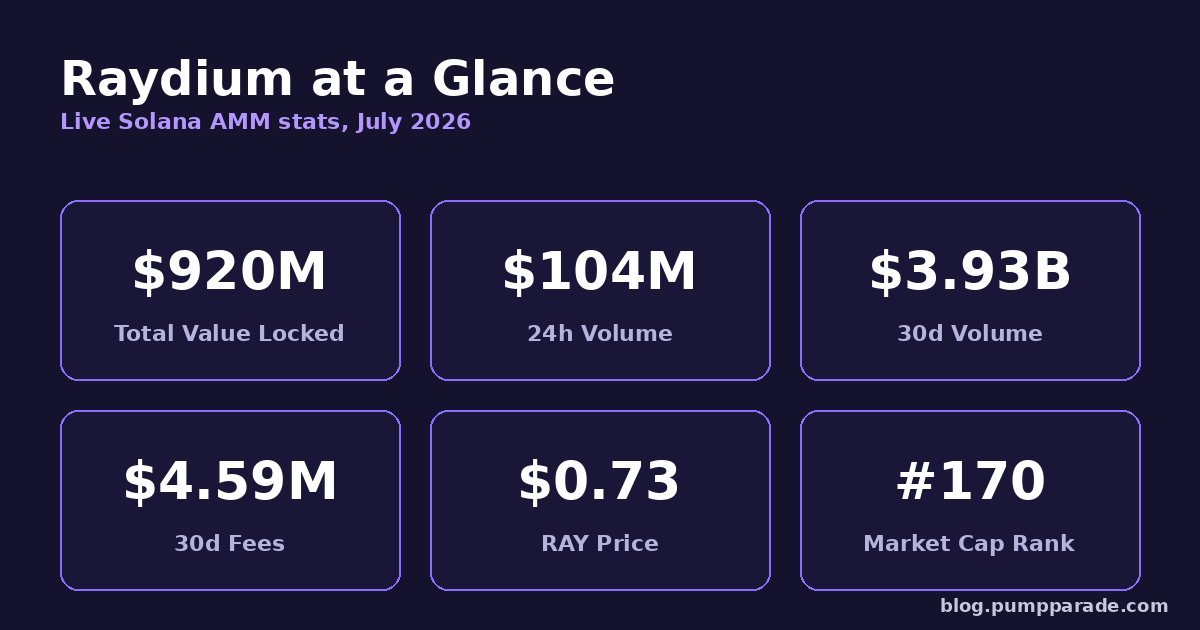
Those are not tiny numbers. Raydium routinely sits inside the top five DEXs by fees across all chains, and it is consistently the number one AMM on Solana by both TVL and volume. When Solana has a hot memecoin week, Raydium fees spike into the top-three across all of crypto, briefly beating Uniswap on daily revenue.
Features Deep Dive
1. AMM v4 (Legacy Pools)
The classic Raydium experience: constant-product pools with a 0.25% swap fee, of which 0.22% goes to LPs and 0.03% is used to buy back RAY. These pools power a huge share of long-tail Solana liquidity, especially for memecoins that graduated from pump.fun. If you swap a token that launched in the last 12 months on Solana, odds are your route touches at least one AMM v4 pool.
2. Concentrated Liquidity (CLMM)
Raydium’s CLMM lets LPs concentrate capital inside a chosen price range, which dramatically improves capital efficiency for correlated pairs like SOL/USDC or wSOL/mSOL. Fee tiers are configurable at 0.01%, 0.05%, 0.25%, and 1%, which mirrors Uniswap v3’s tier structure but with slightly different defaults. If you are farming SOL/USDC or a stable-stable pair, CLMM is where you want to be.
3. CPMM (Permissionless)
The CPMM is Raydium’s answer to “let anyone create a pool for any SPL token in five clicks.” It supports Token-2022 extensions, has cheaper pool-creation costs than AMM v4, and does not require an OpenBook market ID, which was a friction point on the older program. This is the pool type most new token launches use in 2026.
4. Farms and Staking
Every LP position on Raydium can be staked in a farm to earn dual rewards: RAY plus whatever the pool’s launcher chooses to bootstrap with. Solo RAY staking earns a share of protocol buybacks. Yields on stablecoin farms typically sit in the 6% to 12% APR range, while volatile pairs can push north of 40% during memecoin season, though impermanent loss risk is real.
5. LaunchLab
LaunchLab is Raydium’s native token launchpad, competing with pump.fun and Believe. It uses a bonding curve to bootstrap price discovery, then automatically migrates graduated tokens into a Raydium CPMM pool. For creators, it removes the need to fund initial liquidity out of pocket. For traders, it gives an early-access flywheel that keeps liquidity inside the Raydium ecosystem.
6. Portfolio and Pool Tools
The portfolio tab shows every LP position, staked RAY, and unclaimed reward across the four product lines in one view. It is not as detailed as a dedicated portfolio tracker like Zapper or DeBank, but it is enough to manage a Raydium-only book without spreadsheeting.
Fees and Pricing
Raydium’s fee schedule is where people either love it or feel gouged, depending on which pool they land in.
- AMM v4 pools: 0.25% total per swap. 0.22% to LPs, 0.03% to RAY buybacks.
- CLMM pools: Tier-based. 0.01%, 0.05%, 0.25%, or 1%. LP receives 84%, treasury takes 12%, RAY buybacks take 4%.
- CPMM pools: 0.25% per swap, split 84% LP, 16% protocol.
- Pool creation: A small SOL fee, typically less than $10 at current SOL prices.
- Solana gas: Fractions of a cent per swap.
Compared to Ethereum-based AMMs, Raydium’s fees are broadly in line with Uniswap v3 tiers, but the total cost per swap is dramatically lower because Solana gas is negligible. The point where Raydium looks expensive is on stablecoin-to-stablecoin pairs versus something like Orca’s Whirlpools or Meteora’s DLMM, both of which sometimes offer tighter spreads. In practice, most traders route through Jupiter and let the aggregator pick the best venue, at which point Raydium’s raw fee tier matters less than its depth.
Pros and Cons
Pros
- Largest AMM by TVL and volume on Solana, so slippage is generally the lowest available for long-tail tokens
- Four distinct pool types cover almost every LP strategy, from concentrated stable pairs to memecoin gambles
- Permissionless pool creation via CPMM is genuinely fast and cheap
- LaunchLab keeps liquidity in-house, giving Raydium a structural moat over standalone AMMs
- Direct integrations with virtually every Solana wallet, aggregator, and portfolio tracker
- Consistent uptime through Solana’s 2024 and 2025 network hiccups
Cons
- UI still hides advanced settings behind extra clicks, and the pool discovery flow is dense for new users
- No native cross-chain support beyond Solana, so you have to bridge in and out
- Direct swaps often lose on execution price to Jupiter, which aggregates across all Solana venues
- Some CLMM tiers have thin liquidity outside the top pairs, making concentrated positions risky
- RAY tokenomics still leave over half the supply undistributed, which is an overhang for holders
Security and Trust
Raydium has been through multiple audits over its lifetime, including work from OtterSec and Kudelski Security on the newer CLMM and CPMM programs. In late 2022, Raydium suffered a serious exploit on its AMM v4 admin authority when a compromised owner key allowed an attacker to drain roughly $4.4 million across several pools. The team promptly compensated affected LPs, migrated admin authority to a multisig, and moved to timelocked upgradeable programs. Since that incident, there has been no comparable failure. Program upgrades now flow through a governance-controlled timelock, and the CLMM and CPMM programs have not required emergency intervention.
Raydium is not decentralized in the way a fully immutable Uniswap v2 fork is: the team still controls program upgrades. For most users, the tradeoff is acceptable, but if you are LPing eight-figure size, you should read the current authority setup on the docs page before committing.
User Experience
The Raydium app is fast, no surprise given it runs on Solana. Swap confirmations land in one to two seconds under normal conditions, and the UI keeps essentials on one screen: token pair selector, slippage, priority fee, and route. Where it gets busy is the pool creation flow, which has legitimately many parameters, and the farms tab, which now spans four product lines with different reward structures. New users should expect a learning curve of about an hour before they can navigate confidently.
Mobile support is functional through the Raydium web app in Phantom’s in-app browser, though there is no native iOS or Android app. If you are doing serious LP work on mobile, expect friction.
How Raydium Compares to Other Solana DEXs
For a fuller head-to-head on aggregators, see our Jupiter vs 1inch review, and for a concentrated-liquidity alternative, our Meteora review is the right next read. At a high level:
- Raydium vs Orca: Orca’s Whirlpools are often cheaper for stable pairs, but Raydium wins on long-tail depth
- Raydium vs Meteora: Meteora’s DLMM is superior for advanced LPs, but Raydium hosts more launches
- Raydium vs Jupiter: Not the same product. Jupiter is an aggregator that routes into Raydium, so use Jupiter for best execution and Raydium for pool depth and LPing

Verdict and Rating
Raydium is the default Solana AMM in 2026 for a reason. It has the deepest liquidity, the widest product surface, and the structural advantage of hosting most new token launches through LaunchLab and its CPMM. For the average trader, the honest recommendation is this: swap through Jupiter, but LP through Raydium. That combination gives you best execution on the buy side and top-tier depth on the yield side. Casual users should stick to farms with audited pool contracts and avoid CLMM ranges they cannot actively manage.
Final rating: 8.7 / 10. Best for Solana LPs, new-token traders, and anyone routing meaningful memecoin flow. Ready to try it? Visit Raydium and check the current pools yourself. For where the RAY token itself might trade next year, see our Raydium price prediction for 2026.
Frequently Asked Questions
Is Raydium safe to use in 2026?
Raydium’s CLMM and CPMM programs have been audited by OtterSec and Kudelski, and the protocol operates on a timelocked upgrade path controlled by a multisig. The one serious historical incident was a 2022 admin-key compromise on AMM v4 that has since been remediated. It is as safe as any major Solana AMM, but not immutable code, so use appropriate size discipline.
How does Raydium make money?
Raydium collects a small cut of every swap fee across its four pool types. Some of that revenue flows to the protocol treasury, some funds RAY buybacks, and the rest goes to liquidity providers. Annualized fee revenue is currently running above $50 million, most of it generated on Solana memecoin flow.
What is the difference between Raydium AMM, CLMM, and CPMM?
AMM v4 is the classic constant-product pool with a fixed 0.25% fee. CLMM offers concentrated liquidity with configurable fee tiers, ideal for stable and correlated pairs. CPMM is a newer permissionless pool type that supports Token-2022 extensions and is the default for most new token launches.
Can I use Raydium on Ethereum or Base?
No. Raydium is Solana-native and does not currently deploy on other chains. You need to bridge assets to Solana first using a bridge like Wormhole or deBridge.
Should I stake RAY?
RAY staking earns a share of protocol buybacks, which scales with Raydium’s fee revenue. It is a directional bet on Solana DEX activity remaining high. If you already hold RAY and want passive exposure to protocol growth, staking is reasonable. If you are looking for the highest yield on Raydium, LP farms typically pay more, especially on volatile pairs during active memecoin cycles.