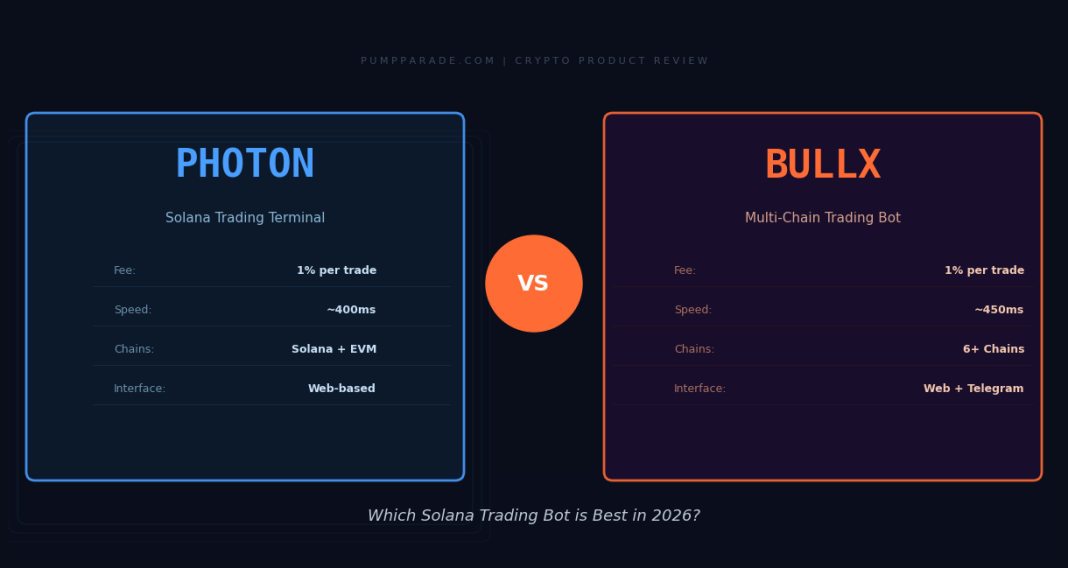
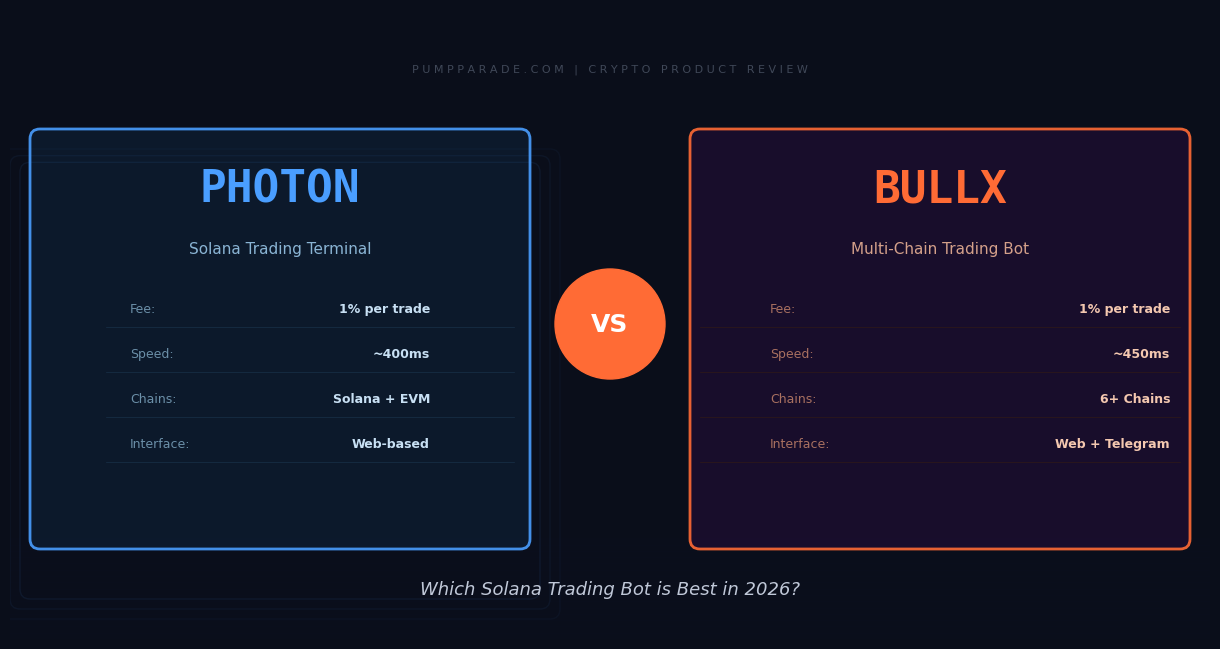
If you have spent any time trading memecoins or new token launches on Solana, you already know the difference between catching a 10x and watching it moon without you often comes down to milliseconds. Two platforms dominate the Solana trading bot space in 2026: Photon and BullX. Both promise speed, smart order types, and edge over manual trading. But they are built for slightly different traders.
In this head-to-head review, we break down everything you need to know: fees, execution speed, supported chains, token discovery tools, security, and who each platform is really built for. By the end, you will know exactly which one deserves your SOL.
Quick Verdict (TL;DR)
- Photon is the better pick for chart-driven Solana traders who want the cleanest, fastest visual interface and one-click execution on Raydium and pump.fun listings.
- BullX wins if you want multi-chain flexibility, Telegram access, and powerful token discovery tools like Pump Vision and Neo Vision for sniping early launches across six-plus blockchains.
- If you only trade Solana and live in the terminal, go Photon. If you want a full trading ecosystem across chains, BullX is the smarter long-term choice.
What Is Photon?
Photon launched as a web-based Solana trading terminal designed to replace the clunky Telegram-bot experience with a proper desktop-style interface. Instead of typing commands into a chat, you get live candlestick charts, one-click buy/sell buttons, color-coded P&L history, and real-time token data all in one browser window.
The platform is non-custodial: you generate a dedicated trading wallet inside Photon, export the private key, and all trades happen on-chain from your own address. No registration, no KYC, no waiting. Photon connects directly via private node infrastructure, which is a big part of why its execution times land around 400ms on average.
Key features include limit orders, DCA (dollar-cost averaging), stop-loss triggers, multi-wallet support (up to five wallets simultaneously), MEV protection via Jito, and token safety indicators that flag mint authority status, liquidity pool burn status, and top-holder concentration before you pull the trigger.
What Is BullX?
BullX started as a Telegram-native sniper bot but has evolved into something much bigger. The current flagship product, BullX Neo, is a full trading terminal that bridges the Telegram interface with a professional web dashboard. The result is one of the most feature-rich trading platforms in the Solana ecosystem, now extended across six-plus chains including Ethereum, Base, BNB Chain, Blast, Arbitrum, and TRON.
BullX Neo’s standout feature is Pump Vision (now upgraded to Neo Vision), a real-time dashboard that tracks every new token launching on pump.fun and Moonshot. Tokens are categorized as newly created, about to graduate to a real liquidity pool, or already graduated. This lets you spot early momentum plays before they hit DexScreener and before everyone else piles in.
Beyond token discovery, BullX offers limit orders, DCA, stop-loss, take-profit, automated trading rules, copy trading features, portfolio tracking across wallets and chains, and realtime security audits that scan contract code for known exploits and suspicious wallet patterns. BullX has reportedly processed over $12.4 billion in lifetime trading volume and generated approximately $112 million in platform fees, numbers that speak to serious adoption.
Fees and Pricing
Both platforms charge a flat 1% fee on every buy and sell transaction, collected in the native token of the chain you are trading on. For Solana trades, that is SOL. On top of the platform fee, you will also pay standard Solana network fees (typically under $0.01) and optional priority fees or Jito bribe tips if you want to jump the queue during high congestion periods.
BullX has a slight edge here: users who sign up through a referral link pay a reduced fee of 0.9%, a 10% discount that adds up meaningfully if you are trading high volume. Photon does not currently offer a referral discount on fees.
Neither platform charges a subscription fee or monthly membership, which keeps the barrier to entry low for new traders.
Speed and Execution
Execution speed is where Photon earns its reputation. Independent tests measuring time from click to on-chain confirmation across high-volatility token launches consistently put Photon at approximately 400ms. BullX lands at around 450ms. The gap is small in absolute terms but matters in the memecoin market where a 50ms advantage on a trending launch can mean the difference between a 2x entry and chasing a 3x that has already topped.
Photon achieves this speed through its private node infrastructure, which routes transactions outside the standard public RPC endpoints. BullX also uses optimized routing and Jito MEV protection but lags slightly due to the overhead of its more complex multi-chain architecture.
For pure Solana speed, Photon has the edge. For multi-chain reliability, BullX is solid.
Token Discovery and Research Tools
This is where BullX clearly pulls ahead. Photon lets you search for tokens by name or contract address, displays live charts and order flow, and shows basic safety metrics. It is excellent for monitoring tokens you already know about.
BullX goes further with Neo Vision, which gives you a live feed of every token launching on pump.fun grouped by lifecycle stage. You can filter by volume, market cap, transaction count, and insider wallet activity. The realtime security audit scans each token’s contract and flags known red flags before you even consider a buy. For traders whose edge comes from finding gems early, BullX’s discovery layer is genuinely valuable and has no real equivalent in Photon.
Supported Blockchains
Photon’s core strength is Solana, but the platform has expanded to support Ethereum, Base, and BNB Chain as well. BullX supports all of those plus Blast, Arbitrum, and TRON, making it the better choice if you want to hunt for opportunities across the full EVM landscape as well as Solana.
If you are 100% focused on Solana, this distinction may not matter much. But as cross-chain meme seasons become more common (Base had its moment in 2024 and early 2025), having BullX’s multi-chain reach gives you flexibility.
Interface and User Experience
Photon is built for desktop. The web interface is clean, fast, and designed around the chart. Everything you need is visible without digging through menus: price chart, buy/sell buttons with preset SOL amounts, transaction history, and token metrics. There is a mobile-optimized view but it is not the primary experience.
BullX offers both a web terminal and a Telegram bot. The Telegram interface is excellent for traders who want to manage positions on the go or get alerts on their phone. The web dashboard is more feature-rich but slightly busier than Photon’s lean design. If you prefer a streamlined chart-first experience, Photon feels more natural. If you want full functionality across devices, BullX is the more versatile option.
Comparison Table
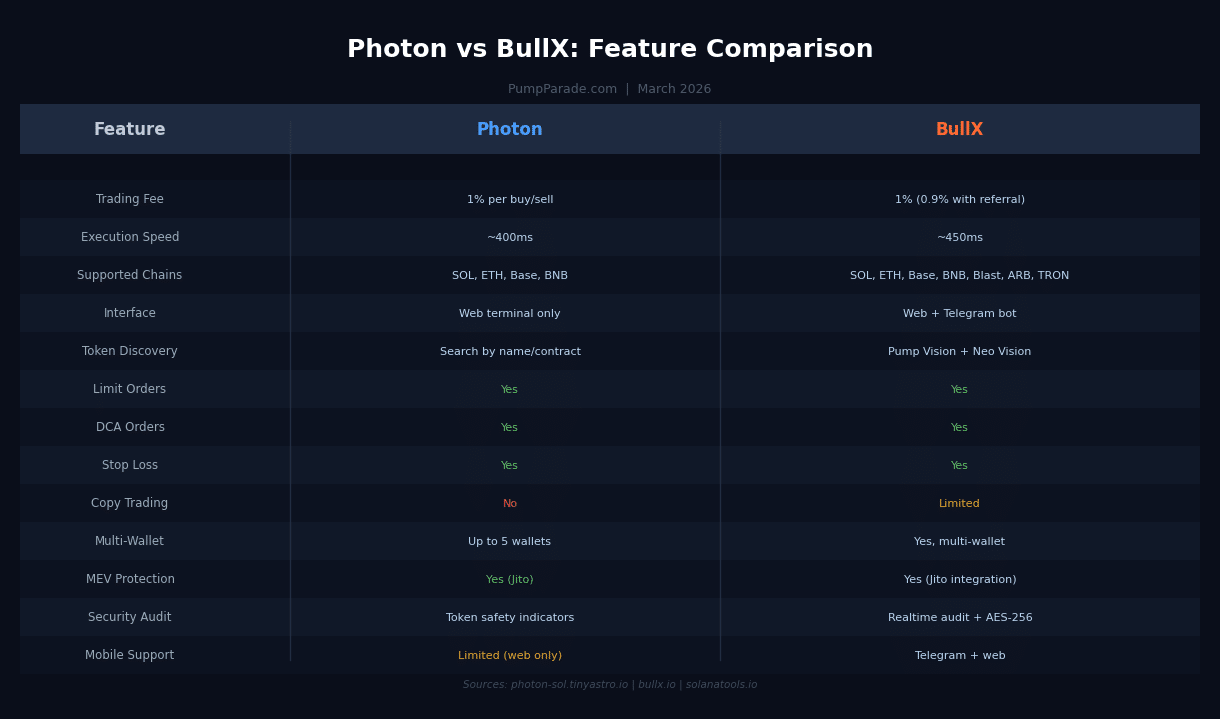
Comparison based on publicly available data as of March 2026. Sources: Photon, BullX, SolanaTools.io.
Security and Trust
Both platforms are non-custodial, meaning your funds stay in your own wallet and you retain full control of your private keys. Neither requires KYC or account creation, which is consistent with the ethos of self-custody crypto trading.
Photon displays token safety indicators directly on the trading view, including mint authority status (can the developer mint unlimited new tokens?), LP burn status (has the liquidity pool been locked?), and holder concentration data. These are essential checks before entering a new position.
BullX goes a step further with its realtime security audit system, which runs AES-256 encrypted scans of contract code and flags suspicious wallet clusters. BullX’s infrastructure also uses AWS CloudHSM for key management, which is a higher security bar than most competitors in this space.
Standard caution applies to both: use a dedicated trading wallet, never put more than you are willing to lose, and verify you are on the official URL (photon-sol.tinyastro.io for Photon, bullx.io for BullX) to avoid phishing clones.
Pros and Cons
Photon
Pros:
- Fastest execution speed on Solana (~400ms)
- Clean, intuitive chart-first interface
- Limit orders, DCA, stop-loss, and multi-wallet support
- Non-custodial with instant private key export
- No registration or KYC required
Cons:
- No Telegram bot, desktop-focused only
- Weaker token discovery vs BullX
- No referral fee discount
- No copy trading features
BullX
Pros:
- Multi-chain support across 6+ blockchains
- Pump Vision and Neo Vision for early token discovery
- Web + Telegram access for mobile-friendly trading
- Realtime security audits on contracts
- 0.9% fee with referral (vs standard 1%)
- Massive proven volume: $12.4B+ lifetime trades
Cons:
- Slightly slower execution than Photon (~450ms)
- More complex interface with a steeper learning curve
- Copy trading is limited compared to dedicated copy-trade platforms
Who Should Use Each Platform?
Choose Photon if you: primarily trade Solana, prefer a clean visual terminal over Telegram, want the absolute fastest execution for manual sniping, and prioritize simplicity over feature density.
Choose BullX if you: trade across multiple chains, want AI-assisted token discovery for pump.fun launches, need Telegram alerts and mobile trading, or want a more complete ecosystem with portfolio tracking and automated strategies.
Many serious traders use both, running Photon for pure Solana speed and keeping BullX active for its pump.fun discovery dashboard. Given there are no subscription fees, running them in parallel costs nothing beyond the per-trade fees.
For more on Solana DeFi opportunities, check out our latest articles on crypto trading strategies.
Verdict
Photon: 8.5/10 for Solana-focused speed traders.
BullX: 9.0/10 for multi-chain traders and pump.fun hunters who need discovery tools.
BullX edges out Photon overall because its token discovery layer (Neo Vision) and multi-chain reach make it the more complete product for 2026. But if you are a Solana purist who lives and dies by chart reading and sub-500ms fills, Photon’s cleaner interface and marginally faster execution may be worth the tradeoff in features.
Either way, both platforms are a massive upgrade over trying to trade memecoins through a standard DEX interface. The 1% fee on both is worth every fraction of a SOL when the alternative is fumbling through a swap interface while a token goes parabolic.
Frequently Asked Questions
Is Photon or BullX safer to use?
Both are non-custodial and do not hold your funds. BullX has a slight edge with its realtime contract audits and AES-256 encrypted infrastructure. Always use a dedicated hot wallet with limited funds on either platform.
What is the fee difference between Photon and BullX?
Both charge 1% per trade. BullX reduces this to 0.9% for users who join through a referral link. Neither charges a monthly subscription.
Can I use BullX on Ethereum and Base as well as Solana?
Yes. BullX Neo supports Solana, Ethereum, Base, BNB Chain, Blast, Arbitrum, and TRON. Photon supports Solana, Ethereum, Base, and BNB Chain.
Which is better for sniping pump.fun launches?
BullX is better for pump.fun discovery thanks to its Pump Vision and Neo Vision dashboards, which track every new token by lifecycle stage. Photon is faster for execution once you have identified a target.
Do I need to create an account to use Photon or BullX?
No. Both platforms allow you to start trading immediately by connecting a wallet or generating a new one inside the app. No registration, email, or KYC is required.