Solana is now the second-largest venue for on-chain perpetual futures, and one protocol keeps showing up at the top of the leaderboard: Drift. But 2026 has been anything but easy for the protocol. On April 1, attackers drained roughly $285 million in what became the largest DeFi hack of the year and the second-largest exploit in Solana history. This Drift Protocol review for 2026 covers what the platform actually offers today, how the recovery has played out, and whether it still deserves its reputation as Solana’s flagship perps DEX.
Quick Verdict / TL;DR
Rating: 3.8 / 5. On the merits, Drift is still the most feature-complete on-chain derivatives platform on Solana. Hybrid orderbook execution, up to 101x leverage on majors, gasless order placement, cross-margin across dozens of collaterals, and a growing product line (vaults, BET prediction markets, borrow/lend) are best-in-class among native Solana venues. Taker fees start at 0.10 percent and step down with volume, with DRIFT staking discounts on top. The April 2026 exploit is the elephant in the room. Tether stepped in with a recovery plan of up to $150 million, the team has commissioned fresh audits from OtterSec and Asymmetric Research, and structural changes to signer operations are underway. Users returning to Drift should size positions carefully while the relaunched stack proves itself in production. For self-custodial perps on Solana, it remains the default pick, with eyes open.
Drift Protocol Overview
Drift is a decentralized exchange on Solana focused on perpetual futures, spot swaps, borrow/lend, prediction markets, and automated vaults. The core product is a hybrid perp DEX that combines an on-chain central limit orderbook with a dynamic AMM backstop and a Just-in-Time (JIT) auction model, letting professional market makers post tight quotes while retail liquidity still gets filled inside the visible spread.
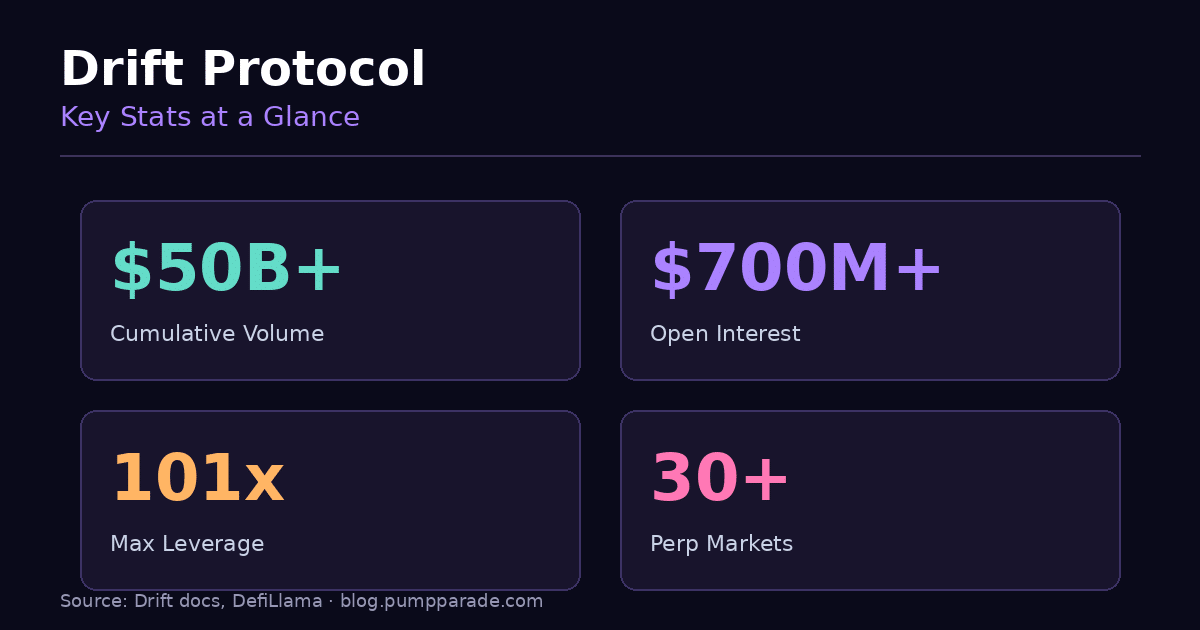
By 2026 the numbers are difficult to ignore. Drift has processed more than $50 billion in cumulative trading volume, historically sat around $700 million in open interest across 30+ perp markets, and manages roughly $200 million in TVL today according to DefiLlama down from over $550 million pre-exploit. The December 2025 v3 upgrade added top-of-block execution and direct market maker integration, closing most of the latency gap with the biggest centralized venues.
Who is it for? Active perps traders, memecoin traders who want leverage without leaving Solana, delta-neutral yield strategies, and DeFi power users who want to keep collateral working (LSTs, memecoins, stables) while trading against it. If you are brand new to derivatives, you can technically start on Drift, but you will want to read the docs before opening a position, and consider whether you want exposure to a protocol still digesting a major incident.
Features Deep Dive
Perpetual Futures
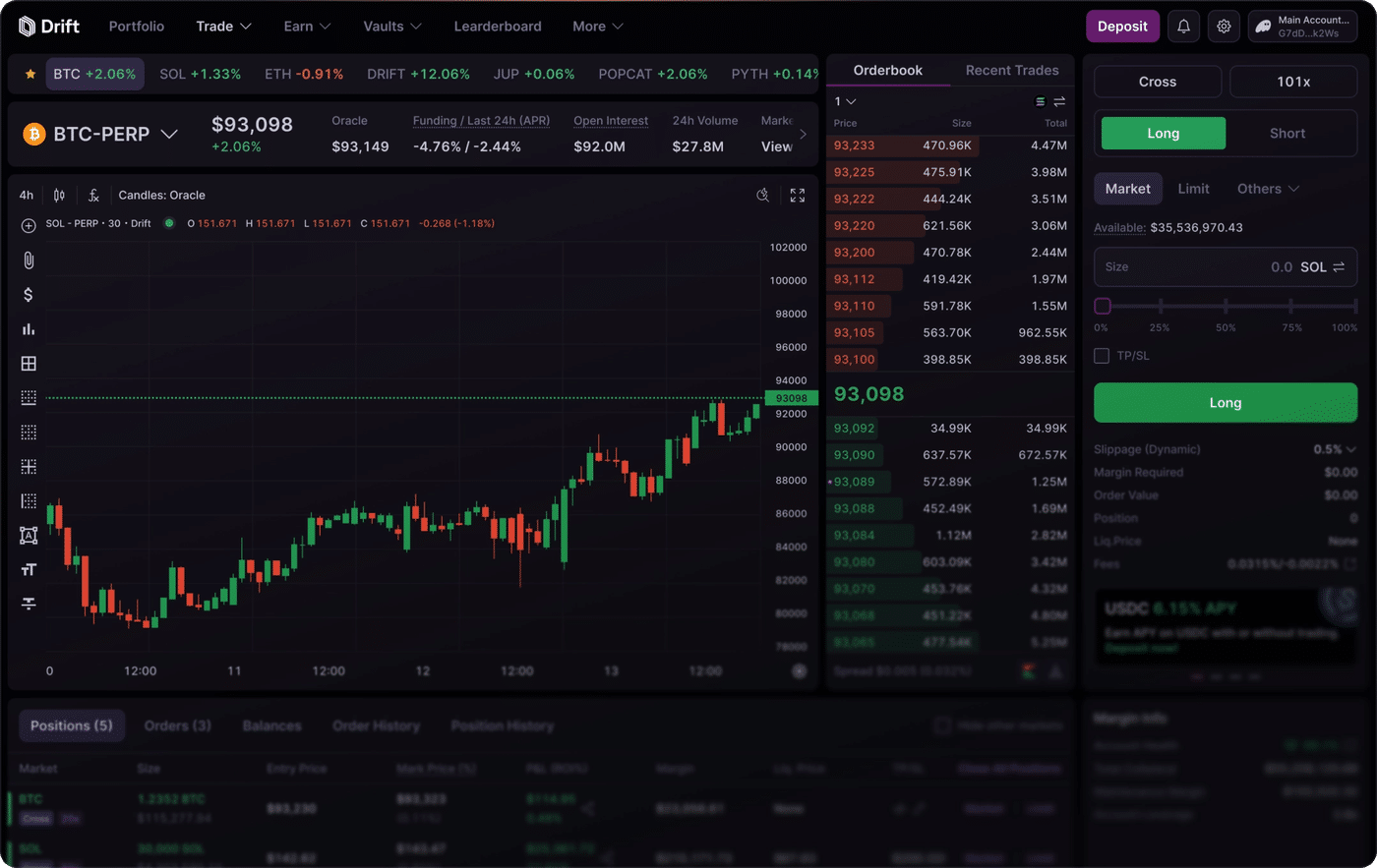
Perps are the flagship product. Drift supports over 30 markets including BTC, ETH, SOL, majors like DOGE and AVAX, and a rotating shelf of Solana memecoins and AI tokens. Leverage goes up to 101x on the largest markets, with sensible caps on smaller pairs. Cross-margin is enabled by default, so your entire collateral portfolio backs every position and you can use LSTs, stables, or even memecoins as margin.
Spot Trading and Borrow/Lend
Drift also runs a spot orderbook and an integrated money market. You can swap SPL tokens directly, deposit assets to earn yield, or borrow against your collateral. This is what makes cross-margin so powerful: a jitoSOL deposit earns staking yield, backs your perp positions, and can be borrowed against, all in one account.
Vaults
Drift Vaults are automated, non-custodial strategies run by third-party managers. Depositors get exposure to market-making, delta-neutral, and directional strategies without operating them themselves. Managers earn a performance fee, depositors keep the rest, and everything sits inside on-chain smart contracts you can inspect. Vaults have become one of the fastest-growing pieces of the protocol as passive users chase yield they cannot get from a simple LST.
BET Prediction Markets
In mid-2026 Drift shipped BET (Bullish on Everything), an on-chain prediction market pitched as a Solana-native answer to Polymarket. What makes BET interesting for a DeFi audience is capital efficiency: you can post over 30 different tokens as collateral, including liquid staking tokens and memecoins, and continue to earn yield on that collateral while your prediction sits open. That alone gives it a real angle against Polymarket, which is USDC-only.
Just-in-Time (JIT) Auctions and Additional Tools
Every market order kicks off a short Dutch auction where market makers compete to fill inside the visible spread. Beyond that, the trader stack includes sub-account isolation for risk management, a mobile app, TradingView charts, in-app funding-rate dashboards, insurance staking (stake USDC or SOL to backstop the exchange and earn a slice of fees), and referral rebates. If you have used a modern CEX, most of what you expect is here.
Fees & Pricing
Perp fees on Drift are competitive with the tighter end of centralized exchanges.
- Taker fee: starts at 10 bps (0.10 percent) and steps down with 30-day volume.
- Maker rebate: negative fees on majors, with rebates up to 2 bps for the highest tier makers.
- DRIFT staking discount: holding staked DRIFT (sDRIFT) can cut taker fees by up to 40 percent.
- Spot swap fee: routes via the Drift orderbook, no additional platform markup on top of maker/taker.
- Borrow/lend: variable rates by asset, published live in the app.
You also pay Solana network fees, which are usually a fraction of a cent, plus optional priority fees during congestion. There is no gas fee to place, cancel, or update orders because Drift subsidizes those transactions inside its orderbook. Compared with EVM perp DEXs like Hyperliquid and GMX, Drift lands in the same fee neighborhood on majors and undercuts most of them on Solana-native pairs.
The April 2026 Exploit and Recovery
Any honest Drift review in 2026 has to address the elephant in the room. On April 1, 2026, attackers drained roughly $285 million from Drift in about 12 minutes, making it the largest DeFi hack of the year and the second-largest security incident in Solana history, behind only the 2022 Wormhole exploit.
According to reports from TRM Labs and Chainalysis, the exploit was not a smart contract bug in the traditional sense. Attackers, later attributed to DPRK-linked actors, spent months socially engineering multisig signers and eventually pushed a fictitious collateral token (CarbonVote Token) with manipulated oracle pricing. The token was recognized as valid collateral, and the attackers used it to drain real assets from the vaults. Most stolen funds were bridged to Ethereum within hours.
Drift’s TVL fell from over $550 million to roughly $200 million in the immediate aftermath. Tether then stepped in with a recovery plan of up to $150 million to help users recoup losses. The team has commissioned fresh audits from OtterSec and Asymmetric Research, is rebuilding operational security around signer devices and pre-signed authorizations, and is moving toward a community-governed multisig for core protocol assets.
For traders, the practical implication is that Drift’s relaunched stack should be treated as a new system on its first laps. The response so far has been credible: transparent communication, a real recovery package, dual independent audits, and structural operational changes. None of that fully erases the incident, but it is roughly as good as post-incident responses get in DeFi.
Pros & Cons
Pros
- Largest orderbook-style perps venue on Solana with deep liquidity in majors.
- Up to 101x leverage on BTC, ETH, SOL, with cross-margin across dozens of collaterals.
- Gasless order placement and cancellation.
- Real DeFi composability: LSTs, memecoins, and stables all work as margin.
- Vaults and BET expand the product line well beyond a simple perp DEX.
- Transparent post-incident response backed by Tether and independent auditors.
Cons
- April 2026 exploit ($285M) is significant; users should size positions cautiously.
- Interface is dense and can overwhelm first-time derivatives traders.
- Liquidity on some longtail alts is thinner than on top-tier CEXs.
- Solana network congestion still occasionally impacts execution during frenzy events.
- DRIFT staking discounts are meaningful only for higher-volume traders.
- No fiat on-ramp; you need SOL or supported SPL tokens to get started.
Security & Trust
Pre-incident, Drift had been audited multiple times and operated for years without a major exploit. The April 2026 attack targeted human and operational weaknesses rather than a single vulnerability in audited contract logic, which is why the recovery plan focuses heavily on signer hygiene, dedicated devices, and a community-governed multisig in addition to fresh code audits.
OtterSec, one of the most respected Solana security firms, is leading the codebase redesign and pre-launch audit. Asymmetric Research is conducting a parallel independent review. Both firms will sign off before the relaunched stack goes live. The protocol also maintains a publicly-funded insurance vault backed by USDC and SOL stakers who earn a share of exchange fees in exchange for taking on backstop risk.
None of that removes on-chain risk. You are trusting the rebuilt code, the oracle set, and the market-maker liquidity to hold up under stress. But by the standard of on-chain derivatives platforms post-incident, Drift’s handling has been credible, and the team has a multi-year track record of shipping through bull and bear cycles.
User Experience
The web app at app.drift.trade is where most of the trading happens. It is fast, uses TradingView charts, and offers a genuinely professional layout: orderbook and depth on one side, positions and PnL below, and a market list on the left. Order types include market, limit, stop, and take profit, plus advanced options like scale orders and trigger orders.
Onboarding is quick if you already have a Solana wallet. Connect Phantom, Backpack, or another Solana wallet, deposit collateral, and you are trading in under a minute. The mobile app covers most of the same ground for anyone who wants to manage positions on the go. Support is handled through Discord and an in-app help center, with active mods and a responsive team.
The learning curve is the biggest UX complaint. Between sub-accounts, cross-margin, funding, and vaults, there is a lot to absorb. The docs are strong, but expect to spend an evening reading before you deploy real size.
Verdict & Rating
Rating: 3.8 / 5
Drift remains the clear default for serious perps trading on Solana. The combination of orderbook liquidity, cross-margin across a huge collateral set, low fees, and shipping velocity around vaults and BET makes it stand out from every other Solana derivatives venue. Compared with EVM heavyweights it holds its own on fees and, thanks to Solana’s throughput, feels closer to a centralized experience than most on-chain competitors. The April 2026 exploit costs Drift a full grade in this review, but the response has been credible enough to keep it in the “use with appropriate size” category rather than “avoid entirely.”
Use-case recommendations:
- Active Solana traders: Drift is the right home base for leveraged bets on SOL and Solana memecoins, with position sizes calibrated to your risk tolerance.
- Delta-neutral yield hunters: the combination of LST collateral and negative-funding shorts opens real basis-trade opportunities.
- Passive DeFi users: Drift Vaults or insurance staking are the right entry points, not perps.
- Beginners: start on spot SOL first, get comfortable with self-custody, then graduate to perps once the relaunched stack has more time in production.
FAQ
Is Drift Protocol safe to use after the April 2026 exploit?
The protocol has secured a recovery plan of up to $150 million from Tether, is re-auditing its codebase with OtterSec and Asymmetric Research, and is rebuilding operational security. It is reasonable to use the platform with appropriately sized positions, but treat the relaunched stack as a new system on its first laps and monitor closely. Do not deposit more than you are willing to lose.
What is the maximum leverage on Drift?
Up to 101x on the largest markets like SOL, BTC, and ETH. Leverage is capped lower on smaller and more volatile pairs to protect the insurance fund.
What fees does Drift charge?
Taker fees start at 0.10 percent and decline with 30-day volume. Makers can earn rebates of up to 2 bps on majors. Staking DRIFT can reduce taker fees by up to 40 percent.
Does Drift have a token?
Yes. DRIFT is the governance token. Staked DRIFT (sDRIFT) grants voting rights, fee discounts, and a share of protocol revenue. Insurance stakers can also stake USDC or SOL directly to earn from exchange fees.
How is Drift different from Hyperliquid or GMX?
Drift lives on Solana and leans into cross-margin with a huge collateral set, plus adjacent products like BET prediction markets and Vaults. See our full Hyperliquid vs GMX comparison for how the EVM leaders stack up. If you already hold Solana assets, Drift usually wins on capital efficiency and speed. If you prefer EVM liquidity or hold HYPE, one of the other two may fit better.
Can I use LSTs like jitoSOL as collateral?
Yes, that is one of Drift’s standout features. You can deposit jitoSOL or mSOL, keep earning staking yield, and use the same balance as margin for perps. See our Jito review for more on Solana’s largest liquid staking token.
Disclaimer: This article is for informational purposes only and does not constitute financial or investment advice. Trading derivatives is high risk and can result in the loss of all deposited capital. Always do your own research before using any DeFi protocol.