The perp DEX race is not really a race anymore. One venue has vacuumed up the majority of decentralized futures flow, another has quietly kept a devoted user base on Arbitrum for years, and everyone else is fighting for scraps. If you are trying to decide where to open your next leveraged position, the choice usually comes down to two names: Hyperliquid and GMX.
Both are legitimately great. Both are non-custodial, on-chain, and battle-tested. But they solve the perp problem in almost opposite ways, and that difference matters more than any fee schedule. This review compares Hyperliquid and GMX v2 head to head so you can pick the one that actually fits how you trade.
TL;DR: Quick Verdict
Hyperliquid wins for active traders. Deeper order books, more markets, tighter spreads, faster execution, and a CEX-grade UX. It is now the default perp venue for anyone who trades size regularly.
GMX v2 wins for two very specific crowds: liquidity providers who want real yield in a proven pool model, and traders who want zero price impact on large single positions in the majors. It is also the default choice if you are already deep in the Arbitrum or Avalanche ecosystems.
If you have to pick one for general trading, pick Hyperliquid. If you are staking capital for yield or hedging a large ETH or BTC bag with one big trade, GMX still deserves a slot in your rotation.
What Is Hyperliquid?
Hyperliquid is a decentralized exchange built on its own purpose-built Layer 1 blockchain. Every order, cancel, fill, and liquidation happens on-chain and is visible in real time, but the chain itself was designed from the ground up for one job: running a high-throughput central limit order book without the usual on-chain latency tax.
The trading experience looks and feels like Binance or Bybit. You get an order book, a depth chart, market and limit orders, TP and SL, funding rates, cross and isolated margin, and a mobile app. The difference is that your funds never leave a smart contract you can inspect, and settlements are trustless.
As of mid-2026, Hyperliquid supports more than 365 perpetual markets, 288+ spot pairs, and up to 50x leverage on majors. Monthly perp volume routinely clears $250 billion, and the platform is estimated to hold around 70 to 75 percent of the entire decentralized perpetuals market. That kind of concentration is unusual in DeFi, and it is a direct result of the architecture working as advertised.
The native token, HYPE, launched in late 2024 and remains one of the standout large-cap DeFi tokens by revenue capture. Fee income from the exchange flows back to the ecosystem, which is one reason the community has stayed dense and vocal.
What Is GMX?
GMX is the veteran. It launched on Arbitrum in 2021 and pioneered the oracle-based perpetual model that a dozen forks have since imitated. Instead of matching buyers and sellers on an order book, GMX has traders trade against a pool of liquidity provided by LPs. Prices come from Chainlink oracles, so trades under the pool’s capacity execute with zero price impact.
The v2 launch in 2023 replaced the shared GLP model with isolated GM pools for each market pair. That change gave LPs finer control over risk exposure and let the protocol expand the list of tradable assets past the original blue chips. GMX v2 now supports over 100 perpetual markets and 24+ spot assets, with leverage up to 100x on select pairs.
Deployments are live on Arbitrum, Avalanche, Botanix, and MegaETH, with cross-chain access via the GMX Account from Ethereum, Base, and BNB Chain into the Arbitrum markets. The bulk of volume still concentrates on Arbitrum, where GMX is one of the top revenue-generating protocols on the network. LPs earn real yield paid in the underlying assets rather than inflated token emissions, which is the reason a specific class of yield-focused DeFi user has stayed loyal for years.
The Core Architectural Difference
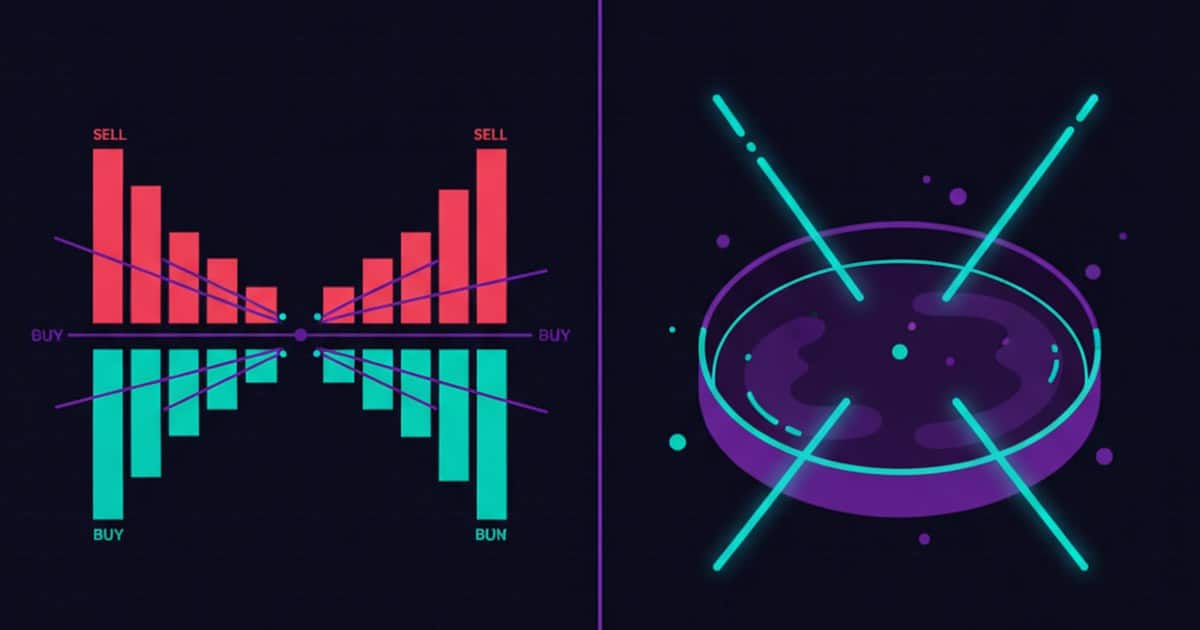
Everything downstream flows from this: Hyperliquid runs a fully on-chain order book. GMX runs an oracle-priced liquidity pool.
On an order book, price is discovered by resting orders. Makers post bids and asks, takers cross the spread, and the mid-price moves when one side runs out of size. It is efficient for active price discovery, brutal on illiquid markets, and rewards sophisticated market makers.
On an oracle pool, price is imported from Chainlink feeds and the protocol quotes a spread around the oracle mid. Traders take the other side of the LP pool at that price. Small and medium trades execute with essentially zero slippage, but very large trades against a small pool skew utilization and can push funding rates hard against the winning side.
Which model is better depends entirely on what you are doing. High-frequency scalpers and traders who care about limit-order precision want the order book. LPs who want passive yield and traders who want to punch a large market order into an ETH-USD pool without moving the price want the oracle model.
Fees Compared
Fee schedules on both platforms are transparent and public, but they are not directly comparable because of the different execution models.
Hyperliquid perp fees start at 0.045% taker and 0.015% maker at the Base tier for accounts with under $5 million of 14-day weighted volume. High-volume traders drop into progressively better tiers: at Diamond, with more than $7 billion of rolling 14-day volume, taker fees are 0.0144% and maker fees drop to 0%. Spot fees are slightly higher across the board, starting at 0.070% taker and 0.040% maker.
GMX v2 perp fees land in the 0.04% to 0.06% range depending on the market and whether the trade increases or decreases open interest against the pool. Swaps run 0.05% to 0.07%. There is also a borrow fee for the time you hold a leveraged position, plus a funding fee paid between longs and shorts based on skew. On the flip side, price impact on trades that fit inside the pool’s utilization is effectively zero, which is a real dollar saving on large orders that would move an order book.
For a scalper doing dozens of round trips per day on ETH perps, Hyperliquid’s maker rebate and lower base taker fee usually win. For a swing trader putting on a single $500K BTC hedge and holding it a few days, GMX’s zero price impact can more than offset the borrow fee. Run the math on your actual trade size and holding period before assuming one is universally cheaper.
At-a-Glance Comparison
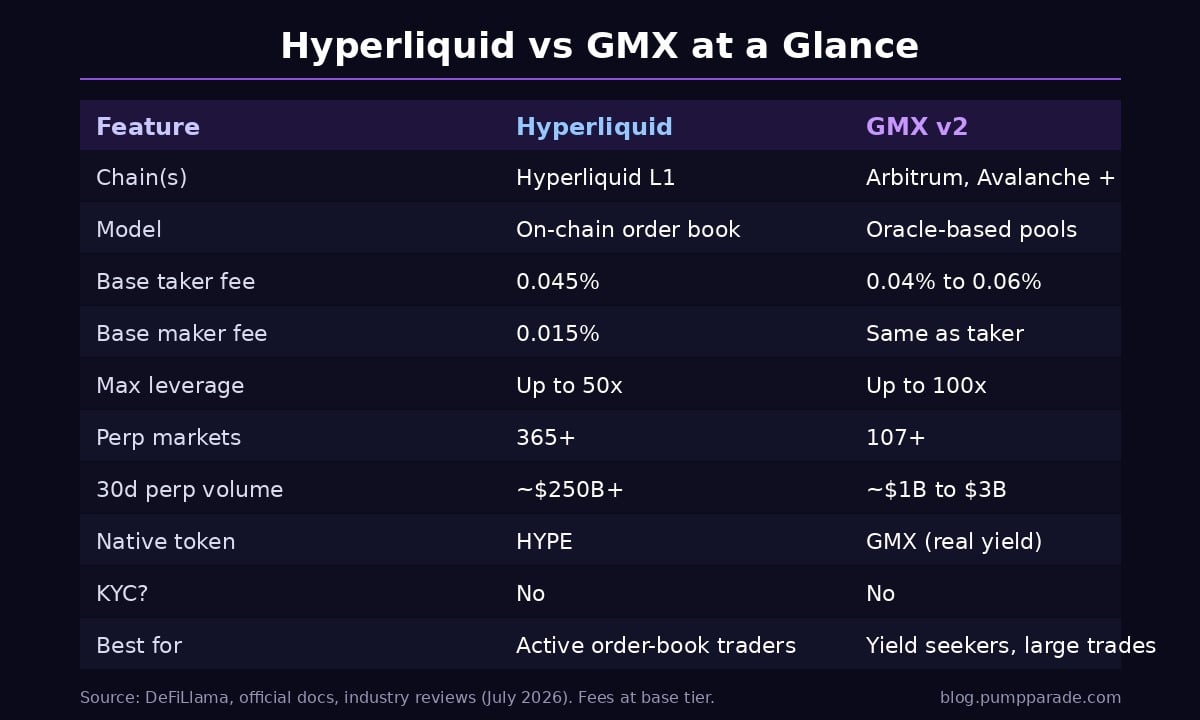
| Feature | Hyperliquid | GMX v2 |
|---|---|---|
| Chain(s) | Hyperliquid L1 | Arbitrum, Avalanche, Botanix, MegaETH |
| Execution model | On-chain central limit order book | Oracle-priced liquidity pools |
| Base taker fee (perp) | 0.045% | 0.04% to 0.06% |
| Base maker fee (perp) | 0.015% | Same as taker |
| Max leverage | Up to 50x | Up to 100x |
| Perp markets | 365+ | 107+ |
| Approx. 30-day perp volume | ~$250B+ | ~$1B to $3B |
| Native token | HYPE | GMX (real yield to stakers) |
| Price impact on large trades | Depends on book depth | Zero within pool capacity |
| KYC required | No | No |
| Best for | Active order-book traders | Yield seekers, single large trades |
Hyperliquid Pros and Cons
Pros
- Deepest liquidity of any decentralized perp venue by a wide margin
- CEX-grade UX with order book, depth chart, and mobile app
- Very low base fees, especially for makers
- Massive selection of perp markets, including long-tail assets
- No KYC, self-custody, fully on-chain settlement
- HYPE token has real revenue backing it
Cons
- Runs on its own L1, so you bridge in and out rather than trading from an existing wallet on Ethereum or Arbitrum
- Order-book model rewards sophisticated traders and can be punishing to inexperienced users on volatile pairs
- Concentration risk: a single venue holding most of the decentralized perp market is fragile if anything goes wrong at the L1 level
- Sequencer decentralization is a legitimate ongoing debate
GMX Pros and Cons
Pros
- Zero price impact on trades within pool capacity, which is a huge win for large single positions
- Real yield paid to LPs and GMX stakers in ETH, AVAX, and USDC rather than inflationary emissions
- Deployed on the chains where a lot of DeFi capital already lives (Arbitrum and Avalanche)
- Multiple audits from ABDK, Sherlock, and Guardian, plus active bug bounty coverage
- Track record of over four years of continuous operation without a protocol-level exploit
- Very high maximum leverage (up to 100x) on select markets
Cons
- Fewer markets than Hyperliquid
- Oracle model means you cannot post resting limit orders in the traditional sense
- Borrow fees eat into the P&L of longer-held positions
- Volume and mindshare have clearly shifted toward Hyperliquid over the last 18 months
- Cross-chain complexity if you want to move collateral around
Security and Track Record
This is the section where both platforms actually earn their reputations, and it is the reason we are comfortable recommending either one.
GMX has been live since 2021 and has been audited multiple times by ABDK, Sherlock, and Guardian. The Sherlock engagement in particular is notable because it includes active bug bounty insurance rather than a one-time report. GMX did suffer an incident in 2024 involving an issue on its AVAX market that resulted in a temporary loss, but the core smart contracts have never been drained.
Hyperliquid is younger but has been audited by ZellicVR and Trail of Bits, and its bug bounty program pays out on validated findings. The main open critique is around validator decentralization and the fact that the L1 is still operated primarily by the core team. That is being addressed in stages, but it is the honest tradeoff for the throughput the chain delivers.
Neither exchange has custody of your funds beyond an on-chain smart contract you can inspect. That is a very different risk profile than trusting a centralized exchange with your keys.
User Experience
Hyperliquid feels like a Binance clone in the best possible way. The interface is dense, fast, and information-rich. You can drag order lines directly on the chart, size positions with a slider, and switch between cross and isolated margin in one click. The mobile app is genuinely good, which is still rare for on-chain venues.
GMX feels like a DeFi power tool. It is cleaner and simpler than Hyperliquid, which is either a feature or a bug depending on how much information you want on screen at once. The workflow is: pick a market, pick collateral, size the position, set leverage, confirm. There is no order book to interpret. For someone who wants perp exposure without the mental overhead of managing limit orders, that simplicity is the whole point.
Both platforms have solid documentation. If you want to go deeper on the mechanics, the official Hyperliquid docs and the GMX v2 docs are the primary sources.
Verdict by Use Case
Active perp trader who cares about tight spreads and market selection. Use Hyperliquid. The fee schedule, depth, and UX all favor you. Nothing else on-chain comes close.
Swing trader putting on a single large hedge in ETH or BTC. Use GMX v2. The zero price impact on trades within pool capacity is a real edge and often outweighs Hyperliquid’s fee advantage on holding-period-adjusted basis.
DeFi user hunting real yield on productive capital. GMX. Providing liquidity to GM pools or staking GMX pays out in the underlying assets. Hyperliquid does not have a direct LP equivalent for retail users at the same scale.
Retail user new to perps. Start with GMX. The oracle model is simpler to reason about than an order book, and you cannot accidentally cross a wide spread on a thin market.
Trader on the Arbitrum or Avalanche ecosystems who does not want to bridge. GMX. The whole point of staying on your existing chain is not having to move funds.
You want one venue that does everything. Hyperliquid. It has become the default on-chain perp exchange for a reason, and if you can only pick one, that is the safer bet in 2026.
Frequently Asked Questions
Is Hyperliquid safer than a centralized exchange like Binance?
Different risk profile. Your funds are held in a smart contract you can inspect, not in a company’s balance sheet, so you avoid the classic exchange-insolvency risk. In exchange you take on smart-contract risk and, at the moment, validator centralization risk on the L1. Neither is strictly safer, they are different tradeoffs.
Can I use GMX from Ethereum mainnet?
The GMX Account feature lets you access GMX’s Arbitrum markets from Ethereum, Base, and BNB Chain without manually bridging. Native deployments are on Arbitrum, Avalanche, Botanix, and MegaETH.
Does either platform require KYC?
No. Both are non-custodial and permissionless. You connect a wallet and trade. Some jurisdictions block access via geolock, but there is no identity verification.
What is the maximum leverage on each?
Hyperliquid tops out around 50x on major perps. GMX v2 allows up to 100x on select markets. Using max leverage is almost always a bad idea, but the raw ceiling is higher on GMX.
Is HYPE or GMX a better token to hold?
Both accrue value from real revenue rather than emissions. HYPE has captured more volume growth over the last year and trades on stronger fundamentals in absolute terms. GMX is a more mature token with a longer history of yield distribution. This is not investment advice, and past performance is not indicative of future returns.
Are Hyperliquid and GMX audited?
Yes, both. GMX has been audited by ABDK, Sherlock (with active bug bounty coverage), and Guardian. Hyperliquid has been audited by Zellic and Trail of Bits and runs a public bug bounty.
Can I use both?
Absolutely, and most active traders do. Route order-book flow to Hyperliquid and large single positions or LP capital to GMX. There is no reason to be dogmatic about which one you use for what.
Bottom Line
Hyperliquid is winning the perp DEX war right now and it deserves to be. The order book architecture, market depth, and fee schedule genuinely beat GMX for most active trading. If you are just picking one venue to open positions on today, that is the one.
GMX has not been dethroned so much as it has settled into a specialist role. Zero price impact on pool-sized trades and real yield to LPs are still edges nothing else on the list matches. For yield-focused DeFi users and swing traders on Arbitrum, GMX v2 is still the right tool.
Both are non-custodial, both are audited, and both let you take on-chain perp exposure without handing your keys to anyone. That was not a given three years ago, and it is worth remembering when either of them frustrates you on a bad day.
For more on the tools active on-chain traders are using this year, see our reviews of the top Solana trading bots and our recent Jito review. If you want to verify volume and revenue numbers yourself, cross-reference the official metrics on DeFiLlama’s Hyperliquid page and GMX v2 page.
This article is for informational purposes only and does not constitute financial or investment advice. Perpetual futures are high-risk instruments and you can lose more than your initial deposit. Do your own research and never invest more than you can afford to lose.