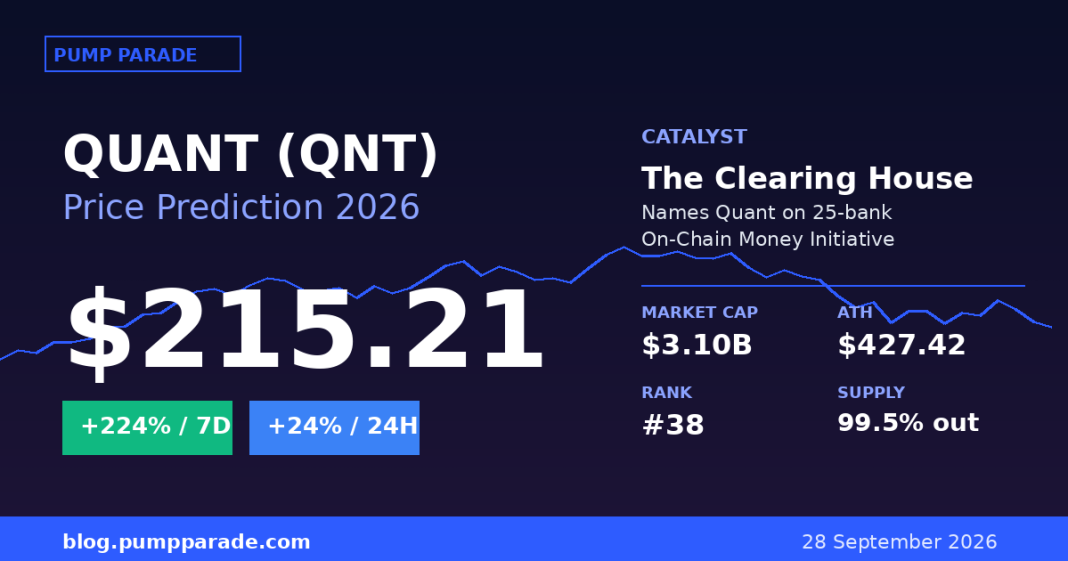
Our Quant price prediction 2026 starts with a number that is not a typo: QNT is up 224% in seven days, trading at $215.21. The catalyst is real and specific. On September 24, The Clearing House, the private consortium that settles roughly $2 trillion a day for JPMorgan, Citi, Bank of America, Wells Fargo, and 21 other US banks, named Quant as an infrastructure partner for its On-Chain Money Initiative launching in the first half of 2027.
Suddenly the market is repricing a token that had spent most of 2025 stuck between $60 and $100. QNT sits $212 below its September 2021 all-time high of $427, and traders want to know how much of that gap can close in the next 12 months. This article lays out the bear, base, and bull scenarios, the on-chain math behind them, and the specific catalysts and risks that will decide which one plays out.
Key Takeaways
- QNT trades at $215.21 with a $3.10B market cap after a 224% seven-day rally, ranking #38 on CoinGecko.
- The Clearing House partnership is the largest institutional catalyst in Quant’s history: 25 US banks moving toward on-chain settlement rails.
- Base case for year-end 2026: $280 to $340, roughly 30% to 60% upside from current price, assuming steady banking integration progress.
- Bull case: $400 to $475 if the On-Chain Money Initiative launches on schedule and Overledger becomes a preferred orchestration layer.
- Bear case: $110 to $145 if the rally proves speculative and pilot delays push adoption revenue into 2028.
- Circulating supply is 14.54M of a 14.61M max: the float is already close to fully diluted, which amplifies both directions.
Where Quant Stands Today
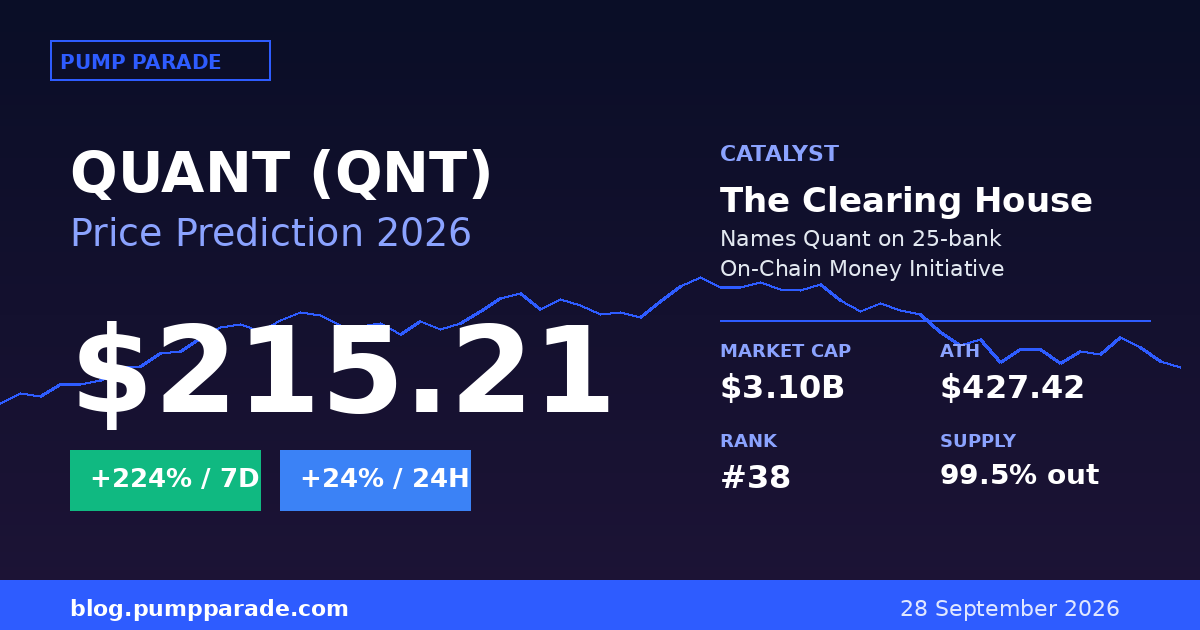
Before we get to the targets, let’s ground the analysis in current numbers. Every price target on this page is measured against these figures, timestamped September 28, 2026.
| Metric | Value |
|---|---|
| Price | $215.21 |
| 24-hour change | +24.49% |
| 7-day change | +224.59% |
| 30-day change | +251.91% |
| Market cap | $3.10B |
| 24-hour volume | $1.22B |
| CoinGecko rank | #38 |
| All-time high | $427.42 (Sep 2021) |
| % from ATH | -49.65% |
| Circulating supply | 14.54M / 14.61M max |
Two things jump out. Volume of $1.22 billion is nearly 40% of market cap: that is what a repricing event looks like, not a healthy trend. And the supply picture is unusually clean. With 99.5% of max supply already circulating, no treasury unlock will quietly erode whatever price the market settles on.
Why is QNT rising right now?
The proximate cause is a single news event. On September 24, The Clearing House, the private-sector settlement network owned by 25 of the largest US banks, published details of its On-Chain Money Initiative and named Quant’s Overledger platform as the interoperability layer. The initiative aims to bring tokenized deposits and programmable settlement onto shared rails without ripping out the existing RTP and CHIPS infrastructure that already move around $2 trillion a day between US banks.
For context, this is the same infrastructure JPMorgan uses to send you your direct deposit. It has never had a public blockchain component. The proposed model is not a memecoin: it is regulated banks running tokenized dollars on rails that Quant orchestrates. Founder and CEO Gilbert Verdian called it “a worldwide milestone for the firm,” and the market clearly agrees, given the +224% weekly move.
There is a second layer to the story that has been building since 2024: the industry-wide migration to ISO 20022, the messaging standard that SWIFT and most major payment systems now use. Quant has spent years positioning Overledger as a translation layer between ISO 20022 messaging and on-chain settlement. When banks finally begin issuing tokenized deposits at scale, the interoperability layer that speaks their language wins the mandate. The Clearing House pick is the first big vote in that direction.
What is driving the Quant bull case?
1. Banking rails are Quant’s home turf
Quant was founded in 2018 by a former UK Treasury and Vocalink executive. It is one of the few crypto projects that started with financial infrastructure as its first customer, not as an eventual pivot. The Clearing House deal validates that thesis at a scale nothing else in the sector can match: 25 US banks, plus a separate UK track that includes Barclays, HSBC UK, Lloyds, Monzo, Nationwide, NatWest, and Santander. When the On-Chain Money Initiative launches in the first half of 2027, Overledger becomes production infrastructure at the top of the global banking stack.
2. The supply side is already tight
QNT has a max supply of 14.61 million tokens and 14.54 million already in circulation. There is no vesting schedule left to worry about. Compare that to any recent layer-1 launch, where 30% to 60% of the eventual supply is still locked up. If institutional demand rises, it will meet a supply curve that cannot flex. In similar setups, that has historically produced sharper moves than the underlying flow would suggest.
3. Tokenization is finally moving from talking point to policy
The BIS, the ECB, and the US Treasury have all published tokenization frameworks in the last 18 months. Standard Chartered forecast in a June 2026 note that tokenized real-world assets could reach $30 trillion by 2034. Even a small fraction of that flowing through Quant-orchestrated rails is a materially different revenue picture than the one priced in six months ago. Related coverage: our Ondo (ONDO) price prediction walks through the same theme from the tokenized-treasury angle.
What are the biggest risks to the QNT thesis?
1. This much of the move is pure narrative
The Clearing House pilot does not launch until the first half of 2027. Between now and then, Quant needs to convert a design partnership into billed revenue. Pilots slip. Bank IT integrations slip. If Q4 2026 earnings from Quant show no material change in the top line, the rally becomes a chart pattern in search of a fundamental, and $215 starts to look like an air pocket. Historically, similar rallies on future-catalyst news have given back 40% to 60% of the move before finding a durable floor.
2. Chainlink is a well-funded competitor with a head start
Chainlink’s Cross-Chain Interoperability Protocol has been live since 2023 and is already integrated with SWIFT, Fidelity, and 20+ banks in the SWIFT tokenization pilot. If the same institutional buyer chooses CCIP over Overledger, the addressable market shrinks fast. Our Chainlink (LINK) price prediction covers the other side of this rivalry in detail.
3. QNT has no staking, no fee capture, no direct revenue link
Owning QNT does not entitle you to a share of Overledger usage fees. The token functions as a license to operate on the network for gateway operators and as an ecosystem access token, but there is no direct value accrual mechanism like ETH burns or LINK staking rewards. In a risk-off tape, tokens without a clear cash-flow story tend to underperform. That is a structural headwind the current narrative does not fix.
Quant Price Prediction 2026: Targets by Timeframe
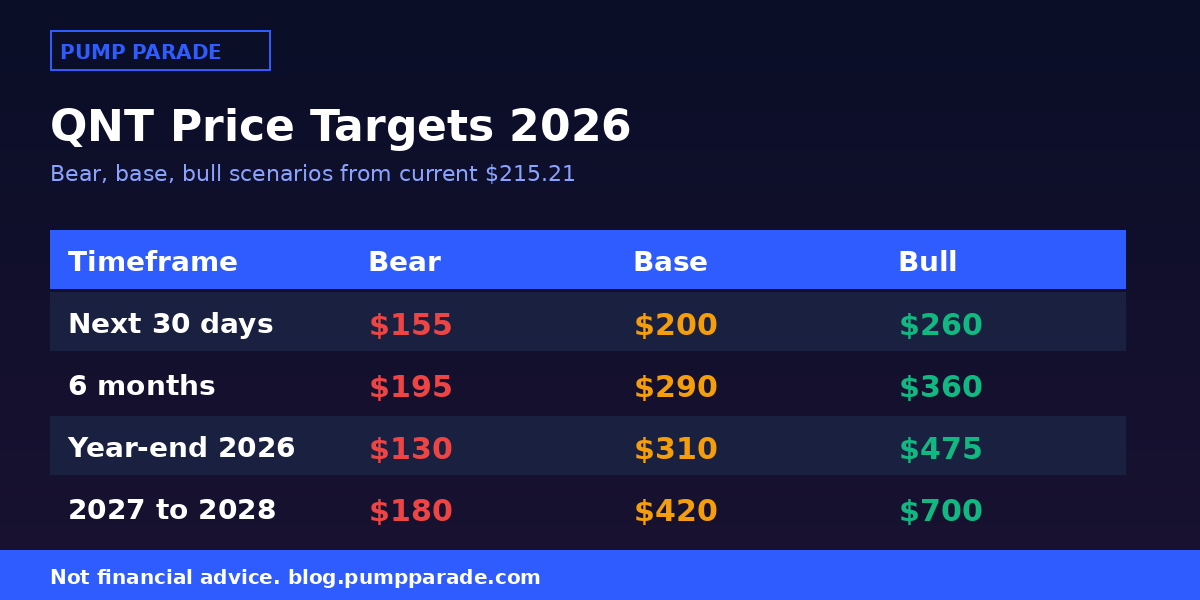
Below is the framework our team is using to think about QNT into year-end 2026 and beyond. These are scenarios, not predictions. We show the conditions each one requires so you can update your own view as the data changes.
Next 30 days ($185 to $260)
The 24-hour turnover ratio near 40% of market cap suggests the price is still finding its clearing level. In similar post-catalyst rallies for infrastructure tokens, we typically see one or two 25% to 35% pullbacks in the first four weeks as short-term traders take profits. A retest of the $170 to $185 zone is our base case for a pullback low. If buyers defend that band, a push into the $250 to $260 area, matching the recent local high near $257, is the near-term bull scenario. A break below $150 would flip the short-term picture.
Six months ($235 to $360)
Between now and April 2027, the market will be pricing in the run-up to the On-Chain Money Initiative launch. Expect news-driven volatility around every bank integration milestone. Base case: $260 to $310 as pilot details firm up. Bull case: $340 to $360 if Quant signs a second Tier-1 consortium (SWIFT direct participation would be the ultimate catalyst) or announces a fee-sharing mechanism that gives QNT holders economic exposure. Bear case: $185 to $220 if pilot updates disappoint or Chainlink lands a competing mandate.
Year-end 2026 targets
| Scenario | Target | % from $215 | Trigger |
|---|---|---|---|
| Bear | $110 to $145 | -49% to -33% | Rally unwinds on pilot delay or macro risk-off |
| Base | $280 to $340 | +30% to +58% | Banking integration on schedule, no major setback |
| Bull | $400 to $475 | +86% to +121% | On-schedule launch, second Tier-1 mandate, ATH reclaim |
For comparison, analyst Ted Pillows publicly targeted $373 as a reasonable near-term ceiling, roughly 13% below the 2021 all-time high. Cryptopolitan’s model output for 2026 sits at $150 to $182, and Cryptonews aggregates community targets in the $250 to $310 range for 2027. Our base case sits between the two, weighted by the specificity and scale of the Clearing House catalyst.
Long-term view (2027 to 2028)
If the On-Chain Money Initiative launches and Overledger orchestrates tokenized deposits at even three of the 25 member banks, a 2028 range of $550 to $700 is reasonable, above the 2021 ATH. That path requires two years of clean execution. Longer horizons involve too many unknowns to model.
How does Quant compare to Chainlink?
Chainlink is the most direct competitor for the institutional interoperability mandate. Both projects want to be the layer that connects legacy banking rails to tokenized assets. The table below sums up the differences that matter for a QNT vs LINK trade decision.
| Metric | Quant (QNT) | Chainlink (LINK) |
|---|---|---|
| Price | $215.21 | $13.57 |
| Market cap | $3.10B | $10.15B |
| Circulating / max supply | 99.5% | 67% |
| Core product | Overledger (bank-first orchestration) | CCIP (chain-agnostic messaging) |
| Flagship institutional deal | The Clearing House (25 US banks) | SWIFT tokenization pilot (20+ banks) |
| Token utility | Gateway licensing, access | Node payments, staking, service fees |
| Direct value accrual | Indirect | Staking + fees |
| 7-day performance | +224% | +5.9% |
The pattern is clear. Chainlink is the bigger, more diversified play with a working value-accrual model. Quant is the more concentrated bet on a specific institutional adoption story that, if it works, has an unusually clean supply picture behind it. They can both win, since the addressable market for tokenized banking is measured in trillions, but the risk profiles are different.
What Would Change Our View
Three specific triggers would move us out of the base case in either direction.
Upgrade to bull case if: Quant announces a second Tier-1 institutional partner (SWIFT direct integration, ECB, or a major central bank), a fee-sharing or staking mechanism that gives QNT holders direct economic exposure to Overledger volume, or a live production pilot in Q1 2027 rather than late 2027.
Downgrade to bear case if: Chainlink is chosen as the primary orchestration layer for a second bank consortium of comparable size, The Clearing House pilot slips past H2 2027, or Quant issues additional tokens outside the existing supply cap (unlikely given the fixed max supply, but worth watching).
Reassess entirely if: US regulators publish a framework that explicitly favors permissioned bank-run chains over public infrastructure, cutting the addressable market for QNT’s model in half.
Frequently Asked Questions
Is Quant a good investment in 2026?
Quant is a high-conviction, high-volatility bet on institutional adoption of blockchain interoperability. The Clearing House catalyst is real and unusually specific, but the current price already prices in a lot of good news. Investors who want direct exposure to bank-led tokenization and can tolerate 40% drawdowns have a stronger case than those looking for a lower-risk store of value.
Will Quant reach $500 in 2026?
Reaching $500 in 2026 would require QNT to trade above its September 2021 all-time high of $427 and add another 17% on top. The probability improves meaningfully if The Clearing House launch is confirmed for the first half of 2027 and a second Tier-1 partner signs on. Our base case sits below $500 for year-end, with a bull-case ceiling of $475.
What is the Quant price prediction for 2027?
Assuming the On-Chain Money Initiative launches on schedule and Overledger becomes production infrastructure at even a handful of the 25 member banks, our 2027 range sits at $350 to $550. The bear case slips back toward $180 if pilot revenue disappoints or a competitor takes the lead mandate.
Does Quant have a future beyond the current rally?
Yes, in the sense that the underlying product has real institutional customers and the ISO 20022 tailwind is durable. Whether the token captures the upside from that product growth is the harder question. QNT’s utility is indirect: no staking, no fee share, no burn. That structural fact caps how much of Overledger’s success translates into token appreciation.
Is Quant better than Chainlink?
They are not the same trade. Chainlink is more diversified, has direct value accrual through staking and service fees, and is larger. Quant is more concentrated on bank-run financial infrastructure with a cleaner supply picture. A portfolio approach that owns both hedges the “which interoperability layer wins” question. A binary bet on one comes down to whether you believe banks will run their own orchestration or license Chainlink’s chain-agnostic model.
Where can I buy Quant (QNT)?
QNT is listed on Coinbase, Kraken, Binance, and OKX, and is in the Coinbase 50 Index. It is an ERC-20 token, so any Ethereum wallet holds it. Uniswap has QNT pairs on-chain, though centralized liquidity is deeper.
The Honest Take
Quant is one of the more interesting stories in this cycle, but it is also one of the harder ones to size correctly. The catalyst is real, the customer is real, and the supply picture is unusually clean. That combination is worth respecting. At the same time, a 224% weekly move on a partnership that will not generate settlement volume for another six to nine months is the definition of narrative pricing. Some of that will get given back.
The right frame: if you believe banks are moving to tokenized settlement over the next three years, QNT deserves a watchlist spot. If you already own it below $100, taking partial profits into strength is discipline, not bearishness. At $215, sizing matters more than timing. Underwrite for a 40% drawdown, and the base case still pays. Our take on Stellar’s DTCC integration applies here too: banking pilots are slow-moving stories with high-conviction ceilings. Pace yourself.
Disclaimer: This article is for informational and educational purposes only and should not be construed as financial, investment, or trading advice. Cryptocurrency markets are highly volatile, and past performance does not guarantee future results. The price predictions and analyses presented here are based on AI models, technical indicators, and available data at the time of writing, they are not guarantees. Always conduct your own research (DYOR) and consult with a qualified financial advisor before making any investment decisions. Pump Parade and its authors do not assume liability for financial losses incurred based on information provided in this article.
Sources: CoinGecko QNT market data, Cryptonomist coverage of the Clearing House deal.