
Insider buying is one of the oldest signals in investing. When a director or an executive spends their own money on their company’s stock, it feels like the closest thing to a tip you can get legally. I wanted to know if that holds up at big US companies right now, so I ran a small paper test on 72 recent insider buys and checked every one against the S&P 500 a month later.
Most of them lost to the index. Here is what I tested, what happened, and how I would use insider buys after seeing it.
The short answer
Sometimes, but not reliably at large companies. In our paper test of 72 open-market insider purchases of $100,000 or more at big US companies, only 25 beat $SPY over the next 20 trading days. The median buy trailed the index by 2.27 points. The academic research that does find a signal finds it mostly in smaller firms.
Why insider buying is supposed to work
Officers, directors and 10% owners of US public companies have to report trades in their own company’s stock on SEC Form 4, generally within two business days. A purchase on the open market shows up as transaction code P. If you have never read one, our guide on how to read SEC Form 4 walks through every box.
The logic is simple. Insiders sell for many reasons: taxes, a house, diversification, a planned sale schedule. They mostly buy for one reason, which is that they think the stock is cheap. The research backs part of that. Lakonishok and Lee studied insider trades on the NYSE, AMEX and Nasdaq from 1975 to 1995 in “Are Insider Trades Informative?” (Review of Financial Studies, 2001). They found the useful information came from purchases, selling had no predictive ability, and the predictive power was driven by smaller firms. Cohen, Malloy and Pomorski (“Decoding Inside Information”, Journal of Finance, 2012) found that routine trades, the ones an insider makes on the same schedule every year, carry no signal, while opportunistic ones do.
So the theory says insider buys can matter. The question is whether a plain, simple version of the idea works on the big names most people actually trade.
How we tested it
We kept the rules simple so anyone could repeat them:
- Universe: the milo insider feed, which covers 503 large US companies.
- Signal: Form 4 filings with code P (open-market or private purchase) worth $100,000 or more, filed over the 120 days to Oct 17, 2026. That gave 80 filings across 50 tickers.
- Entry: the first close after the filing was public. No buying on the insider’s own trade date, since you could not have known about it yet.
- Exit: 20 trading days later, about one month. 72 filings across 45 tickers had a full 20 days of prices, with entries from Jun 23 to Sep 18, 2026.
- Benchmark: $SPY over the exact same 20 days. A buy “beats SPY” if its return is higher than SPY’s over that window.
- Prices: Yahoo Finance adjusted closes. No trading costs, no taxes. Paper money only.
For the four filings named below, we opened the original Form 4 on EDGAR and read the transaction lines and footnotes, to make sure each one was a real open-market buy and not a gift, a trust transfer or a plan purchase.
What happened
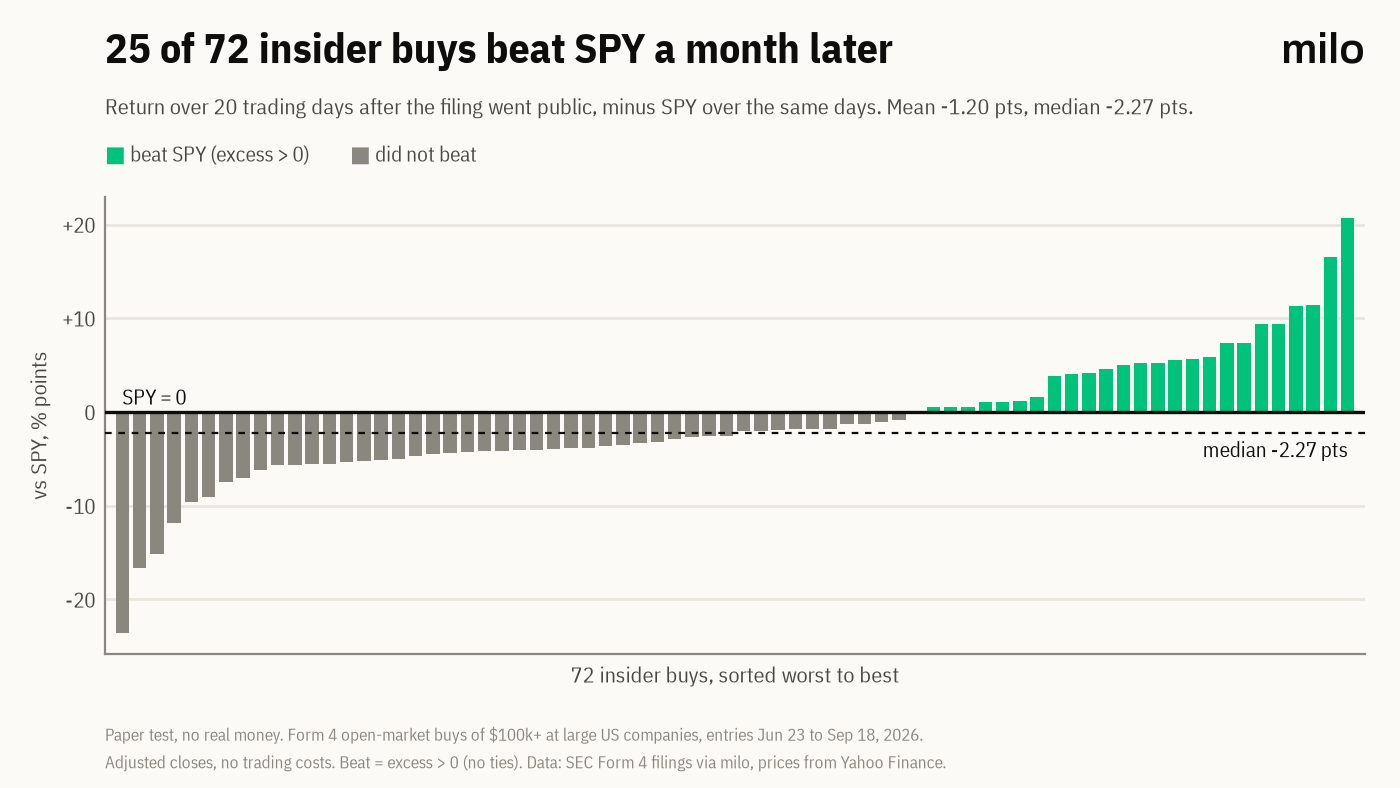
Across all 72 buys, the average return over 20 trading days was -0.79% and the median was -1.79%. Against SPY, the average buy trailed by 1.20 points and the median by 2.27 points. Only 31 of the 72 went up at all, before even comparing to the index.
I sliced the results a few ways to see if any simple filter rescued the signal:
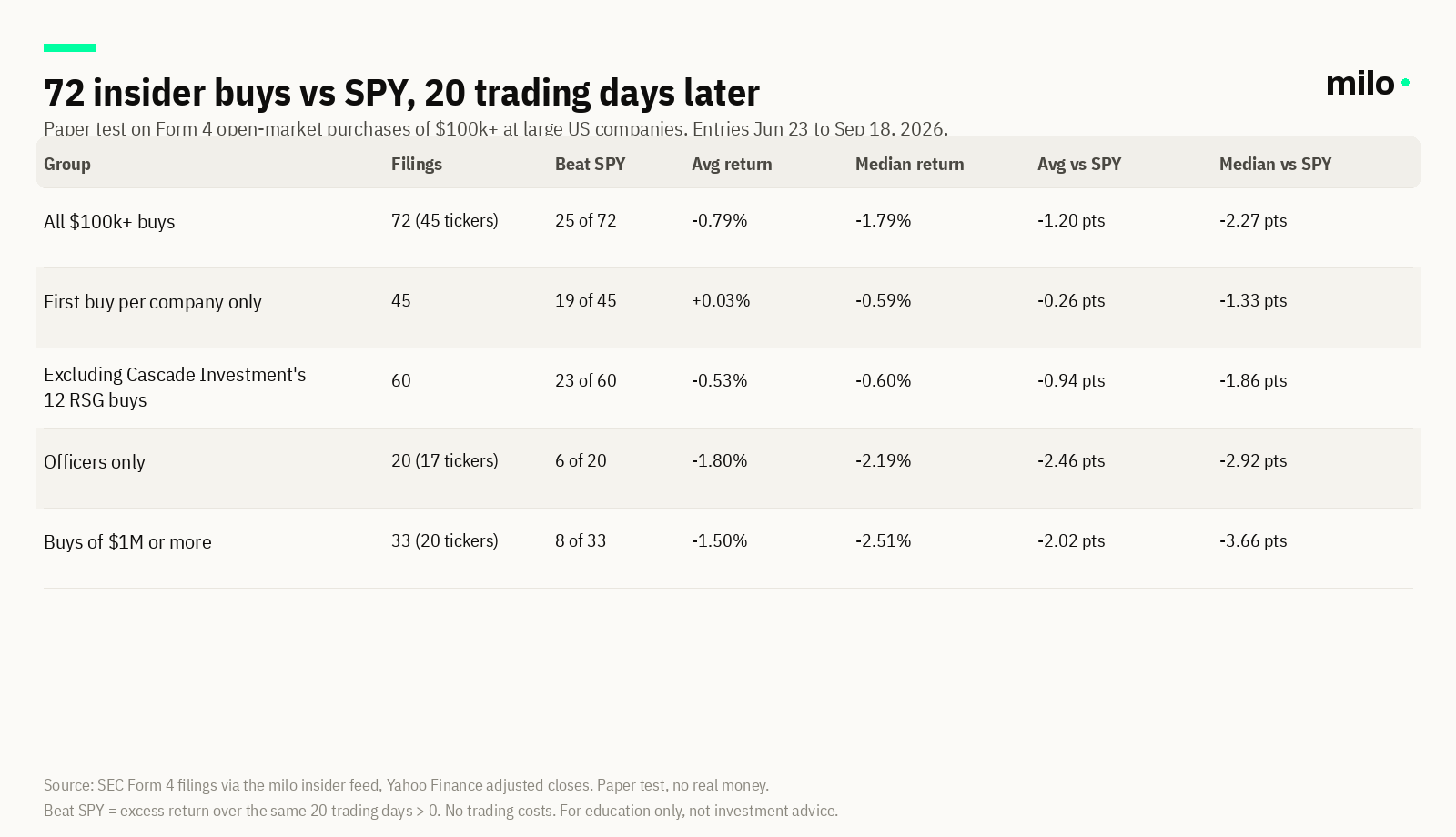
- First buy per company only (45 filings): 19 beat SPY, average return +0.03%, still 0.26 points behind SPY on average.
- Excluding one big buyer (60 filings): Cascade Investment made 12 of the 72 filings, all in $RSG. Taking those out, 23 of 60 beat SPY and the median trailed by 1.86 points.
- Officers only (20 filings, 17 tickers): 6 beat SPY. The average trailed by 2.46 points. Directors did a little better: 17 of 40 beat SPY, with the average buy 0.17 points behind.
- Buys of $1 million or more (33 filings, 20 tickers): 8 beat SPY. The median trailed by 3.66 points, the worst of any cut. Bigger checks did not mean better results here.
The best and worst cases
The winners looked exactly like the story people tell about insider buying.
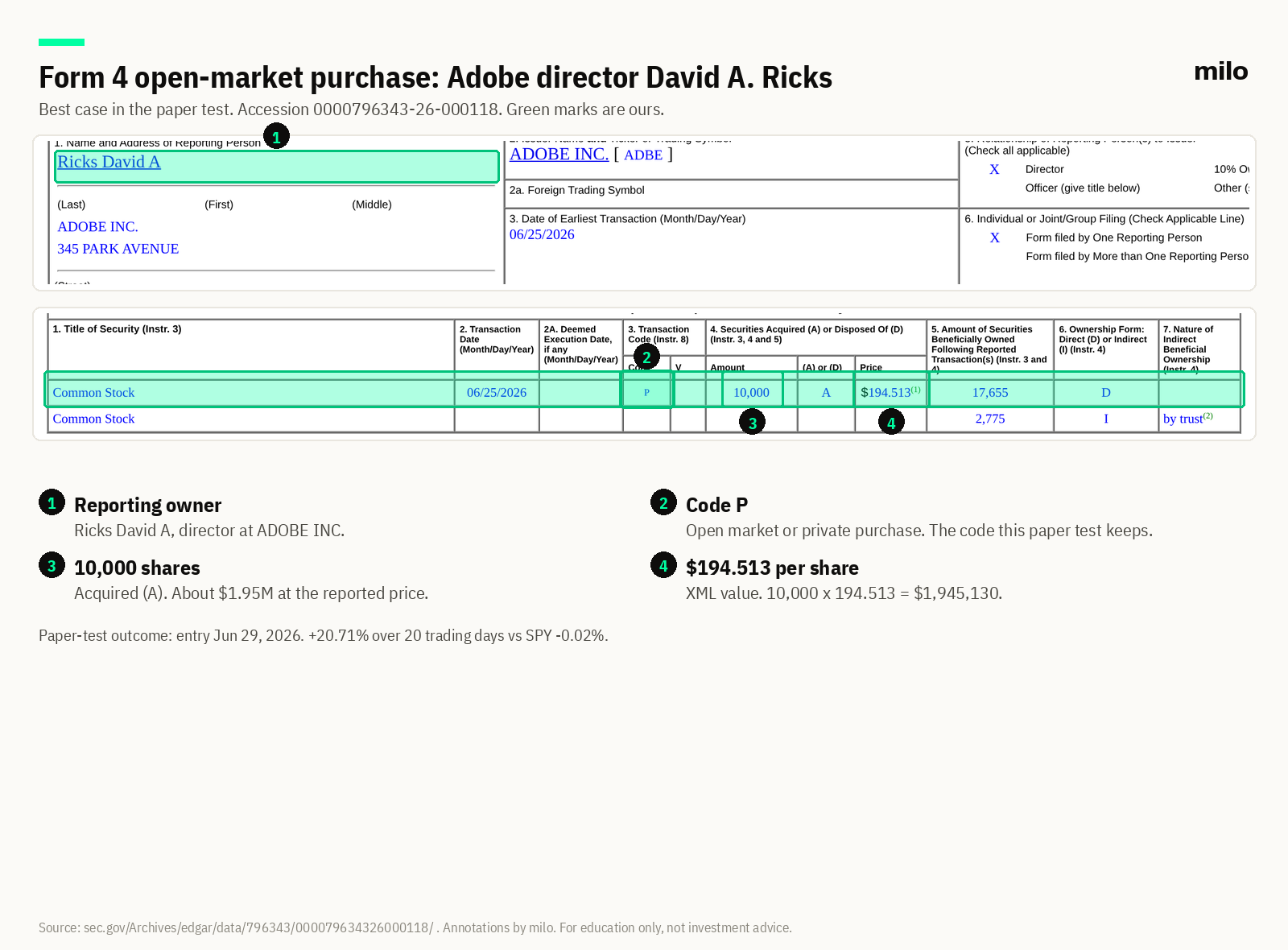
- $ADBE: director David A. Ricks bought 10,000 shares on Jun 25, 2026 at a weighted average of $194.513, about $1.95 million (Form 4). From the Jun 29 entry, Adobe gained 20.71% over 20 trading days while SPY was down 0.02%.
- $BG: director Christopher Mahoney bought 6,500 shares across Jul 31 and Aug 4, about $689,000 (Form 4). From the Aug 5 entry, Bunge rose 15.96% while SPY fell 0.60%.
The losers looked just as convincing on the day they were filed.
- $ARE: Executive Chairman Joel S. Marcus bought 5,000 shares at $49.68 on Sep 11, about $248,000 (Form 4). From the Sep 16 entry, Alexandria fell 21.29% while SPY gained 2.32%.
- $AON: director Lester B. Knight bought 20,000 shares on Sep 2, about $6.55 million, held through a family partnership (Form 4). From the Sep 4 entry, Aon fell 15.80% while SPY gained 0.85%.
None of these four filings showed a 10b5-1 plan box checked. They were all real, discretionary purchases by people who know their companies well. Two of them worked brilliantly and two of them lost a fifth or a sixth of their value in a month. That spread is the main lesson. One good insider buy proves nothing, and neither does one bad one.
Why big-company insider buys may be weaker
I can’t prove why from 72 trades, so treat this part as reasoning, not results.
Large companies are covered by dozens of analysts and traded by every fund in the market. An insider at a $100 billion company is less likely to know something the market has not already priced. A $2 million buy is also small next to the wealth of many senior directors, so it may say more about personal finances than about next quarter. Some buys are signals of support after a drop, which is a message to shareholders and not necessarily a forecast.
This lines up with the research above. Lakonishok and Lee found the predictive power came from smaller firms. A 2026 paper by Shi, Ma and Song, “Insider Trading Signals Across Industries” (Journal of Risk and Financial Management), looked at US data from 2005 to 2025 and found the signal varies a lot by sector: purchases in banks were the most informative, and the signal was much weaker in tech.
What this test can’t tell you
- It is small. 72 filings over about three months is a snapshot, not a study. A different quarter could look very different.
- It is one market regime. Summer and early fall 2026 is not every market.
- It is one holding period. Insiders often think in quarters or years. A 20-day window may be too short to see what they saw.
- It is large companies only. Small caps, where the research finds the strongest signal, are not in this universe.
- It ignores costs. Real trading would make the results slightly worse, not better.
So the honest conclusion is narrow: a simple “buy every $100k+ insider purchase at a big US company and hold for a month” rule did not beat the index in this sample.
How to use insider buys without fooling yourself
I still read insider filings every week. I just use them as a reason to look closer, not a reason to buy.
- Only count code P. Grants, option exercises, gifts and transfers are not someone choosing to spend cash.
- Read the footnotes. Check for 10b5-1 plans, trusts, family partnerships and weighted average prices. The footnotes are where “insider buy” headlines most often go wrong.
- Count people, not filings. Cascade’s 12 $RSG filings were one buyer, not twelve signals. Several different insiders buying in the same window is a stronger sign, which is what our piece on cluster insider buying covers.
- Look for a break from routine. A director who buys every year on the same date is telling you less than one who has never bought before.
- Write down your thesis first. Before you act, note why you think the insider is right and when you will check. Then put the result next to it.
- Paper test before real money. Run your own rule on paper for a few months and see if it beats SPY before you trust it.
Test it yourself on paper
This is the kind of check milo is built for. milo pulls Form 4 filings for large US companies into one feed, flags open-market buys, and lets you paper test a stock idea before any money is involved. You can see the latest filings by company on andmilo.com/stocks, and we send the most notable buys in the weekly milo Insider Digest.
If you want to try your own insider rule on paper, open the app with this link. Pick a filter, let it run for a month, and see if it beats SPY. That will teach you more than any headline about a CEO buying shares.
FAQ
Does insider buying predict stock returns?
Academic studies find that insider purchases carry some information, mostly at smaller companies and mostly for opportunistic, non-routine trades. In our paper test of 72 buys of $100,000 or more at large US companies, only 25 beat SPY over 20 trading days and the median trailed by 2.27 points.
Is insider buying more meaningful than insider selling?
Generally, yes. Insiders sell for many personal reasons, so sales say less. Lakonishok and Lee (2001) found selling had no predictive ability, while the information came from purchases.
Do bigger insider buys work better?
Not in our sample. Buys of $1 million or more beat SPY only 8 times out of 33, and the median trailed by 3.66 points, worse than the full group.
Are CEO and officer buys better than director buys?
Not in this test. Officers beat SPY 6 times out of 20, while directors beat it 17 times out of 40. The sample is small, so I would not read much into the gap.
How fast are insider buys reported?
Form 4 is generally due within two business days of the trade, so you can usually see a purchase on EDGAR within a few days of when it happened.
Can I follow insider buys automatically with milo?
You can track them and paper test ideas based on them. milo can link a brokerage for regular US stocks, but those trades are paper only, so there are no real orders for regular US stocks (tokenized stocks and crypto are real).
For education only. Not investment advice. milo agents and research are not registered investment advice. Past results, including paper results, do not predict future returns. milo can link a brokerage for regular US stocks, but those trades are paper only for now: no real orders for regular US stocks (tokenized stocks and crypto are real). Sources: SEC Form 4 filings on EDGAR (linked above) collected through the milo insider feed; Yahoo Finance adjusted closing prices; SEC Form 4 instructions (sec.gov/files/form4.pdf); Lakonishok and Lee, “Are Insider Trades Informative?”, Review of Financial Studies 14(1), 2001; Cohen, Malloy and Pomorski, “Decoding Inside Information”, Journal of Finance, 2012; Shi, Ma and Song, “Insider Trading Signals Across Industries”, Journal of Risk and Financial Management 19(5), 2026. Data checked Oct 18, 2026.