Danelfin and Tickeron both sell “AI” to people picking stocks, but they are not the same kind of product. Danelfin gives every stock a score from 1 to 10 and leaves the trading to you. Tickeron sells signals and trading bots, some of them running on its own brokerage accounts. I read both sites end to end on Oct 26, 2026, including the parts most reviews skip: Danelfin’s own audit site and the small print under Tickeron’s 191% headline.
I also work on milo, so I’ll say where milo fits and where it doesn’t. It isn’t a third option that beats both. It answers a different question.
The short answer
Pick Danelfin if you want a daily 1 to 10 rating on about 5,600 US and European stocks and you’ll place the trades yourself. Pick Tickeron if you want ready-made signals or bots that trade on 5 to 60 minute timeframes. Both lead with backtests. Danelfin publishes an audit that shows its live record so far is flat. Tickeron’s headline numbers don’t come with dates.
Danelfin in plain English
Danelfin calls itself “AI-Powered Stock Picking.” Every trading day it gives each stock an AI Score from 1 to 10, which it describes as the probability of beating the market over the next three months. A 10 means the model likes it most, a 1 means least. You also get sub-scores for technical, fundamental, sentiment and low risk.
How the AI Score works
Per Danelfin’s how-it-works page, the model looks at more than 600 technical, 150 fundamental and 150 sentiment indicators a day, which it turns into 10,000+ features per stock. It uses hundreds of decision trees and trains on the latest 252 market days for US stocks. Coverage is all US stocks, the main European markets and US-listed ETFs. The audit site puts the count at roughly 5,600 stocks scored daily.
Danelfin pitches this as explainable AI, “no black boxes,” because it shows which features pushed a score up or down. That’s useful. It still won’t tell you why a 9 should beat an 8 in your account.
One thing to get straight early: Danelfin doesn’t trade for you. The audit site says it plainly, “you execute the trades on your own brokerage account.” The paid plans can sync a US broker portfolio so you see scores on what you own, but that’s a read, not an order.
Danelfin pricing
From danelfin.com/pricing on Oct 26, 2026:
- Free: $0. Top 10 lists, 10 stock reports a month, one portfolio of 5 stocks, top alpha signals only.
- Plus: $22 a month billed yearly ($264). Adds portfolio sync with US broker accounts.
- Pro: $59 a month billed yearly ($708). Adds full alpha signals and CSV export.
- Elite: $134 a month billed yearly ($1,608). Adds an API with 10,000 calls a month and historical daily scores back to 2017 on request.
The per-month prices are the yearly plan divided by 12. The page says yearly saves $84, $240 and $540 a year, which works out to about $29, $79 and $179 a month if you pay monthly. There’s a 30-day money-back guarantee.
The performance claims, and Danelfin’s own audit
The homepage says stocks with a Score of 10 beat the market by +21.05% on average after three months (annualized alpha) since 2017, and stocks scored 1 lagged by 33.28%. It also says its Best Stocks strategy returned +456% from Mar 29, 2017 to Sep 3, 2026, against +228% for the S&P 500.
The how-it-works page is honest about what those are: “This Danelfin Best Stocks strategy performance is based on backtested results. Backtested performance is not an indicator of actual future results.” The +21.05% figure covers Jan 3, 2017 to Apr 1, 2025.
Credit where it’s due, Danelfin runs a public audit site and the audit is tougher on Danelfin than the homepage is. Here’s what it says:
- The current model went live on Jul 7, 2025. Every score before that date was recalculated afterward, walk-forward. The audit calls this a “simulated backtest” and notes the model was picked after its performance was known.
- It splits the Score 10 backtest into three periods. Average 3-month alpha was +5.4% in 2017 to 2019, +0.3% in 2020 to 2022, and -0.5% from 2023 to Jul 6, 2025. The audit says only 2017 to 2019 is statistically significant and tells readers to “treat the recent period as unproven.”
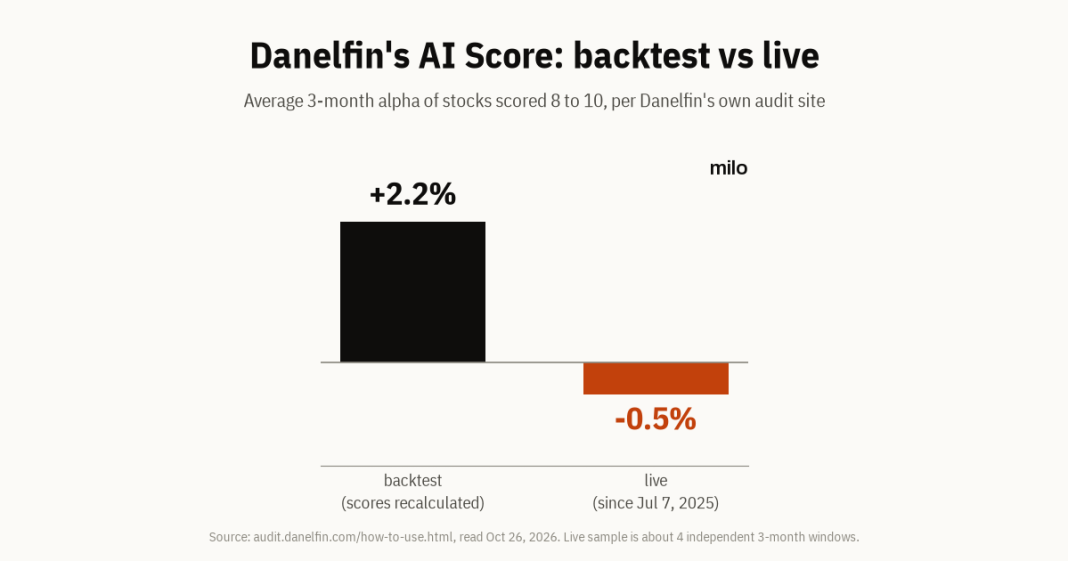
- Live, stocks scored 8 to 10 averaged -0.5% 3-month alpha since Jul 7, 2025, against +2.2% for the same bucket in the backtest. That’s about four independent 3-month windows, so it’s early either way.
- It passed 7 of 14 robustness checks, with 6 cautions and 1 fail. The fail is t-stat inflation: naive t-stats overstate significance by about 4.9x.
- Survivorship bias isn’t controlled. Delisted companies like Twitter, SVB and Celgene are missing from the history.
- A Top 20 portfolio backtest returned 22.4% a year vs 15.1% for SPY from Apr 2017 to Jul 2026, before trading costs, with about 70% turnover at each monthly rebalance.
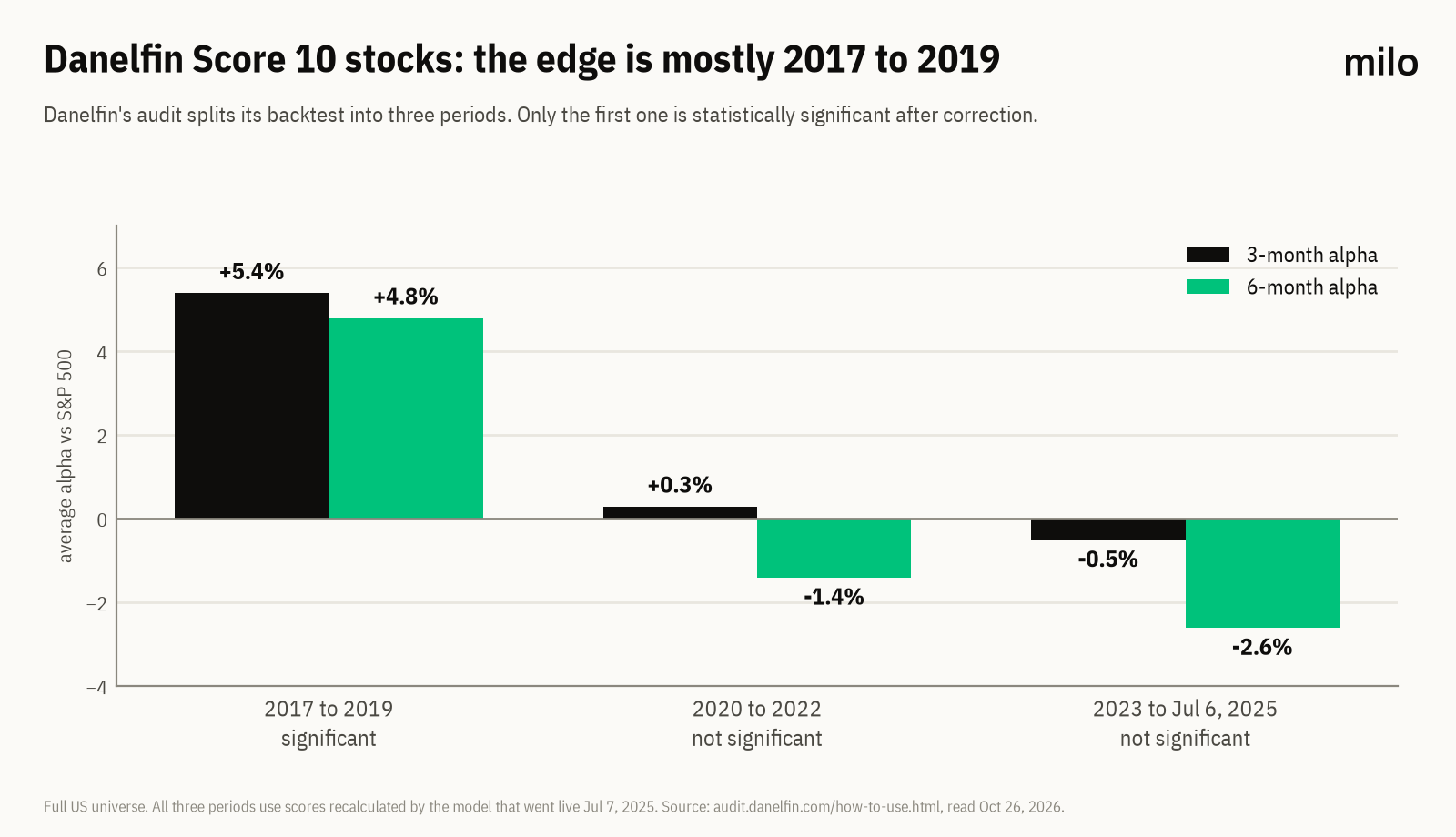
Six-month alpha tells the same story: +4.8%, then -1.4%, then -2.6%. So the big homepage number leans mostly on 2017 to 2019. That doesn’t make the score useless as a screen. It does mean nobody, Danelfin included, can show it beats the market now.
Tickeron in plain English
Tickeron’s homepage reads “AI Trading Agents, Tools and News.” Where Danelfin is one score, Tickeron is a shelf of products: Daily Buy/Sell Signals, AI Robots, Real-Time Patterns, Trend Prediction, Pattern Search and a screener, plus crypto signal agents. Its models, which it calls Financial Learning Models (FLMs), run on 5-minute, 15-minute and 60-minute charts. That’s short-term trading, not “hold for three months.”
Bots, signals and patterns
The bot trading page talks about “1,000+ back-tested algorithms, verified forward testing” and lists 25 bots selected from 351. The homepage the same day said 30 selected out of 298. The bot count moves, which makes sense if bots get added and retired. Some are “Double Agent” bots that hedge with inverse ETFs, for example pairing $NVDA with NVDS or $MSFT with QID.
Brokerage Agents vs virtual agents
This is the part people mix up. Tickeron’s AI agents page says Brokerage Agents are “designed for those who intend to use them for trading on real-money accounts,” and invites you to “review trades and copy from our brokerage accounts.” So Tickeron runs the bot on its own account and you mirror the trades. Virtual agents and signal agents don’t trade real money at all.
Can a bot place orders straight into your own broker account? Tickeron’s FAQ, dated Nov 22, 2023, said robot brokerage integration was “under development” with plans for Binance, Alpaca, Kraken, Ameritrade and IBKR. I couldn’t find a current page confirming it shipped, so ask them before you pay for that.
Tickeron pricing
There’s no public pricing page. Both tickeron.com/pricing and /pricing/ returned 404 when I checked. The only prices I found were in a Sep 21, 2026 sale post: Daily Buy/Sell Signals at $60 a year instead of $240, and AI Robots at 50% off without a dollar figure. Expect to see prices after signing up.
The 191% claim
The bot page headline is “191% Annualized Return During the Reported Period,” with 419 closed trades, a 71% win rate, a 2.92 profit factor, $456 average profit per trade and a 13:1 profit-to-drawdown ratio. It adds “Past performance does not guarantee future results.”
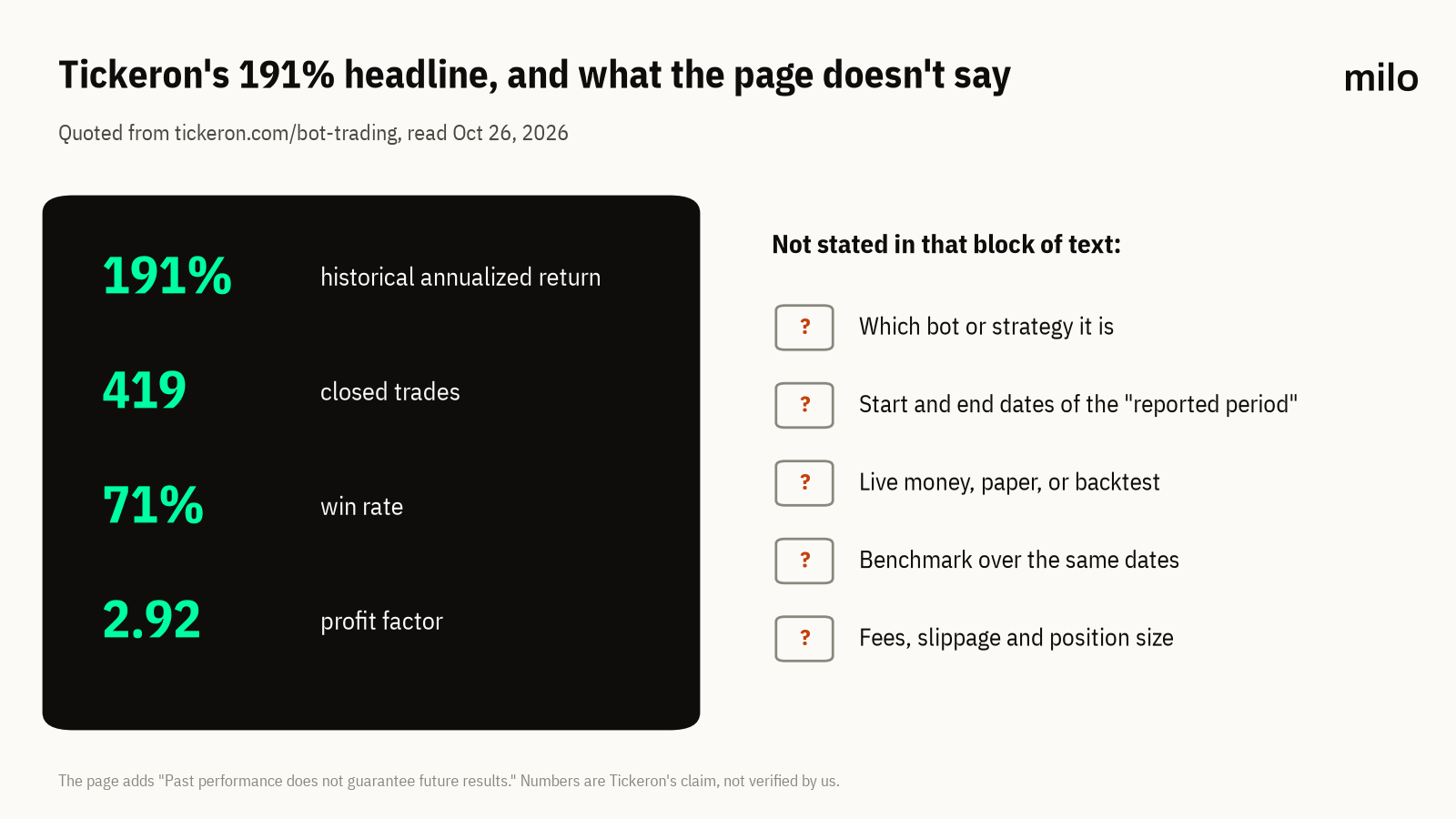
What the block doesn’t say is which bot that is, what dates “the reported period” covers, whether it was live money, paper or a backtest, and what a benchmark did over the same window. 419 trades is a decent count, but annualized returns from a short window can look huge. Until you know the dates, 191% is a hard number to judge.
Danelfin vs Tickeron side by side
| Danelfin | Tickeron | milo | |
|---|---|---|---|
| What you get | Daily AI Score 1 to 10 per stock | Signals, pattern tools, trading bots | SEC filing and insider data, AI research digests, crypto trading agents |
| Coverage | ~5,600 stocks (US, main European markets), US ETFs | US stocks and ETFs, crypto | Insider data on 503 US tickers, 50 stocks on the public /stocks page |
| Time horizon | 3 months | 5 to 60 minute bars | Event driven (filing dates) |
| Who places trades | You, in your broker | Tickeron’s own accounts for Brokerage Agents; you copy | Stocks: paper only. Crypto: agents trade on-chain from your own wallet |
| Track record shown | Backtest headline plus a public audit with live results | 191% claim with no dates or strategy name | No stock picking record. Crypto agents show public PnL |
| Price (Oct 26, 2026) | Free, then $22 / $59 / $134 a month billed yearly | No public page. Sale: signals $60/yr | /stocks page is free to read |
Where milo fits, and where it doesn’t
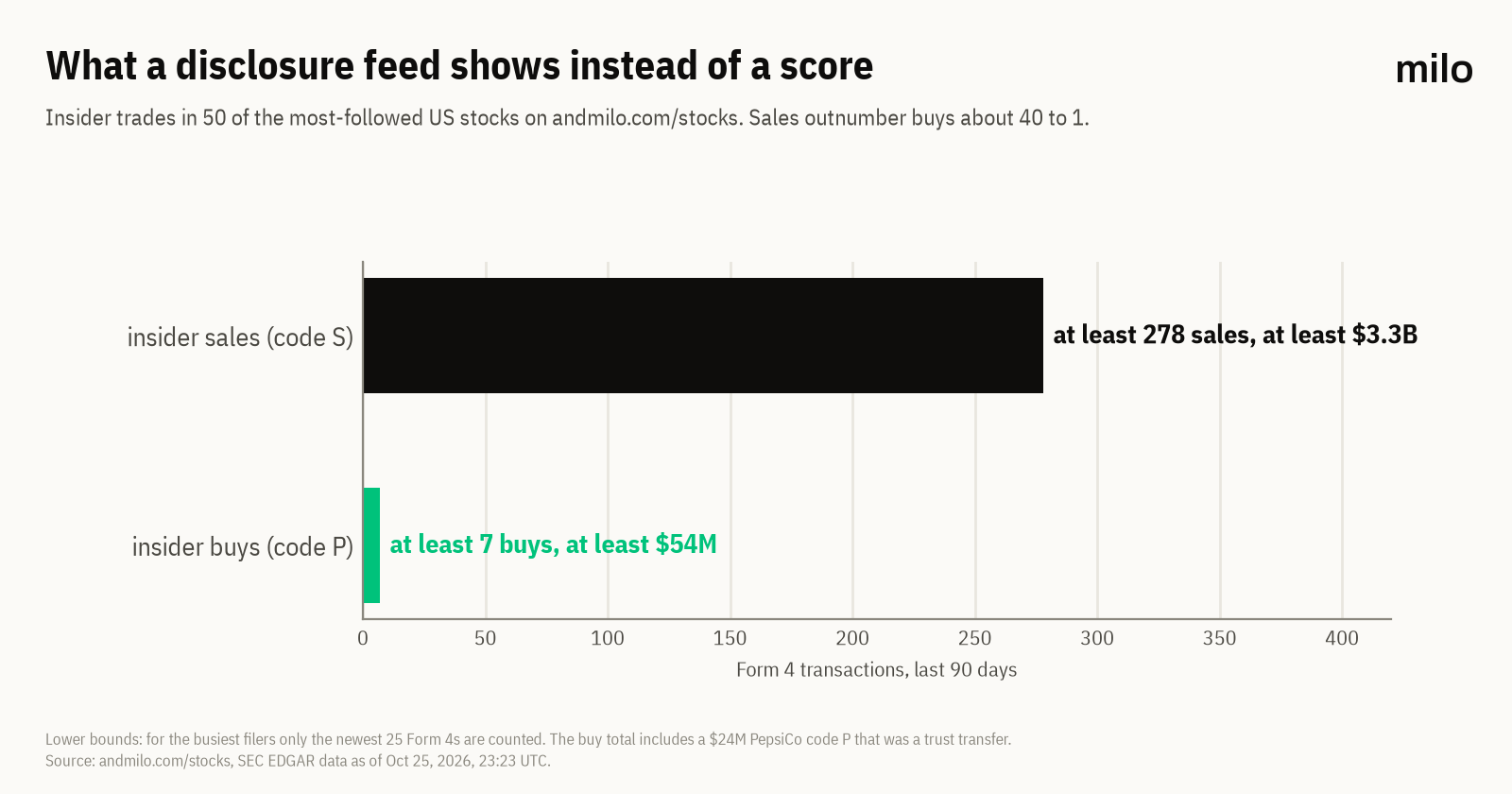
milo doesn’t score stocks and doesn’t run stock bots. On the stock side it reads filings. The andmilo.com/stocks page pulls Form 4 insider buys and sales and 8-K filings from SEC EDGAR for 50 of the most-followed US stocks, refreshed daily. As of Oct 25, 2026, 23:23 UTC, it showed at least 278 insider sales worth at least $3.3B over 90 days, against at least 7 buys worth at least $54M.
Here’s a real one. On Sep 29, 2026, Oracle director Stephen Rusckowski bought 25,000 shares of $ORCL at a weighted average of $139.352, about $3.48M, filed Oct 1. I opened the Form 4 to check: code P, open-market fills between $138.96 and $139.74, held through his living trust, and the 10b5-1 plan box isn’t checked. That’s a clean buy with his own money.
Now a messy one. The same feed lists a $24M $PEP “buy.” The footnotes show it was a swap between Pohlad family trusts, not someone betting on PepsiCo. A score wouldn’t catch that and neither does a raw count. You have to read the filing, which is how to read SEC Form 4 is about.
Where milo is weaker than these two, plainly:
- No AI score or ranking of stocks.
- No ETFs or European stocks. Insider data covers 503 US tickers, against about 5,600 for Danelfin.
- No backtest or stock-picking track record to show you.
- No real-money stock trading. Stock features are paper trading and research only.
- No intraday pattern tools like Tickeron’s.
Where it’s different: every data point links back to a public SEC filing you can open yourself, and on the crypto side milo agents trade from your own wallet with public PnL and a plain-English diary of each move.
If you want the wider field, the best AI stock pickers roundup compares more tools, and can ChatGPT pick stocks covers the public AI paper-trading tests.
How to judge any AI tool’s track record
The same five questions work for Danelfin, Tickeron, milo or whatever comes next:
- When did the model go live? Anything before that date is a backtest, however it’s labeled. Danelfin gives you the date (Jul 7, 2025). Tickeron’s 191% doesn’t.
- Is the result split by period? One big number from 2017 can hide a flat last three years. Danelfin’s audit shows exactly that.
- Are dead companies in the data? Without delisted stocks, backtests look better than reality.
- Is it before or after costs? 70% monthly turnover or hundreds of short-term trades cost real money.
- What’s the benchmark over the same dates? A return with no comparison isn’t a result.
If a vendor can’t answer those, treat its performance number as marketing. If you want to test ideas without risking money, paper trade them first. That’s the only way milo handles stocks anyway.
FAQ
Is Danelfin better than Tickeron?
They do different jobs. Danelfin is a 3-month stock rating you act on yourself. Tickeron is short-term signals and bots. Danelfin is more open about its record, since it publishes an audit with live results.
Is Danelfin’s AI Score accurate?
By its own audit, Score 10 stocks beat the market in 2017 to 2019 and were roughly flat after that. Live since Jul 7, 2025, stocks scored 8 to 10 averaged -0.5% 3-month alpha.
How much does Danelfin cost?
There’s a free plan. Paid plans were $22, $59 and $134 a month billed yearly on Oct 26, 2026, with higher monthly-billing prices.
How much does Tickeron cost?
Tickeron doesn’t publish a pricing page. A Sep 2026 sale listed Daily Buy/Sell Signals at $60 a year, down from $240.
Do Tickeron bots trade real money?
Brokerage Agents trade on Tickeron’s own real-money accounts and you can copy the trades. Virtual and signal agents don’t trade real money.
Is Tickeron’s 191% return real?
It’s Tickeron’s claim for “the reported period.” The page doesn’t name the bot or the dates, so you can’t check it from that page.
Does Danelfin place trades for me?
No. You place trades in your own brokerage account. Paid plans can sync a US broker portfolio to show scores.
Is milo an alternative to Danelfin or Tickeron?
Not a direct one. milo tracks SEC filings and insider trades for US stocks with paper trading only, and runs AI trading agents for crypto.
Try milo to see insider buys and 8-Ks for the stocks you follow, and paper trade the ideas before any money is involved.
For education only. Not investment advice. milo stock features are paper trading and research only. Competitor details checked on their own sites on Oct 26, 2026 and may change. Sources: danelfin.com (home, how-it-works, pricing), audit.danelfin.com, tickeron.com (home, bot-trading, ai-agents, FAQ, Sep 21, 2026 sale post), andmilo.com/stocks, SEC EDGAR Form 4 accession 0001341439-26-000099.