Picking a self custody wallet in 2026 usually comes down to a familiar pair: MetaMask or Trust Wallet. Both are non custodial, both are free, both run on your phone and your browser, and both have tens of millions of users. So which one is actually the better home for your crypto this year? We put them head to head across chains, fees, security, DeFi depth and everyday usability to settle it.
Quick Verdict: TL;DR
MetaMask wins for hands on DeFi users on Ethereum, Layer 2s and the rest of the EVM world who want the deepest dApp compatibility, the widest hardware wallet support and features like Smart Accounts and Transaction Shield. Trust Wallet wins for everyone else: casual holders, mobile first users and anyone who wants to touch 100+ chains and 10M+ assets in one app without hunting for network RPCs. If you cannot pick, MetaMask edges it 4.4 / 5 to Trust Wallet’s 4.2 / 5 for our default recommendation, but the honest answer is that most crypto users should probably run both.
Product Overview
MetaMask in 2026
MetaMask is the wallet Consensys shipped in 2016 to make Ethereum usable in a browser, and it has quietly become the largest self custody wallet in the world. In 2026 it is far more than a key manager. It now includes native Bitcoin, Solana and TRON support, EIP 7702 Smart Accounts with programmable permissions, social login recovery, Transaction Shield for scam protection, in app perps and prediction markets, tokenized real world assets, a MetaMask Money Account, a MetaMask Card and a new Agent Wallet for on chain automation. If you have ever bridged, staked or minted anything on Ethereum, you have almost certainly signed a transaction in MetaMask.
Trust Wallet in 2026
Trust Wallet, acquired by Binance in 2018 but run independently, took the opposite bet. Instead of going deep on Ethereum, it went wide on every chain it could support. In 2026 it advertises support for 100+ blockchains and 10M+ assets in one app, along with built in swap, staking, on ramp, NFT gallery and dApp browser features. It ships as a mobile app on iOS and Android with a growing browser extension. The pitch is simple: one app, all your coins, no manual network setup.
Supported Chains and Assets
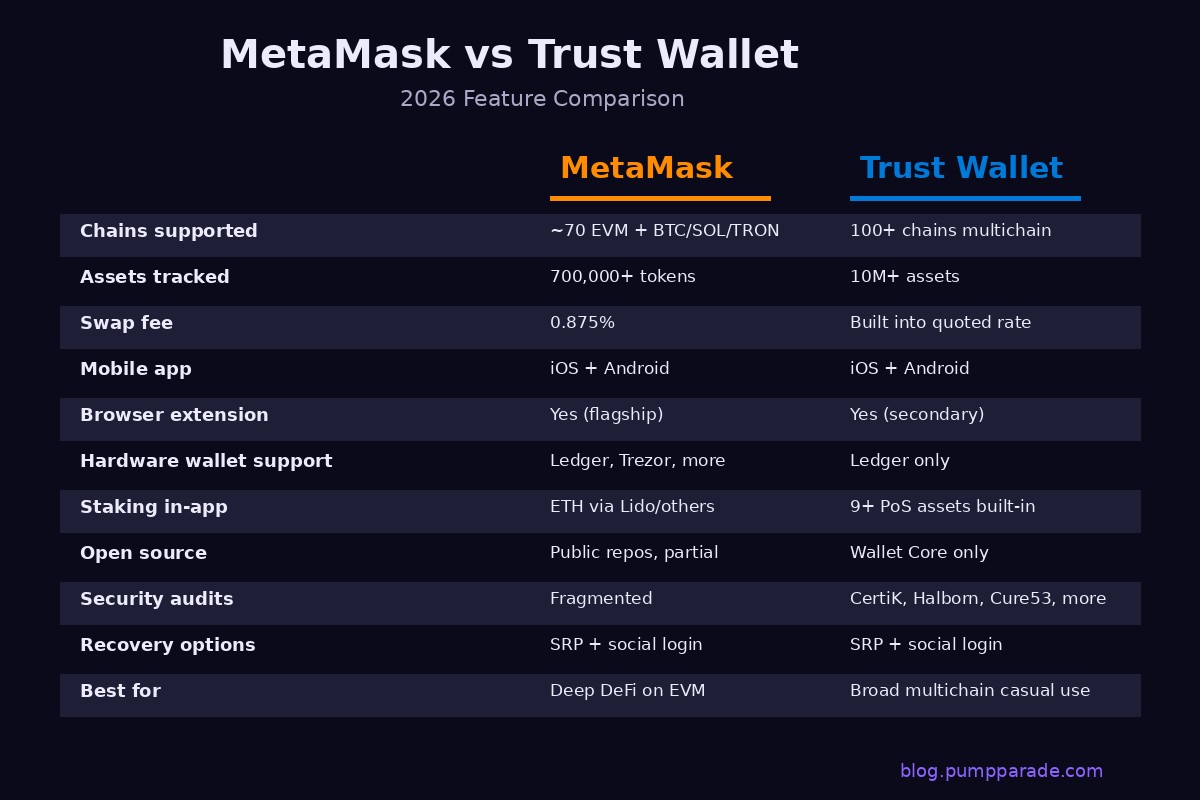
This is the first place the two wallets meaningfully diverge. MetaMask in 2026 covers roughly 70 EVM chains out of the box, plus native (not bridged) support for Bitcoin, Solana and Tron, and more than 700,000 tokens. That is a huge jump from the Ethereum only wallet longtime users remember, but its center of gravity is still EVM. Adding an obscure chain often still means importing an RPC.
Trust Wallet claims 100+ blockchains and 10M+ assets with no manual network setup for the vast majority of chains. Bitcoin, Ethereum, Solana, BNB Chain, TON, Cosmos ecosystem chains, Aptos, Sui and many long tail chains all work as first class citizens on install. If your holdings span exotic L1s, Trust Wallet is the more painless default.
Winner: Trust Wallet for breadth, MetaMask for depth on EVM.
Features Deep Dive
MetaMask
The MetaMask feature set in 2026 leans into power users. Swaps and bridging are integrated across chains, staking works via partners like Lido and native ETH staking, and Smart Accounts (EIP 7702) let you batch transactions, sponsor gas and set granular permissions per dApp. The new Agent Wallet gives structured, revocable access to AI agents, which is useful if you use trading assistants. Transaction Shield reads and simulates every transaction before you sign to warn about approvals that would drain the wallet. There is also a Snaps system that lets third party developers add features like account abstraction plugins, custom chains and dApp specific UIs.
Trust Wallet
Trust Wallet’s feature set is broader but shallower. You get in app buy with card via third party on ramps, in app swaps and cross chain swaps, staking for 9+ proof of stake assets directly in the app, and an NFT gallery that works across supported chains. Its Security Scanner previews risky transactions and flags dodgy dApp connections before you sign. App Lock with biometrics protects the wallet itself even if someone gets your phone. The dApp browser is fine for casual DeFi but noticeably less polished than MetaMask’s browser extension experience.
Winner: MetaMask for DeFi power features, Trust Wallet for one tap simplicity.
Fees and Pricing
Both wallets are free to download and use. Where they differ is in the cost of doing things inside the wallet.
MetaMask swap fee: 0.875% baked into every in app swap on top of the underlying DEX or aggregator fee. That is one of the higher wallet swap markups in the industry, though the router usually picks up enough extra liquidity to still land a competitive net rate. There are no withdrawal fees, only standard blockchain gas.
Trust Wallet swap fee: no explicit add on fee. Trust Wallet’s swap cost is embedded in the quoted rate rather than shown as a separate line item, which is honestly less transparent, but on many pairs the effective spread ends up lower than MetaMask’s 0.875%. Buying crypto with card through third party providers adds their own fees on top, usually 1% to 4%.
If you swap frequently, price out the exact route in each wallet before you sign. In our tests on major pairs like ETH to USDC, Trust Wallet came in a hair cheaper. On thin liquidity long tail pairs, MetaMask’s routing sometimes won.
Winner: Trust Wallet for headline fees, but check per trade.
Security and Trust
Security is where you should never take a wallet’s marketing at face value. Both MetaMask and Trust Wallet are non custodial: your 12 word seed phrase generates every key locally, and the company holds nothing it could freeze or reset. But the details matter.
MetaMask keeps its major repositories public and readable on GitHub, but this is not OSI approved open source, there is no reproducible build process, and third party audit coverage is fragmented across features rather than covering the whole wallet at once. Consensys has a solid disclosure and bounty record. High profile drainer attacks over the years have targeted MetaMask users heavily because it is the biggest surface, and Transaction Shield in 2026 is a direct response to that.
Trust Wallet has been audited by CertiK, Halborn, Cure53, Kudelski Security and Quantstamp, and holds ISO 27001 and ISO 27701 certifications. That is a stronger audit posture on paper. On the other hand, the track record includes a catastrophic entropy CVE in 2023, a 2024 migration bug and a 2025 supply chain compromise on the browser extension, all of which put user funds at risk before being patched. Only Wallet Core, the low level cryptographic library, is open source under Apache 2.0. The mobile app and extension built on top are closed source.
Neither wallet is a hardware wallet substitute. If you hold more than a few thousand dollars in crypto, both let you pair with a Ledger. MetaMask also supports Trezor, Keystone, GridPlus and more. See our Ledger vs Trezor 2026 comparison for the cold storage layer that should sit behind whichever hot wallet you pick.
Winner: Toss up. Trust Wallet has cleaner audits on paper, MetaMask has broader hardware wallet integration and Transaction Shield. Both have had incidents.
User Experience
MetaMask has the more polished browser extension experience by a wide margin. The Fox is where most dApps default their WalletConnect and injected connectors, so if you do most of your DeFi from a laptop, MetaMask will feel like less friction. The mobile app has improved dramatically in the last two years, but the extension is still the flagship.
Trust Wallet is the opposite. Its mobile app is beautiful, fast and genuinely one of the best crypto UX experiences on iOS and Android. The extension is fine but clearly a companion product. If you live on your phone, Trust Wallet feels lighter and easier for everyday sends, receives and swaps.
Both offer social login recovery in 2026 alongside the classic seed phrase, which lowers the on ramp for less technical users without giving up self custody.
Winner: MetaMask for desktop DeFi, Trust Wallet for mobile everyday use.
Pros and Cons
MetaMask
Pros: Deepest dApp compatibility on EVM, Smart Accounts and Snaps, Transaction Shield built in, broadest hardware wallet support, Agent Wallet for on chain automation, huge developer ecosystem.
Cons: 0.875% swap fee is high, mobile UX still trails Trust Wallet, chain support outside EVM feels bolted on, biggest phishing target in crypto so scam surface is enormous.
Trust Wallet
Pros: 100+ chains and 10M+ assets out of the box, cleaner audit list, no explicit swap fee, gorgeous mobile UX, built in staking for 9+ assets, Security Scanner flags risky signs.
Cons: Extension is a second class citizen, only Wallet Core is open source, 2023 to 2025 track record includes real incidents, no Smart Accounts equivalent yet, hardware wallet support limited to Ledger.
Ratings
MetaMask 2026: 4.4 / 5. The default power user wallet on EVM. Docked half a point for its swap fee and phishing exposure.
Trust Wallet 2026: 4.2 / 5. The best mobile first multichain wallet you can install today. Docked for the incident history and closed source app.
Which Should You Pick?
Pick MetaMask if you spend most of your on chain time on Ethereum, Base, Arbitrum, Optimism, Polygon or BNB Chain, you use hardware wallets, you care about Smart Accounts and permissioned agents, and you mostly work from a desktop browser.
Pick Trust Wallet if you touch a lot of different chains, you live on mobile, you want painless in app staking and buying, and you value one app that just works over deep DeFi tooling.
Run both if you take crypto seriously. Use MetaMask for EVM DeFi and dApp signing. Use Trust Wallet for everyday holds, mobile sends and chains MetaMask does not cover cleanly. Neither is a substitute for a hardware wallet on serious size.
FAQ
Is MetaMask or Trust Wallet safer?
Both are non custodial and have solid teams behind them. Trust Wallet has more audits on paper (CertiK, Halborn, Cure53, Kudelski, Quantstamp) plus ISO 27001. MetaMask has better hardware wallet integration and Transaction Shield to catch phishing signs. Both have had public incidents. For real safety, pair either with a hardware wallet.
Does MetaMask support Solana in 2026?
Yes. As of 2026 MetaMask ships native support for Solana, Bitcoin and Tron alongside its 70 or so EVM chains. It is not as feature rich on Solana as a Solana native wallet like Phantom, but for basic sends, holds and swaps it works fine. See our Phantom Wallet 2026 review if Solana is your main chain.
Does Trust Wallet charge fees?
The app itself is free. Trust Wallet does not charge an explicit swap add on fee, but the cost is baked into the quoted rate. On card purchases via third party on ramps you will pay 1% to 4% depending on provider. Standard blockchain gas fees apply to every send.
Can I import my MetaMask wallet into Trust Wallet?
Yes. Both wallets are BIP 39 compatible on their EVM accounts, so you can import a MetaMask seed phrase into Trust Wallet and see the same EVM addresses. Non EVM accounts (Solana, Bitcoin, etc.) use different derivation paths so those addresses will differ. Do this only on a device you trust, and consider migrating to fresh keys behind a hardware wallet if you are worried about exposure.
Which wallet is best for beginners?
Trust Wallet. The mobile UX is friendlier, buying crypto in app is one tap, and the multichain support means beginners do not have to learn what an RPC endpoint is. MetaMask is more powerful but has more sharp edges.
Final Word
The best crypto wallet in 2026 honestly depends on what you actually do on chain. If your world is Ethereum, Layer 2s and dApps, MetaMask is still the wallet the ecosystem was built around. If your world is many chains, many assets and mostly mobile, Trust Wallet is the smoother daily driver. Neither is a substitute for a hardware wallet on real size. Either way, back up your seed phrase, verify every transaction, and never sign a message you do not understand.