Celestia (TIA) is trading near $0.33 at time of writing, roughly 97% below its 2024 peak and stuck inside a slow, grinding range. That is the setup nobody outside of modular blockchain circles is talking about, and it is exactly why this Celestia (TIA) price prediction 2026 matters. The token that was supposed to become the base layer for the entire rollup thesis has spent most of the last 18 months as a case study in unlock overhang, weak retail demand, and vicious sector rotation.
Then something changed. The Fibre protocol, first previewed in Celestia Vision 2.0, is on track to go live in stages through the back half of 2026, targeting a jump in blockspace throughput that would leapfrog every rival data availability (DA) layer. On-chain fee revenue is climbing off a low base. And John Adler, one of the four co-founders, is publicly pushing a proof-of-governance proposal that would cut inflation by a factor of 20.
So the real question is not whether TIA is dead. It is whether the setup is finally clean enough to run. This article breaks down where TIA stands right now, what could actually push it back to $1, what could send it back to $0.20, and how the numbers line up against the closest DA competitors.
Key Takeaways
- TIA trades near $0.33 with a market cap around $303M, ranked #97 by CoinMarketCap at time of writing.
- The Fibre protocol targets up to 1 Tb/s of blockspace throughput, a potential 100x leap over current capacity.
- Our base case sees TIA at $0.55 within 6 months and $0.85 in 12 to 24 months if Fibre ships on time and rollup demand recovers.
- The bull case reclaims $1 in 2026 and points to $1.60. The bear case grinds toward $0.24 on continued unlock pressure.
- Biggest risks: EigenDA and Avail eating market share, and the vesting schedule that runs all the way through September 2027.
Where Celestia (TIA) stands today
Before we get into targets, let us anchor on where the tape actually is. The numbers below are pulled at time of writing and rounded for readability. If you are reading this a week from now, check CoinGecko for the live figure.
| Metric | Value |
|---|---|
| Price | ~$0.33 |
| 24h change | +2.4% |
| Market cap | ~$303M |
| 24h volume | ~$11M |
| CMC rank | #97 |
| All-time high | ~$20.85 (Feb 2024) |
| % from ATH | approximately negative 98% |
Two things stand out. The market cap sits under the war chest that Celestia Labs is sitting on. Co-founder Mustafa Al-Bassam has publicly referenced a $100M treasury and a six-year operational runway, which means the project is not going anywhere on funding alone. But the price also sits inside a multi-quarter consolidation between roughly $0.28 and $0.65. Break either end and the setup changes fast.
Why is Celestia’s price stuck in a range right now?
Three things are pressing on TIA at once. First, supply. The next scheduled unlock on July 31, 2026 released 10.7M tokens, about 1.1% of total supply, and the vesting cliff runs all the way through September 30, 2027. Every month adds new float that has to be absorbed by real demand.
Second, narrative. The modular blockchain thesis, which is the entire pitch for TIA, cooled off after Ethereum’s own Dencun and PeerDAS upgrades cut Layer 2 (L2) data costs directly on Ethereum. That took some oxygen away from third-party DA layers, and Bitcoin’s dominance stayed pinned above 55% for most of 2026.
Third, competition. EigenDA has quietly built market share by tapping into restaked ETH security, and Avail has picked up several new rollup integrations. Celestia is no longer the only credible DA option, which is why raw blob demand matters more now than it did a year ago.
The offset is that on-chain activity has actually been climbing. Blob demand on Celestia is up roughly 3x from the January 2026 lows, driven by rollups like Manta Pacific, Movement, and a handful of new app-chains that opted for cheap DA over Ethereum L1 blobs. If that curve holds, the fee-based revenue story becomes real.
What is the bull case for TIA in 2026?
Fibre protocol delivers the throughput leap
Fibre is the reason to care. Announced as part of Celestia Vision 2.0, it uses zero-knowledge (ZK) sampling techniques and a new networking layer to push blockspace throughput toward 1 Tb/s in its long-term target, with earlier stages targeting a 100x improvement over the post-V8 baseline. In plain terms, that is enough capacity to host every serious rollup, orderbook, and AI agent payment layer that anyone is currently trying to build. If Fibre ships in stages through H2 2026 on schedule, the “modular is dead” thesis breaks.
Fee revenue starts to justify the market cap
The market cap under $310M looks small on its own. It looks even smaller against a $100M-plus treasury and rising blob revenue. Historically, in similar setups, layer-one tokens have started to re-rate once trailing 90-day fee revenue crosses an annualized run rate of 5% to 10% of market cap. Celestia is not there yet, but the trajectory since Q1 is the closest it has ever been. Learn more about how L2 rollups and DA layers compare in our Ethereum price prediction breakdown.
Proof-of-governance cuts issuance by 20x
John Adler’s proof-of-governance proposal, if it passes, would slash annual TIA issuance from roughly 5% to 0.25%. That is not a small tweak. It is a supply shock. The Lotus (v4) upgrade already reduced inflation from around 7.2% to 5% and capped validator commissions at 25%. A follow-up that takes issuance to a fraction of a percent would meaningfully change the sell pressure profile once vesting winds down.
What could push TIA back to $0.20?
Unlock overhang keeps grinding
Every month between now and September 2027, more locked TIA hits the market. If demand does not scale fast enough, the price simply cannot hold. The pattern in 2024 and 2025 was clear: bounces got sold into the unlock windows, and every attempt to reclaim higher moving averages failed. That pattern breaks only when spot demand starts absorbing supply, and there is no guarantee that happens on the schedule bulls hope for.
EigenDA and Avail eat the DA market
The single biggest risk factor is not price action, it is competition. EigenDA leans on restaked ETH security, which is a story institutional allocators find easy to understand. Avail has focused on the AppChain and Polkadot-adjacent developer stack. And Ethereum itself is pushing through PeerDAS and eventually full danksharding, which puts native, cheap DA directly inside L1. If Celestia’s blob market share slips below 20% by mid-2027, the fee-revenue thesis breaks.
Modular narrative loses another cycle
The uncomfortable version of this: modular might just be early. If the next 12 months of rollup growth are underwhelming, and if end users keep gravitating to monolithic chains like Solana for consumer apps, TIA’s core investment case gets pushed out another cycle. Cycles are unforgiving in crypto. Missing one often means missing many.
Celestia (TIA) price prediction 2026: targets by timeframe
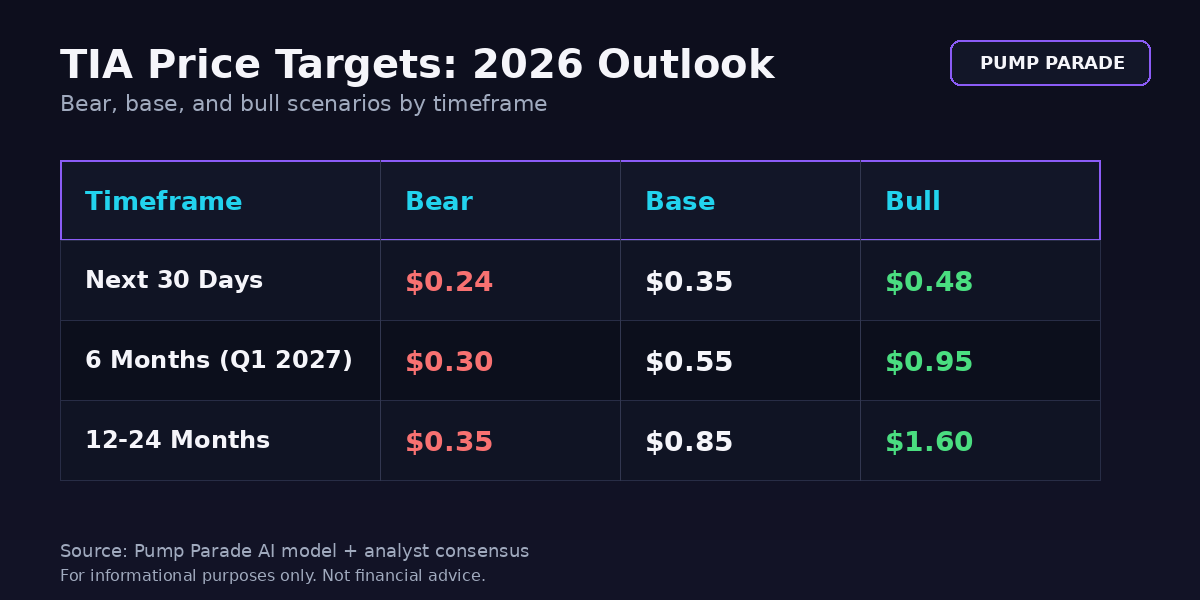
Below is how our AI model, tuned against on-chain fee data, unlock schedules, and comparable L1 setups, splits the outcomes. These are not promises. They are scenarios with conditions attached.
Next 30 days: $0.24 to $0.48
Bear case sees TIA break the lower end of the range around $0.28 on any macro flush, targeting $0.24. Base case holds the range and drifts back toward $0.35 on light Fibre progress updates. Bull case reclaims $0.42 and pushes toward the round $0.48 psychological level, likely driven by a single narrative catalyst rather than fundamentals shifting in 30 days.
6 months (into Q1 2027): $0.30 to $0.95
The base case at $0.55 assumes Fibre ships partial mainnet functionality on schedule and blob demand keeps climbing at its current pace. The bull case at $0.95 assumes Fibre lands ahead of schedule and the proof-of-governance vote passes, both of which are non-trivial “ifs” but neither is fringe. The bear case at $0.30 is what happens if unlocks keep outrunning demand.
12 to 24 months (long-term): $0.35 to $1.60
This is where the reclaim-$1 question actually gets resolved. Standard Chartered’s mid-2026 note on DA infrastructure did not name TIA directly, but its framework for pricing modular blockspace demand implies a range where TIA at $1 to $1.50 is defensible if Celestia holds 40%-plus DA market share. Beyond $1.60 requires a full risk-on altseason plus Fibre-level throughput being live and used. Analyst sources like Changelly’s TIA price prediction model land in a broadly similar range with meaningful variance depending on macro assumptions.
How does Celestia compare to EigenDA and Avail?
The DA layer race is not a monopoly and is not going to be one. Here is where the three main players stand on the metrics that matter for pricing.
| Metric | Celestia | EigenDA | Avail |
|---|---|---|---|
| Security model | Sovereign PoS | Restaked ETH | Sovereign PoS |
| Token status | Live (TIA) | EIGEN linked | Live (AVAIL) |
| Current throughput (est.) | ~32 MiB blocks | High (variable) | Comparable to Celestia |
| Roadmap ceiling | 1 Tb/s (Fibre) | Restaking-scaled | Multi-hundred MB blocks |
| Notable rollups | Manta, Movement | Numerous ETH L2s | Growing AppChain set |
| Distinct edge | Ships now, ZK roadmap | ETH security narrative | Polkadot-adjacent devs |
The takeaway: no one wins outright. But Celestia has a unique combination of a live token, a large treasury, and the most aggressive throughput roadmap. That combination is what any $1 reclaim thesis depends on.
What would change our view
Three specific triggers would flip our base case, in either direction. Watch these more than the daily candles.
- Fibre mainnet timeline slips more than a quarter. If the throughput ceiling moves out to 2027, the market caps the multiple. Bear case gets more weight.
- Blob market share drops below 25%. Celestia held roughly 40% to 50% of tracked DA blob volume through mid-2026. A structural drop below 25% would mean competitors are winning new rollup integrations, and the fee-revenue story pauses.
- Proof-of-governance proposal passes governance vote. This is the asymmetric upside. Cutting issuance by 20x is a supply-side re-rating catalyst that is hard for the market to price in until it happens.
For a wider view on how new protocol upgrades tend to move prices, our NEAR Protocol price prediction walks through a comparable modular narrative playing out on a different chain.
Frequently asked questions
Will Celestia (TIA) reach $1 in 2026?
Reaching $1 in 2026 is possible but conditional. It requires TIA to reclaim the $0.65 range high, hold it, and then break through $0.85 on rising volume. That path most likely needs the Fibre protocol to ship on schedule and blob demand to keep expanding. Our base case sees $0.55 within 6 months, and the bull case pushes to $0.95, so $1 sits right at the edge of that scenario.
Is Celestia a good investment in 2026?
Celestia is a high-beta bet on the modular blockchain thesis. It is asymmetric: the market cap is small relative to the treasury, but the token still has vesting unlocks running into late 2027. Investors who believe DA becomes a paid, competitive market and who can tolerate 40% to 60% drawdowns are the natural audience. Traders looking for near-term momentum should probably look elsewhere.
What is Celestia used for?
Celestia is a modular blockchain that provides data availability and consensus as a service. Rollups and app-chains post their transaction data to Celestia, which stores it and makes it verifiable, so they do not have to run their own DA layer. Think of it like renting scalable storage instead of building your own data center. Rollups pay Celestia in TIA for that blob space.
Why has Celestia’s price dropped so much from its all-time high?
TIA is roughly 98% below its February 2024 peak for three overlapping reasons: heavy token unlocks that increased circulating supply, the cooling of the modular narrative after Ethereum’s own DA upgrades cut L2 data costs, and rising competition from EigenDA and Avail. None of these have been fully absorbed yet, which is why the price has base-built rather than snapped back.
Can TIA reach $10 again?
Not in 2026, in our view. Getting back to $10 requires a roughly 30x move from current levels, which would mean either a full altcoin supercycle plus Celestia dominating the DA market, or a fundamental repricing of L1 blob revenue that has not happened in any comparable protocol yet. $10 is a 2028 to 2030 conversation, and only if the modular thesis wins convincingly.
How does TIA staking work?
Holders delegate TIA to validators, who secure the network and produce blocks. In return, delegators earn a share of block rewards and fees. Current annual inflation is around 5% after the Lotus (v4) upgrade, with dis-inflation of roughly 6.7% per year until a long-run floor. Staking yields sit meaningfully above the inflation rate, which is the mechanism designed to prevent dilution for active stakers.
The honest take
Here is the thing. Celestia is not a hype trade right now. That is actually the point. The price sits near multi-year lows, the war chest is bigger than the market cap, the upgrade roadmap is credible, and the competitive landscape, while real, has not knocked Celestia out of the top tier. If you believe modular blockchains eventually win a meaningful share of the L2 stack, TIA at $0.33 is a very different asymmetric bet than TIA at $8.
None of that guarantees the reclaim. Unlocks are real. Competition is real. Narrative fatigue is real. But the setup, meaning the combination of small market cap, catalyst calendar, and technical range, is the cleanest it has been in over a year. The smart move is to size accordingly, define your invalidation level, and stop watching the daily chart. This is a story-driven repricing, if it happens, and story-driven repricings do not usually announce themselves on a Tuesday.
Disclaimer: This article is for informational and educational purposes only and should not be construed as financial, investment, or trading advice. Cryptocurrency markets are highly volatile, and past performance does not guarantee future results. The price predictions and analyses presented here are based on AI models, technical indicators, and available data at the time of writing. They are not guarantees. Always conduct your own research (DYOR) and consult with a qualified financial advisor before making any investment decisions. Pump Parade and its authors do not assume liability for financial losses incurred based on information provided in this article.