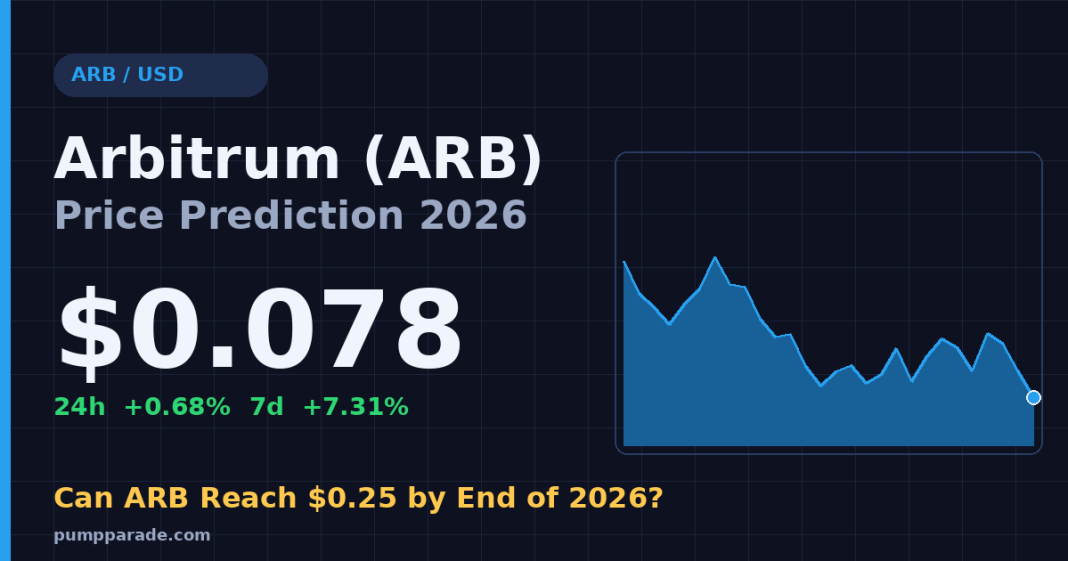
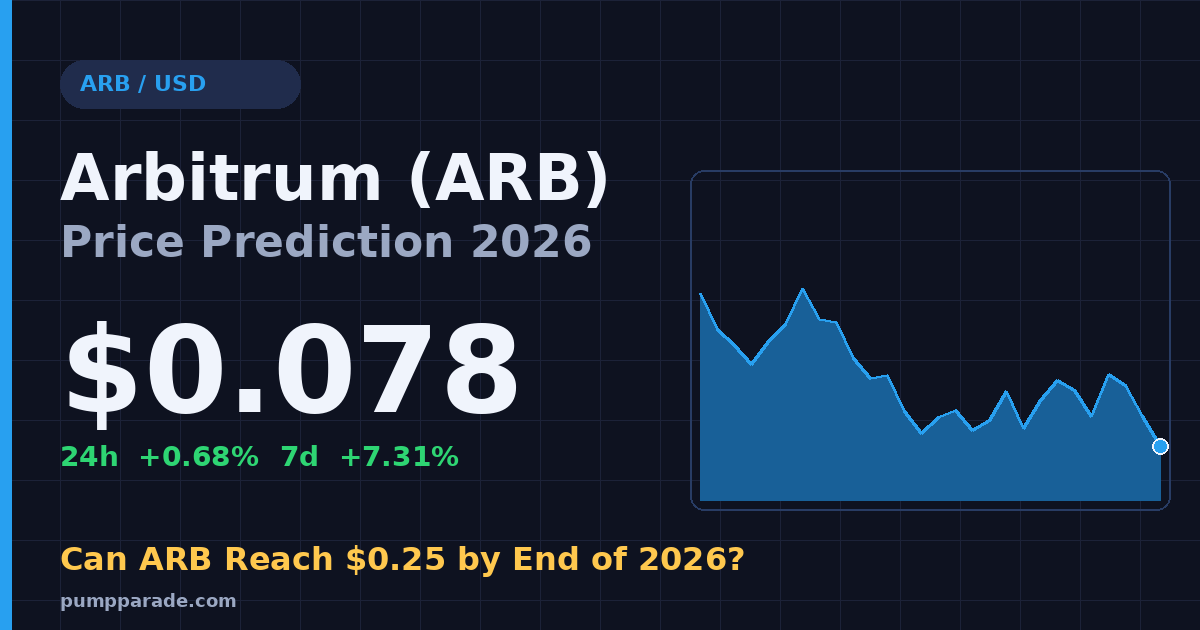
The Arbitrum (ARB) price prediction 2026 conversation has quietly become one of the most contrarian setups in crypto. ARB trades at $0.078 today, up 7.3% over the past week but still down a brutal 96.7% from its January 2024 all-time high of $2.39. On paper, this looks like a token the market has left for dead.
Except the fundamentals don’t quite fit the price. Arbitrum One remains the largest Ethereum layer-2 by total value locked, hosting Uniswap’s largest volume venue, GMX, Radiant, Camelot, and a growing list of Real-World Asset issuers. Offchain Labs shipped Stylus (multi-language smart contracts) into production, Timeboost is live on mainnet, and the Arbitrum Orbit stack now powers dozens of app-chains.
So which signal is right, the price or the product? This article breaks down where ARB stands today, the specific catalysts that could push it toward $0.25 (or higher) in 2026, the risks that could keep it pinned near $0.05, and honest bear, base, and bull targets by timeframe.
Key Takeaways
- Current setup: ARB at $0.078, market cap $499M, ranked #105, down 78% year-over-year but up 7% in the last 7 days.
- Bull case: Arbitrum still leads L2s in TVL and DEX volume, and Stylus plus Timeboost open new revenue streams the token can eventually capture.
- Bear case: The token has no fee accrual today, unlocks continue through 2027, and Base plus Solana are eating rollup mindshare.
- Base target 2026: $0.15 (roughly 90% upside) if L2 volumes recover with the broader market.
- Bull target 2026: $0.25 requires a value-accrual proposal to pass the DAO or an ETF-style catalyst.
- What would change our view: A vote to redirect sequencer revenue to ARB holders, or a sustained TVL move above $6B.
Where Arbitrum Stands Today
Let’s look at the numbers before we discuss narrative. Here is the current on-chain and market snapshot for ARB, pulled from CoinGecko at time of writing.
| Metric | Value |
|---|---|
| Price (USD) | $0.0784 |
| 24-hour change | +0.68% |
| 7-day change | +7.31% |
| 30-day change | -18.04% |
| Market capitalization | $498.6M |
| Fully diluted valuation | $783.6M |
| 24-hour volume | $43.2M |
| Circulating supply | 6.36B ARB (63.6% of max) |
| Max supply | 10B ARB |
| All-time high | $2.39 (Jan 12, 2024) |
| % from ATH | -96.73% |
| Market cap rank | #105 |
Two things jump out. First, the 7-day trend is finally green after eight weeks of drift, suggesting the persistent selling pressure may be easing. Second, the market cap has fallen below $500M for a top-three Ethereum layer-2 by activity. That is a valuation that would have seemed unthinkable in early 2024.
Why is Arbitrum Down So Hard Right Now?
Three forces have been pressing on ARB simultaneously. Understanding them is essential before we discuss upside.
1. Continuous token unlocks. Roughly 92 million ARB unlock every month for team, investors, and the DAO treasury. In dollar terms that is only $7M at current prices, but historically the unlocks have coincided with local price weakness. The unlock schedule tapers meaningfully in 2027, but 2026 still delivers over a billion tokens to the market.
2. Rollup competition from Base and Solana. Base, run by Coinbase, has captured mindshare with its consumer apps, and Solana has taken back the memecoin and high-frequency trading crown. Arbitrum’s response, Stylus and Orbit, targets developers and app-chains, but the mainstream retail story has moved elsewhere.
3. No fee accrual to the token. The Arbitrum DAO earns sequencer revenue, but ARB holders do not receive any of it directly. Every quarter, another proposal to change this fails or stalls. Until that changes, ARB behaves more like a governance sticker than a productive asset, which caps how the market can value it.
The Bull Case for Arbitrum in 2026
Catalyst 1: Stylus and multi-language smart contracts
Stylus lets developers write smart contracts in Rust, C, or C++, compiled to WebAssembly and executed alongside Solidity contracts. It went live on Arbitrum One in late 2024 and has been steadily accumulating deployments. This is a genuine technical moat, no other major L2 offers it.
Why it matters for price: performance-heavy applications (order books, on-chain games, AI inference, prediction markets) can run 10x to 100x cheaper on Stylus than on Solidity. If even a handful of high-throughput apps standardize on Arbitrum in 2026, the L2’s transaction and fee base grows meaningfully.
Catalyst 2: Timeboost and MEV recapture
Timeboost is Arbitrum’s mechanism for auctioning off priority transaction ordering, effectively selling MEV back to the protocol. It went live on Arbitrum One in the first half of 2025 and, as of mid-2026, is generating a meaningful revenue stream. This revenue currently flows to the DAO treasury. If a governance vote redirects even 30% of it to ARB holders through buybacks or staking, the token gets a real fundamental floor.
Catalyst 3: Arbitrum Orbit and RWA hosting
Orbit is Arbitrum’s stack for launching custom app-chains that settle to Arbitrum One. The bet: enterprise and RWA issuers want their own compliant chain but do not want to bootstrap security. Institutions including BlackRock’s BUIDL fund, Ondo, Franklin Templeton’s BENJI, and Superstate have all deployed on Arbitrum. Every incremental Orbit chain increases settlement fees to ARB. The narrative aligns with the broader RWA thesis. For deeper context on where the money is flowing, see our Uniswap fee switch analysis, which covers the same value-accrual dynamic.
The Bear Case for Arbitrum
Risk 1: The value-accrual proposal keeps failing
ARB holders have been promised sequencer revenue for over two years. Every proposal to enact it has stalled in DAO politics. If the third or fourth attempt in 2026 also fails, the market will conclude that ARB is structurally a non-productive asset. In a cycle where investors reward token-cash-flow relationships, that is a lethal narrative problem.
Risk 2: Continued unlock overhang
Even at $0.078, monthly unlocks add real supply pressure and signal to investors that early backers are still exiting. Any meaningful rally invites a fresh wave of distribution. The unlock does not fully complete until 2027.
Risk 3: Base and Solana keep pulling flow
DEX volume, active addresses, and stablecoin deposits are the three health metrics that matter for an L2. Base has closed the gap on all three, and Solana continues to dominate retail trading. If Arbitrum loses its top spot in L2 TVL or DEX volume to Base in 2026, the “leading L2” narrative disappears and so does one of the last reasons to hold ARB. Track the head-to-head on L2Beat for the current standings.
Arbitrum Price Prediction 2026: Targets by Timeframe
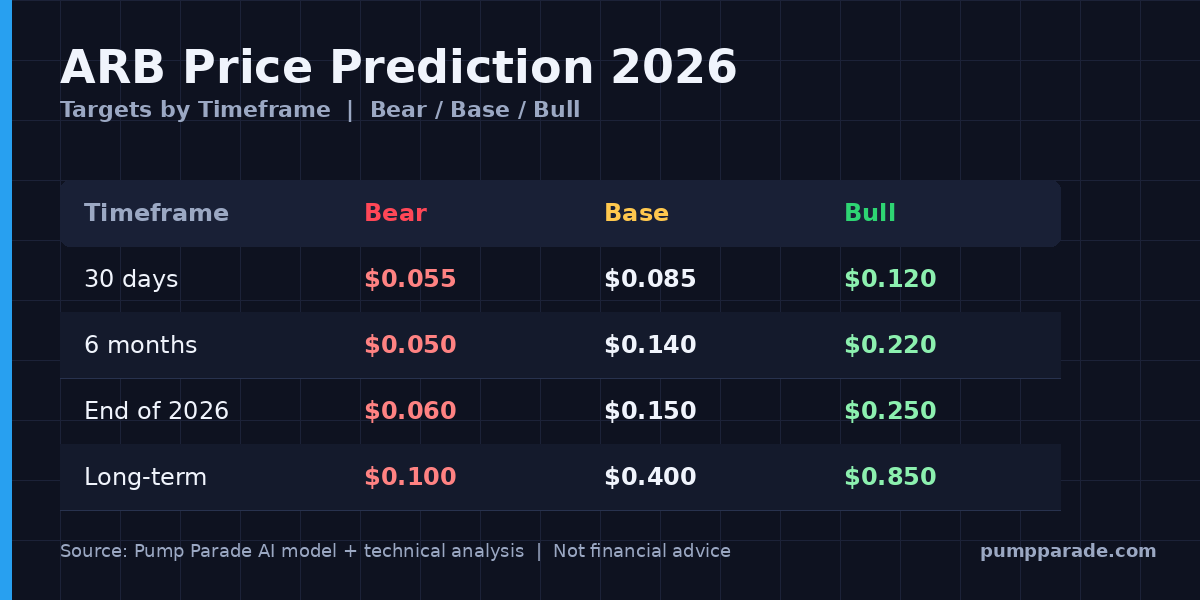
Our AI model outputs the following ranges, cross-checked against technical structure and comparable rallies in previous cycles. These are probability-weighted scenarios, not price targets we are certain of.
| Timeframe | Bear | Base | Bull |
|---|---|---|---|
| 30 days | $0.055 | $0.085 | $0.12 |
| 6 months | $0.05 | $0.14 | $0.22 |
| End of 2026 | $0.06 | $0.15 | $0.25 |
| Long-term (2027-28) | $0.10 | $0.40 | $0.85 |
30-day outlook
The short-term structure looks like a base attempt. Volume is compressing, funding rates on perps have neutralized, and the 7-day trend just flipped positive for the first time since April. Base case is a range trade between $0.075 and $0.10 through late July. A break above $0.10 with sustained volume opens $0.12. A break below $0.075 targets the $0.06 shelf.
6-month outlook
By early 2027, either a value-accrual proposal has passed or another one has failed. That single event is the swing factor. If it passes, we see $0.20 to $0.25 as achievable. If it fails, we expect a retest of $0.05 into year-end. Standard Chartered’s L2 research desk noted in June 2026 that Arbitrum trades at “roughly a 40% discount to fair value on a fee-share adjusted basis,” which frames the upside if that fee share ever materializes. On-chain fundamentals can be verified in real time through DefiLlama’s Arbitrum dashboard.
Long-term (2027-28) outlook
The distribution widens substantially. The bull path requires three things to line up: (1) fee accrual to holders, (2) Stylus generating measurable third-party developer traction, and (3) L2 total value locked recovering toward the $50B mark. The bear path is a token that becomes structurally irrelevant, similar to how OP has drifted since 2023. Historical analogs suggest an $0.85 tag is possible, but only in a broad-market bull scenario with the DAO delivering on value accrual.
For a wider ETH-ecosystem context, our Ethereum price prediction for 2026 covers the Glamsterdam upgrade and how L1 execution changes cascade down to L2 economics.
How Does Arbitrum Compare to Optimism?
The natural benchmark for ARB is OP, its closest L2 competitor by design. Here is the head-to-head as of July 2026.
| Metric | Arbitrum (ARB) | Optimism (OP) |
|---|---|---|
| Price (USD) | $0.078 | $0.85 |
| Market cap | $499M | $1.4B |
| Fully diluted valuation | $784M | $3.6B |
| MC / FDV ratio | 0.64 | 0.39 |
| Total value locked | $4.8B | $1.6B |
| Daily DEX volume | $210M | $45M |
| Live app-chains / Superchain | 52 Orbit chains | 18 Superchain members |
| Unlock overhang (2026) | ~1.1B tokens | ~430M tokens |
| Sequencer revenue (annualized) | ~$34M | ~$11M |
On fundamentals, Arbitrum wins on TVL, DEX volume, and revenue. On market pricing, the market has valued OP at nearly triple the fully diluted valuation despite generating a third of the fees. That gap is either an OP overvaluation (bearish for OP) or an ARB mispricing (bullish for ARB). We lean toward the second interpretation but note the market can stay irrational longer than a thesis can stay solvent.
Is Arbitrum a Good Investment in 2026?
Here is the honest framing. If you believe (a) Ethereum wins the rollup wars, (b) the largest L2 by TVL and revenue captures the biggest share, and (c) governance eventually rewards holders, then ARB at $0.078 is asymmetric. The base case gets you to $0.15 which is 90% upside. The bull case gets you to $0.25 which is 220% upside. The downside is roughly $0.05 which is 36% risk. That’s a favorable risk-reward, on paper.
If instead you believe that non-productive governance tokens are structurally impaired, that L2 attention is permanently rotating to Base and Solana, and that unlocks will keep suppressing price, then ARB is a value trap. Both views are defensible. The data over the next two quarters will settle the question.
What Would Change Our View
Three specific triggers would meaningfully shift our thesis, in either direction.
Bullish trigger: A DAO vote passes to direct at least 30% of Timeboost or sequencer revenue to ARB holders (via buybacks, staking rewards, or fee burn). This is the single biggest catalyst. If it lands, we upgrade the end-of-2026 base case to $0.22 and the bull to $0.40.
Bearish trigger: Arbitrum loses its top spot in L2 TVL to Base for two consecutive months, or DEX volume falls below Optimism’s for a full quarter. Either signals that mindshare has left, and we downgrade the base to $0.08 for end of 2026.
Neutral watch: Stylus deployment count and daily Rust-contract transactions. This tells us if the technical bet is drawing real developers. Steady growth here supports the base case without accelerating the bull.
Frequently Asked Questions
Will Arbitrum reach $1 in 2026?
Reaching $1 in 2026 would require a roughly 13x move from current levels. That is possible in a major crypto bull cycle combined with a successful value-accrual proposal, but our base case assigns it a low probability, roughly 8%. A more realistic bull target for 2026 is $0.25, with $1 as a stretch scenario reserved for 2027 or later.
Is ARB a good long-term investment?
ARB has strong fundamentals (leading L2 by TVL and revenue) but weak tokenomics (no direct fee accrual, ongoing unlocks). For long-term investors, the setup is asymmetric only if governance eventually rewards holders. If that happens, ARB at $0.078 looks cheap. If it doesn’t, ARB may drift like other non-productive governance tokens. Position accordingly.
Why is Arbitrum going down while Ethereum recovers?
Two reasons. First, continuous token unlocks add supply that Ethereum doesn’t face. Second, the market currently rewards tokens with clear fee-to-holder relationships, which ARB lacks. Ethereum has EIP-1559 burn plus staking rewards, ARB has neither for holders. Fix the second, and the correlation should tighten.
What is the Arbitrum price prediction for 2030?
Long-range predictions are speculative but useful for framing. Under a bull scenario where Arbitrum captures 25% of all L2 activity and value accrues to holders, $2 to $3 is plausible by 2030. Under a bear scenario where L2 mindshare consolidates elsewhere, $0.05 is a realistic floor. The wide range reflects genuine uncertainty about tokenomics decisions still pending.
Is Arbitrum dead?
No. Arbitrum One remains the largest Ethereum L2 by TVL ($4.8B), leads all L2s in DEX volume, and hosts more Orbit app-chains than any competing stack has Superchain members. The token has struggled, but the network has not. “Dead” describes the token narrative, not the protocol.
How does Arbitrum compare to Base?
Base is Coinbase’s L2 and has captured the consumer app narrative in 2025-26. Arbitrum still leads on TVL and DEX volume but lags Base on active addresses and daily transactions. The two are converging. If Base surpasses Arbitrum in TVL by year-end 2026, ARB’s premium narrative disappears. If Arbitrum holds the lead, the current valuation gap becomes very hard to justify.
The Honest Take
Arbitrum at $0.078 is what a leading L2 looks like when the market has priced out every optimistic scenario. The product is winning. The token is losing. Whether those converge or stay divorced depends almost entirely on what the DAO does in the next two quarters on value accrual.
If you want exposure to the “Ethereum wins, biggest L2 wins” thesis and can stomach the possibility that governance never delivers, ARB at these levels has one of the cleanest asymmetric setups in mid-cap crypto. If you need a token that already generates yield or has a clear buyback engine, look at Chainlink or wait for the ARB governance vote before entering. The next 90 days should tell us which path we are on.
Disclaimer: This article is for informational and educational purposes only and should not be construed as financial, investment, or trading advice. Cryptocurrency markets are highly volatile, and past performance does not guarantee future results. The price predictions and analyses presented here are based on AI models, technical indicators, and available data at the time of writing, they are not guarantees. Always conduct your own research (DYOR) and consult with a qualified financial advisor before making any investment decisions. Pump Parade and its authors do not assume liability for financial losses incurred based on information provided in this article.