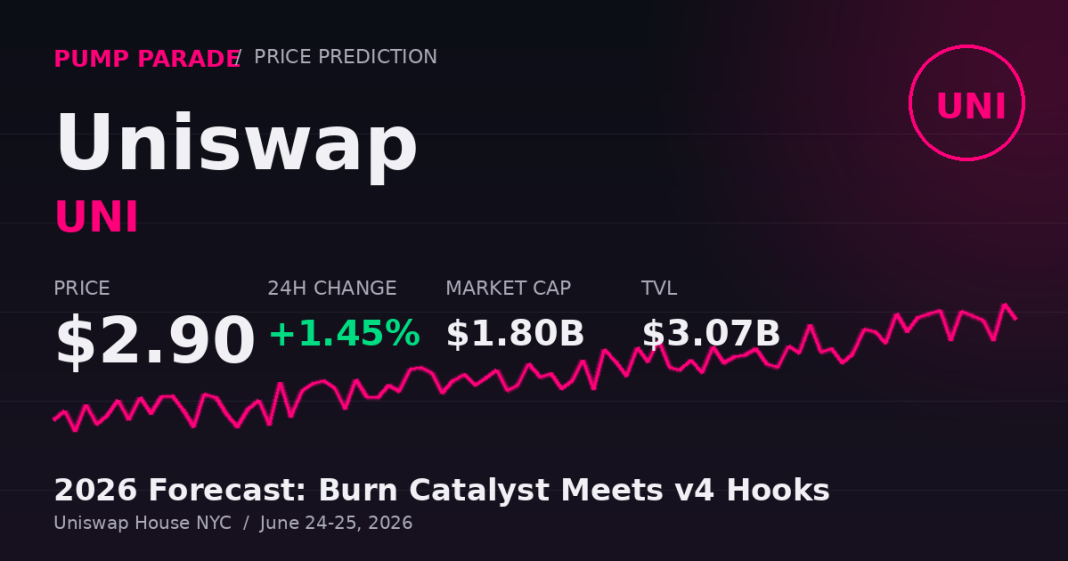
Uniswap (UNI) trades at $2.90 today, up 1.45% on the day but still down nearly 17% over the last week. The token has burned 100 million UNI since December, launched a fee switch, and watched v4 process a fifth of all Ethereum DEX volume. None of it has fixed the chart.
That tension is the story right now. Uniswap House opens in New York City today, June 24, 2026, and runs through tomorrow. The two-day event packs 32 speakers across 15 talks, all centered on v4 hooks, institutional DeFi, and AI-powered UX. The protocol has never had more product to sell. The token has rarely traded with less enthusiasm.
This Uniswap price prediction breaks down the real data, the burn math, and the catalysts that could finally pull UNI off the floor.
Uniswap Price Today: Where UNI Actually Stands
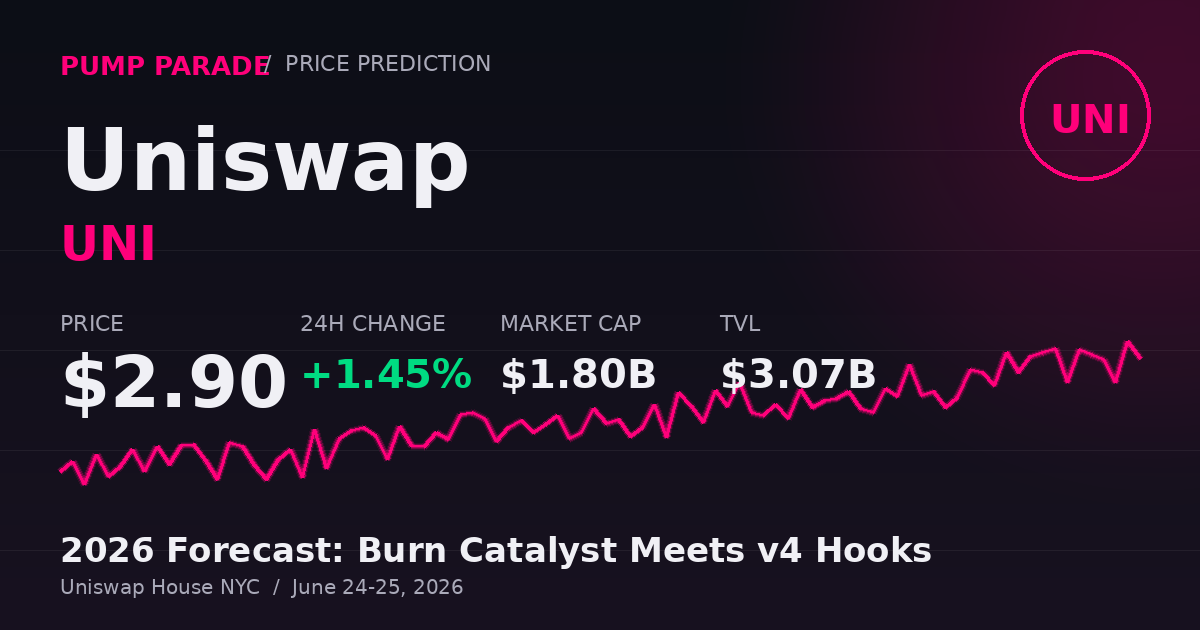
Here is the current snapshot. UNI is at $2.90 with a market cap around $1.80 billion and a fully diluted valuation near $2.59 billion. Daily volume sits at roughly $137 million. Total Value Locked across all Uniswap pools is just over $3.07 billion, more than the market cap of the token itself.
The recent price action looks ugly on every meaningful timeframe. UNI is down 17% over seven days, 14% over thirty days, and 58% over the past year. The all-time high of $44.92 set in May 2021 looks like ancient history. Yet the protocol underneath the token is doing more volume than at any point in its existence.
According to CoinGecko data, Uniswap still processes between 50% and 65% of weekly decentralized exchange volume depending on chain activity. That dominance has not translated into UNI buyers. The market is asking a fair question: if v4 is winning, why is UNI losing?
The UNIfication Burn: A Slow Fuse
The biggest structural change to UNI in years happened in late December 2025. Uniswap governance approved the UNIfication proposal, which burned 100 million UNI tokens from the supply and flipped the long-debated protocol fee switch.
Here is how the new fee math works. On v2 pools, the LP share dropped from 0.30% to 0.25%. The 0.05% difference now goes to the protocol. On curated v3 pools, the protocol takes 25% of LP fees on the lowest tiers and 16.7% on the highest. Those fees fund a programmatic UNI burn that runs continuously.
The 100 million tokens burned in December represented about 14% of the circulating supply at that time. The supply now sits near 621.6 million UNI against a 1 billion max. Over time, the burn flow should pull more tokens out of circulation if v4 volume keeps climbing.
So why has the price not responded? Two reasons. First, the fee burn has only been live for about six months. The absolute UNI removed per week is still small relative to the float. Second, the broader market priced UNI as a governance token for years. The shift to a cash-flow asset takes time to digest. Both factors fade with time, which is part of the bull thesis.
V4 Hooks: The Product That Could Actually Move UNI
Uniswap v4 went live on Ethereum mainnet on January 30, 2026, with simultaneous deployments on Arbitrum, Base, Optimism, and Polygon. By the end of Q1, v4 pools had attracted more than $4 billion in TVL and were processing roughly 20% of all DEX volume on Ethereum mainnet.
The unlock is hooks. A hook is a small piece of code that runs at specific points in a pool’s life. It can fire before a swap or after liquidity is added. Builders can use hooks to ship dynamic fees, MEV protection, custom oracles, on-chain limit orders, or whatever else they can write. More than 1,500 builders joined hook programs in 2025 and over 2,500 custom liquidity pools have been deployed.
Why does this matter for UNI? Hooks turn Uniswap from a single AMM into a programmable liquidity layer. Every new hook adds reasons for liquidity to land on v4 instead of a competitor. More volume means more fees, more fees means more burn, more burn means tighter supply. The story works if v4 share keeps climbing. Most analysts expect v4 to pass 50% of Uniswap volume by the end of 2026.
For traders comparing the broader DEX landscape, our Raydium vs Orca DEX comparison shows how the Solana DEX market is fragmenting in parallel. That fragmentation is part of why Uniswap is racing to ship hooks fast.
Institutional DeFi and Tokenized Stocks
The other Uniswap catalyst is one the token holder base barely talks about. Uniswap is becoming a tokenized asset venue. Users can now trade tokenized versions of SpaceX, Apple, Tesla, and NVIDIA shares through the Uniswap app, wallet, and API. UniswapX is integrated with Securitize for BlackRock’s BUIDL fund.
If real-world assets become a meaningful slice of DEX volume, Uniswap captures protocol fees on every trade. Standard Chartered modeled this out and projects UNI targets of $6.50 in 2026 and up to $100 by 2030. That long-dated number is aggressive and rests on tokenized asset volume scaling through the late 2020s. The 2026 target is closer to consensus and roughly aligns with our base case below.
UNI Technical Outlook: Where the Chart Stands
UNI’s chart is a study in repeated tests of the $2.50 to $3.00 range. The token has bounced off the low end of that band three times in 2026. Each bounce has stalled before reclaiming the 200-day moving average near $3.40. Bulls need a clean break and hold above $3.40 to confirm a trend change.
The 24-hour high is $2.94 and the low is $2.84. Volume around $137 million is below the 30-day average. That tells you the market is waiting for a catalyst, not selling hard. Uniswap House could be that catalyst if a major v4 product launch or partnership drops during the event.
Bearish counter-argument: UNI has had catalysts before. The fee switch was the holy grail for years. It activated, and the price kept drifting lower. Some traders are now treating UNI as a value trap rather than a growth bet. That view is fair until the burn rate gets big enough to matter.
UNI Price Prediction by Timeframe
Short-Term: Next 30 Days (July 2026)
The 30-day window is driven by sentiment from Uniswap House and the broader DeFi tape.
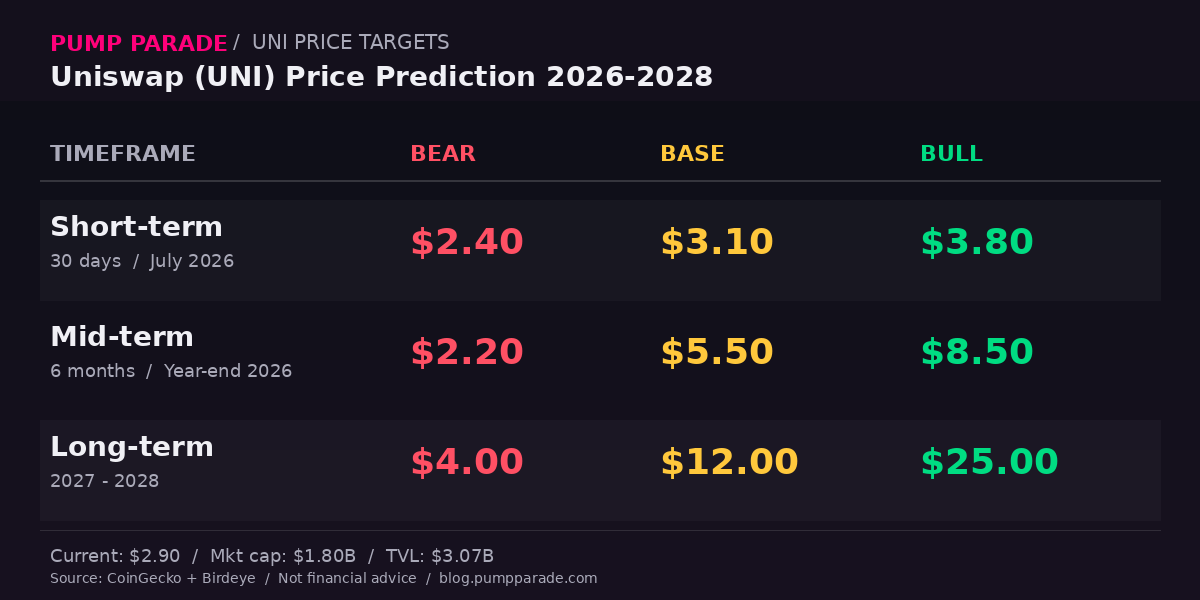
Bear: $2.40. NYC event passes without a major product reveal and macro stays risk-off. UNI breaks the $2.50 support and tests the 2026 lows.
Base: $3.10. The event delivers solid news on hooks adoption and a couple of institutional partnerships. UNI recovers to the 50-day average and consolidates.
Bull: $3.80. A major partnership drops, possibly with a top-tier hook developer or a tokenized asset issuer. UNI breaks $3.40 and runs to retest the spring 2026 highs.
Mid-Term: 6 Months (Year-End 2026)
The 6-month view depends on v4 share, burn velocity, and whether real-world asset volume scales.
Bear: $2.20. v4 growth stalls, competing DEXs eat share, and the burn fails to outpace governance unlocks. UNI keeps grinding.
Base: $5.50. v4 captures the projected 50% of Uniswap volume, fee burn ramps, and RWA flows add a meaningful slice of volume. This aligns roughly with the Standard Chartered 2026 target.
Bull: $8.50. A breakout DeFi quarter, tokenized assets cross 10% of UniswapX volume, and the burn becomes visible in supply data. UNI re-rates to a cash-flow multiple.
Long-Term: 2027 to 2028
This is the cash-flow thesis. If protocol fees compound and supply keeps shrinking, UNI becomes a different kind of asset.
Bear: $4.00. DeFi share peaks, hook innovation slows, and a competitor wins the next cycle of liquidity wars.
Base: $12.00. Uniswap remains the dominant DEX, v4 hooks become an ecosystem standard, and the burn meaningfully tightens supply over two years.
Bull: $25.00. Tokenized stocks and bonds become real volume on UniswapX. The protocol captures a slice of every DEX trade through aggregator hooks. UNI trades like a high-multiple fintech.
Risk Factors Worth Watching
A few things could break this thesis. Regulatory action on tokenized securities is the biggest single risk. If U.S. regulators force Uniswap to geo-block tokenized stocks, the RWA leg of the bull case weakens. Second, a major hook exploit would dent the trust in v4 and slow developer adoption. Third, the broader Ethereum gas market matters. If L2 economics shift hard and rollup fees compress, Uniswap’s share of total DEX volume on layer 2s could move in unexpected directions.
The crypto market overall remains in a neutral to cautious posture, with total market cap near $1.68 trillion as of mid-June 2026. Bitcoin sits in a tight range and the Fed has signaled it is in no rush to cut. UNI will trade with that tape until it does not.
The Bottom Line on Uniswap Price
UNI at $2.90 is a value-versus-growth debate. The growth case rests on v4 hooks, tokenized assets, and a fee burn that compounds quietly. The value trap case is the obvious one: every prior catalyst has failed to move the price.
Our base case puts UNI around $3.10 in 30 days and $5.50 by year-end 2026, with $12 plausible by 2027 to 2028 if the burn math works. The bull case stretches to $8.50 by year-end and $25 over the longer view. The bear case is real and warrants stops below $2.40 if you trade the breakout.
Uniswap House this week is a useful read on sentiment. Watch the announcements out of New York. If a hook partnership lands with a recognized institutional player, the chart story changes quickly. If the event passes quietly, the slow burn thesis is your only edge.
Disclaimer: This article is for informational and educational purposes only and should not be construed as financial, investment, or trading advice. Cryptocurrency markets are highly volatile, and past performance does not guarantee future results. The price predictions and analyses presented here are based on AI models, technical indicators, and available data at the time of writing, they are not guarantees. Always conduct your own research (DYOR) and consult with a qualified financial advisor before making any investment decisions. Pump Parade and its authors do not assume liability for financial losses incurred based on information provided in this article.