Buying a Solana memecoin used to mean juggling a wallet seed phrase, a DEX aggregator, a slippage slider, and a stack of failed transactions. Moonshot wants to collapse all of that into a single tap. With Apple Pay funding, a curated discovery feed, and a self-custodial wallet hiding under the hood, it has become one of the most downloaded crypto apps for memecoin traders on Solana. But is the convenience worth the fee, and how has the product changed since Jupiter took a majority stake in January 2025?
This Moonshot review for 2026 covers the features, fees, security model, user experience, and competitive position so you can decide whether it deserves a permanent spot on your home screen.
Quick Verdict (TL;DR)
Moonshot is the easiest way to buy a Solana memecoin with a credit card or Apple Pay, full stop. The mobile-only experience is genuinely polished, the self-custodial setup is invisible to the user, and post-Jupiter integration has tightened the routing and discovery layer. The catch is the fee. At 2.5 percent on smaller trades, you are paying for convenience, not cost efficiency.
Rating: 4.0 / 5. Best for new traders, mobile-first users, and anyone who values speed over squeezing every basis point. Not the right choice for active scalpers or whales chasing the cheapest possible execution.
Visit Moonshot to try the app, or keep reading for the full breakdown.
What Is Moonshot?
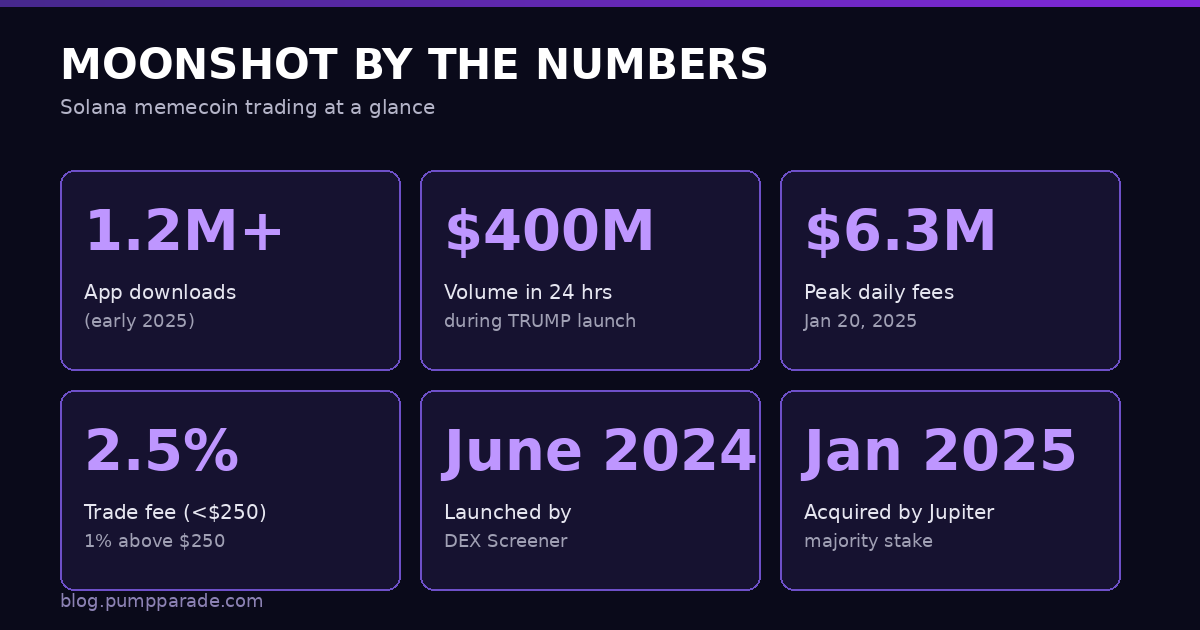
Moonshot is a mobile-first, self-custodial trading app focused on Solana memecoins. It was launched in June 2024 by the team behind DEX Screener, the dominant on-chain analytics dashboard for new tokens. The product is available on iOS and Android. There is no desktop version, by design.
The pitch is simple. Open the app, sign in with email or social login, fund it with Apple Pay, a card, or crypto, and you can buy any Solana token in a few taps. The wallet keys are generated and protected via Multi-Party Computation through Turnkey, so users never see a seed phrase, but they still retain control of the funds. Fiat on and off ramps are handled by MoonPay, Coinbase Pay, and Robinhood Connect, depending on region and payment method.
In January 2025, Jupiter acquired a majority stake in Moonshot, in the same week it picked up portfolio tracker SonarWatch. The acquisition came on the back of a record period during the launch of the Official Trump memecoin, when Moonshot added more than 400,000 new users in 24 hours and processed close to 400 million dollars in trading volume. That single weekend was enough to put the app on every Solana trader’s radar.
Key Stats at a Glance
Moonshot is no longer a niche side project. The numbers from the past 18 months tell a clear story.
For a publicly visible record of total trading fees Moonshot has generated, the community-maintained Dune dashboard is the cleanest source. DeFiLlama tracks fee revenue as well and is useful for comparing Moonshot to other Solana front ends.
Features Deep Dive
Onboarding and Funding
Onboarding is where Moonshot earns most of its credit. New users can be transacting within roughly two minutes. Sign in with Apple, Google, or email, accept terms, and the wallet is spun up in the background. Funding options include Apple Pay, debit and credit cards, ACH in supported regions, and deposits in SOL, USDC, or USDT.
The Apple Pay flow in particular is unusually clean for crypto. Most competitors still bounce users to a third party Stripe-style checkout. Moonshot keeps the experience native, even though MoonPay is processing the fiat behind the scenes.
Discovery and Trading
The home feed surfaces trending tokens with recent volume, price action, and basic charts, similar to a stripped down DEX Screener inside a phone-shaped frame. Tapping a token opens its detail page with contract address, holders, security checks, social links, and a single buy or sell button. Slippage is set automatically with a 5 percent dynamic ceiling, which is reasonable for memecoins but worth tightening manually if you are buying liquid majors.
Since the Jupiter acquisition, swap routing has been tied more deeply into the Jupiter aggregator backend, which generally improves execution on less liquid pairs compared to the earlier in-house routing.
Withdrawals and Sends
Users can withdraw to a bank account through the same fiat partners, or send tokens out to any external Solana wallet such as Phantom, Backpack, or Solflare. Moonshot does not charge an administrative fee on sends, only the standard Solana network cost.
Token Launchpad
Moonshot also includes a lightweight launchpad. Anyone can mint a memecoin from the app with a fixed configuration, then trade it on the same surface. This feature is less aggressive than pump.fun’s bonding curve model and skews more toward casual creators than launchpad farmers.
Fees and Pricing
Moonshot’s fees are the single biggest source of debate among users, and they deserve a careful look.
Trading fees follow a two tier structure as published in the official Moonshot fee documentation:
- Trades from 1 to 250 USD: 2.5 percent platform fee, with a minimum fee of roughly 0.99 USD per trade.
- Trades above 250 USD: 1 percent platform fee.
These figures are inclusive of the network fees and priority fees that Moonshot pays on behalf of users to keep transactions landing during congestion. That coverage is the main justification for the spread. A direct on-chain swap on Jupiter typically costs only a few cents in Solana fees plus a small DEX fee, but you have to manage your own priority and slippage.
Fiat fees are layered on top by MoonPay. A typical Apple Pay or card deposit in the US adds roughly 3.5 to 4.5 percent depending on the size of the deposit and the card type. ACH and crypto deposits are significantly cheaper.
Slippage defaults to a 5 percent dynamic tolerance. That is generous and intentional given how violently memecoin prices move, but it means you can sometimes receive notably less than the quoted amount. Power users should reduce this manually for stable pairs.
A practical takeaway. For a 100 dollar buy of a brand new memecoin funded with Apple Pay, you are probably looking at a total all in cost in the 5 to 7 percent range once platform and fiat fees stack. That is real money, but it is also competitive with Robinhood and Coinbase consumer pricing for similar speculative tokens.
Pros and Cons
Pros
- Fastest fiat to Solana memecoin path in mobile crypto. Apple Pay onboarding is best in class.
- Self-custodial wallet without a seed phrase, secured by MPC via Turnkey.
- Tight integration with Jupiter routing since the 2025 acquisition.
- Built in launchpad and discovery feed, useful for casual traders.
- No administrative fee on outbound sends to external wallets.
- Strong backing from Alliance and now Jupiter, with a credible operational track record.
Cons
- 2.5 percent fee on smaller trades is high versus direct DEX swaps.
- Mobile only, no desktop or web app for power users.
- Default 5 percent slippage can hurt on stable pairs if not adjusted.
- Founding team remains pseudonymous, though investor backing is public.
- Withdrawal limits and KYC requirements vary by region and payment method.
- Limited chart and order book features compared to dedicated trading terminals.
Security and Trust
Security is the area where Moonshot has worked hardest to look adult. The wallet uses Multi-Party Computation through Turnkey, meaning the private key is split into shares and never reconstructed in one place. There is no seed phrase to lose, but the user can still export the underlying key to import the wallet elsewhere, which preserves the self-custody promise.
Fiat compliance is delegated to regulated providers. MoonPay, Coinbase Pay, and Robinhood Connect are all licensed money transmitters in the regions they operate, which is what allows Moonshot to live in the Apple App Store and Google Play.
The remaining risk surface is the application layer. Moonshot has not publicly disclosed a comprehensive security audit of its in app routing and order construction, which is something the team should address as the product matures. Sensitive operations should still be performed on a hardware wallet such as Ledger or Trezor for larger balances.
User Experience
This is where Moonshot earns its reputation. The app feels closer to a modern consumer fintech product than to a crypto wallet. Animations are smooth, copy is plain English, and you can complete a full buy in well under 60 seconds from a cold start. There is genuine attention paid to the kind of details that newer crypto users actually struggle with, such as understanding what slippage means or why a transaction failed.
The home feed, while not as data dense as DEX Screener or Birdeye, is good enough to act on if you are scanning for movers. Notifications can be configured for price moves on watchlisted tokens, which is useful when a memecoin starts running.
The biggest UX shortcoming is the lack of advanced trading tools. There are no limit orders, no stop losses, and no advanced charting. For anything beyond casual entries and exits, a dedicated terminal like Photon or BullX is still the right tool. Moonshot is explicitly not trying to be that product.

How Moonshot Compares
For Solana memecoin traders the practical competitive set is roughly:
- Direct DEX via Phantom or Backpack: Cheapest pure execution, requires more setup and seed phrase management.
- pump.fun: Launchpad first, lower fees during the bonding curve, but a different product surface.
- Photon, BullX, GMGN, Trojan: Pro trading terminals with limit orders, copy trading, and faster sniping. Much higher learning curve.
- Coinbase or Robinhood: Easier fiat onramp than ever, but extremely limited memecoin selection.
Moonshot sits in a clear lane: easier than the DEX, broader than Coinbase, simpler than the pro terminals. That is a real position to occupy.
Verdict
If you are a new or casual Solana memecoin trader who values speed and simplicity over saving a few basis points on every fill, Moonshot is the most polished mobile option available in 2026. The Jupiter acquisition has made the routing better, the team has more resources, and the product still feels miles ahead of any other consumer crypto app on iOS. Pay the convenience premium with eyes open, keep large balances elsewhere, and adjust slippage when you are not buying a brand new ticker.
If you are an active trader running multi token entries, scalping low caps, or executing strategies that require limit orders and faster sniping, Moonshot is not your primary tool. Use a pro terminal and treat Moonshot as the fiat ramp for your hot wallet.
Final rating: 4.0 / 5. The best mobile memecoin app for the general market, with a fee structure that is honest about what it is paying for.
Try Moonshot here if you want to test it firsthand. Start with a small deposit, look at the realised fee on the receipt, and decide whether the convenience is worth it for your style.
FAQ
Is Moonshot safe to use?
Moonshot is a self-custodial wallet protected by Multi-Party Computation via Turnkey, with fiat handling delegated to regulated providers like MoonPay. It is broadly safe for everyday use, but large balances should be held on a hardware wallet, and users should still verify token contracts before buying.
What are Moonshot’s fees in 2026?
Trades from 1 to 250 USD incur a 2.5 percent platform fee, with a minimum of about 0.99 USD. Trades above 250 USD are charged 1 percent. Network and priority fees are included. Fiat deposit fees from MoonPay are separate and depend on the payment method.
Is Moonshot owned by Jupiter?
Jupiter acquired a majority stake in Moonshot in January 2025. The product continues to operate under the Moonshot brand, but routing and back end infrastructure are increasingly tied into the Jupiter ecosystem.
Can I use Moonshot outside the US?
Yes. Moonshot is available in most regions where the App Store and Google Play distribute crypto apps, although fiat funding options vary by country. Some payment methods such as ACH are US only.
Does Moonshot support chains other than Solana?
The core experience is built around Solana memecoins. Some token expansion has been added through the Jupiter integration, but Solana remains the primary chain. Users wanting heavy multichain exposure should pair Moonshot with a broader wallet like Phantom or Rabby.