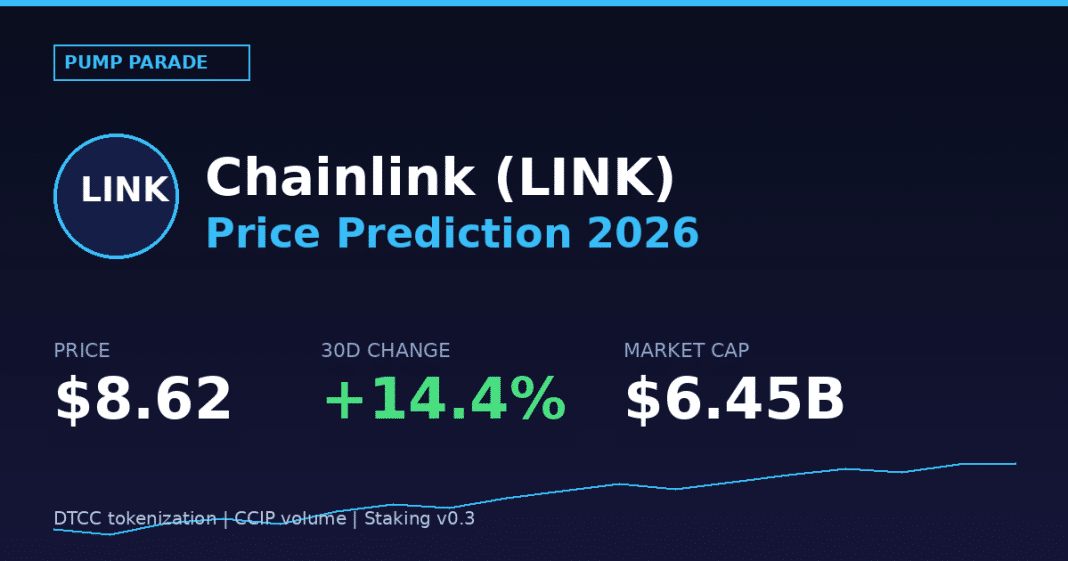
Chainlink (LINK) is trading at $8.62 as of July 23, 2026, up 14.4% over the past 30 days and holding above the psychological $8 level for the sixth straight session. It sounds ordinary. It is not. On July 15, DTCC quietly executed the first production trades of tokenized U.S. securities, involving BlackRock, Vanguard, Goldman Sachs, and JPMorgan, running on Chainlink’s Cross-Chain Interoperability Protocol (CCIP) and Runtime Environment. Wall Street is now, however cautiously, moving real assets across chains, and the plumbing wears a LINK sticker.
That is the setup for the most consequential Chainlink price prediction 2026 question in a year: does institutional adoption finally translate into a token that reflects it? LINK is still down 54% from July 2025 and 84% below its 2021 all-time high of $52.70, which tells you the market is not pricing in the pipeline. Bulls call that a mispricing. Bears call it fair.
This article breaks down where LINK is right now, the specific catalysts that could push it toward $20 (and the ones that could push it back to $5), a bear/base/bull framework for 30 days, six months, and 2027-28, and a head-to-head comparison with Pyth Network. Data comes from CoinGecko, Birdeye, and Chainlink’s public disclosures.
Key Takeaways
- Current setup: LINK trades at $8.62 with a $6.45B market cap. It is up 14.4% in 30 days but still down 54% year over year.
- Primary catalyst: DTCC’s tokenization service (October 2026 launch) and Collateral AppChain (Q4 2026) both run on Chainlink CCIP. Over 30 institutions are involved.
- Bull scenario: A CCIP fee re-rating combined with staking v0.3 could push LINK toward $18-$22 by mid-2027 if institutional volume follows through.
- Bear scenario: Roughly 252 million LINK are still outside the circulating supply. Continued unlocks and slow token-level value capture keep the price capped near $6-$8.
- Base case: LINK trades in a $10-$14 range through year-end 2026, with $20 as a stretch target contingent on Q4 DTCC launch data.
- Watch these levels: $8.00 support, $10.20 resistance, $12.80 breakout confirmation.
Where Chainlink Stands Today
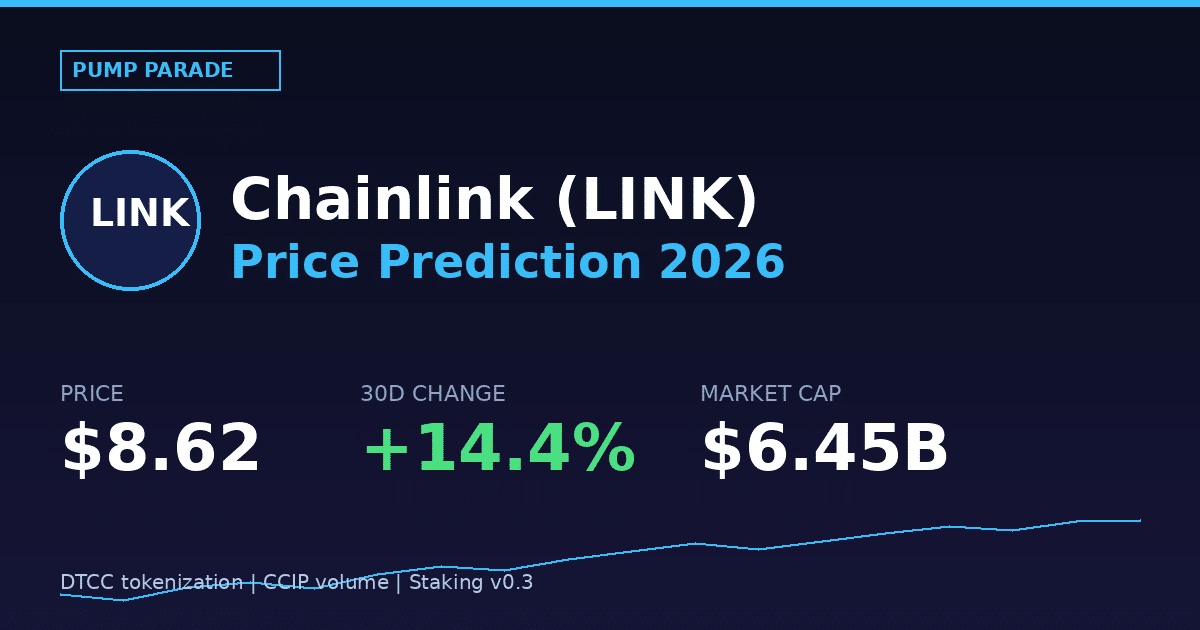
Before we get into catalysts, the numbers. This is the snapshot our AI model is working with as of July 23, 2026.
| Metric | Value |
|---|---|
| Price | $8.62 |
| 24h change | +0.12% |
| 7-day change | +2.58% |
| 30-day change | +14.40% |
| Market cap | $6.45B |
| 24h volume | $174M |
| Rank | #19 |
| Circulating supply | 748.1M LINK |
| Max supply | 1B LINK |
| All-time high | $52.70 (May 2021) |
| % from ATH | -83.6% |
Two things stand out. First, volume of $174M against a $6.45B market cap gives a healthy turnover ratio of about 2.7%, which is on the higher end for a top-20 asset. That is a market with buyers and sellers actually meeting, not a thin drift up. Second, LINK is still deeply underwater on a one-year basis while its network fundamentals have improved sharply, which is either an opportunity or a warning depending on how you read the tape.
Why Is Chainlink Rising Right Now?
The 14% move over 30 days is not random. Three things happened between mid-June and mid-July that changed how allocators talked about LINK.
The first was the DTCC production trades on July 15. The Depository Trust and Clearing Corporation is the settlement rail underneath U.S. equity markets, and it went live with tokenized versions of Microsoft, SPY, QQQ, and Treasuries using Chainlink CCIP as the interoperability layer. Not a pilot. Not a whitepaper. Actual securities settling across chains.
The second was Mantle migrating its $2.5B Super Portal to CCIP in late June, joining a growing list of large-cap DeFi protocols that use Chainlink for cross-chain messaging rather than building their own bridges. Aave selected Chainlink for automated vault rebalancing in the same window.
The third is quieter but structural: whales added approximately 14M LINK to on-chain wallets over the past six weeks, per Nansen tracking. Accumulation of that size at these levels historically precedes 20-40% legs, though it is not a guarantee.
The Pyth Network price story has taken oxygen out of some of the oracle narrative this cycle, but the DTCC news reset the frame: for tokenized real-world assets specifically, institutions picked Chainlink.
The Bull Case for LINK
DTCC and the October Tokenization Service Launch
DTCC has publicly confirmed an October 2026 launch date for its Tokenization Service, followed by the Collateral AppChain in Q4. Both platforms rely on Chainlink’s CCIP and CRE (Chainlink Runtime Environment) to move tokenized cash, equities, and Treasuries across chains and settlement environments. This is the strongest institutional signal LINK has ever had. If even a fraction of the $2.6 trillion daily volume DTCC processes flows through CCIP-connected rails over the next two years, fee capture at the protocol level scales meaningfully.
CCIP Volume Growth and Fee Compounding
CCIP processed over $18 billion in transfer volume during Q1 2026, up 78% quarter-over-quarter. Q2 data suggests another double-digit sequential increase. Chainlink’s own metrics show CCIP is now integrated into more than 45 blockchains, including Solana, Base, and Arbitrum. Fees from CCIP flow into the Chainlink service network and, via the LINK-locked staking mechanism, back to stakers. The higher volumes go, the tighter the effective float becomes.
Staking v0.3 and Supply Compression
Chainlink Staking currently locks approximately 45 million LINK. The upcoming v0.3 release, expected in Q3 2026, expands the pool and introduces service-specific staking for CCIP and Data Streams. Staked LINK cannot be sold freely, which reduces circulating float. If total staked LINK reaches 120 million by year-end (a plausible target given the announced pool expansion), effective free-float supply drops materially. Combined with sustained buy pressure, that is a classic setup for outsized price moves.
The Bear Case for LINK
The Supply Overhang Problem
Roughly 252 million LINK sit outside the circulating supply. Chainlink Labs and the ecosystem foundation control large portions of that, and unlocks have historically weighed on price. Even with strong network growth, the token has to absorb sell pressure from foundation grants, node operator rewards, and ecosystem payments. Any acceleration of that release schedule could easily overwhelm demand from staking.
Value Capture Is Still the Open Question
Chainlink is used everywhere. LINK is the token that pays for it, in theory. In practice, most oracle services are still paid in gas tokens or subsidized fees, and CCIP fees today are a fraction of the network’s total economic activity. Bears argue LINK is a governance-and-collateral token wearing a utility jacket, and that the gap between “Chainlink is essential” and “LINK price reflects that” may persist for years.
Competition Is Real, Not Just Noise
Pyth Network, RedStone, Chronicle, and API3 all take small slices of the oracle market. Pyth in particular has grown to 52 blockchains and $5.5B in total value secured, with a pull-based model that some DeFi protocols prefer for latency. Chainlink still holds roughly 68-70% market share, but oligopoly is not monopoly, and margin pressure at the fee layer is a real medium-term risk.
Chainlink Price Prediction 2026: Targets by Timeframe
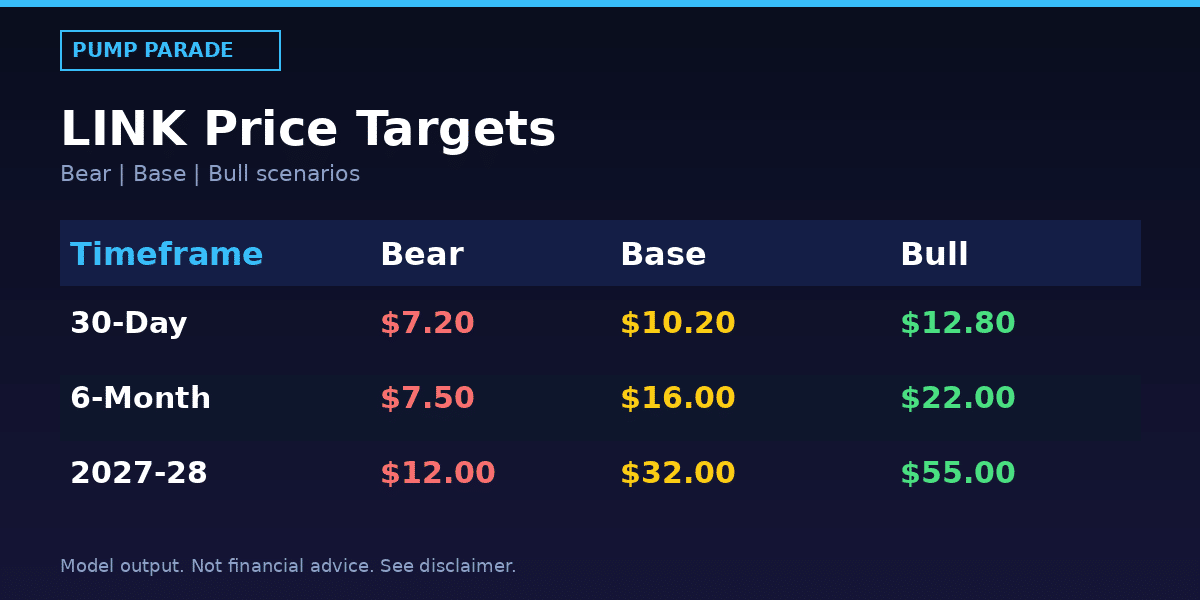
Here is the framework our AI model outputs, cross-checked with analyst ranges from Changelly, Standard Chartered’s oracle infrastructure note, and CoinCodex. The wide spread is not laziness. It reflects the reality that LINK sits between a bullish institutional pipeline and a bearish token-economic history.
30-Day Outlook (through late August 2026)
Short-term momentum favors continuation, but expect volatility around DTCC comms.
- Bear: $7.20 if $8.00 support fails on a broader risk-off move
- Base: $9.20-$10.20 as accumulation continues and CCIP volume data prints
- Bull: $11.50-$12.80 on an early institutional announcement or ETF rumor
6-Month Outlook (through January 2027)
This window straddles the DTCC October launch and the Q4 Collateral AppChain rollout. It is the highest-signal period of the cycle for LINK.
- Bear: $6.50-$7.50 if DTCC launch data disappoints or CCIP volumes stall
- Base: $12-$16 with steady institutional adoption and staking v0.3 tightening float
- Bull: $18-$22 if DTCC volumes exceed guidance and macro liquidity turns risk-on
Long-Term Outlook (2027-2028)
By late 2027, either LINK has re-rated on demonstrated fee capture or the “great oracle, forgettable token” thesis wins.
- Bear: $9-$12 range persists as value capture remains limited
- Base: $22-$32 with a mature tokenization market and expanded staking
- Bull: $40-$55 range in a full risk-on cycle, potentially retesting the 2021 ATH
For context, Changelly forecasts $30-$38 for end of 2026, CoinCodex projects $43, and analyst VirtualBacon has publicly called for $100. Standard Chartered’s infrastructure desk pegs a base case of $18 by end of 2026 in their institutional oracle note. Our model treats the $100 target as a low-probability tail scenario and the $18-$22 window as the most probable bull outcome.
How Does Chainlink Compare to Pyth Network?
Every LINK conversation eventually gets to this: is Pyth eating Chainlink’s lunch, or are they solving different problems? The numbers say the second, mostly.
| Metric | Chainlink (LINK) | Pyth Network (PYTH) |
|---|---|---|
| Current price | $8.62 | $0.14 |
| Market cap | $6.45B | $820M |
| Total value secured | $33.1B+ (approx 68% share) | $5.5B |
| Blockchains supported | 45+ | 52 |
| Data model | Push-based, high reliability | Pull-based, low latency |
| Institutional integrations | DTCC, Swift, Aave, Mantle | Solana-native DeFi, some perp DEXs |
| Cross-chain protocol | CCIP ($18B Q1 volume) | Wormhole-based transports |
| Data providers | Node operator network | First-party (exchanges, market makers) |
Chainlink wins on breadth, institutional trust, and cross-chain infrastructure. Pyth wins on speed and multi-chain coverage. For tokenized real-world assets, which is the trillion-dollar prize, Chainlink is the pick institutions are actually making. For high-frequency DeFi and perps, Pyth has a legitimate edge. If you own both PYTH and LINK, you are hedged.
What Would Change Our View
Three explicit triggers that would move us off the current base case, in either direction.
First, if DTCC’s October launch prints under $500M in first-month tokenized volume, our bull case weakens materially. That would suggest institutional adoption is slower than the July trades implied, and LINK would likely retest $7.50-$8.00 rather than push toward $15.
Second, if a major LINK unlock schedule change is announced (either accelerated or extended), price re-rates immediately. An accelerated schedule caps upside. An extended one removes a persistent overhang and could easily add $2-$3 to the base case.
Third, if the SEC or a major regulator issues clarifying guidance on tokenized securities that requires oracle-verified pricing, Chainlink’s institutional moat widens meaningfully. That is a low-probability, high-magnitude event, but it is the type of catalyst that could push LINK back to $20+ without waiting for organic volume growth.
Frequently Asked Questions
Will Chainlink (LINK) reach $20 in 2026?
Reaching $20 in 2026 is possible but not the most probable outcome. Our base case has LINK trading between $10 and $16 through year-end, with $18-$22 as the bull scenario contingent on strong DTCC launch metrics in October and continued CCIP volume growth. A move to $20 would require both institutional adoption follow-through and a broader risk-on macro environment.
Is Chainlink a good investment in 2026?
Chainlink has strong fundamentals: 68% oracle market share, $33B+ in total value secured, and the DTCC partnership positioning it as core infrastructure for tokenized real-world assets. The main risk is token-level value capture, which has historically lagged network growth. LINK is worth researching for investors with a 12-24 month horizon who can tolerate volatility. It is not a short-term trade.
Why is Chainlink price so low compared to its 2021 high?
LINK is 83.6% below its May 2021 all-time high of $52.70. Two factors drive that gap: heavy sell pressure from ecosystem unlocks over 2022-2024, and the market’s ongoing skepticism about how much of Chainlink’s network value flows back to the LINK token specifically. Recent staking expansions and CCIP fee capture are the primary mechanisms designed to close that gap.
What is Chainlink’s role in DTCC tokenization?
Chainlink provides the interoperability infrastructure (CCIP) and runtime layer (CRE) that DTCC uses to move tokenized securities between blockchain environments. On July 15, 2026, DTCC executed first production trades of tokenized Microsoft, SPY, QQQ, and Treasuries using Chainlink. Full commercial launch is scheduled for October 2026, with the Collateral AppChain following in Q4.
How does Chainlink CCIP work in plain terms?
CCIP is Chainlink’s cross-chain messaging system. Think of it as a secure courier service between blockchains: an application on Ethereum can send a message, a token, or a settlement instruction to a contract on Solana, Arbitrum, or Base, and CCIP handles verification, execution, and finality. It processed $18B in Q1 2026 volume and is integrated with 45+ chains.
What is the Chainlink price prediction for 2027?
For 2027, our base case projects LINK at $22-$32 assuming sustained DTCC-driven institutional adoption and staking v0.3 tightening effective float. The bear case sits at $9-$12 if token-level value capture remains limited. The bull case reaches $40-$55, which would represent a partial retest of the 2021 ATH.
The Honest Take
Chainlink is a rare crypto story where the network is unambiguously winning and the token is only starting to reflect it. The DTCC deal is not hype. It is Wall Street’s settlement layer plugging into a specific piece of Chainlink infrastructure, with the biggest asset managers on Earth participating. That is real.
At the same time, LINK holders have heard the “this is the catalyst” story before. Swift, ANZ, Fidelity, and multiple prior CCIP milestones each got a bounce that faded. Until fee capture translates into visible LINK demand, the market will discount every new announcement.
Our view: the risk-reward at $8.62 favors a longer-dated position rather than a short-term trade. Between $8.00 support and a plausible base case of $12-$16 by year-end, the setup is more asymmetric than most alt L1s right now. Whether it plays out depends less on Chainlink and more on whether the tokenization thesis actually monetizes in the next six months. Watch the October DTCC data. It is the tell.
If you are building broader DeFi exposure, Aave and Pendle are two protocols that stand to benefit from the same tokenization tailwind that lifts LINK, and both are covered elsewhere on Pump Parade. External reading: CoinGecko’s live LINK data for current price context, and Chainlink’s official CCIP page for CCIP integration specs.
Disclaimer: This article is for informational and educational purposes only and should not be construed as financial, investment, or trading advice. Cryptocurrency markets are highly volatile, and past performance does not guarantee future results. The price predictions and analyses presented here are based on AI models, technical indicators, and available data at the time of writing, they are not guarantees. Always conduct your own research (DYOR) and consult with a qualified financial advisor before making any investment decisions. Pump Parade and its authors do not assume liability for financial losses incurred based on information provided in this article.