If you’ve spent any time in the Solana ecosystem over the past two years, you’ve almost certainly heard of pump.fun. The platform has become synonymous with memecoin culture on Solana, letting anyone create and trade tokens in seconds. But with over 11.9 million tokens launched and a controversial reputation, is pump.fun actually worth your time and money in 2026?
In this review, we break down everything you need to know: how it works, what it costs, the risks involved, and whether it deserves a spot in your crypto toolkit.
Quick Verdict / TL;DR
Rating: 3.5 / 5
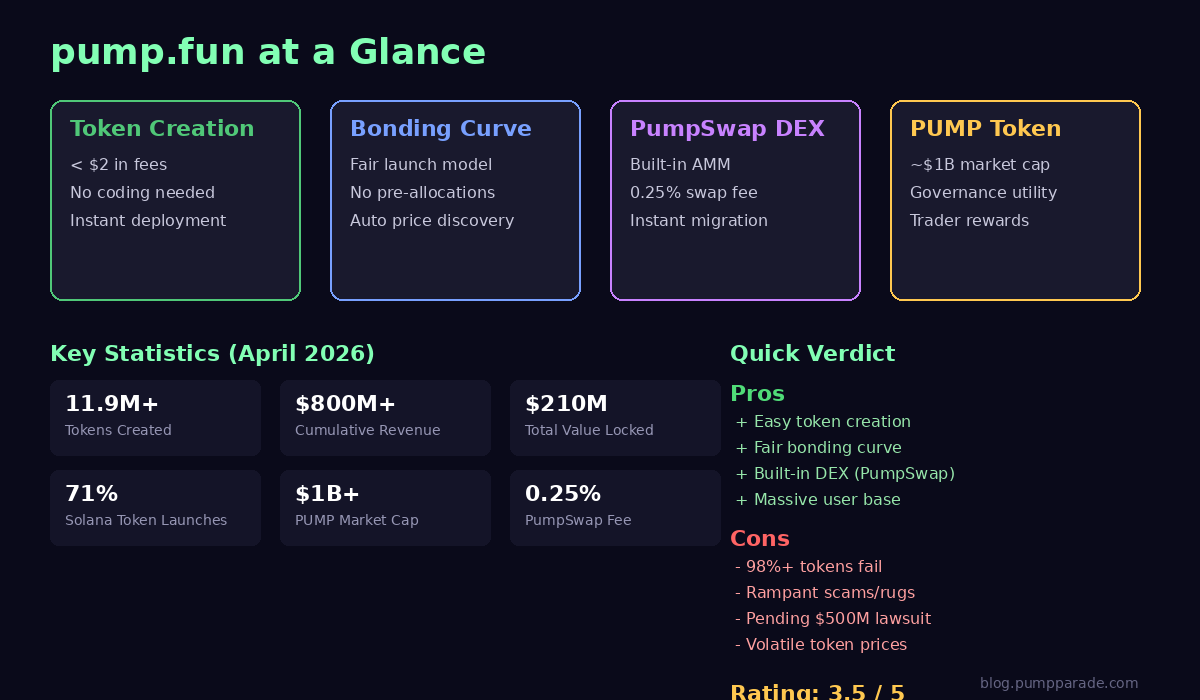
pump.fun is the undisputed king of Solana token launchpads. Creating a token takes seconds and costs under $2, and the bonding curve model ensures fair launches without pre-allocations. The addition of PumpSwap as a native DEX makes the ecosystem self-contained and eliminates migration friction. However, the platform’s biggest weakness is also baked into its design: the vast majority of tokens launched here end up worthless, and scam activity remains rampant. If you know what you’re doing, pump.fun is a powerful tool. If you don’t, it can be an expensive lesson.

What Is pump.fun?
Launched in January 2024, pump.fun is a Solana-based platform that lets anyone create a new token in seconds by simply uploading an image, choosing a ticker, and picking a name. There’s no coding required, no complicated smart contract deployment, and no need for initial liquidity. The platform handles everything through an automated bonding curve that sets the token’s price based on supply and demand.
Since launch, the platform has facilitated the creation of over 11.9 million tokens. At its peak, pump.fun accounted for roughly 71% of all daily token launches on Solana, making it the single largest source of new tokens in the ecosystem. The platform has generated more than $800 million in cumulative revenue, and its parent company raised approximately $1.3 billion through its PUMP token ICO in July 2025.
pump.fun isn’t just a launchpad anymore. With the launch of PumpSwap in March 2025, it became a full trading ecosystem where tokens are created, traded, and graduated all under one roof.
Features Deep Dive
Token Creation
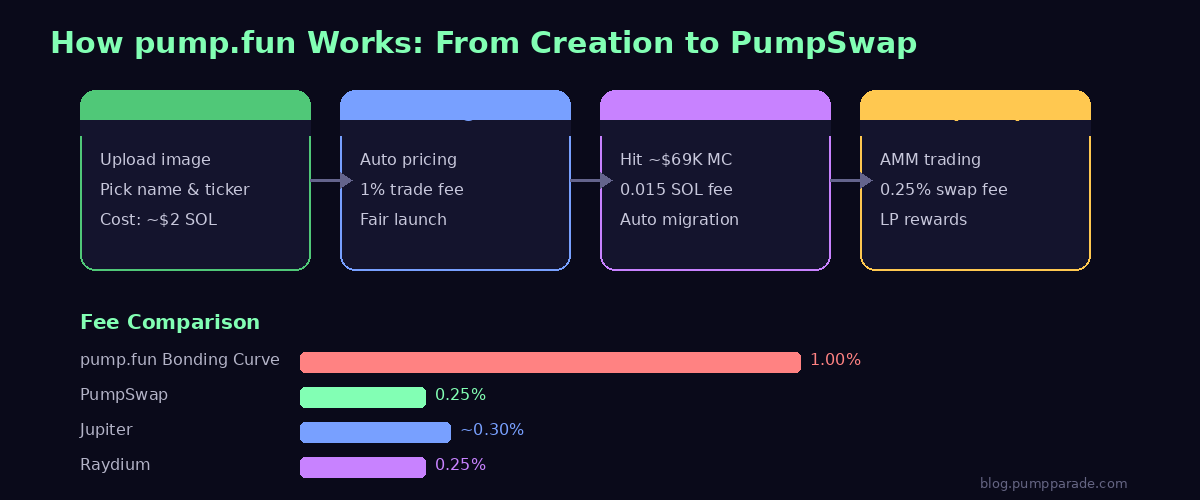
Creating a token on pump.fun is remarkably straightforward. You upload an image (which becomes the token’s avatar), enter a name and ticker symbol, and hit create. The entire process takes under 30 seconds and costs less than $2 in SOL fees. There are no pre-mines, no team allocations, and no insider advantages built into the launch mechanism. Every participant, including the token creator, has to buy in at the same price on the bonding curve.
This simplicity is both the platform’s greatest strength and its Achilles’ heel. The low barrier to entry means anyone can launch a token, but it also means the platform is flooded with low-effort projects and outright scams.
Bonding Curve Mechanics
Every token launched on pump.fun starts on a bonding curve, which is an automated pricing mechanism where the token’s price increases as more people buy in. Early buyers get lower prices, and the price rises along a predetermined curve as demand increases. This creates a built-in incentive for early participation while ensuring transparent, predictable pricing.
When a token reaches a market cap of approximately $69,000 (previously $90,000, adjusted over time), it “graduates” from the bonding curve and migrates to PumpSwap for standard AMM trading. This graduation milestone is a key moment for any pump.fun token, as it signals enough organic demand to sustain trading on an open market.
PumpSwap: The Native DEX
PumpSwap launched in March 2025 as pump.fun’s native decentralized exchange, replacing Raydium as the destination for graduated tokens. It operates on an automated market maker (AMM) model similar to Uniswap V2, using a constant-product formula (x * y = k) to facilitate swaps via liquidity pools.
The migration from bonding curve to PumpSwap is instant and free for token creators. Each trade on PumpSwap incurs a 0.25% fee, split between liquidity providers (0.20%) and the protocol (0.05%). PumpSwap has quickly grown to become the second-largest AMM on Solana by volume, a testament to the sheer trading activity pump.fun generates.
A notable feature is creator revenue sharing, which gives token creators a cut of trading fees on their tokens. This incentivizes creators to build lasting projects rather than quick pump-and-dump schemes, though the effectiveness of this incentive is debatable given the platform’s track record.
Additional Features
Beyond its core launchpad functionality, pump.fun offers several supplementary features. The platform includes a live feed of newly created tokens, a “Trending” section highlighting tokens with momentum, and filter tabs like “Movers,” “Mayhem,” “Live,” “New,” and “Market cap” to help users discover tokens. There’s also a built-in chat feature, voice chat rooms, and an “Agents” category for AI-related tokens. A mobile app is available for iOS and Android, and the platform actively encourages mobile usage for faster trading.
Fees and Pricing
pump.fun’s fee structure is straightforward but important to understand before you start trading:
| Action | Fee | Notes |
|---|---|---|
| Token Creation | ~$2 (in SOL) | One-time fee to deploy a new token |
| Buy/Sell on Bonding Curve | 1% per transaction | Charged in SOL on each trade |
| Graduation Fee | 0.015 SOL | When token migrates to PumpSwap |
| PumpSwap Trading | 0.25% per swap | Split: 0.20% to LPs, 0.05% to protocol |
The 1% bonding curve trading fee is higher than what you’d pay on most DEXs (Jupiter charges around 0.3%, and Raydium sits at 0.25%). However, once a token graduates to PumpSwap, the 0.25% fee is competitive with other Solana AMMs. Keep in mind that Solana network transaction fees are also minimal (usually fractions of a cent), so they won’t add much to your total cost.
Pros and Cons
Pros
- Incredibly easy token creation – Launch a token in under 30 seconds with no coding knowledge. The lowest barrier to entry of any launchpad on the market.
- Fair launch model – The bonding curve eliminates pre-mines and insider allocations. Everyone buys in at the same starting point, creating a level playing field.
- Self-contained ecosystem – With PumpSwap, tokens never need to leave the pump.fun universe. Creation, trading, and graduation all happen under one roof.
- Massive liquidity and user base – As the dominant Solana launchpad, pump.fun has more active traders and more volume than any competitor, which means better price discovery and tighter spreads on popular tokens.
- Mobile app available – Trade on the go with a dedicated mobile experience, which is increasingly important for memecoin trading where speed matters.
- Creator revenue sharing – Token creators earn a percentage of PumpSwap trading fees, incentivizing longer-term project development.
Cons
- Overwhelming majority of tokens fail – Research from Solidus Labs found that approximately 98.6% of tokens launched on pump.fun end up as scams or worthless. Only about 97,000 of 7+ million analyzed tokens maintained at least $1,000 in liquidity.
- Rampant scam activity – Fake volume bots, bundled transactions, wallet manipulation, and coordinated pump-and-dump schemes are widespread. The low barrier to entry that makes the platform accessible also makes it a playground for bad actors.
- Legal uncertainty – A $500 million lawsuit accuses pump.fun’s co-founders of operating an insider-driven system that favored privileged participants, with allegations of early access advantages and artificial price inflation.
- Thin liquidity on most tokens – Outside of the top trending tokens, most pump.fun tokens have extremely shallow liquidity pools. This means high slippage and significant price impact even on modest trades.
- Higher bonding curve fees – The 1% fee on bonding curve trades is notably higher than standard DEX swap fees, eating into profits on frequent trades.
Security and Trust
Security is arguably pump.fun’s weakest area, and it’s the primary reason the platform doesn’t score higher in this review.
The platform’s open design means that anyone can create a token with zero vetting. While this is philosophically aligned with crypto’s permissionless ethos, it creates a breeding ground for fraud. A report from Solidus Labs found that roughly 98.6% of tokens launched on the platform turned into scams, with creators either draining funds or dumping tokens on buyers.
Common scam tactics on pump.fun include fake volume generation (where bots simulate demand), bundled transactions that obscure large sell-offs, impersonation tokens that copy popular projects, and coordinated social media hype campaigns designed to attract unsuspecting buyers before a rug pull.
On the legal front, pump.fun faces a $500 million lawsuit alleging that insiders had early access to newly launched tokens at minimal prices, artificially inflated values through bonding curves, and exited at the expense of retail users. The outcome of this case could have significant implications for the platform’s future operations.
On the positive side, the bonding curve itself provides some structural protections. Since there are no pre-allocations and everyone (including creators) must buy in, it’s harder to execute traditional rug pulls where developers hold a large pre-mine. The transparency of on-chain data also means that savvy users can analyze wallet distributions and trading patterns before buying in.
User Experience
pump.fun’s interface is clean and intuitive. The dark-themed UI is easy on the eyes, and the main dashboard surfaces trending and newly created tokens prominently. Navigation is straightforward with a sidebar offering Home, Live, Support, Chat, Terminal, and More sections.
Token creation is a standout UX achievement. The process is so simple that it could be completed by someone with zero crypto experience: upload an image, type a name, pick a ticker, and click create. The real-time bonding curve charts provide clear visual feedback on price action, and buying/selling tokens requires just a wallet connection and a few clicks.
The search functionality works well for finding specific tokens, and the filter tabs (Movers, Mayhem, Live, New, Market cap, Agents, Oldest, Last trade) offer useful ways to slice and dice the token feed. The mobile app mirrors the web experience faithfully, which is important since memecoin trading often requires quick reactions.
One UX weakness is the sheer volume of tokens. With thousands of new tokens launching daily, even the filters can feel overwhelming. There’s no robust way to separate legitimate projects from scams within the interface itself, and users are largely left to do their own research.
PUMP Token
pump.fun launched its native PUMP token through an ICO in July 2025 that raised roughly $1.3 billion ($600 million in a public sale that sold out in 12 minutes, plus $720 million in private sales). As of April 2026, PUMP trades at approximately $0.0019 with a market cap around $1 billion, ranking in the top 70 cryptocurrencies globally.
The token has a total supply of approximately 1 trillion PUMP, with about 430 billion currently in circulation. Key upcoming catalysts include a PUMP token incentive program that would reward traders for platform activity, potential expansion to EVM-compatible chains, and a $3 million Pump Fund hackathon in 2026.
Investing in the PUMP token is essentially a bet on the continued dominance of pump.fun as the leading memecoin launchpad. However, competition from platforms like LetsBonk.fun (which briefly captured over 55% market share in mid-2025) and Raydium’s own launchpad features means that dominance is not guaranteed.
Competitors
pump.fun operates in an increasingly competitive space. LetsBonk.fun emerged as a significant challenger in 2025, at one point capturing over 55% of the Solana memecoin launchpad market compared to pump.fun’s 27%. Believe (formerly LaunchCoin) has also gained traction as a more curated alternative. On EVM chains, platforms like trading bots such as Photon and BullX serve adjacent but different needs.
pump.fun’s moat lies in its first-mover advantage, massive user base, and the PumpSwap ecosystem that keeps trading activity in-house. However, the platform’s struggles with scam prevention and legal challenges could create openings for competitors that emphasize safety and curation.
Verdict
Rating: 3.5 / 5
pump.fun is a product that does exactly what it set out to do: make token creation and trading as frictionless as possible. On that front, it’s a resounding success. The platform’s UX is excellent, the bonding curve model is elegant, and PumpSwap rounds out the ecosystem nicely.
But frictionless access cuts both ways. The platform’s openness has made it a haven for scams, with less than 2% of tokens maintaining meaningful value. The pending $500 million lawsuit adds regulatory uncertainty, and competition is heating up from both Solana-native and cross-chain alternatives.
Who should use pump.fun: Experienced crypto traders who understand memecoin risks, can read on-chain data, and have a clear strategy for managing exposure. Developers looking for the fastest, cheapest way to launch a token on Solana.
Who should avoid pump.fun: Beginners who might confuse easy access with easy money. Anyone who can’t afford to lose their entire investment on a single trade. Investors looking for fundamentally sound projects with long-term value.
If you go in with eyes open and risk management in place, pump.fun is a powerful and unique platform. Just don’t mistake its simplicity for safety.
FAQ
Is pump.fun safe to use?
The platform itself functions as intended, but the tokens traded on it carry extreme risk. An estimated 98.6% of tokens launched on pump.fun end up worthless or are outright scams. Always do your own research (DYOR), check wallet distributions, and never invest more than you can afford to lose.
How much does it cost to create a token on pump.fun?
Creating a token costs less than $2 in SOL fees. Trading on the bonding curve incurs a 1% fee per transaction, and PumpSwap charges 0.25% per swap after graduation.
What is PumpSwap?
PumpSwap is pump.fun’s native decentralized exchange (DEX) that launched in March 2025. When a token’s bonding curve reaches approximately $69,000 in market cap, it automatically graduates to PumpSwap for standard AMM trading. PumpSwap has grown to become the second-largest AMM on Solana by volume.
What is the PUMP token?
PUMP is pump.fun’s native governance and utility token, launched via an ICO in July 2025 that raised $1.3 billion. It trades at approximately $0.0019 with a market cap around $1 billion as of April 2026. An upcoming incentive program may reward traders with PUMP tokens for platform activity.
Can I use pump.fun on mobile?
Yes. pump.fun offers a dedicated mobile app for iOS and Android. The platform actively encourages mobile usage, displaying a banner on the web version stating “Trade faster. Pump is better on mobile.”