Choosing the right crypto analytics platform can make or break your trading edge. Two names dominate the space in 2026: Birdeye and DexScreener. Both offer real-time on-chain data, token discovery, and charting tools, but they take fundamentally different approaches to solving the same problem.
If you’ve ever wondered which platform deserves a permanent tab in your browser, this head-to-head comparison will help you decide. We’ll break down features, supported chains, pricing, user experience, and more to determine which one comes out on top for different types of traders.
Quick Verdict: Birdeye vs DexScreener
Choose Birdeye if you’re a Solana-focused trader who wants deep wallet intelligence, smart money tracking, and advanced token screening with configurable alerts.
Choose DexScreener if you trade across multiple chains, want a completely free core experience, and prioritize speed and simplicity for discovering new tokens.
Both are excellent tools, but they serve different trading styles. Let’s dig into why.
What Is Birdeye?
Birdeye launched as a Solana-native data aggregation platform and has grown into one of the most comprehensive crypto analytics tools available. With over 2 million users globally, it aggregates data from 400+ decentralized exchanges across 10+ blockchain networks including Solana, Ethereum, Base, BNB Chain, Arbitrum, and Sui.
What sets Birdeye apart is its data-first approach. Rather than just showing you charts and prices, it gives you deep insights into wallet behavior, holder distribution, liquidity depth, and trade flow. The platform’s “Smart Money” feature tracks profitable wallets across launches, helping you spot early moves before they show up on price charts.
Birdeye also offers an enterprise-grade API through Birdeye Data Services (BDS), making it a go-to for developers and institutions who need reliable on-chain data feeds.
What Is DexScreener?
DexScreener is a real-time charting and token discovery platform that covers 100+ blockchain networks and thousands of DEXs. It has positioned itself as the default starting point for traders who want to quickly scan market activity across the entire crypto landscape.
The platform’s strength is its speed and breadth. DexScreener monitors millions of active trading pairs and provides real-time price data, volume metrics, transaction counts, and liquidity information. Its “Trending” and “New Pairs” sections have become essential tools for early-stage token discovery, especially in the memecoin and low-cap space.
DexScreener also operates Moonshot, a verified fair launch platform for new tokens, and has expanded into token profiles and advertising services that generate revenue while keeping the core product free for users.

Features Deep Dive
Token Discovery and Screening
Both platforms let you find new tokens, but they approach discovery differently.
Birdeye gives you granular control with filters for market cap, trading volume, holder distribution, liquidity depth, contract age, and LP size. You can combine multiple signals (like “volume spike plus liquidity drop”) to create custom screens. The Smart Money section identifies wallets with consistent track records and shows you what they’re buying in real time.
DexScreener takes a faster, more visual approach. The Trending section ranks tokens by various timeframes (5 minutes to 24 hours), while New Pairs surfaces freshly created trading pools. You can filter by chain, boosted status, and profile verification. It’s less granular than Birdeye but significantly faster for spotting what’s moving right now.
Winner: Birdeye for advanced screening, DexScreener for speed-based discovery.
Charting and Technical Analysis
Both platforms integrate TradingView charts, giving you access to standard technical indicators, drawing tools, and timeframe options.
Birdeye pairs its charts with contextual data like holder changes, liquidity events, and large trade markers directly on the chart view. DexScreener’s Multicharts feature lets you view multiple pairs simultaneously, which is useful for monitoring correlated assets or tracking the same token across different DEXs.
Winner: Tie. Both deliver solid charting with TradingView integration.
Wallet and Smart Money Tracking
This is where the two platforms diverge most significantly.
Birdeye offers a full wallet intelligence suite. You can track any wallet address across multiple chains, view consolidated P&L statements, transaction history, and portfolio breakdowns. The Smart Money feature algorithmically identifies consistently profitable wallets and surfaces their recent activity, giving you a legitimate edge for following informed capital.
DexScreener offers basic watchlist functionality but lacks the deep wallet analytics that Birdeye provides. You can track tokens on a watchlist and set price alerts, but you won’t find wallet-level intelligence or smart money feeds.
Winner: Birdeye, decisively.
Multi-Chain Support
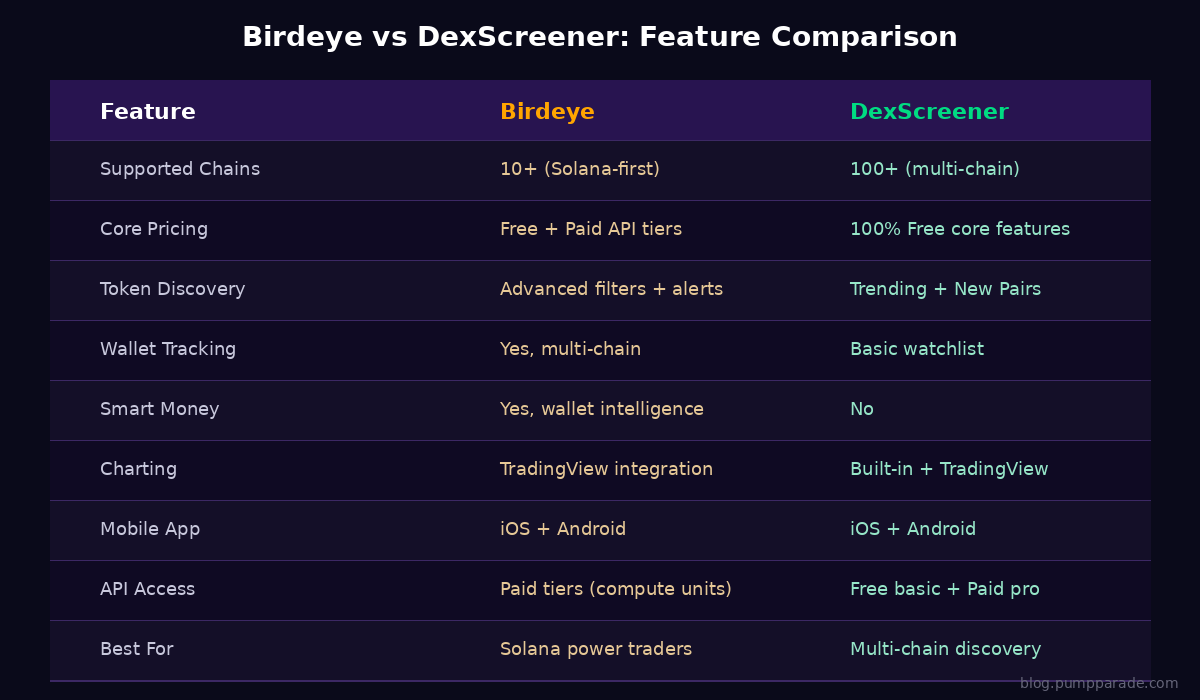
DexScreener supports 100+ blockchain networks, making it the clear leader in chain coverage. Whether you’re trading on Solana, Ethereum, Base, BSC, Polygon, Avalanche, Sui, Aptos, TON, or dozens of smaller chains, DexScreener has you covered.
Birdeye supports 10+ chains with deep coverage on Solana and expanding EVM support. While it covers the major networks, its depth of data is strongest on Solana, where it aggregates from 400+ DEXs.
Winner: DexScreener for breadth, Birdeye for depth on supported chains.
Fees and Pricing
This is one of the biggest differentiators between the two platforms.
DexScreener keeps its core features entirely free. Charts, token data, trending lists, new pairs, and basic API access cost nothing. The platform generates revenue through token profile listings and advertising placements. For power users, there’s a paid tier that unlocks higher API rate limits and additional data access.
Birdeye also offers a free tier with access to basic token data, charts, and the dashboard. However, advanced features like full API access, higher-resolution data, and premium analytics are behind paid tiers. API pricing is based on compute units, which vary by the complexity of each call. Enterprise customers can negotiate custom pricing.
Winner: DexScreener for free access. Birdeye’s paid tiers are worth it if you need the advanced analytics, but there’s a higher cost of entry for power features.
Pros and Cons
Birdeye
Pros:
- Best-in-class wallet intelligence and smart money tracking
- Advanced token screening with combinable filters and alerts
- Deep Solana ecosystem coverage (400+ DEXs aggregated)
- Enterprise-grade API for developers and institutions
- Multi-chain portfolio tracking with consolidated P&L
Cons:
- Best features are behind paid tiers
- Strongest on Solana; other chain coverage is less comprehensive
- Steeper learning curve for new users
- Interface can feel overwhelming with all the data available
DexScreener
Pros:
- 100% free core experience with no hidden paywalls
- Unmatched chain coverage (100+ networks)
- Lightning-fast token discovery via Trending and New Pairs
- Clean, intuitive interface that’s easy for beginners
- Multicharts for monitoring multiple pairs simultaneously
- Mobile apps with full charting capability
Cons:
- No wallet intelligence or smart money tracking
- Token screening filters are less granular than Birdeye
- Advertising and boosted tokens can create noise in rankings
- Limited portfolio tracking compared to dedicated tools
Security and Trust
Both platforms are data aggregators, not custody solutions. They read on-chain data and display it; they don’t hold your funds or require wallet connections for basic use.
Birdeye has been operating since 2021 and has built a strong reputation in the Solana ecosystem. The platform has partnerships with major Solana projects and has been featured in the Solana Foundation’s ecosystem guides. It also offers token risk signals and audit information as part of its data layer.
DexScreener has been live since 2021 as well and is one of the most-visited crypto data sites globally. The introduction of token profiles with verification adds a trust layer for token discovery, and the platform’s Moonshot fair launch feature includes built-in security checks. However, some users have raised concerns about paid boosted placements potentially highlighting risky tokens.
Winner: Tie. Both are reputable, established platforms. Birdeye edges slightly ahead with its risk-signal integration.
User Experience
DexScreener wins on simplicity. The interface is clean, loads fast, and gets you to the information you need with minimal clicks. The sidebar navigation is straightforward, and the default Trending view immediately shows you what’s moving. It’s the kind of tool you can hand to a crypto newcomer and they’ll figure it out within minutes.
Birdeye is more feature-dense, which means a steeper learning curve. The dashboard presents a lot of information at once, including trending tokens, smart money activity, bubble maps, find-gems sections, and large trade feeds. Power users love this, but it can be overwhelming for beginners. The navigation bar includes sections for Trending, Smart Money, Perps, Tracker, and Explore, each with their own sub-views.
Both platforms offer mobile apps for iOS and Android with full functionality, which is essential for active traders.
Winner: DexScreener for simplicity, Birdeye for power users who want everything in one view.
Verdict: Which Should You Use?
The honest answer? Most serious crypto traders should have both bookmarked. They complement each other rather than directly competing.
Use Birdeye if:
- You’re primarily a Solana trader
- Smart money tracking and wallet intelligence matter to your strategy
- You want advanced token screening with custom alerts
- You need API access for building trading tools or bots
- You’re willing to pay for premium analytics
Use DexScreener if:
- You trade across many different blockchains
- You want a free, no-friction analytics experience
- Speed and simplicity are your priorities
- You focus on early token discovery and trending plays
- You’re newer to crypto trading and want an accessible starting point
Our overall pick: For the Solana-heavy audience that reads Pump Parade, Birdeye gets the edge thanks to its smart money features and deeper Solana data. But DexScreener remains an essential tool for its unbeatable chain coverage and free access model. The best setup is using both: DexScreener for broad discovery across chains, and Birdeye for deep analysis on the tokens that make it to your watchlist.
If you’re interested in tools that can help you act on the data these platforms surface, check out our Photon Review 2026 for a look at one of the best Solana trading bots, or our Phantom vs Backpack comparison to find the right wallet for executing those trades.
FAQ
Is Birdeye free to use?
Yes, Birdeye offers a free tier with access to basic token data, charts, and the dashboard. Advanced features like full API access, wallet intelligence details, and premium analytics require paid tiers. API pricing is based on compute units that vary by call complexity.
Is DexScreener completely free?
DexScreener’s core features are 100% free, including charts, token data, trending lists, new pair discovery, and basic API access. The platform makes money through token profile listings and advertising. A paid subscription is available for higher API rate limits.
Which platform has better data for Solana tokens?
Birdeye has deeper Solana coverage, aggregating data from 400+ DEXs on the network. It also provides Solana-specific features like smart money wallet tracking and advanced holder analysis. DexScreener covers Solana well but with less depth in its analytics layer.
Can I use both platforms together?
Absolutely, and many active traders do exactly this. A common workflow is using DexScreener’s Trending section to spot new opportunities across chains, then switching to Birdeye for deeper analysis on specific tokens, especially for wallet intelligence and holder distribution data.
Do either of these platforms offer trading functionality?
Birdeye offers swap functionality through integrated DEX aggregation, allowing you to trade directly from the platform. DexScreener primarily focuses on analytics and charting, though it provides links to trade on the underlying DEXs. For dedicated trading tools, you might want to explore specialized platforms like Photon or similar trading bots.