More
    Home Blog Page 68

    Ethereum (ETH) Price Prediction for 2029

    0

    As the digital asset space matures, investors are increasingly looking beyond short-term charts to understand the long-term value proposition of cornerstone assets like Ethereum. Predicting the price of any volatile asset five years into the future is a speculative exercise. However, by analyzing current trends, fundamental drivers, and potential market scenarios, we can build a framework for what Ethereum’s valuation might look like by 2029.

    This analysis aims to provide a balanced, insightful perspective on a potential Ethereum (ETH) price prediction for 2029, based on current data and future catalysts. It is for informational purposes only and should not be considered financial advice.

    TL;DR: Ethereum Price Outlook for 2029

    • Current Momentum is Strong: Ethereum is showing significant bullish strength with a price of $4,541.7, up over 25% in the last 30 days, indicating strong buying pressure and positive market sentiment.
    • Fundamental Drivers are Key: Long-term growth hinges on factors like the adoption of spot ETH Exchange Traded Funds (ETFs), the continued expansion of Layer 2 scaling solutions, and the deflationary pressure from EIP-1559’s fee-burning mechanism.
    • Base Case Prediction for 2029: $12,000 – $18,000. This scenario assumes steady institutional adoption, successful network scaling, and Ethereum maintaining its dominance as the leading smart contract platform.
    • Wide Range of Outcomes: A bearish scenario could see ETH trading between $3,500 and $6,000 due to regulatory hurdles or competitive pressure. A highly bullish scenario, driven by mass adoption, could push the price above $25,000.

    What is Ethereum? A Quick Refresher

    Before diving into price predictions, it’s crucial to remember what Ethereum is. It’s not just a digital currency; it’s a decentralized, global computer. Developers can build and deploy “smart contracts,” which are self-executing applications that run on the Ethereum blockchain. This technology powers a vast ecosystem of decentralized finance (DeFi), non-fungible tokens (NFTs), gaming, and more.

    The network’s native asset, Ether (ETH), is used to pay for transaction fees (known as “gas”) and to secure the network. Following the “Merge” in 2022, Ethereum transitioned to a Proof-of-Stake (PoS) consensus mechanism. This shift not only reduced the network’s energy consumption dramatically but also introduced staking, allowing ETH holders to earn rewards for helping to secure the network, and turned ETH into a productive, yield-bearing asset.

    Current Market Conditions

    As of this writing, the market is painting a clear picture of bullish enthusiasm for Ethereum. The current price of $4,541.7 is supported by a robust market capitalization of over $547 billion, cementing its status as the second-largest crypto asset. The 24-hour trading volume stands at a healthy $22.3 billion, suggesting deep liquidity and active market participation.

    Recent price action reinforces this positive sentiment. While the 1-hour change shows a minor dip of -0.28%, this is typical short-term volatility. The broader trend is undeniably upward: ETH has gained 2.94% in the last 24 hours, 8.21% over the past week, and an impressive 25.56% in the last 30 days. This sustained momentum suggests a strong accumulation phase and growing investor confidence leading into potential catalysts on the horizon.

    On-Chain and Narrative Drivers for 2029

    Looking ahead to 2029, Ethereum’s price will be less about daily chart fluctuations and more about the success of its core narratives and underlying technology. While specific on-chain data for 2029 is impossible to have, we can analyze the key drivers that will likely shape its valuation.

    One of the most significant catalysts is the potential for widespread institutional adoption through spot ETH ETFs. If approved and embraced by the traditional finance world, these products could unlock trillions of dollars in capital, creating sustained buying pressure. Furthermore, the growth of Layer 2 solutions like Arbitrum, Optimism, and various zk-rollups is critical. These networks make Ethereum more scalable and affordable, attracting more users and applications, which in turn increases demand for ETH as the base settlement layer and drives more fee burns via EIP-1559. This mechanism makes ETH a potentially deflationary asset, where more coins are destroyed than created, a powerful “ultrasound money” narrative.

    Scenarios for ETH’s Price in 2029

    Forecasting five years out requires thinking in scenarios rather than absolutes. We will use the current price of ~$4,500 as a starting point for a professional technical analysis looking at long-term possibilities.

    Bear Case: $3,500 – $6,000

    In a bearish scenario, Ethereum faces significant headwinds. This could stem from a harsh global regulatory crackdown on DeFi and staking, a persistent multi-year bear market in risk assets, or the rise of a technically superior competitor that siphons away developers and users. In this world, spot ETH ETFs either fail to launch or see lackluster inflows.

    From a technical perspective, this price range would represent a failure to decisively break and hold above the previous all-time high of ~$4,891. The price could find itself consolidating in a wide range, with the 2021 highs acting as major resistance and previous cycle support levels around $3,500 providing a floor. This outcome reflects a stagnation of growth and a loss of market narrative.

    Base Case: $12,000 – $18,000

    This is the most probable scenario, assuming a continuation of current trends. Here, spot ETH ETFs are approved and see steady, meaningful inflows from institutional and retail investors. Layer 2 solutions mature, handling the bulk of network traffic and making the Ethereum ecosystem accessible to millions more users. The deflationary “ultrasound money” narrative takes hold as network activity consistently burns more ETH than is issued.

    Technically, achieving this price range would involve a significant market cycle expansion. Using Fibonacci extension levels drawn from the 2021 market top to the 2022 bottom, the 2.618 and 3.618 extension levels often serve as long-term targets in strong bull markets. These levels would project a target well within the $12,000 to $18,000 range, representing a logical and powerful next wave of price discovery for a maturing blue-chip asset.

    Bull Case: $25,000 – $40,000

    The bull case imagines a world where Ethereum fulfills much of its grand vision. It becomes the undisputed settlement layer for a significant portion of the tokenized global economy, including real-world assets (RWAs) like real estate, stocks, and bonds. DeFi becomes a mainstream alternative to traditional finance, and institutional capital flows through ETH ETFs are massive, creating a severe supply shock on exchanges as more ETH is staked and locked in DeFi.

    In this scenario, price discovery would enter a parabolic phase. A valuation in this range would push Ethereum’s market cap towards the $3 to $5 trillion mark. While a huge leap, it would be comparable to major tech giants or a fraction of the global bond market it would be disrupting. Technically, this would align with higher Fibonacci extension targets (like the 4.236) and the upper bounds of long-term logarithmic growth channels, reflecting exponential network effects and a “flippening” of value from traditional systems to the blockchain.

    A Simple Valuation Model

    We can create a simple back-of-the-envelope model to sense-check these figures. Let’s focus on network revenue (transaction fees).

    • Assumption 1: By 2029, as Web3 grows, Ethereum (including its Layer 2s) generates $70 billion in annual protocol revenue. This is an aggressive but plausible growth trajectory if tokenization and DeFi go mainstream.
    • Assumption 2: The market values Ethereum at a 30x Price-to-Sales (P/S) multiple, treating it like a high-growth global technology platform.
    • Assumption 3: Due to the EIP-1559 burn, the total supply of ETH by 2029 is a slightly deflationary 118 million coins.

    Calculation: $70 billion (Revenue) * 30 (P/S Multiple) = $2.1 Trillion (Market Cap).
    $2,100,000,000,000 / 118,000,000 ETH = $17,796 per ETH.

    This simple model shows that our base case prediction of $12,000 – $18,000 is grounded in reasonable, albeit optimistic, assumptions about network growth and valuation multiples.

    Risks and What to Watch

    Despite the bullish outlook, investing in Ethereum is not without risks. Investors should keep a close watch on several key areas:

    • Regulatory Environment: Unfavorable rulings from bodies like the SEC regarding staking or the classification of ETH could stifle growth.
    • Competition: While Ethereum has a strong lead, other Layer 1 blockchains are continuously innovating and could chip away at its market share.
    • Technical Risks: A major bug or exploit in a core DeFi protocol or the main Ethereum protocol itself could severely damage confidence.
    • Scalability Execution: The success of Ethereum is heavily reliant on its Layer 2 ecosystem. Watch for metrics like daily active users and transaction volumes on these networks.

    Conclusion and Next Steps

    Ethereum’s journey to 2029 is paved with immense potential and notable risks. The current market momentum is strong, but long-term success will depend on fundamental execution: scaling the network, attracting institutional capital, and fostering a vibrant developer ecosystem.

    Our analysis suggests a base case price target of $12,000 to $18,000 by 2029, reflecting a future where Ethereum solidifies its role as the foundational layer of a new digital economy. For investors, the next step is not to blindly follow predictions, but to use this framework to deepen their own understanding. Research the key drivers, understand the risks involved, and formulate a strategy that aligns with your personal financial goals and risk tolerance.

    FAQ

    Is Ethereum a good long-term investment?
    Many analysts believe Ethereum has strong long-term potential due to its dominant position as the leading smart contract platform, its deflationary monetary policy, and its growing ecosystem. However, it remains a volatile, high-risk asset.

    Can ETH realistically reach $20,000?
    Reaching $20,000 would place Ethereum’s market cap at over $2.3 trillion. While a significant increase, it falls within the realm of possibility in a highly bullish scenario where institutional adoption is massive and the network captures significant value from tokenized real-world assets.

    What is the single biggest risk to Ethereum’s future price?
    The biggest single risk is arguably regulatory uncertainty. A coordinated global effort to restrict decentralized finance or staking could severely hamper Ethereum’s growth trajectory and adoption by mainstream institutions.

    How do Layer 2s affect ETH’s price?
    Layer 2 solutions are overwhelmingly positive for ETH’s price. By making the network cheaper and faster to use, they attract more users and applications. All these transactions ultimately must be settled on the Ethereum mainnet, which increases demand for ETH and drives the fee-burning mechanism, making ETH more scarce.

    Not financial advice. Do your own research.

    Pump.fun (PUMP) Price Prediction for 2035

    0

    Predicting the price of any cryptocurrency over a decade into the future is a speculative exercise, but by analyzing current data, market trends, and potential growth scenarios, we can build a framework for what might lie ahead for Pump.fun (PUMP). This analysis aims to provide a long-term perspective, not short-term trading signals.

    TL;DR: Key Takeaways for PUMP in 2035

    • Narrative Dependent: PUMP’s long-term success is fundamentally tied to the health and persistence of the memecoin ecosystem, particularly on Solana and potentially other blockchains.
    • Wide Price Range: Our 2035 price predictions vary significantly based on market conditions, from a bearish scenario of $0.0001 to a bullish outlook of $0.05 or more.
    • Adoption is Key: The platform’s ability to innovate, attract users, generate revenue, and fend off competitors will be the primary drivers of the PUMP token’s value.
    • High Risk, High Reward: As an asset linked to the most volatile sector of crypto, PUMP represents a high-risk investment profile. Its potential for massive returns is matched by its potential for significant losses.

    What is Pump.fun (PUMP)?

    Pump.fun is a platform built on the Solana blockchain that radically simplifies the process of creating and launching a new cryptocurrency, specifically memecoins. It allows anyone to launch a token in minutes with just a few clicks and minimal cost. The platform’s key innovation is its use of a bonding curve, where tokens are bought and sold directly from a smart contract.

    This model ensures immediate liquidity and helps prevent common “rug pull” scams where developers drain liquidity pools. Once a token launched on Pump.fun reaches a certain market capitalization, its liquidity is automatically deposited onto a decentralized exchange like Raydium, and the contract’s ownership is renounced. The PUMP token is the native token of this ecosystem, with its value proposition linked to the platform’s overall success and potential future utility, such as governance or fee-sharing.

    Current Market Conditions: A Snapshot

    To understand where PUMP might go, we first need to analyze where it stands today. The current metrics paint a picture of a project that has experienced a massive hype cycle and is now in a period of price discovery and consolidation.

    As of this writing, PUMP is trading at approximately $0.0034. Its market capitalization stands at a formidable $1.2 billion, placing it firmly among the top-tier crypto assets. This is not a small, undiscovered project; it is a major player. The 24-hour trading volume of over $183 million indicates strong liquidity and continued interest from traders. However, the price action tells a story of recent turbulence. A 9.4% drop in the last 24 hours and a 38% decline over the past 30 days suggest that the initial speculative frenzy has cooled. The market is now trying to determine a fair long-term value for the token, moving past the initial launch hype.

    On-Chain & Narrative Drivers

    The primary narrative driving Pump.fun is its role as the “memecoin factory” of Solana. It democratized token creation, making it accessible to everyone. This narrative is incredibly powerful during bull markets when retail interest in memecoins surges. The platform’s success is a direct reflection of the health of this niche. For PUMP to thrive through 2035, this narrative must either persist or evolve.

    While we lack specific on-chain data for this analysis, the key metrics to watch are the platform’s core business drivers. These include the number of new tokens launched daily, the total fees generated by the platform, and the growth in active users. A sustained increase in these metrics, even during market downturns, would be a strong bullish signal, indicating that the platform has genuine, sticky utility beyond pure speculation. Conversely, a sharp decline in platform activity would be a major red flag for the long-term value of the PUMP token.

    Scenarios for 2035: Bear, Base, and Bull Cases

    Projecting over a decade into the future requires accounting for multiple bull and bear market cycles. Here are three potential scenarios for PUMP by 2035.

    Bearish Scenario: $0.0001 – $0.001

    In a bearish scenario, the memecoin craze of the 2024 cycle proves to be a cyclical peak that is never revisited with the same intensity. Stricter regulations could target platforms like Pump.fun, classifying token launches as unregistered securities offerings and creating massive legal hurdles. Furthermore, a more efficient and innovative competitor could emerge, rendering Pump.fun obsolete. In this future, platform revenue dwindles, user interest fades, and the PUMP token loses its relevance, with its price falling over 90% from current levels.

    Base Scenario: $0.008 – $0.015

    Our base case assumes that memecoins remain a persistent, albeit volatile, part of the crypto landscape. Pump.fun successfully maintains its brand and market share as the leading launchpad on Solana. It may not become a cross-chain behemoth, but it remains the go-to choice for its core user base. Its growth would likely track the overall expansion of the crypto market. If the total crypto market cap grows 5-10x by 2035, a well-established infrastructure player like Pump.fun could reasonably see its valuation grow 3-5x, placing its price in the $0.008 to $0.015 range.

    Bullish Scenario: $0.03 – $0.05+

    The bullish case envisions Pump.fun becoming the undisputed, cross-chain standard for community-driven token launches. It expands beyond Solana to other major blockchains, solidifying its “memecoin NYSE” status. The PUMP token could evolve to capture a direct share of the platform’s revenue through a staking or burn mechanism, creating a direct link between platform success and token value. In this world, Pump.fun is seen as essential crypto infrastructure. A 10x to 15x increase from its current valuation is plausible, which could push the PUMP price towards the $0.03 to $0.05 range, and potentially higher if it truly dominates the market.

    Simple Valuation: A Back-of-the-Envelope Calculation

    We can apply a simple valuation model to sanity-check these scenarios. Let’s think of Pump.fun as a software company and use its revenue to estimate its value.

    • Assumption 1: Annual Revenue. At its peak, the platform generated millions in daily fees. A more conservative, sustainable average might be $200,000 per day. Annualized, this is approximately $73 million in revenue ($200,000 * 365).
    • Assumption 2: Valuation Multiple. The current market cap is ~$1.2 billion. This gives it a Price-to-Sales (P/S) ratio of about 16.4x ($1.2B / $73M). This is a healthy multiple for a high-growth tech platform.
    • 2035 Bull Case Projection: Let’s assume by 2035, Pump.fun has expanded and crypto adoption is much higher, allowing it to generate an average of $1 million in daily fees, or $365 million annually. If it commands a similar or slightly higher P/S multiple of 20x due to its market dominance, its market cap would be approximately $7.3 billion. This would translate to a token price of around $0.02, aligning with our bull scenario.

    Risks & What to Watch

    Investing in PUMP carries significant risks that must be carefully considered. The primary risk is regulation. Governments worldwide are still deciding how to handle crypto, and platforms that facilitate the easy creation of speculative assets are a potential target.

    Another major risk is competition. The model is simple and can be replicated. A competitor with a better user experience, lower fees, or superior technology could quickly steal market share. Finally, the memecoin narrative itself could fade, reducing the platform’s relevance. Investors should closely monitor platform revenue, user growth statistics, and any news related to regulatory crackdowns on this sector of the crypto market.

    Conclusion

    The long-term future of Pump.fun (PUMP) is a story of immense potential tempered by substantial risk. Its fate is interwoven with the memecoin phenomenon it so effectively serves. If memecoins mature from a fringe activity into a lasting cultural and financial fixture within crypto, Pump.fun is perfectly positioned to become a blue-chip infrastructure asset.

    For potential investors, the path forward requires diligent monitoring of the platform’s fundamental performance metrics—revenue, users, and launch volume. These numbers, more than daily price swings, will tell the true story of its journey toward 2035. The scenarios laid out here, from bearish lows to bullish highs, highlight the wide range of possible outcomes for this pioneering but speculative asset.


    Frequently Asked Questions (FAQ)

    1. Can the PUMP token reach $1?
    For PUMP to reach $1, its market capitalization would need to be approximately $350 billion, assuming the current token supply. This would make it larger than Ethereum today. While anything is possible in crypto, this is an extremely unlikely scenario and should not be a realistic basis for an investment decision.

    2. Is PUMP a good long-term investment?
    PUMP is a high-risk, high-reward asset. Its potential for a significant return is high if the platform becomes a dominant, long-lasting piece of crypto infrastructure. However, it could also lose most of its value if the memecoin narrative fades or it is outcompeted. It should only be considered by investors with a high tolerance for risk.

    3. What makes Pump.fun different from other crypto launchpads?
    Pump.fun’s main differentiators are its extreme simplicity, speed, and low cost. It eliminates the complexities of setting up liquidity pools. Its bonding curve mechanism also provides instant liquidity and protects early buyers from the most common type of “rug pull” scam, making it a more accessible and seemingly safer environment for launching highly speculative tokens.

    4. How does the overall crypto market impact the PUMP price?
    PUMP is highly correlated with the broader crypto market, especially the Solana ecosystem and memecoin sector. In a bull market, when speculative interest is high, PUMP is likely to perform exceptionally well. Conversely, during a bear market, demand for launching and trading memecoins will likely decrease significantly, which would negatively impact PUMP’s price.

    Not financial advice. Do your own research.

    Ethereum (ETH) Price Prediction for 2040

    0

    Predicting the price of any asset nearly two decades into the future is a challenging thought experiment, not a precise science. For a volatile and rapidly evolving technology like Ethereum, this is doubly true. However, by analyzing its core fundamentals, potential market growth, and long-term narratives, we can outline plausible scenarios for where Ether (ETH) could be heading by 2040.

    This article explores the potential future of Ethereum, grounded in current data and long-term trends. It is intended for informational purposes and should not be considered financial advice.

    TL;DR: Ethereum in 2040

    • Current State: Ethereum is showing strong bullish momentum, with significant price gains over the past month, indicating high investor confidence and market activity.
    • Base Case Prediction: $40,000 – $80,000. In this scenario, Ethereum solidifies its position as the dominant smart contract platform, the foundation for Web3, and a key asset in institutional portfolios.
    • Bull Case Prediction: $100,000 – $250,000+. Ethereum achieves widespread global adoption as the settlement layer for a tokenized economy, with ETH becoming a premier store-of-value and productive capital asset.
    • Bear Case Prediction: $5,000 – $15,000. Technical hurdles, fierce competition, or a harsh regulatory environment hinder Ethereum’s growth, causing it to lose market share and relevance.
    • Key Drivers: The long-term price will be driven by the success of its scaling roadmap (Layer 2s), institutional adoption (via ETFs), its deflationary supply mechanics, and the overall growth of the decentralized economy.

    What is Ethereum? A Quick Refresher

    Before looking ahead, let’s remember what Ethereum is. It’s more than just a cryptocurrency; it’s a decentralized, global computer. While Bitcoin is often compared to digital gold, a store of value, Ethereum is a platform for building and running applications (dApps) using smart contracts.

    These self-executing contracts power everything from Decentralized Finance (DeFi) and Non-Fungible Tokens (NFTs) to complex supply chain management systems. Ether (ETH) is the native asset of this network. It’s used to pay for transaction fees (known as “gas”), and it also functions as digital collateral within the vast DeFi ecosystem. This utility gives ETH an intrinsic value tied directly to the activity and growth of its network.

    Current Market Conditions: A Snapshot of Momentum

    To understand where we might go, we must first know where we stand. As of this writing, Ethereum’s market metrics paint a picture of significant strength and investor interest.

    • Price: At $4,637.7, ETH is trading at a high valuation, reflecting strong market confidence.
    • Performance: The recent price action is notably bullish. While the 1-hour change is a minor -0.04%, suggesting short-term consolidation, the broader trend is clear. A 2.17% gain over 24 hours, 18.96% over 7 days, and an impressive 47.26% over the last 30 days signal powerful upward momentum. This isn’t a slow grind; it’s a market showing conviction.
    • Market Cap & Volume: A market capitalization of over $560 billion places Ethereum firmly in the category of a global macro asset. The 24-hour trading volume of over $59 billion represents more than 10% of its total market cap, which indicates a highly liquid and active market. This high turnover suggests that the recent price appreciation is backed by substantial buying and selling activity, not just passive holding.

    On-Chain and Narrative Drivers for the Long Term

    Forecasting to 2040 requires looking beyond daily charts to the fundamental forces shaping Ethereum’s future. Traditional technical analysis is not applicable over such a long time horizon. Instead, we analyze the core drivers of supply and demand.

    A primary driver is Ethereum’s changing supply dynamics. Following the transition to Proof-of-Stake (The Merge) and the implementation of EIP-1559, ETH’s supply issuance has drastically reduced. The EIP-1559 mechanism burns a portion of every transaction fee, permanently removing that ETH from circulation. When network activity is high, the amount of ETH burned can exceed the amount issued to stakers, making ETH a deflationary asset. Over a 15-year period, this sustained reduction in supply, assuming constant or growing demand, is a powerful tailwind for price.

    On the demand side, the narrative is centered on Ethereum as the foundational settlement layer for a new digital economy. This includes the continued growth of DeFi, the tokenization of Real-World Assets (RWAs) like real estate and stocks, and the expansion of the creator economy through NFTs. Furthermore, the recent approval of Spot ETH ETFs in major markets is expected to unlock significant institutional capital, legitimizing ETH as a core holding in diversified portfolios alongside assets like gold and equities.

    Scenarios for ETH’s Price in 2040

    Projecting decades into the future is an exercise in strategic foresight. Here are three plausible scenarios, each based on a different set of assumptions about technology, adoption, and competition.

    Bear Case: $5,000 – $15,000

    In a bearish scenario, Ethereum fails to fully overcome its challenges. Its scaling solutions might prove insufficient for global demand, leading to persistently high fees and a clunky user experience. A new generation of competing blockchains could offer superior technology, siphoning away developers, users, and capital.

    Furthermore, a globally coordinated, restrictive regulatory approach could stifle innovation in DeFi and other key sectors on the network. In this world, Ethereum survives but does not thrive. It remains a niche platform for enthusiasts, its grand vision unrealized. The price would likely stagnate, with its value primarily driven by inflation and its legacy status rather than growing utility.

    Base Case: $40,000 – $80,000

    This is the scenario where Ethereum largely succeeds in its mission. Layer 2 solutions effectively scale the network, making transactions cheap and fast for the average user. Ethereum solidifies its position as the undisputed leader for high-value settlement, securing trillions of dollars in DeFi, tokenized assets, and corporate applications.

    Institutional adoption becomes mainstream, with pension funds and asset managers holding ETH as a productive, yield-bearing asset and a hedge against inflation. While competitors exist, Ethereum’s vast network effect, robust security, and decentralization keep it at the center of the Web3 ecosystem. The price in this scenario reflects its status as a critical piece of global financial infrastructure.

    Bull Case: $100,000 – $250,000+

    In the most optimistic scenario, Ethereum becomes the trust layer for the internet. It evolves into a “Global Settlement Layer” where a significant portion of the world’s financial assets are issued, traded, and settled. The concept of tokenizing everything—from stocks and bonds to art and intellectual property—becomes a reality, with Ethereum as the default registry.

    In this future, ETH is not just a tech investment; it is a global, decentralized bond, a store of value, and the internet’s base money. Its market capitalization would rival that of gold or even major global equity indices. The demand for ETH as collateral, a staking asset, and a transaction fee mechanism would be immense, while its supply remains static or deflationary, leading to a significant price re-rating.

    A Simple Valuation Back-of-the-Envelope

    To ground these scenarios, let’s perform a simple valuation based on Total Addressable Market (TAM). This is not a precise calculation but a way to frame the potential.

    • Assumptions for Base Case (2040):
      • Market Captured: Let’s assume the digital asset ecosystem captures 10% of the value of today’s global gold market (approx. $15 trillion) and 5% of the global bond market (approx. $130 trillion). This gives a captured TAM of ($1.5T + $6.5T) = $8 trillion.
      • Ethereum’s Dominance: Assume Ethereum maintains a 60% share of this valuable activity. This results in a network valuation of $4.8 trillion.
      • ETH Supply: Assume a slightly deflationary future, with a circulating supply of 110 million ETH.
    • Calculation:
      • $4,800,000,000,000 / 110,000,000 ETH = ~$43,636 per ETH.

    This simple model lands squarely in our base case range. For the bull case, if Ethereum were to capture a value equivalent to half of the gold market ($7.5 trillion), the price per ETH would exceed $68,000, showing how capturing even a fraction of legacy markets can have a profound impact.

    Risks and What to Watch

    The path to 2040 is filled with uncertainty. Investors should monitor several key areas:

    • Technological Execution: Can Ethereum’s developer community successfully implement future upgrades like Danksharding to scale the base layer? The success of its L2 ecosystem is paramount.
    • Competition: Keep an eye on alternative Layer 1 blockchains. A competitor that offers a 10x improvement in speed, security, and decentralization could pose a serious threat.
    • Regulation: The regulatory landscape is the biggest unknown. Clear, supportive frameworks could accelerate adoption, while restrictive policies could cripple it.
    • Macroeconomics: As a risk asset, ETH will remain sensitive to global economic conditions, including interest rates and recessions.

    Conclusion and Next Steps

    Predicting Ethereum’s price in 2040 is less about finding a specific number and more about understanding the scale of its ambition. The current market shows strong momentum, but the long-term journey depends entirely on execution and adoption.

    Ethereum’s goal is to become the backbone of a more open, transparent, and efficient financial system. If it succeeds, even partially, its valuation has significant room to grow from today’s levels. However, the risks—technological, competitive, and regulatory—are real and should not be underestimated. For investors, the most prudent approach is to focus on the underlying technological developments and the growth of network activity, rather than short-term price fluctuations.

    Frequently Asked Questions (FAQ)

    Can ETH really reach $100,000?
    In a highly optimistic bull case scenario, yes, it’s theoretically possible. This would require Ethereum to capture a significant portion of the global financial market, becoming a settlement layer for trillions of dollars in tokenized assets, and for ETH to be seen as a premier store-of-value asset like gold. This is a highly speculative outcome and is not guaranteed.

    What is the biggest risk to Ethereum’s future?
    The most significant risk is likely a combination of two factors: a failure to scale effectively to meet global demand, leading to a poor user experience, and the simultaneous rise of a technically superior competitor that siphons away its network effect. Harsh and targeted regulation also remains a major threat.

    Is ETH a better investment than Bitcoin?
    They are fundamentally different assets with different risk profiles. Bitcoin’s investment thesis is simpler: it aims to be the ultimate digital store of value. Ethereum’s thesis is more complex and ambitious, tied to the growth of a new digital economy built on its platform. Ethereum’s potential upside might be higher, but its attack surface and technological risks are also greater.

    How does Ethereum’s supply affect its price?
    Ethereum’s supply mechanic is a potentially powerful price driver. The combination of low issuance from Proof-of-Stake and the fee-burning mechanism (EIP-1559) can make the total supply of ETH decrease over time (deflation). If demand for ETH continues to grow while the supply shrinks, basic economics suggests this will put upward pressure on the price.

    Not financial advice. Do your own research.

    Over 60% of Pump.Fun Wallets Lose Money — Here’s How to Be in the 40% That Don’t

    0

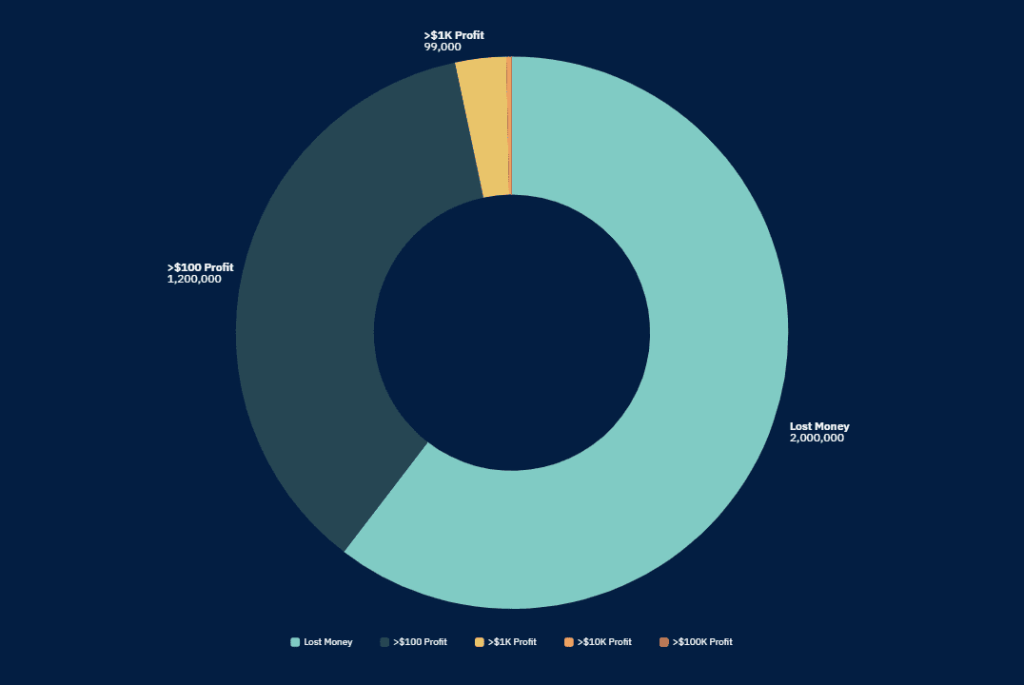
    More than 60% of Pump.fun users are losing money. That’s millions of wallets in the red, with 1,700 of them down over $100,000 each and a small handful losing more than a million.

    On the surface, Pump.fun feels like a golden ticket into Solana’s meme coin scene. It’s cheap to launch a token, easy to trade, and simple enough for anyone to try. But behind the fun branding and viral hype, the numbers tell a very different story.

    From Dune Analytics data, back in June:

    • 56.6% of wallets lost between $0 and $1,000
    • Nearly 1,700 wallets lost over $100,000
    • 46 wallets lost over $1 million
    • Around 5,000 wallets made more than $100,000
    • Just 311 wallets cleared over $1 million in gains
    60% of Pump.Fun wallets lose money on crypto and memecoin trades.

    For most participants, “winning” means a few hundred dollars. And for a large majority, it means losing. Reports of bots, frontrunning, scam tokens, and wash trading have been circulating for months, and the PUMP token launch is already causing major volatility across the Solana ecosystem.

    If you want to be in the minority who come out ahead, you need to trade differently from the crowd.

    We recently published an article about what works and what doesn’t in the world of memecoins. It’s a great complementary read to this article. Check it out here: The Brutal Truth About Solana Memecoins: Here’s Why You’re Missing the Best Opportunities

    How to Tilt the Odds in Your Favor on Pump.fun

    We won’t sugarcoat it: Pump.fun is a wild, unpredictable beast. If you jump in without a plan, you’re probably going to lose. 

    Even if you do have a plan, you can still struggle to make a profit. But if you’re smart about it (and have a little bit of luck), there’s a chance to be in that profitable 40%. It comes down to mindset, patience, and a few practical moves that most people overlook. 

    Let us walk you through what we’ve seen work.

    Don’t Chase the Hype After It’s Already Exploded

    The hardest pill to swallow when trading cryptocurrency (especially memecoins) is accepting that you missed a once-in-a-lifetime opportunity.

    In other words, most people jump in way too late. You’ll see a coin blowing up on Twitter or Discord, and your first instinct is to buy in right away, thinking you’re catching the wave. But by then, the early buyers and bots have already made their move, and you’re left chasing their profits.

    The better play is to get in early, when nobody’s talking about the coin yet. Now, we know what you’re thinking: that’s easier said than done. But you can do this by paying attention to two factors: the community growth and the chain itself. 

    Watch for new tokens that just popped up and liquidity that just got added. Monitor social media mentions and token holders since day one. These early signals give you a clearer picture before the hype train leaves the station.

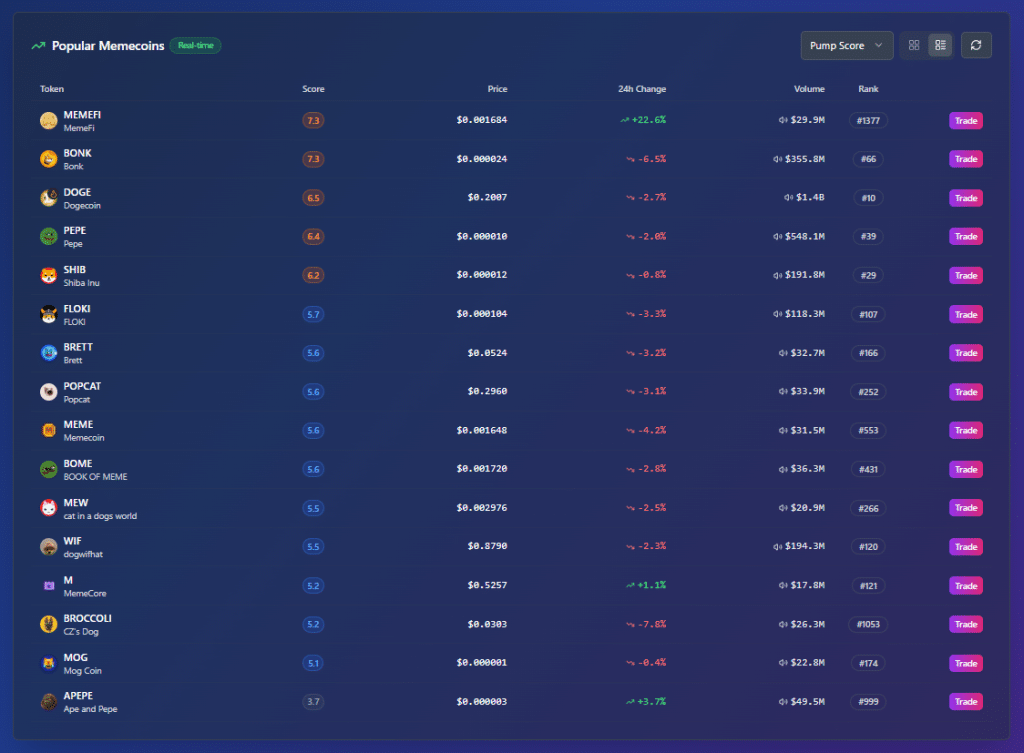
    Of course, this is a lot of data to process for our brains. Fortunately and thanks to AI, we now have second brains to take care of this for us. Tools like Milo and Pump Parade can help you not only process data, but also interpret and analyze it to receive fresh, curated insights on memecoin opportunities.

    You won’t catch every winner this way, true. But you’ll avoid a ton of losses caused by late entry.

    Always Assume You’re Dealing With a Scam Until Proven Otherwise

    This one is brutal but true: nearly every token on Pump.fun is suspect. Scam tokens, rug pulls, and shady projects are everywhere. So you have to be your own gatekeeper. Don’t just buy a coin because it sounds fun or because a couple of influencers hype it.

    When dealing with Solana memecoins, always assure they're scams until proven otherwise.

    Here’s what we check every single time before we even think about putting money in:

    • Is the liquidity locked? If it’s unlocked or locked for only a few days, run.
    • How much of the token supply does the team hold? If they control a massive chunk, you’re basically betting on them not to pull the rug.
    • Does the contract code have any scary functions, like the ability to mint unlimited tokens or block your trades?
    • Is the community real, or are you seeing bot spam and fake hype everywhere?

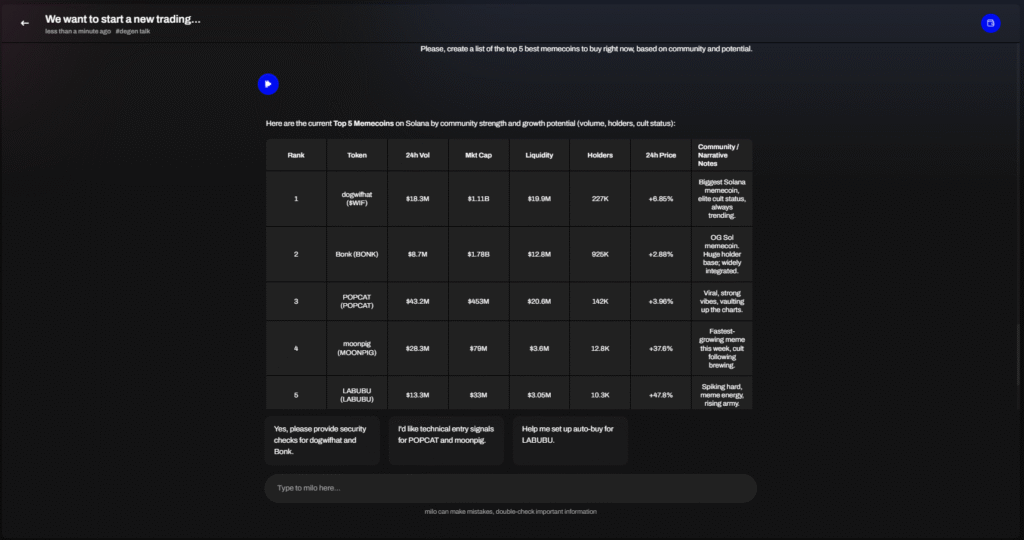
    If you don’t know how to do some of this yourself, there are tools and AI-powered scanners that can flag the obvious red flags for you. We recommend you simply connect to Milo, open a chat, and ask it to run a security check on the tokens you’re interested in. It takes only a few seconds and you’ll get a detailed, comprehensive report to ensure you make the right decision.

    Don’t skip this step, it’s where most people lose the most money.

    Watch Out for Bots and Whales, They’re Playing a Different Game

    Unfortunately, bots and whales dominate Pump.fun’s early action. They have lightning-fast tech and big pockets, which means they get in and out before most of us even see what’s happening.

    But if you know exactly what to look for, you can avoid getting steamrolled by them. For example, watch addresses that keep winning big: these are usually bots or pros. When you see a big player making a move, don’t just blindly follow. 

    Sometimes they’re setting traps to shake out smaller traders. These are called pump-and-dump schemes, and you wouldn’t believe how many people get caught in them. We’re talking about millions of dollars in liquidity being absorbed by these whales every single time.

    You can also spot suspicious patterns of volume spikes that don’t match genuine buying interest. The more you watch, the better you get at sensing when the market is being manipulated and when it’s just normal trading. Again, make sure you use the right crypto research and market analysis tools to stay ahead.

    Watch out for bots and whales! They're all over Pump.Fun.

    Take Your Profits Sooner Rather Than Later

    Greed is the enemy here. We get it, it’s tempting to hold out for that huge 10x moonshot. But most of the time, you’ll end up watching your gains evaporate while hoping for a miracle.

    The smart move is to take partial profits early and secure your wins. For example, when your token doubles or triples, lock in some gains. You don’t have to sell everything, but securing some profits means you walk away ahead even if the price crashes later.

    And don’t be afraid to set stop losses to protect what you’ve earned. In fact, we actively encourage you to do it. The market can turn on a dime, and keeping some distance from your winners helps keep you in the game longer.

    Don’t Put All Your Eggs in One Basket

    This should be a no-brainer already, but in case you need a reminder: memecoin trading is high-risk by nature. You want to protect yourself from any one trade wiping you out. That means dividing your capital into smaller chunks and spreading it over multiple tokens.

    Limiting your position size to just a small percentage of your total funds helps you weather inevitable losses while still giving you room to catch a big winner.

    It’s like the saying goes: don’t bet the farm on a single hand. Small bets over time are what lead to smaller, yet consistent and sustainable profits. 

    We recommend using AI agents to diversify your memecoin portfolio. They are surprisingly effective at it. With the right prompts, you can have them surface multiple coins that respond to different market conditions, giving you broader coverage. The key is in how you ask

    Catch the First Wave, But Be Wary of the Afterparty

    Most Pump.fun tokens make their big moves right out of the gate, within minutes or a few hours. That’s when volume, attention, and price surge all at once.

    If you miss that first burst, be very cautious about jumping in later. The “second wave” is often where the traps lie. Developers and bots may unload their tokens, and volume tends to dry up fast.

    Always be the first to catch the wave of new Solana memecoin launches on Pump.Fun.

    Look for clear signs before chasing a token that’s already cooled off. Factors like renewed social activity, fresh liquidity, or sustained buying interest are good signs. Otherwise, you’re more likely to get stuck holding tokens that nobody else wants.

    Keep Your Emotions in Check

    We can’t stress this enough: memecoin trading is a rollercoaster, and emotion is the enemy of logic. Fear and greed make you chase losses, hold losers, or buy at the wrong time .

    Try to build a simple trading routine and stick to it. Decide your entry and exit points in advance. When you hit your target, take profits and walk away. When you hit a stop loss, accept it and move on. 

    Don’t ever change your plan because of how you feel in that particular moment. “I’ve hit my target but I’ll let it run a little bit more, it’s been doing good so far.” Famous last words.

    This is where AI can make the biggest difference. It acts purely on data, without fear, greed, or hype clouding its decisions. Designed to simply follow the rules you set, it helps you stick to your plan and avoid the emotional mistakes that can derail trades. 

    AI can scan multiple coins at once, analyze market sentiment, liquidity, and volatility, and surface opportunities that fit your strategy. It can even simulate different scenarios, giving you a clear picture of potential outcomes before you commit. In a market as unpredictable as memecoins, AI becomes your steady hand, keeping your decisions rational, disciplined, and focused on your goals.

    Interested in more ways AI can help you with your crypto trading strategy? Make sure to check out our article about it: How to Use AI for Crypto Trading (The Right Way) 

    Remember, no one wins every trade. Success comes from making consistent, disciplined choices over time, not chasing a single big win. AI has become an invaluable tool for maintaining that consistency.

    Now, let’s dive deeper into how exactly you can make this happen.

    Using AI Agents to Level the Playing Field

    Pump.fun moves at Solana speed, faster than most traders can think, let alone react. AI agents bridge that gap by processing massive amounts of data in seconds and acting on it instantly.

    Here’s what they can do for you:

    • Scan on-chain activity in real time: thousands of wallets, new token launches, liquidity pool changes… and flag unusual patterns before the crowd notices
    • Run instant technical analysis: detecting breakouts, volume surges, and momentum shifts without you staring at charts all day
    • Check contracts and wallets for scams: spotting risky code and suspicious wallet behavior before you enter.
    • Monitor community sentiment: separating genuine buzz from botted hype across Twitter, Discord, and Telegram
    • Automate trades: buying or selling based on pre-set conditions so you can react in milliseconds, not minutes

    Think of it like having a 24/7 research team, analyst, and sniper trader rolled into one. They never get tired, never get emotional, and never chase a meme out of boredom.

    Like we mentioned, we tried a Solana AI agent called Milo that blew our minds, and we have been recommending it ever since. 

    If you’re willing to dive into the world of memecoins, make sure to connect to Milo and check it out. It’s free, extremely easy to use, and connects directly to your wallet. And if you’re feeling skeptical (like we did at first) you can start small, with as little as $1.

    Memecoins & Pump.Fun: The Wild West of Web3 

    Pump.fun isn’t designed to make everyone rich. It’s fast, volatile, and full of traps. However, if you approach it with discipline, do your homework, take profits quickly, spread your risk, and let AI handle the parts humans can’t do fast enough, you have a much better chance of being in the profitable 40%.

    In a space where most traders end up as exit liquidity, your only job is to make sure you’re not the last buyer holding the bag.

    Pump.Fun and Solana Memecoins are like the wild west of Web3.

    There’s no magic formula for making every trade profitable. But there are guidelines that, if followed carefully and consistently, can help you win more often than you lose. Remember, these are:

    • Assume every token could be a scam until proven safe.
    • Watch out for whales and bots. Not every wallet you see on-chain is a trader like you.
    • Avoid chasing trades after the big move has already happened. That ship has sailed.
    • Get in early on coins before the hype hits. Monitor community growth and social sentiment before anything else.
    • Stick to a clear routine with pre-set entry and exit points.
    • Lock in profits early and use stop losses to protect gains.
    • Diversify your positions so one bad trade doesn’t wipe you out.
    • Leverage AI tools to scan data, track sentiment, flag risks, and keep decisions disciplined.

    In the end, winning on Pump.fun takes a mix of skill, discipline, and luck. Most traders will keep feeding the machine, chasing pumps, and holding empty bags. 

    If you want to be different, you need to think ahead, act early, and let data, not emotion, guide your decisions. The chaos is not going away, but with the right mindset, smart risk management, and AI as your companion, you can avoid joining the majority that loses and start positioning yourself among the few who consistently come out ahead. 

    In this game, survival is victory, and every win you stack after that is pure profit.

    The Brutal Truth About Solana Memecoins: Here’s Why You’re Missing the Best Opportunities

    0

    If you’re trying to trade Solana memecoins like any other crypto, you’re setting yourself up to lose. Every time. 

    Memecoins aren’t investments. They aren’t real assets, just high-risk bets. These tokens have no use case, no roadmap, and no product. Indeed, memecoins operate on a completely different standard than most cryptocurrencies: virality, momentum, and pure chaos.

    And that’s exactly why traditional trading strategies fall apart the moment you apply them here. 

    If you’re serious about catching the next pump and avoiding becoming someone else’s exit liquidity, you need to rethink your entire approach. Don’t worry, we’ll show you. 

    Here’s how to do it right.

    Memecoins Don’t Care About Fundamentals, Neither Should You

    If you’ve spent hours staring at charts and websites, hoping to find a clue to your Solana memecoin’s next move, you know how cruel the market can be. You wake up to your bags halved, the community ghosted, and no update or shiny “partnership” to save you.

    Here’s the brutal truth: memecoins don’t follow rules. They don’t care about utility or tech or locked liquidity. Their only currency is attention, and that evaporates fast.

    One day your X feed is flooded with memes, hype is pumping through Telegram, influencers are shouting it from the rooftops. The next day, all you hear is crickets. Sometimes, it turns out the memecoin creators paid for engagement and the community wasn’t real. Other times, the hype just moves on, and the price crashes.

    So forget “fundamentals.” The real question is: Is the meme alive? Are people sharing, tagging, hyping, laughing? Are new faces flooding into the chat? If the answer is no, your bags are a ticking time bomb.

    When it comes to memecoins, your only reliable bullish signal is social momentum, not candlesticks or volume charts. And when the buzz fades, so should you.

    When it comes to Solana memecoins, social sentiment and community is key.

    Why Technical and Fundamental Analysis Will Burn You Here

    We know for most cryptocurrencies, these two methods are the backbone of research and analysis. Drawing support and resistance feels like the only thing you can do to make sense of these crazy charts. 

    But memecoins are different. You spot a breakout, set your target, and then boom, someone dumps 80% of liquidity, and your profit turns to dust.

    It’s like the market is trolling you, because it kind of is. In the world of memecoins, charts lie. Locked liquidity or “nice devs” won’t save you if the hype train derails.

    Memecoins move on hype cycles, virality, and social chatter. Not logic. The smart traders know this and chase the community wave instead of the chart wave.

    In this context, crypto research tools that help you track social sentiment are invaluable. They don’t pretend memecoins behave like blue-chip tokens. Instead, they show you what actually matters: who’s buying, how fast Telegram’s growing, which memes are blowing up, and when the narrative is about to explode.

    This is how you stay one step ahead instead of being blindsided.

    Solana memecoins are powered by sentiment, hype, and virality.

    When Trading Memecoins, Watch the Crowd (Not the Chart)

    Price action in memecoins is a lagging indicator. The real money is made by feeling the shift before the price pops.

    The moment a memecoin stops being an inside joke and becomes a full-blown obsession or massive Internet movement, the clock starts ticking. You want to be in before the crowd floods in, not after.

    Watch wallet inflows, Telegram growth, retweet speed, and who’s buying and selling. Ask yourself:

    • Is this real hype or bots pumping fake engagement?
    • Are people creating memes or just farming likes?
    • Are whales quietly accumulating or already cashing out?

    With the right crypto tools (especially those built for Solana memecoins) you can spot these subtle signs while others are still clueless.

    How to Make Better Solana Memecoin Trades

    Most traders lose because they treat memecoins like investments: holding long, hoping for a recovery, trusting the dev team. That’s a losing game because there are no fundamentals to back it up. With memecoins, virality is key. 

    Here’s the smarter play:

    • Don’t hold memecoin bags for too long. Although there are exceptions, most Solana memecoins are made to pump fast and dump faster. Take your profits quickly and move on. If you’re up, scale out. Avoid hero plays.
    • Use automated trading tools. Bots win this game every time. Both Solana trading bots and crypto memecoin sniper are good options, as automation always beats manual trades. Fast fingers get crushed by fast scripts. We use Milo, a free-to-use crypto AI agent that connects directly to your wallet and executes trades for you. Try it, you won’t regret it.
    Scan the market with the best crypto research tools integrated with this crypto AI agent.
    • Protect your downside. Set strict stop losses, keep your position sizes small, and only risk what you’re willing to lose. This isn’t blue-chip crypto, it’s more like digital scratch-offs. Again, Solana AI agents can help you do this, or even do it for you. All you need to do is ask. 
    • Trade like a predator, not a fan. Don’t get emotionally attached to communities or projects. Your job is to spot when hype is about to blow, ride it, then get out before the turn.
    • Track the right metrics. Forget just watching the price. Use a crypto screener or memecoin tracker that focuses on social signals, wallet flows, and fresh buyers. Pump Parade makes this simple by pulling data from Twitter, Telegram, and on-chain activity all in one place.
    Crypto sniper tools are excellent for finding Solana memecoin opportunities.

    Where to Find and Trade the Best Solana Memecoins

    Solana is at the center of the memecoin boom, driven by its lightning-fast transactions, low fees, and an ecosystem built for viral momentum. 

    If you’re wondering where to buy Solana memecoins, the action is happening across a growing set of launchpads. Platforms like Let’sBonk and Pump.fun have become ground zero for early-stage memecoin launches, fueling the next wave of speculative frenzy.

    But don’t let the launch simplicity fool you. What comes after launch is chaos. Bots snipe launches within seconds, whales fight for position, and the market moves in milliseconds.

    If you don’t know what you’re doing, you’ll be down 80% before you even realize what went wrong. Over 60% of wallets on Pump.fun end up losing money. Only preparation, sharp instincts, and smart decision-making will keep you in the winning 40%.

    That’s why having the right tools, like Solana trading bots, memecoin platforms, social sentiment trackers, can make all the difference. The edge comes from spotting momentum before it shows up on the charts. 

    Platforms that combine on-chain activity, social buzz, and AI-driven alerts help you catch the wave early instead of chasing it after the fact. And this is exactly what we built PumpParade for.

    The Truth About Solana Memecoins

    If you trade memecoins like regular altcoins, you’ll keep losing to those who don’t. 

    Solana memecoins don’t follow fundamentals, roadmaps, or even logic. They run on speed, hype, and herd psychology. Success doesn’t go to the most “informed” trader, it goes to the fastest, the sharpest, and the ones who understand the rules of the game.

    And the first rule is this: memecoins are not investments. They’re social trades. Attention is the fuel, and once that attention fades, so does the chart. If you’re not tracking where the crowd is going, what they’re laughing at, hyping up, or aping into, you’re already behind.

    Solana memecoins don't work like other cryptocurrencies.

    Winning in this market means adapting. It means having tools that surface early momentum, not just clean technical analysis. It means knowing how to read Telegram spikes, wallet inflows, and meme velocity. It means understanding when to ride the wave and, more importantly, when to get off.

    This is why most traders get wrecked. They either hold too long, enter too late, or ignore the signals that matter. But with the right mindset, the right discipline, and a real edge in narrative tracking, you can flip the odds.

    So if you’re treating memecoins like tech stocks, stop. Start treating them like what they are: fast-moving, emotionally driven, narrative-fueled mini-cycles.

    Memecoins are a game. If you’re going to play, play to win.

    How to Use AI for Crypto Trading (The Right Way)

    Most traders using AI in crypto are doing it wrong.

    They open up ChatGPT, ask for “the best altcoins to buy now,” and act on whatever response they get. But this is a major mistake that could cost them dearly. 

    Tools like ChatGPT weren’t designed for this market. They don’t use real-time data. They don’t understand wallet behavior. And they certainly can’t provide grounded analysis of what’s happening on-chain or across exchanges.

    If you’re using general-purpose AI to guide trades in a volatile, fast-moving space like crypto, you’re not gaining an edge. You’re betting on a losing horse.

    That being said, there is good news too. There’s another way (the right way) to use AI to level up your crypto trading strategies and execution.

    We’ve spent months building and testing real crypto-native AI systems, and we’ve seen what actually moves the needle. 

    Here’s how serious traders are using AI to make smarter decisions, move faster, and trade with conviction.

    1. Don’t Use ChatGPT for Market Decisions

    We’ve touched on this already, but let’s be extremely clear: ChatGPT and similar models are incredible for general tasks like writing, brainstorming, or summarizing concepts. But they are not trading tools.

    They’re trained on static datasets. They cannot process live wallet data. They don’t monitor DEX volume or pick up on emerging narratives in Telegram groups. All they can do, at best, is a quick search on Google or other search engines.

    Every trading suggestion they generate is based on probability of language, not probability of outcome. In practice, that means they can’t analyze or reason: they simply guess what “sounds” correct.

    Trading based on that kind of output is worse than speculation. It’s fiction. The problem is, many traders find it comforting when an AI confirms their existing biases. It feels reassuring, like a second opinion backing up what they already want to believe. But that sense of validation is often a trap, because they end up following the AI’s suggestions blindly and walking straight into bad trades.

    That’s not to say ChatGPT is never right. Even a broken clock is correct twice a day. But if you’re using it regularly as part of your trading process, treating it like a source of analysis or market insight, you should stop immediately. It simply doesn’t work. Not for this use case, not in this market.

    2. Use AI That Processes On-Chain and Off-Chain Data

    The real advantage of AI in crypto comes from how it handles complexity at scale. While humans struggle to keep up with thousands of tokens, wallet movements, and shifting narratives, AI can process it all in real time.

    We recommend using AI tools that monitor and analyze:

    • Wallet behavior and smart money flow.
    • Token velocity and DEX volume trends.
    • Social sentiment from Twitter, Reddit, Discord, and Telegram.
    • Developer activity, governance proposals, and protocol updates.
    • Market narratives as they emerge and spread.

    With this kind of system in place, it becomes possible to identify not just individual tokens with momentum, but entire sectors or narratives gaining traction. Using AI to scan real-time market and social data allows you to position ahead of the crowd instead of reacting to it.

    This is exactly why we built Pump Parade, because we needed this tool ourselves. Something that could cut through the noise, surface what actually matters, and make sense of all the chaos flying around on-chain and across social channels.

    If you’re spending hours bouncing between DEXs, Twitter threads, Telegram alphas, and on-chain scanners trying to spot what’s moving… Pump Parade simplifies all of that. It tracks real wallet flows, narrative spikes, smart money activity, and gives you the kind of signal that helps you stop guessing and start acting with clarity. And it’s completely free.

    3. Use AI Agents Built Specifically for Crypto Research

    Crypto is different from other markets. It moves faster. It’s more fragmented. And it’s heavily influenced by both on-chain behavior and off-chain community dynamics.

    This is where purpose-built AI agents shine. These agents are trained to understand how wallets behave during airdrops, how Telegram groups influence early-stage projects, and how developer activity correlates with price movements.

    Instead of relying on raw data feeds or generic dashboards, crypto-native AI agents surface patterns that would take a human hours (or days) to piece together. For example, they can detect when known wallet clusters begin accumulating in a new ecosystem, or when engagement on a specific protocol suddenly spikes across social channels.

    More importantly, they can also act on command. You can ask a crypto AI agent like Milo to run a security check or a technical analysis on a specific token, scan the market for opportunities, and even design and optimize your trading strategy for maximum results.

    There’s a catch however, and it’s prompting. Indeed, AI agents aren’t infallible. They are only as good as the prompt you use. Don’t worry, we’ve put together a guide to help you get started. Click on the link below to check it out.

    We Tried 50+ Crypto Trading Prompts on a Solana AI Agent — These 7 Delivered the Best Profits

    This type of tool is what leads to real alpha, not generic token lists or recycled hype.

    4. Automate Trade Execution with Strategy-Driven AI

    Research is only half the equation. Execution matters just as much, especially in a market that doesn’t sleep.

    AI-powered execution agents allow traders to automate setups based on real-time conditions. These agents can:

    • Monitor liquidity and snipe new listings within seconds.
    • Execute orders based on narrative triggers or wallet signals.
    • Set automated stop-losses and take-profits based on volatility.
    • Dynamically reallocate portfolios in response to market shifts.

    What this unlocks is a new level of speed and efficiency. No more missed entries because of time zones. No more second-guessing exits. AI removes the emotional drag from decision-making and allows strategies to run with precision around the clock. 

    5. Combine Research and Automation for Full-Spectrum Advantage

    The real power of AI in crypto trading comes when you connect research and automation in a single flow.

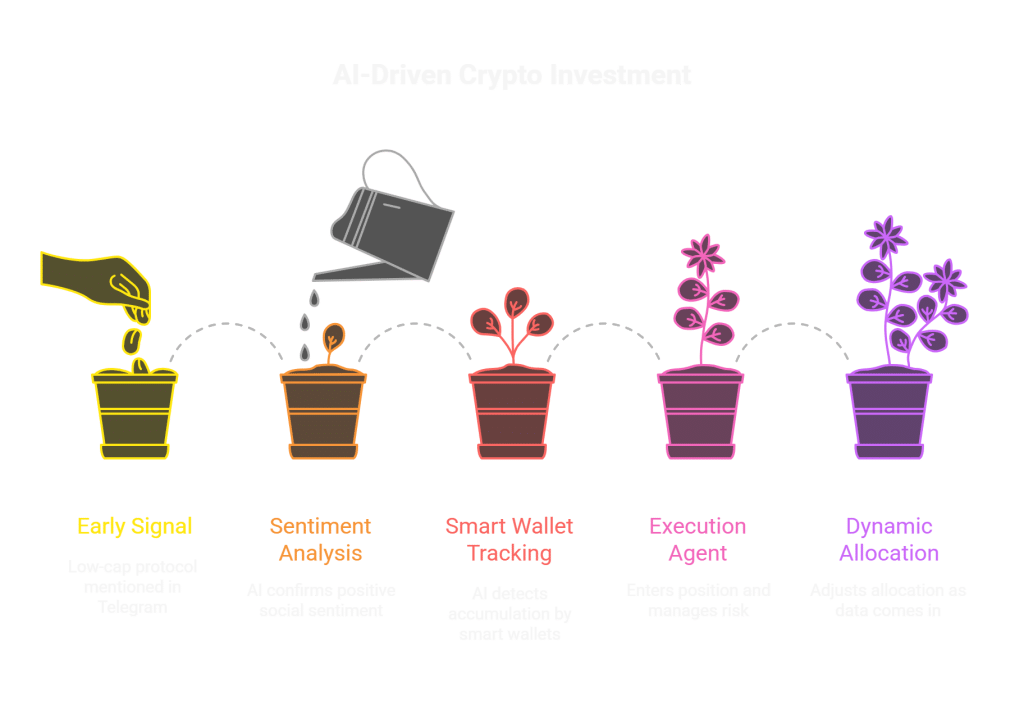
    Imagine this: an AI agent picks up early traction around a low-cap protocol that’s being mentioned in Telegram groups. It confirms that smart wallets are accumulating and social sentiment is turning positive. That signal is instantly passed to an execution agent, which enters a position, manages the risk, and adjusts the allocation dynamically as more data comes in.

    This is how top traders operate now. Not by watching charts all day, but by building systems that observe, decide, and act faster than the market.

    That’s why we’re so excited about Milo. It can execute all these commands, tasks and trades seamlessly and automatically from your own wallet. It has a simple, user-friendly chat interface where you just ask him what to do, and it does it immediately. Can’t get any easier than that!

    We recommend you give it a go. After all, it’s free. Connect to Milo and level up your crypto trading.

    You’ve Been Using AI Wrong, Start Making It Right

    The key to using AI in crypto trading isn’t in chasing predictions. It’s in building clarity. 

    When you use AI the right way, you get a powerful tool for cutting through noise, spotting real opportunities, and executing trades with discipline and speed.

    Pump Parade integrates AI systems designed for real-time crypto research, narrative tracking, wallet analysis, and automated trading. We avoid shallow hype and fictional predictions. Just the data and insight needed to trade with confidence in a market that never stops moving.

    If you’re still relying on chatbots or Twitter threads for your edge, it might be time to upgrade your approach.

    The next wave of winners in crypto will be those who can see clearly and act faster. With the right AI, that advantage is real.

    I’ve Been in Crypto for 8 Years: Here’s What I Learned and What I’d Do Differently

    0

    In 2018, I watched over tens of thousands disappear from my portfolio in less than 60 days. I wasn’t rugged or hacked. I was just stupid: overleveraged, overconfident, and completely unprepared for the reality of this market.

    I remember staring at the charts, refreshing Blockfolio every 10 minutes like it was going to change something. It never did.

    Back then, I thought I was early. Turns out, I was just unseasoned.

    Eight years later, I’m still here. A little more scarred, a lot more grounded. And if I had the chance to start again with the knowledge I’ve earned the hard way, this is exactly what I’d do differently.

    If you’re just starting in the messy world of crypto, this might be useful for you.

    Lesson #1: I Wouldn’t Chase the Noise, I’d Watch What Moves in Silence

    In the first bull run I ever experienced, I got swept up in the ICO wave. Everyone was shouting about the “next ETH,” so I followed the crowd. 

    Got in late, obviously. Held a bunch of projects with pretty websites and zero working code. One of them, I remember clearly: Envion. Promised decentralized mobile mining units. Raised over $100 million. I aped in near the top, watched it implode, and then found out the founders were suing each other (what every crypto investor wants to hear about their project, right?).

    At the time, it felt like bad luck. Now I know better. There were no builders. No real traction. Just noise. They were loud about everything they did and poured a lot of money into marketing, but that’s it. Now, I analyze the tokens, not the brand. Well, I use an AI agent called Milo that does it for me. All I have to do is tell it: “Run a security check on $XYZ” and if all looks good, I ask: “Create a trading strategy for $XYZ.” Easy and automated. You can try it yourself here.

    If I could go back, I’d spend less time reading headlines and more time watching what smart wallets were accumulating while no one was looking. Hype is loud, but real momentum is quiet.

    The earlier you learn to tune out the noise and listen for what’s quietly growing, the faster you’ll stop being exit liquidity.

    Lesson #2: I’d Stop Diversifying My Uncertainty

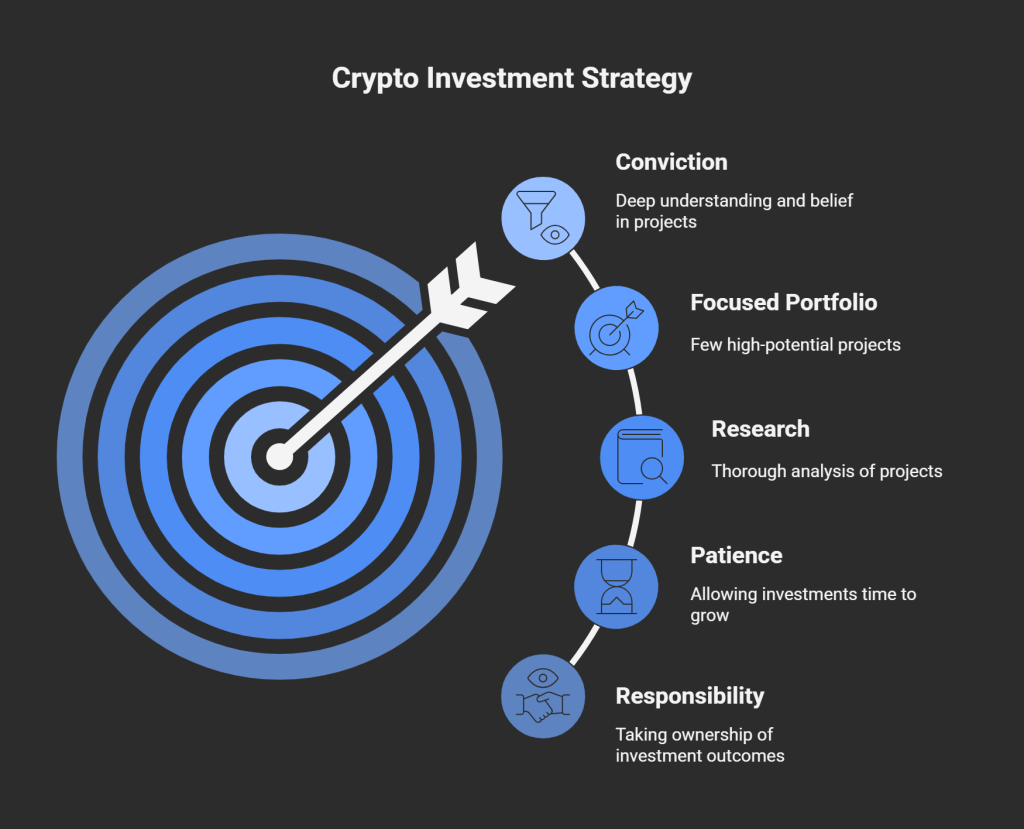
    In 2021, my portfolio looked like a patchwork quilt. I held 31 different coins, from layer 1s to food-themed yield farms to a metaverse project that had literal placeholder art on its homepage. I called it “diversification,” but it was really just me avoiding responsibility. If nothing worked, I could say it was the market’s fault.

    But when the cycle turned, every single one of those coins bled together. And the few that survived? I had so little in them it didn’t even matter.

    I’ve learned that conviction isn’t about how sure you feel, it’s about what you’ve earned through research, through understanding, through time in the trenches with a project. 

    And when you have that, you don’t need 30 bets. You need 3 good ones and the patience to let them breathe.

    Being spread thin isn’t safety. It’s indecision disguised as strategy. Go deep where it matters.

    Lesson #3: I Would’ve Bought When I Was Most Uncomfortable

    There’s this moment I keep replaying in my head: early 2019, LINK was trading around $0.80. I had been watching it for weeks. The community was relentless, the GitHub commits were active, Sergey was actually doing things. 

    But the chart looked dead. It felt like a gamble. I told myself I’d wait for more “confirmation.”

    By the time I got in, it was already over $4. I still made money, but nothing close to what it could’ve been if I’d trusted my gut instead of waiting for permission.

    That’s the thing about crypto: the best entries always feel wrong in the moment. They go against your instincts. But once you’ve seen enough cycles, you realize that’s exactly what makes them a unique opportunity.

    If it feels scary but the fundamentals are strong, lean in. Discomfort is often the cost of getting in early.

    Lesson #4: I Would’ve Taken Profits While I Still Believed the Narrative

    I was sitting on thousands of dollars in profit on $ZRX in 2021. Bought at $0.30, rode it up to over $2. I felt like a genius. And then I did something incredibly dumb: I decided not to sell any of it.

    I read some new tokenomics proposals and thought it was bullish. Everyone on Discord was convinced it was headed to $5. So I held.

    Six months later, I panic-sold it at $0.65.

    I didn’t lose that money because of bad research or bad timing. I lost it because I was greedy and addicted to the feeling of being right. I wanted to be more right. And that blind spot cost me a life-changing win.

    Now, whenever a coin I hold is still trending, still getting attention, and I still believe in it, that’s exactly when I scale out. Not because I’ve lost faith. But because I’ve learned that selling into strength is the only time you get to do it on your terms.

    If you wait to feel “done” before taking profit, the market will decide for you. And it rarely chooses kindly.

    Lesson #5: I Would’ve Followed Wallets, Not People

    In 2022, I was following this influencer with half a million followers. He tweeted nonstop about a specific DeFi project, said he was “in for the long haul,” doing “multi-year research,” and all the usual conviction theater.

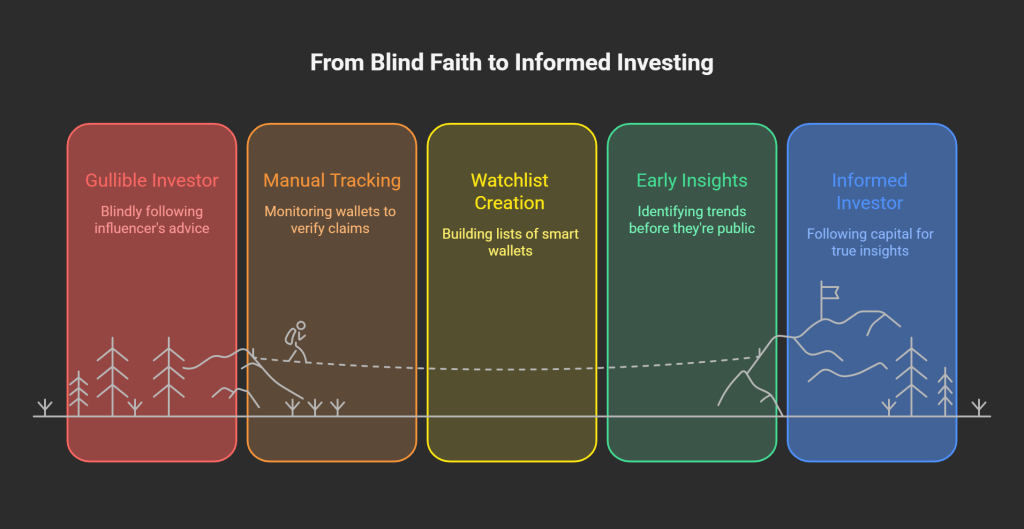
    Turns out, he had been offloading that same token in chunks every week. I only realized it after I started tracking his wallets manually.

    Could’ve been a paid shill or a pump-and-dump. It doesn’t matter. The point is, it was gullible and painful to blindly get into a token just because someone popular said so. It was like being punched in the gut, and then waking up.

    Since then, I’ve built watchlists around smart wallets. Early seed buyers. Protocol devs. Quiet whales. And I’ve seen how the best entries show up in the wallets weeks before they show up in your feed.

    Everyone talks. But only wallets whisper the truth.

    Follow people and you’ll get played. Follow capital, and you’ll learn how the game is actually being run.

    Lesson #6: I Would’ve Taken Fewer Trades, and Made Them Count

    For a stretch in 2020, I was glued to charts. RSI, Fibonacci, candle patterns. Every hour of every day, I was looking for the next breakout. I used to believe that more trades meant more chances to win.

    All it gave me was stress, sleepless nights, and a portfolio that never moved meaningfully in either direction.

    The funny thing is, the biggest gains I ever made came from just sitting on a high-conviction narrative play and letting the market catch up to it. Not from staring at candles. Just from waiting while everyone else got chopped to death.

    There’s a rhythm to this game. Most days are just noise. And if you try to force meaning into every candle, you’ll miss the rare moments when everything actually does align.

    You don’t need to trade more. You need to wait better.

    Lesson #7: I Would’ve Stayed Liquid Enough to Pivot

    In early 2022, I was fully deployed. No stables, rotation room or flexibility. I was all in. And then the DeFi 2.0 narratives started popping up: Olympus forks (remember those?), aggregators, protocol-owned liquidity, all of it. 

    I saw some of them coming. But I couldn’t touch them. I was locked into illiquid, unprofitable bags, telling myself they’d rebound.

    They didn’t.

    I guess you could also say that I should have taken the loss on some of my bags to capitalize on a fresh, new opportunity. That’s also true, but the bottom line is: whatever you do, always keep a sizable amount of stablecoins ready to deploy.

    Having stables lets you move. And in crypto, the ability to pivot when something new starts brewing is the difference between watching a trend and owning it.

    Being right means nothing if you’re too illiquid to act on it. Stay nimble.

    Lesson #8: I Would’ve Built a System That Fits Me, Not Someone Else

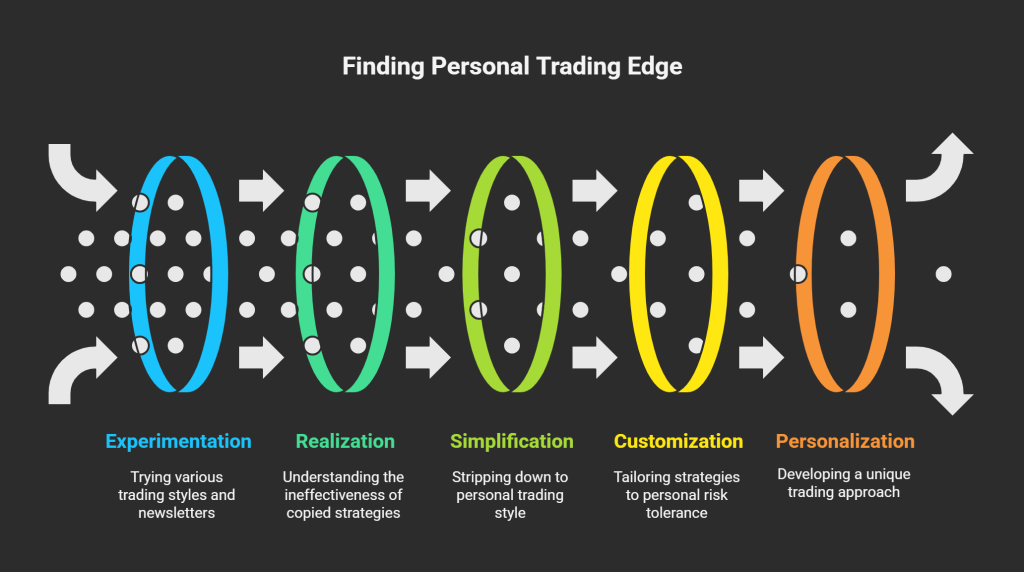
    I wasted years trying to mimic other people’s playbooks. I tried being a full-time trader. Tried copying the styles of high-frequency CT guys. Tried following 15 different newsletter “alphas.”

    But none of it worked. Because none of it was designed for me.

    Eventually, I stripped everything down to what made sense for how I think, how I work, and how I tolerate and manage risk. I focus on narrative rotations. I use tools that surface early sentiment shifts. I hold fewer tokens for longer. I’m not a sniper, I’m a cycle hunter.

    That shift changed everything.

    Once I stopped pretending to be someone else, I finally started making decisions I could live with, win or lose.

    Your edge is who you are. The sooner you stop outsourcing your instincts, the faster you’ll find your lane.

    If You’re Still Here, Let Me Leave You With This

    Crypto is brutal. It rewards patience until it doesn’t. It punishes FOMO, then flips and punishes doubt. You’ll never time it perfectly. But you don’t have to.

    What matters most is sticking around long enough to recognize the rhythm. To spot the recycled narratives. To know when you’re early, and when you’re just wrong. 

    Be critical with yourself, learn from mistakes, and don’t blame anyone else but yourself. That’s the way you learn to navigate this world, and how you get better at it.

    If I had to do it all again, I wouldn’t change the tokens I picked.

    I’d change how I saw them.

    And that shift, from chasing the game to understanding the game, is what finally gave me the edge I was looking for.

    The longer you stay in the game, the less it’s about picks, and the more it’s about perspective.

    The One Wrong Question Everyone Asks About Bitcoin

    0

    The first time I heard about Bitcoin, it was under $1,000. 

    I thought it was interesting, but probably a fad. By the time it crossed $6,000, I remember thinking, “Wow, that ship has definitely sailed.” When it dropped back to $3,000, I assumed it was dead. 

    Then it climbed again. And I kept asking myself the question that almost everyone eventually asks when they finally start paying attention:

    Is it too late to buy Bitcoin?

    It’s a completely natural question. It feels like the right one to ask. You see the chart, you hear the stories of early buyers turning a few hundred dollars into millions, and you wonder if you missed your shot. 

    But the more time I’ve spent in this space, the more I’ve realized that this question is not just unhelpful: it’s fundamentally missing the point of what Bitcoin actually is and why it matters.

    Why “Is It Too Late to Buy Bitcoin?” Is the Wrong Question

    Let’s be honest about what people are really asking when they say this. 

    They’re not really asking about Bitcoin’s fundamentals or adoption curve. What they usually mean is, did I miss the part where a small investment turns into a life-changing amount of money.

    The question is rooted in regret, in comparison, and in fear. It’s a reaction to watching other people win while you sat on the sidelines. But that mindset is backwards. Because if you’re judging Bitcoin only by how much other people made from it, you’re already thinking like a short-term speculator. 

    You’re not trying to understand it. You’re just trying to fast-forward to the reward.

    That’s not how long-term wealth gets built. That’s not how conviction is formed. And with an asset like Bitcoin, which regularly drops 50% in a matter of months, you need conviction to stick around long enough to benefit.

    To buy or not to buy Bitcoin? That is the (wrong) question.

    The Truth Is Most People Still Have No Exposure

    The idea that you’re late is tempting, especially when you look at Bitcoin’s historical chart. But zoom out a bit. 

    Despite being over a decade old, Bitcoin adoption is still in its early stages. The majority of people on Earth don’t own any. Most governments still don’t fully understand it. A large portion of institutional capital still hasn’t touched it. Most banks only started offering exposure in the last two years. Spot ETFs were only approved recently. Many pension funds and endowments still haven’t allocated a dollar.

    This is not a mature market in any real sense. It’s growing, yes. But it’s still developing its infrastructure, its security standards, its legal frameworks, its cultural narratives. It’s still being attacked and defended. 

    It’s still evolving.

    Imagine asking in 1999 whether you were too late to invest in the internet. It would have felt like it. So many dot-coms had already gone public. Big returns had already been made. But anyone who invested in Amazon or Google or built real internet infrastructure in the years that followed was still absurdly early.

    Bitcoin is similar. If you think in terms of decades, not quarters, you’ll start to see how much room there still is to run.

    What Are You Actually Buying?

    Here’s a better question than “Is it too late to buy Bitcoin?” Ask this instead: “Do I understand what Bitcoin is and what role I want it to play in my life?”

    Because when you really dig into what Bitcoin is, it stops being about price. It becomes about ownership, sovereignty, freedom, censorship resistance, scarcity, and trust in code rather than institutions.

    Bitcoin is the first money that cannot be inflated, seized without consent, or manipulated by policy. It is not a tech stock. It is not a meme. It is not a get-rich-quick scheme unless you treat it like one, and even then, that strategy often backfires.

    Bitcoin is infrastructure. It’s base-layer monetary technology. It’s a hedge against monetary debasement, a digital asset with no central issuer, a tool for preserving value across borders without needing permission. It’s the hardest type of money ever created, one that people choose to use, not forced to.

    So ask yourself: if you believe that fiat currencies will continue to be debased, if you believe that the financial system is fragile, if you believe that governments will eventually overreach, then why wouldn’t you want some exposure to something that exists outside of all of that?

    That question will get you a lot further than trying to figure out if you’re too late.

    In other words: Do you trust your government? Do you believe inflation will stop? That the hard-earned money in your bank account will have the same value it has today in five years? If your answer is no, you’ve got a lot to think about.

    Many people often ask if they are too late to buy Bitcoin. The truth is: It's never too late.

    Start Where You Are, Build From There

    Even if you did miss the very beginning (and yes, $100 Bitcoin is never coming back) that doesn’t mean you missed everything. You missed one chapter. The story’s still being written.

    The people who made the biggest returns in Bitcoin often sat through brutal drawdowns. They watched the price crash 70%. They held through winter after winter. The reward wasn’t just for being early. It was for being early and staying long enough to benefit.

    You don’t need to time the bottom. You don’t need to put in your entire net worth. But you do need to start with a framework. 

    Understand what you’re buying. Figure out how much risk you’re comfortable with. Make peace with the volatility. And then start building a position that makes sense for you: slowly, methodically, with intention.

    You’re not going to “catch up” to someone who bought at $300. That moment is gone. But you can build your own thesis and take control of your own timeline. That matters more. 

    You’re not racing against people who already hold Bitcoin. Those coins are theirs and always will be until they decide to sell them. Instead, you’re racing against other people who haven’t bought yet, because there are only 21 million coins, and it’s not enough for everyone.

    Bitcoin Is Not About Timing, It’s About Understanding

    The people who stick around in crypto (the ones who benefit the most) are the ones who eventually stop asking if they’re too late. They stop comparing themselves to others. They stop chasing perfect entries.

    Instead, they start asking better questions. What am I actually holding? What role does this asset play in a world that feels increasingly chaotic? How can I use Bitcoin not to get rich overnight, but to build something durable over the next decade?

    When you stop asking if you’re late and start asking what you’re buying, everything starts to change. Because you understand that when you buy Bitcoin, you are not buying internet money. You’re buying security, time, privacy, resilience, and most importantly, financial freedom.

    Bitcoin doesn’t care when you arrive. What matters is that when you do, you understand why you’re here. And you act accordingly.

    6 Simple Moves That Will Save You Weeks on Your Crypto Tax Reporting (and Take Under 5 Minutes)

    0

    If crypto trading is chaotic, crypto tax reporting is a logistical nightmare. DeFi, NFTs, centralized exchanges, staking, bridges… Every action leaves a trail of taxable events.

    Don’t worry, there’s good news. You can simplify your crypto tax workflow dramatically with a few smart (and fast) habits. 

    Each of the six methods below takes under five minutes, yet can save you hours, even days of cleanup work, missed cost basis matches, and reconciliation hell.

    Let’s jump in.

    1. Sync All Your Wallets and Exchanges Before You Trade Again

    Before you make another swap, bridge, or DEX trade, import your wallets and exchange APIs into your tax software. It takes under 5 minutes per platform.

    Most people only do this at the end of the year, when it’s too late to fix months of missing data. But if you sync early and often, you let the software track your cost basis in real time. It also allows you to find errors, missing data, and other issues with enough time to address these issues.

    Why it matters: Matching disposals to the right acquisition is what makes or breaks your capital gains report. Waiting until the last second means guesswork, and more time spent fixing bad data.

    Fortunately, there are platforms like Cartera that let you sync wallets across 15+ chains in real time, so you’re not stuck trying to patch things together with CSVs later. And because the data updates hourly, you can catch issues early (like missing NFTs or misclassified bridge transfers) before they pile up.

    Start optimizing your crypto taxes now. Your future self will thank you!

    Crypto tax reporting can be overwhelming. Use these tricks to make it easier.

    2. Use Two Crypto Tax Tools Instead of One

    Yes, seriously. Crypto tax software isn’t perfect, especially for edge cases like NFTs, liquidity provision, complex DeFi protocols, or L2 chains. Using multiple crypto tax software tools in tandem helps you:

    • Spot discrepancies
    • Catch errors in cost basis
    • Verify income classification
    • Compare performance and UX

    Some tools allow you to import transaction history from other tax software, so they actually complement each other. For example, you can run two different tools side by side for the same portfolio, and see where they disagree.

    This “double entry” workflow takes an extra 5 minutes, but can prevent hours of cleanup down the line.

    3. Label Your Transactions While They’re Fresh

    This is a criminally underrated practice. Staking rewards, internal transfers, bridge hops, airdrops are all complex transactions and most tax authorities require that you separate them from regular crypto purchases and sales. Failing to do so will likely lead to errors and inaccurate calculations, giving you a big headache when the time for filing arrives. 

    Therefore, these all need tagging and labeling to be properly classified and reported. If you wait until months later, you’ll forget what that $43 transaction to “0x934b…D32” was.

    Now, some tools can detect specific transaction types and auto-label them for you, but they are not 100% accurate. Sometimes, if the staking platform that you used is new or not that well-known, the system won’t identify it.

    That being said, almost every tax tool lets you manually label transactions as:

    • Internal transfer
    • Income
    • Gift
    • Staking reward
    • Airdrop

    Set a reminder once a week or once a month to double-check your latest transactions and tag them if necessary. It takes a few minutes but saves you from scrubbing through block explorers in a rush during tax season.

    Tip: If you are not certain about a specific movement in your wallet, you can use a transaction explorer that gives you a clear breakdown of each operation: value, type, and classification, without needing to dig through block explorers. It even saves your search history so you can quickly revisit complex trades.

    4. Reconcile and Export a Draft Crypto Tax Report Every Quarter

    Even if you’re not filing quarterly taxes, doing a quarterly reconciliation will:

    • Catch broken imports early.
    • Ensure your cost basis is tracking correctly.
    • Let you see capital gains/losses in real time.

    It takes 3-5 minutes to export a draft report once your wallets are synced. Additionally, most crypto tax calculators show you an overview of realized/unrealized gains, giving you early warning if something’s off.

    As a bonus, this also helps you decide if you want to harvest losses before year-end.

    5. Keep a “Catch-All” Wallet for Fringe Activity

    NFT mints, testnet faucets, sketchy DEXs and other “experimental” activities, put them in a separate wallet. Label it clearly: SideQuests.eth, Experimental, or TAX_NIGHTMARE.

    Isolating these activities prevents them from contaminating your main report. Come tax season, this wallet takes little time to review, and you’ll thank yourself for not having it mixed into your clean long-term holdings.

    Useful tip: Some tax software lets you exclude or filter wallets during reporting. This gives you full control.

    6. Save a CSV Backup of Every Exchange and Wallet Regularly

    APIs break. Tokens delist. Exchanges go bankrupt and vanish.

    Even if your tax software imports data today, it might not tomorrow. Take five minutes once a month to download a CSV export of your trades, deposits, and withdrawals from every exchange or wallet interface that supports it.

    Store these in a folder like crypto_tax_backups/YYYY-MM. This tiny habit gives you a permanent audit-proof paper trail, especially if an API fails later or a platform goes offline.

    Simplify your crypto tax reporting to avoid mistakes and save time.

    With Crypto Tax, 5 Minutes Now Saves You 5 Weeks Later

    These six quick habits make a world of difference. Crypto taxes will never be plug-and-play, but they can be clean, fast, and compliant with the right workflow.

    Automate early. Verify with multiple tools. Keep your records clean. And if you still get stuck, find a crypto tax advisor who speaks fluent Web3.

    Most importantly: take advantage of all the wonderful tools the space has to offer. We recommend Cartera, an all-in-one crypto tax platform equipped with multiple features that will handle the heavy lifting for you (real-time syncing, accurate cost basis tracking, and multi-chain support).

    Just remember, even the best crypto tax software works better when your habits are sharp. So make sure to combine these tools with the tips in this article to get your books in order.

    Because tax season is already stressful enough. Don’t let bad habits make it worse.

    Don’t get caught off-guard. Optimize your crypto taxes now.

    We Tried 50+ Crypto Trading Prompts on a Solana AI Agent — These 7 Delivered the Best Profits

    0

    Let us begin by saying the quiet part out loud:

    Crypto AI agents aren’t magic.

    There’s no superintelligence, no singularity. They aren’t independent or capable of thinking. It’s all about data inputs and outputs. So, if you talk to them like a confused intern, they’ll act like one.

    But the reverse is also true:

    If you prompt them well, they become monsters: relentless, hyper-focused trading machines that outclass most of what’s out there.

    We didn’t believe it either… until we tested it.

    So we ran a deeper experiment. Instead of throwing more money at the AI, we threw more language at it.

    We fed Milo, our Solana-based crypto AI agent, over 50 prompts to manage our portfolio and trade for us. And then we watched closely: what worked, what confused it, and what unlocked crypto trading god-mode behavior.

    Let’s break them down.

    Want to try this yourself? Milo’s Beta is live. Connect your wallet now and start automating your crypto portfolio. Just don’t prompt like a potato.

    Why Prompts Matter More Than You Think

    Milo isn’t designed to be an independent trader (not yet, at least). It can design and execute trades, but only after your instructions. It’s critical that you know exactly what you want and are as clear as possible when you instruct him.

    The problem is most people treat crypto AI agents like passive bots.

    But these things are more like trading assistants with a memory, an edge, and a caffeine drip that never runs out.

    You don’t just “run them,” you guide them. And the quality of your prompt is the difference between a sniper and a scattershot.

    That’s what we learned. The hard way.

    Our first few prompts were vague, emotional, or overly complex:

    • “Find the next $WIF.” Too subjective.
    • “Make me money.” Please.
    • “Search for undervalued tokens.” Based on… what?

    Once we got more precise with our prompting, more metric-driven, and more focused, everything changed.

    The AI started to behave like a sharp analyst. All it needed was clear instructions.

    Here’s what worked.

    7 Prompts That Actually Made Milo Smarter (and Us Richer)

    We tested a lot of prompts. Some flopped, some were decent… but these 7? These turned Milo into a scalping, sniping, volatility-hunting beast. 

    If you want to see what actually works (and steal a few for yourself), this is where it gets good.

    1. “Find low MC tokens with >10x volume and >30% holder growth over 24h.”

    This combines volume squeeze and early community growth: two positive indicators and bullish signals. Milo flagged 7 tokens in a couple of seconds. We automatically discarded the first two as they were Solana liquid staking tokens.

    The others were all fair game, although risky plays: Low-cap tokens with different holder amounts, price action, and volume increases.

    There was no clear play, so we took it one step further. We asked Milo:

    Which one of these tokens do you suggest investing in?

    Milo delivered an excellent response, offering a clear overview of each token based on price action, volume, liquidity, market cap, and other key on-chain metrics.

    He then analyzed the data in real time to assess each token’s potential and risk/reward profile, ultimately identifying his top picks, each accompanied by a concise explanation of the logic behind his choices.

    And just like that, we had two winners: HOBBES and NEXUS.

    We instructed Milo to set up the trades and we waited. And soon enough, we were glad to see the crypto AI agent hit the nail right in the head.

    HOBBES pumped 13.11% ($0.000267 to $0.000302) while NEXUS jumped 65.31% ($0.000237 to $0.0003918)

    2. “Scan for tokens with high growth in number of holders and transaction count, with <$3M market cap. Avoid liquid staking tokens and anything with >$100K.”

    This one targets early-stage organic traction: a solid combo of rising demand without bloated valuation. The AI filtered out narrative noise and zeroed in on tokens where actual users were showing up.

    However, our original prompt was flawed: in the list, Milo included kumaSOL, a liquid staking token. We wanted to avoid them as they are merely representations of the underlying token that is staked (in this case, $SOL).

    What we liked here is that, besides the technical information, it included a highlights column with a short comment on each token. For example, one of the tokens it found ($SORRY), had only $15 of trading volume, so it warned us to double check it.

    Another token (Cat Intelligence Agency or $CIA) was also showing a red flag on trading volume. We weren’t fully satisfied with the list. No big deals, but a good reminder that AI can still make mistakes and that we shouldn’t trust it blindly.

    So, we decided to refine our original prompt and filter out liquid staking and other tokens with >$100K trading volume over the past 24 hours.

    Immediately, Milo gave us a new list.

    We decided to go for the two biggest coins on the list by market cap: $MOG and $SIMP. After a quick check, we saw that both tokens were already climbing rapidly. To capitalize on the bullish momentum, we went ahead and asked Milo to set the strategy.

    This time, we went for specific goals, targeting 20% profit: a “conservative” approach for crypto, but a very interesting goal for a single trade.

    Both trades went on to develop in the same way, with a critical difference right in the end.

    $SIMP was a major success, fulfilling the take-profit order after a major pump that cashed us that 20% gain. It even kept running for a little bit more after our trade closed, meaning we could have made even more from it. Still, we achieved our goal, and it’s important not to get greedy.

    $MOG had a similar spike in price, but it had a strong correction barely after the take-profit limit Milo set up for us. 

    We were able to draw some conclusions from this. First, yes, the trade succeeded, but only because we were lucky enough to set that specific goal. Milo had originally suggested a more aggressive approach, targeting 40-50% profit. Our $SIMP trade would have still been fulfilled, but the $MOG trade would have failed, costing us our initial investment. 

    Which brings us to the second item. And that is that despite having great awareness and understanding of the market, token distribution patterns, and technical analysis capabilities; you shouldn’t trust an AI agent with your portfolio to execute a strategy you’re not comfortable with. If its suggestion doesn’t feel right for you, ask it to adjust. 

    Milo is extremely versatile in that regard. You can ask it to lower the price targets, reduce the initial buy amount, or even ask it in plain English: “I want something less risky.” The important thing is to make sure you understand this: The AI does the trading, but it’s you who defines the approach.

    Milo’s Beta is live and you can start using it right now. Connect your wallet now and start automating your crypto portfolio. 

    3. “Find launch-phase tokens with >$3K initial LP and consistent transaction count growth.”

    Great for catching fresh launches that aren’t ghost towns. LP commitment and early traction, are great indicators for Milo to identify projects with real skin in the game, not just hype. 

    At first glance, the list was a little puzzling. 3 out of the 5 tokens of the list had suffered considerable losses over the last 24 hours, the most notable being $BOME with a whopping 25.92% drop.

    Skeptical, we asked Milo to tell us what it considered to be the best investments of the list. Its response was even more confusing, as he doubled down on the tokens with negative momentum.

    Literally, the three tokens that had dropped in the last 24 hours were Milo’s top picks.

    Now, we’re not newbies in the crypto market. We know that the best time to buy is when there’s blood on the market and everyone’s panicking. Still, this felt unnecessarily risky. 

    But we weren’t there to judge. We were there to test Milo’s capabilities and functioning with different prompts, and so we did.

    Imagine our surprise when all three tokens bounced back at almost the same time.

    We went into these trades ready to lose the initial investment, but somehow, Milo knew these tokens would recover in the short term. 

    This one really caught us off guard, so we were curious to know exactly how, out of the hundreds of other scams, pump and dump schemes, and shady coins that launch every day, Milo picked these three.

    To be honest, its response was a little underwhelming. We were expecting some complex formula, packed with advanced reasoning and technical miracles. Instead, he simply said he analyzed the on-chain data and activity. He even dared to say some of its calls were obvious!

    That’s alpha, anon! 🚀 Here’s why those tokens were solid calls:
    1. Early-Stage, Big LP:
    All three had launch-phase vibes with $25M–$41M in liquidity. That means whales and smart money are providing real backing—exit risk is lower, and moves can be strong.
    2. High On-Chain Activity:
    Their trading volumes ($1.8M–$121M daily) and active holders were huge for “new” tokens. Steady or growing transaction counts almost always front-run price reversals and bounces.
    3. Meme/Meta Momentum:
    Meme tokens are notorious for high-volatility, but with strong socials and community, bottoms get bought up fast.
    MEW and FARTCOIN are meta-fresh, and BOME’s resurgence potential was obvious from volume plus all the chatter.
    4. No Wrappers/Stable Risk:
    We cut out low-beta wrapped tokens and stables so you get pure upside, not peg holding.
    5. Liquidity + Social + Trade Growth = 🔥
    These are the core three signals for bounces:
    High initial LP
    Growing or sustained transaction count
    Surging or consistent social traction
    6. Technicals Lined Up:
    The 24h dips signaled local exhaustion, making them prime bounce candidates for risk-manged auto trades.
    Bottom line:
    I filtered for what the best human degen scouts would:
    Early + high LP + action + meme energy + solid risk control.
    Pure crypto-natty instinct, but backed by data and flow.
    Want to ape similar setups or want a real-time signal feed? Just ask for “launch-phase meme plays” or “trend bounce alpha” next round, and I’ll serve the goods.
    Stay up, stay alpha, let’s keep catching these pumps! 🟢✨

    4. “Scan for tokens with big recent volume jumps, check their RSI and recent charts for bullish divergence.”

    Classic signal stacking. Volume spikes catch attention, but pairing it with RSI divergence helped Milo spot breakouts that weren’t just short-term volatility. This prompt was especially strong with tokens trading sideways, where pattern confirmation matters more.

    We were disappointed that three out of the four tokens in Milo’s initial list were quite different to what we were looking for. All of them already had >$1B market cap, and the third one didn’t match our criteria (oversold RSI and bullish divergence).

    The fourth one, however, immediately caught our attention: $SLERF, a much smaller token ($40M market cap) with the lowest RSI of the four. Volume was also low compared to the rest of them, but with a healthy volume to market cap ratio of 3.6%.

    So, we dived in. And it played out exactly as Milo predicted.

    Yes, the AI warned us the token looked bad in the short-term, but it also said that it was likely to bounce off support. And it did. After three, maybe four hours fighting at support, bulls stepped in and the token recovered 7% overnight. 

    Now, although Milo’s 20% target didn’t hit, and that the token looked like it might keep climbing, we decided to pull the plug on this one, secure our 7% gains and move on with the experiment. 

    Which is a good excuse to remind you that you are in command. Milo is supposed to do the trading for you, not the decision-making. That remains your responsibility. We knew this, and we weren’t comfortable with the initial goal, so we made the call. Don’t forget to do it too.

    Milo’s Beta is live and you can start using it right now. Connect your wallet now and start automating your crypto portfolio. 

    5. “Scan current trending/high-volume Solana tokens for the last 3h, dig into their buy/sell pressure and LP growth. Find tokens with steady buys, low sell pressure, and climbing LP.”

    This prompt turned Milo into a real-time market pulse checker. Instead of chasing spikes, it hunted tokens building quiet momentum. 

    At first glance, we thought the list of tokens Milo generates was too long, which made us think it wasn’t specific enough. But then we noticed the last two columns. The first one tracked the liquidity available in the token’s trading pool, and the second one provided a brief note explaining the overall situation of the token.

    Those two columns were perfect. They immediately helped us skip the first three tokens, as they were not what we were looking for. The first two didn’t show the liquidity growth we were targeting, while the third one had already pumped and was going through a correction.

    However, we still had many options to choose from, so we went ahead and asked Milo to narrow it down for us:

    “Which of these coins do you think have more chances of high price increases in the short term?”

    We were happy to see that Milo agreed with us, removing the first three tokens on the list, as well as other options. In the end, it picked four options: $TISM, $COMMUNITY, $MOBY and $DEGEN.

    Additionally, of the four candidates, Milo suggested that $TISM was the best bet, showing “textbook meme liftoff: LP, volume, price, and community heat all spiking together.”

    Now that we had our winner, it was time to set up the strategy:

    “Suggest a plan of action for $TISM. Include specific entries and exits.”

    In a few seconds, Milo created a complete strategy for us.

    The results here were nothing short of outstanding. Not only did Milo pick the right token, it set a bold profit target of 45% on the final sell order, which was hit with ease. 

    $TISM began climbing steadily, then exploded minutes later, hitting every target Milo had placed and soaring well beyond them. Even now, $TISM is trading at nearly 2x our entry. 

    An incredible call by Milo that, once again, could have made us more money had we been more ambitious.

    6. “Avoid tokens with >30% held by the top 5 wallets, or tokens with >40% held by the developer wallet”

    Sometimes the best trade is the one you don’t take.

    This is defense, not offense. Not all gains are worth the risk. Naturally, this type of prompt won’t help you find any good opportunities or make you any money, but it will act as a kill-switch against potential rugs or exit pumps.

    In other words, it helps Milo filter out tokens with high supply concentration, either on whales that can dump and nuke the market or on shady devs that might just be looking to use you as exit liquidity.

    You can use this prompt whenever you like. Make it clear at the start of the conversation to make sure that anything Milo suggests from that point forward has gone through this initial filter, or squeeze it in the middle of the conversation to have the AI double-check on the tokens it has already found to avoid losing time and money on these type of scams.

    7. “Scan for tokens launched in the last 24h, with big recent (1h) transaction counts. Flag rug risks, and only surface tokens with LP locked, renounced ownership, or multisig detected.”

    This is our early-entry filter, but with guardrails. It let Milo move fast on brand new launches without stepping on landmines. 

    It cross-checked volume surges with on-chain safety signals, catching legit early momentum plays and skipping the ticking rugs. 

    One of our best-performing prompts for high-risk, high-reward discovery.

    Milo’s response was outstanding. It found six brand new tokens and provided key information we were looking for regarding token distribution and developer commitment.

    Again, lots of options here, so we asked Milo to help us out once more.

    “Which of these are best for short term gains?”

    And again, Milo didn’t disappoint. It gave us a full pros and cons list of the tokens it found earlier, highlighting the critical aspects of each, explaining the risks, and assigning an overall score to the different tokens according to their potential rewards.

    It also gave us a warning:

    “Devs have sold on all, so these are not for long-term holding.”

    In other words, Milo has enough situational awareness to understand that devs who have dumped all their tokens on the market for quick gains are a sign of low commitment. And that although you might make some short-term profits from these tokens, you don’t want to keep them in your wallet for very long.

    So, onto the important part: how did Milo do this time?

    We decided to give $ANI a shot, the token it placed at the top of the list of potential short-term gainers. As always, it suggested a plan of action, with specific entry points, take-profit and stop-loss orders.

    The results for this one were literally insane. Milo’s plan worked to perfection and all orders were fulfilled within a couple of hours. 

    We probably got lucky and just entered at the right moment. Still, Milo allowed us to find the opportunity in time, and automate the trades so we didn’t miss it. And it worked like a charm.

    So… Are AI Agents the New Alpha?

    Yes and no.

    They don’t give alpha. They amplify it.

    If your prompt is vague, they’ll fumble. If it’s sharp, they’ll fire like a sniper. That’s the entire game. Human brains get tired. AI agents don’t. But they still need a good coach.

    And if you’re thinking these results are way too good to be true, that there’s no way all these prompts worked as well as they did… you’re right, they didn’t.

    Go back to the top and read this article’s headline. We tried more than 50 prompts. Here, we’re only telling you about the 7 that worked flawlessly. Most of them didn’t yield these results, many of them didn’t yield any results whatsoever.

    That’s why we’re sharing these prompts with you. Because we know they can work. But with this comes another warning: just because they did this time, it doesn’t mean they will every time. The crypto market changes constantly, and nobody, not even AI, can predict where it will go next. 

    The point being: even if you have the most powerful crypto AI agent in the world at an arm’s reach, it won’t help you if you don’t use it right. AI isn’t a magic solution to profitable crypto trading. But if you have a strategy, know what you’re looking for, and can take the risk, you’ve already taken the first step.

    If you understand this, you’re ready to try Milo. Connect your wallet now and start automating your trades. You can try our prompts if you want!

    What You Can Do Next

    Here’s our advice if you’re serious about using crypto AI agents like Milo:

    1. Start tracking your best (and worst) prompts.
    2. Focus on data, not vibes.
    3. Treat the AI like a partner, not a genie.
    4. Iterate. Refine. Repeat.

    We also highly encourage you to test, refine, and perfect your own prompts. The seven we list here worked for us, but your trading approach might be different. Maybe you want to do fewer traders with higher risk but also higher rewards. Or you’re more interested in longer term trades with tokens with stronger fundamentals.

    It’s all up to you. Like we said, Milo will take over the trading, but you’re the one calling the shots.

    In any case, you have an incredibly powerful tool at your disposal. But like Uncle Ben said, with great power comes great responsibility. 

    Unfortunately, most people will never get the full value from crypto AI agents. Because most people won’t take the time to talk to them properly.

    Make sure you do, and you’ll be shocked at what you can achieve.