More
    Home Blog Page 46

    The Truth About the Crypto Market Cycles: How to Read It and Act Before Everyone Else

    0

    After enough cycles, you start to notice that the crypto market doesn’t announce itself. It doesn’t flash a warning before the mood shifts. Instead, it changes in ways you feel before you see. 

    The energy on X, the chatter in Telegram, the sudden absence of posts from people who were loud yesterday: that’s the first clue. 

    You don’t need to look at charts to know something has shifted; you just feel it.

    In a bull market, everyone feels unstoppable. In a bear, everyone starts questioning everything they once believed. In a crab market (sideways), the exhaustion is palpable: it’s in every trade you take that goes nowhere and every candle that refuses to break.

    I’ve lived through each of them many times, and the hardest lesson I’ve learned is that you don’t survive by predicting the market; you survive by recognizing the cycle you’re in and aligning with it.

    That’s the best approach. Here, I’ll show you how to identify each cycle and how to act when you do.

    The Bull: When Everything Feels Easy, Until It Doesn’t

    I remember the first bull I really noticed. It wasn’t a single candle or an indicator; it was the energy. 

    Tokens I didn’t even know existed were doubling before lunch. Telegram groups that had been dead were suddenly full of people claiming insane gains. My DMs were blowing up with screenshots of 10x, 15x, 20x coins.

    For a moment, it felt like you could throw a dart at a chart and hit gold. For those who were here at that time, this is what the 2021 bull market felt like, fueled by unhinged money printing and inflation.

    I’ll be honest: I got greedy. I chased coins because everyone else was. I held on too long because I convinced myself “this one is different” and that “it’s impossible that this coin drops 90% from here.” But they did.
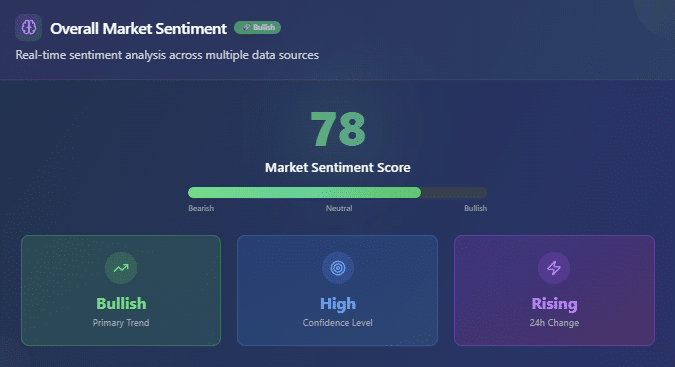
    Watching gains evaporate overnight is humbling. It’s easy to think bull markets are simple, but they teach the opposite. They teach clarity.

    What I’ve learned is that the real winners in this game are the ones who can spot authentic traction early before the herd notices. Volume alone doesn’t tell the full story. You need to know who is driving that volume, why it’s moving, and whether it’s sustainable.

    Here’s what I do now:

    1. Look for engagement, not just noise: Don’t just watch for tokens trending on X or Telegram. Click through. See if real accounts are talking about it, not bot farms. Are people asking questions, making memes, debating? That’s real social lift. On Pump Parade, you can filter by organic engagement to see if the chatter is coming from verified or active traders instead of shill accounts.
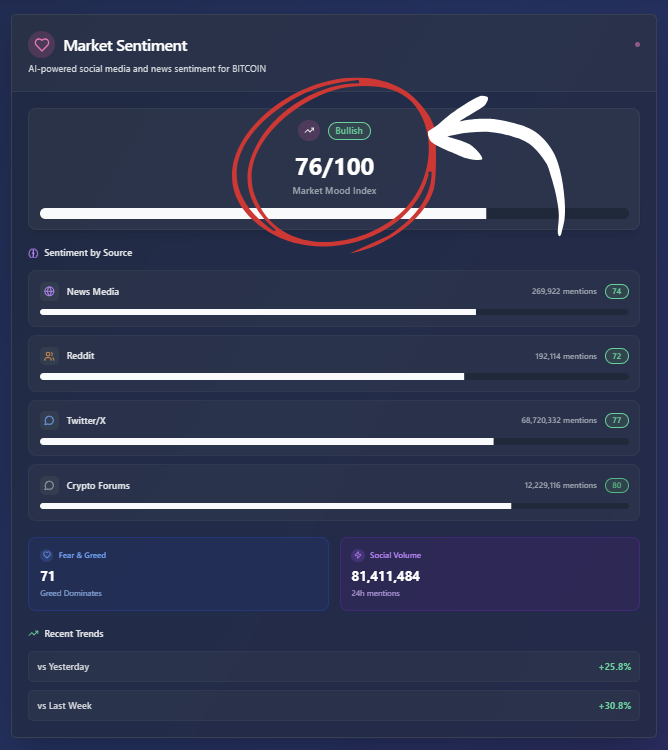
    2. Cross-check wallet activity: A coin can look hot on social media but dead on-chain. I check for unique wallet growth and repeat transactions. If new wallets are holding and existing ones are adding, that’s traction. If it’s the same five wallets bouncing volume back and forth, it’s manufactured hype. Pump Parade’s token screeners show wallet concentration and flow patterns instantly.

    3. Match sentiment with market behavior: If sentiment is rising but volume and liquidity are flat, it’s just talk. If both are climbing together, that’s confirmation. The best setups happen when social momentum, wallet growth, and volume spikes align within a short window, usually 12 to 24 hours.

    4. Time your entries with fresh catalysts: Look for when engagement starts expanding beyond the core community, when new influencers, meme pages, or trading groups start picking it up. That’s usually the moment before the big move. But be careful, because it doesn’t last long until everyone notices and you miss your chance.

    5. Don’t be greedy. Take profits: The market rewards discipline, not perfection. When you’re up big, scale out. Set targets before you enter and respect them. Most of the time, the difference between a winning trade and a baghold is knowing when to walk away. Take profits while there’s still liquidity. You can always re-enter if the setup stays strong.
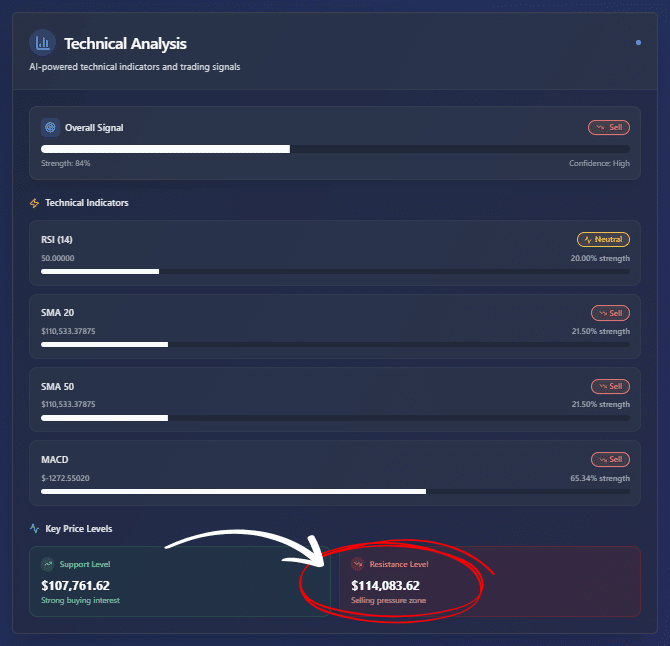
    Using Pump Parade, you can automate most of this:

    • Track real-time engagement spikes across X, Telegram, and Reddit.
    • Combine with on-chain technical analysis to confirm trends.
    • Set alerts for organic narrative lift before it consolidates.

    💪🏼 Visit Pump Parade today and start trading smarter with the most advanced crypto AI tools.

    The difference between luck and conviction is data. Once you start reading traction this way, you’ll stop chasing pumps and start catching them before they happen.

    Even in a bull, you have to manage fear and greed. The fear of missing out pushes you to buy too early; the greed of winning keeps you holding too long. You need both awareness and humility.

    When a trade feels too easy, that’s often when the market is setting up to take it back.

    The Bear: When Conviction Is Tested

    Bear markets feel like someone turned down the lights and left you alone with your losses. I remember staring at a coin that had been my top performer just weeks before, now down 70%, refreshing CoinGecko like the screen itself could reverse reality. My emotions were running circles: frustration, denial, a tiny flicker of hope.

    I learned that patience in a bear isn’t a virtue; it’s a survival skill.

    In these stretches, you start noticing subtle signals. Even while prices bleed, some projects quietly keep growing. Wallet counts rise, liquidity remains stable, developer activity doesn’t slow.
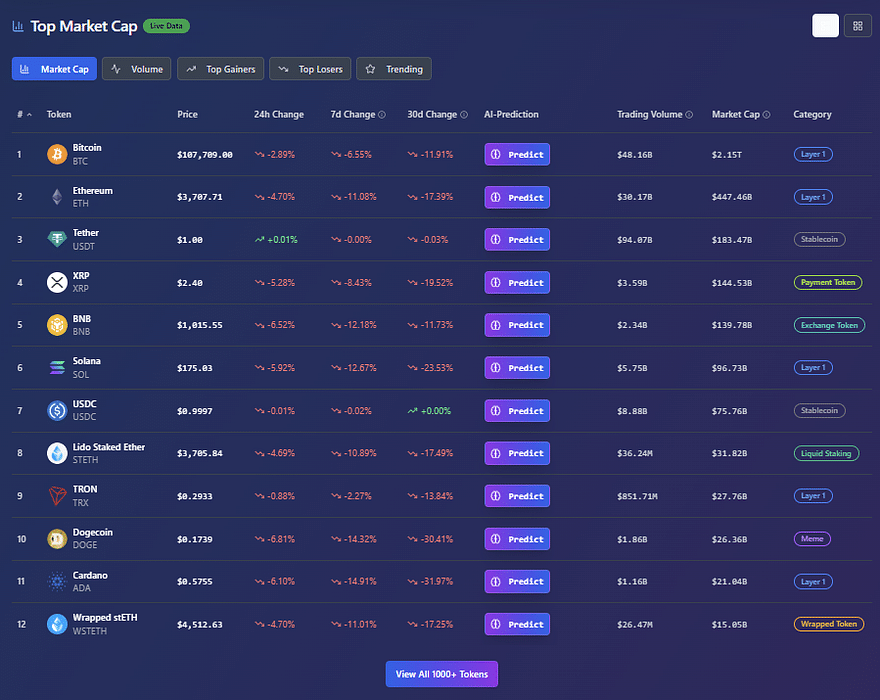
    That’s the real signal: the market whispering, “I’ll come back to these, eventually.” Those are the opportunities.

    Milo, a crypto AI agent for trading and research, has been a game-changer here. With it, you can filter for tokens that are quietly accumulating holders or holding liquidity, even when nobody’s watching.
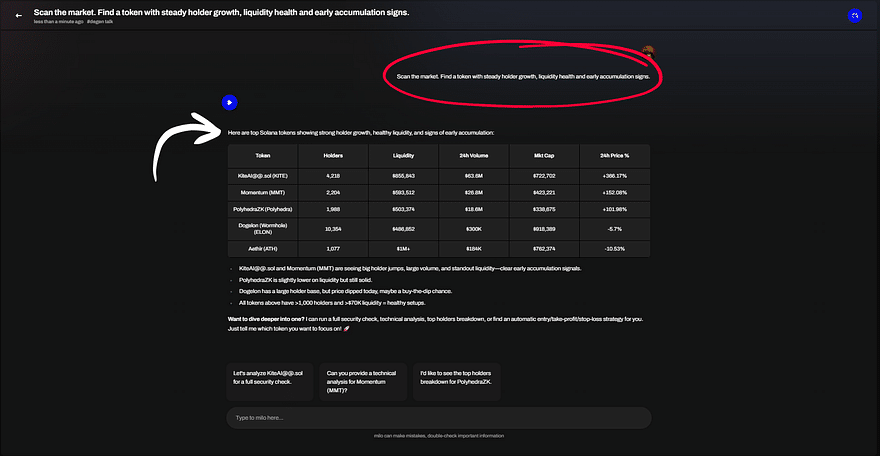
    Those quiet coins become my anchor during the storm. In a bear market, survival isn’t about chasing pumps; it’s about finding consistency where others see only decay.

    Here’s how I use Milo to stay ahead:

    1. Track steady holder growth: Instead of looking for sudden spikes, I focus on tokens with consistent increases in unique wallets. Steady growth shows real adoption and community interest, not short-term hype. Milo lets you screen for these patterns in seconds.

    2. Monitor liquidity health: Liquidity is often overlooked, but it tells you which coins can sustain moves without getting rug-pulled. I filter for tokens with stable or growing liquidity pools to avoid traps.

    3. Spot early accumulation: Milo can flag tokens that are quietly building positions under the radar. These are the coins that often move first when broader attention arrives.

    4. Align research with risk management: I never blindly buy everything Milo flags. I check wallet concentration, sentiment, and transaction patterns before committing. That ensures I’m riding organic traction instead of artificial hype.
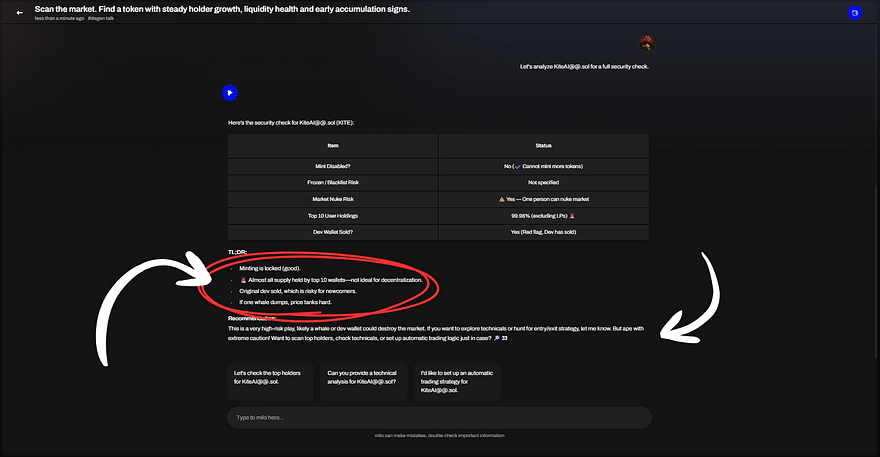
    Using Milo, can help you consistently find gems that survive the bear market and build a foundation for bigger moves when the next cycle begins. It’s about finding calm and consistency while others panic.

    💡Milo is live and free to use. Connect your wallet here and discover how AI can help you navigate the bear market!

    Emotionally, bears are brutal. Watching positions shrink tests every nerve. But the traders who can look past the pain, do their research, and accumulate selectively come out stronger. It’s not glamorous, but it’s where lasting edge is built.

    The Crab: When Patience Feels Impossible

    The crab market is the one that really tests your mental stamina. Prices drift sideways, sometimes from months. Every small breakout turns into a fakeout. Even trades that look solid take half a week to move a few percent.

    If you’re impatient, this is torture. You start questioning yourself: maybe I’m bad at trading, maybe the market has left me behind, maybe I’m never going to catch the next wave.
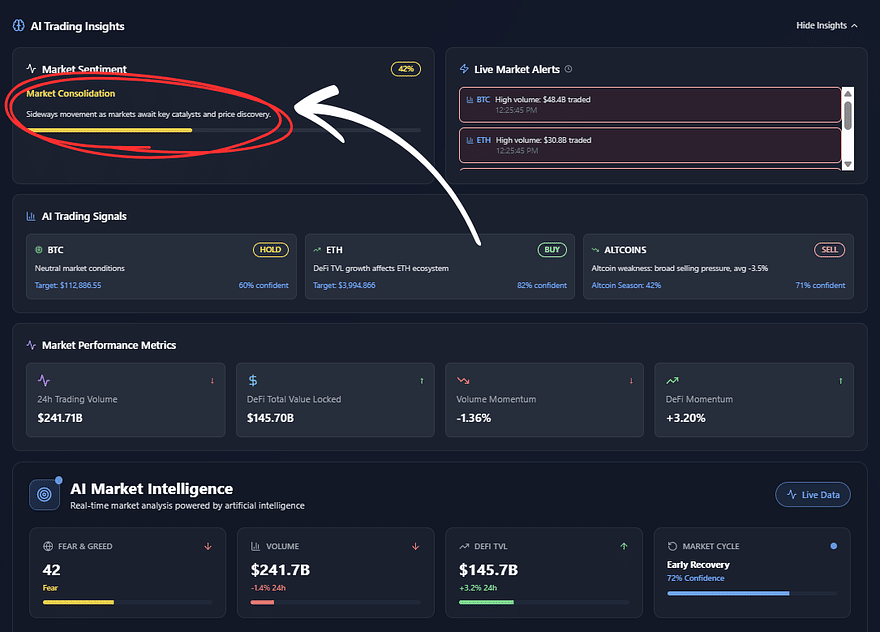
    I’ve been there. I’ve forced trades out of boredom and watched tiny gains disappear, one candle at a time. Eventually, I realized that crab phases are not for doing more: they are for seeing deeper. This is where I build watchlists, research quietly, and start noticing the small sparks of a narrative before the crowd.

    That quiet spark, a project with slow but consistent engagement or a micro-community forming around a token, is often the first hint of the next bull.

    Here’s how I navigate the sideways grind:

    1. Focus on subtle social signals: Even in a chop, some tokens are quietly heating up. Pump Parade’s social sentiment tracking makes it easy to spot these. Look for small but consistent increases in engagement rather than viral spikes.
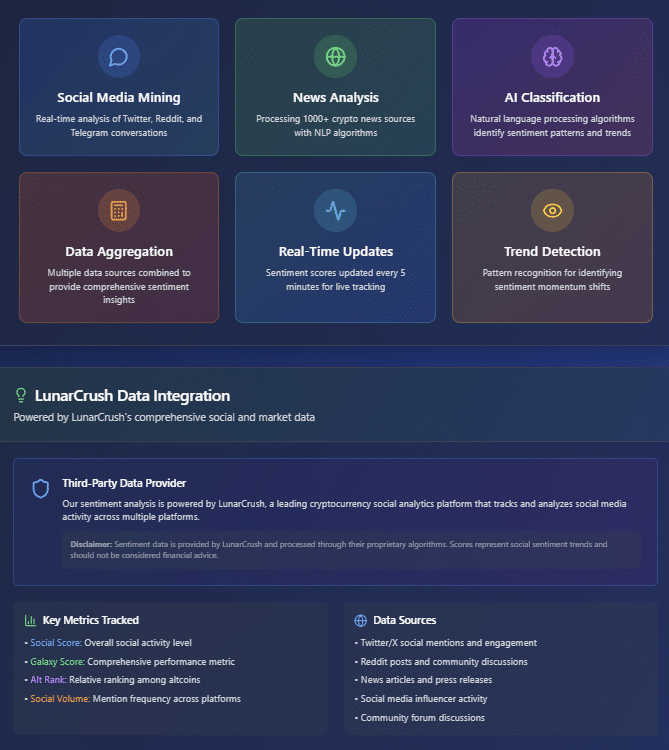
    2. Track early communities: Micro-communities forming around a token often precede larger market moves. I monitor Telegram groups, Discord activity, and X chatter to see which projects are quietly gaining traction.

    3. Watch for steady narrative growth: A slow build in attention often signals a story taking root. I pay attention to the whispers before the scream. In other words, the subtle hints that most traders miss.

    4. Prepare watchlists in advance: Instead of chasing the market, I use crab phases to compile tokens that meet my engagement and liquidity criteria. When volatility returns, I’m ready to act with conviction.

    5. Don’t force trades. Take your time: Crab markets reward patience, not activity. Avoid making moves out of boredom. Let the data guide you. Small sparks become big opportunities if you’re ready when the market wakes up.
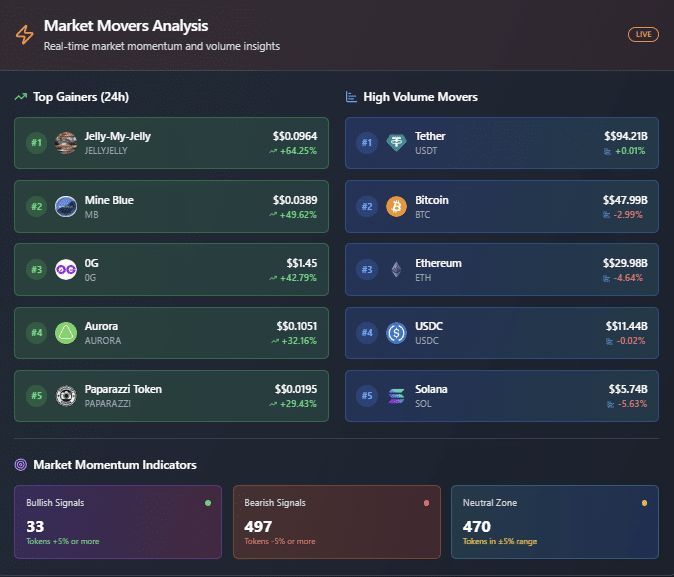
    If you focus on the quiet signals and build a systematic approach, you can turn sideways markets from frustration into an advantage. The edge comes from noticing what others dismiss as nothing.

    Again, Pump Parade’s social sentiment tracking is invaluable here. Even in the sideways chop, you can see which tokens are quietly heating up. You start recognizing subtle signs: the whispers before the scream, that give you an edge when volatility finally returns.
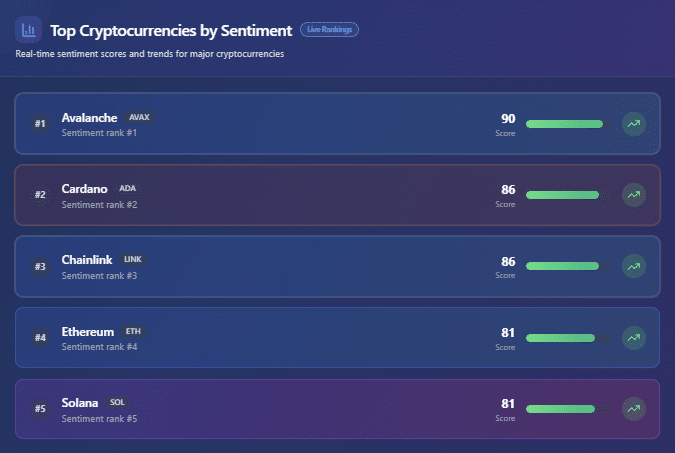
    📢Explore Pump Parade’s social sentiment analysis tool and learn how to leverage the market’s feeling to your advantage.

    Crab markets teach discipline, patience, and foresight. They reward the people who can resist action when nothing is happening.

    Reading the Market Is About Awareness, Not Prediction

    I’ve learned that the real advantage doesn’t come from predicting what’s next. It comes from seeing what’s happening now, clearly, without wishful thinking.

    You can feel when euphoria is building, when despair is settling in, or when the market is quietly consolidating, waiting for its next move.
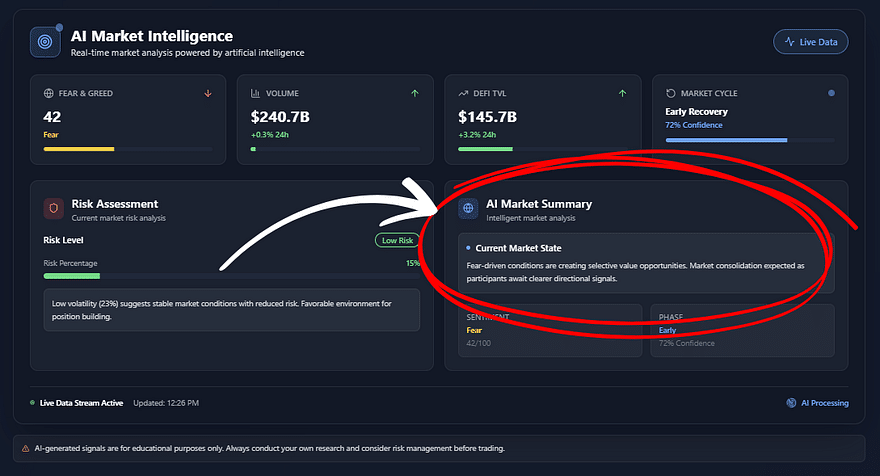
    The traders who last are the ones who can feel the shift before the charts show it. They can recognize the change in energy, in participation, in sentiment. Pump Parade and Milo help me confirm what I already sense. They track social shifts, holder activity, liquidity changes: the signals that tell me the market’s heartbeat.

    After enough cycles, I’ve realized something important: the market always talks before it moves.

    Those who survive and thrive aren’t the loudest, the boldest, or the fastest. They are the ones who listen carefully enough to hear it.


    Balancer (BAL) Price Prediction: What Will BAL Price Be in 2040?

    0

    Staring at a chart that’s bleeding red can be gut-wrenching. You see the price of a once-promising project like Balancer down over 90% from its peak, and the instinct is to either sell everything or just turn off the screen. But what if the greatest opportunities aren’t found in the green euphoria of a bull market, but in the quiet despair of a bear? What if, sixteen years from now, we look back at today’s prices as the chance of a lifetime? This long-term perspective is what separates fleeting traders from patient investors, and it’s exactly what we need for a Balancer (BAL) Price Prediction looking all the way to 2040.

    This article is for educational purposes and should not be taken as financial advice. The crypto market is extremely volatile, and you should always do your own research.

    TL;DR: Balancer (BAL) Price in 2040

    • Current State: BAL is in a severe downtrend, with its price currently at $0.896689 and a market cap of approximately $57.9 million. Recent performance is deeply negative, reflecting broader market fear and a potential loss of narrative momentum.
    • Bearish Scenario (2040): If Balancer fails to innovate and loses its market share in the decentralized finance (DeFi) space, the BAL token could struggle to maintain relevance, with a price potentially falling below $1.
    • Base Scenario (2040): Assuming DeFi continues to grow and Balancer captures a small but consistent piece of the AMM market, a return to a market cap in the $1 billion to $5 billion range is plausible. This could translate to a price of $10 to $55.
    • Bullish Scenario (2040): If Balancer’s flexible liquidity pool technology becomes a cornerstone of a multi-trillion dollar DeFi ecosystem, its market cap could soar. In this highly optimistic scenario, a price of $200 to $500 is conceivable.

    What is Balancer (BAL)?

    Let’s quickly refresh our memory. Balancer isn’t just another crypto token; it’s a foundational piece of the decentralized finance (DeFi) puzzle. At its core, Balancer is an automated market maker (AMM) and liquidity protocol built on Ethereum and other blockchains. Think of it like a decentralized investment portfolio and exchange rolled into one.

    Unlike its main competitor, Uniswap, which traditionally uses 50/50 weighted pools (e.g., 50% ETH and 50% USDC), Balancer allows for highly flexible and customizable liquidity pools. You could have a pool with 80% ETH and 20% DAI, or even one with up to eight different tokens, each with a different weight. This flexibility makes it a powerful tool for projects launching new tokens and for investors creating self-rebalancing index funds. The BAL token is used for governance, allowing holders to vote on the future of the protocol and direct liquidity mining rewards.

    Interpreting the Current Market Conditions

    The data doesn’t lie, and right now, it’s painting a very bearish picture. With a current price of $0.896689, Balancer is a shadow of its former self. Let’s break down the metrics:

    • Price Action: The token is down nearly 10% in the last 24 hours and over 25% in the last month. This isn’t just a minor dip; it’s a sustained, aggressive downtrend. This suggests strong selling pressure and a lack of buyer confidence in the short term.
    • Market Cap: At just under $58 million, Balancer’s market capitalization places it far outside the top-tier of crypto projects. For context, its all-time high market cap was in the billions. This shows how much value has been wiped out and how far it has fallen from investor grace.
    • Volume: A 24-hour volume of $3.7 million is relatively low, indicating that while there is some activity, it’s not attracting massive institutional or retail interest at this moment. Low volume during a downtrend can sometimes signal seller exhaustion, but it can also mean a lack of interest to prop up the price.

    Essentially, the market is currently treating BAL as a high-risk asset that has lost its narrative shine. The key question is whether this is a terminal decline or the point of maximum financial opportunity.

    On-Chain and Narrative Drivers for Growth

    Looking ahead to 2040, short-term charts mean very little. We need to focus on the fundamental drivers that could propel Balancer forward or leave it behind. Since we don’t have live on-chain data in front of us, we must reason based on what matters for a protocol like this.

    The most critical on-chain metric for Balancer is its Total Value Locked (TVL), which represents the amount of money deposited into its smart contracts. A rising TVL indicates growing trust and utility. Equally important is trading volume, as this generates fees for the protocol, which in turn gives value to the BAL token, especially for those who lock it for veBAL (voting-escrowed BAL) to earn a share of those fees. A sustained increase in both TVL and volume would be the first sign of a genuine, long-term recovery.

    The narrative is just as important. Right now, the crypto world is focused on AI, Real World Assets (RWAs), and meme coins. The “DeFi 1.0” narrative has cooled off. For Balancer to thrive, the spotlight needs to return to DeFi innovation. Its unique value proposition—the customizable liquidity pools—could become hugely relevant again as the market matures. Imagine DAOs using Balancer pools to manage their treasuries or new projects using its Liquidity Bootstrapping Pools (LBPs) for fair token launches. If these use cases become standard, Balancer’s narrative will reignite.

    Balancer (BAL) Price Prediction for 2040

    Predicting anything sixteen years from now is highly speculative, but we can build logical scenarios based on potential market evolution.

    Bear Case: The Fade to Obscurity ($0.10 – $2)

    In the bearish scenario, the brutal competition from Uniswap and a constant stream of new, more efficient AMMs simply crowd Balancer out. The protocol could suffer a major exploit that shatters user trust, or it may just fail to keep up with innovation. In this world, DeFi remains a niche part of the crypto landscape, and Balancer’s market share within that niche dwindles. The BAL token would generate very little fee revenue, its governance rights would become meaningless, and the price could slowly bleed towards zero, only held up by a few die-hard believers.

    Base Case: A Respected DeFi Staple ($10 – $55)

    Our base case assumes that the crypto market continues its cyclical growth and DeFi becomes a more integrated part of the global financial system. Balancer doesn’t “win” the AMM war, but it doesn’t lose either. It carves out a durable niche as the go-to protocol for complex, weighted liquidity pools and index-fund-like strategies. Its TVL and volume grow steadily along with the broader market. In this scenario, BAL’s market cap could reclaim its previous highs and grow beyond them, settling into the $1 billion to $5 billion range. This would put its price between $10 and $55, assuming a future circulating supply of around 90 million tokens.

    Bull Case: A Pillar of Decentralized Finance ($200 – $500)

    In the most optimistic scenario, the core thesis behind Balancer plays out perfectly. The future of finance is tokenized, and Balancer’s “80/20” style pools become the industry standard for managing diversified, on-chain portfolios and launching new assets. It becomes a fundamental building block that other protocols rely on, akin to a decentralized BlackRock or Vanguard. If the total crypto market cap swells to tens of trillions and Balancer captures even 1-2% of the DeFi sector, its market capitalization could reach $20 billion to $45 billion. This would result in a staggering BAL price of $200 to $500 per token.

    A Simple Back-of-the-Envelope Valuation

    Let’s try to ground these predictions with some simple math. Remember, this is a rough estimate full of big assumptions.

    1. Future Crypto Market Cap (2040): Let’s assume a base case of $15 trillion.
    2. DeFi’s Share: Let’s assume DeFi protocols manage 10% of that value, so $1.5 trillion.
    3. Balancer’s Market Share: In our base case, let’s say Balancer maintains a 0.5% share of the DeFi market.
    4. Calculation: $1.5 trillion * 0.005 = $7.5 billion market cap for Balancer.
    5. Future Token Price: Assuming a circulating supply of 90 million BAL tokens, this gives us: $7,500,000,000 / 90,000,000 = $83.33 per BAL.

    This simple model shows that a price well above today’s is mathematically plausible under a conservative set of long-term growth assumptions.

    Risks and What to Watch

    Investing in BAL is not without significant risks. The biggest are:

    • Smart Contract Risk: An exploit or hack could drain the protocol’s liquidity and destroy its reputation overnight.
    • Competition: Uniswap is a behemoth, and new competitors are always emerging. Balancer must continue to innovate to stay relevant.
    • Regulatory Risk: A global crackdown on DeFi could severely hamper Balancer’s growth and utility.

    To track its progress, keep a close eye on these key metrics:

    • Total Value Locked (TVL): Is it growing faster or slower than its competitors?
    • Protocol Revenue: Are swap fees increasing over time?
    • veBAL Locking: Are more users locking BAL for governance, reducing the liquid supply?

    Conclusion: Patience or Peril?

    The data today shows an asset in distress. However, the long-term vision for Balancer as a flexible and powerful financial tool remains intact. For investors looking towards 2040, the question is not about the next week or the next month, but about the long-term viability of decentralized finance and Balancer’s place within it.

    The journey from under $1 to potentially over $80 will not be a straight line. It will be filled with volatility, doubt, and periods of intense boredom. The next step is to look beyond the price chart. Read the documentation, engage with the community on Discord, and understand the protocol’s roadmap. Only then can you decide if you believe in its 2040 potential.

    Frequently Asked Questions (FAQ)

    Is BAL a good investment today?
    Given its current low price and significant drop from all-time highs, BAL presents a high-risk, high-reward opportunity. It is only suitable for investors with a very long time horizon and a high tolerance for risk. The project’s survival and success are not guaranteed.

    What was the all-time high for Balancer (BAL)?
    The all-time high for BAL was approximately $74.77, reached in May 2021 during the peak of the last bull market.

    How does the Balancer protocol make money?
    The Balancer protocol earns revenue by charging a small percentage fee on every trade or “swap” that occurs within its liquidity pools. A portion of this revenue is distributed to liquidity providers and veBAL holders.

    Who are Balancer’s main competitors?
    Balancer’s primary competitors are other automated market makers (AMMs) and decentralized exchanges (DEXs). The most notable competitors include Uniswap, Curve Finance, and SushiSwap.

    Not financial advice. Do your own research.

    Internet Computer (ICP) Price Prediction: What Will ICP Price Be in 2038?

    0

    Trying to picture the crypto market in 2038 can feel like staring into a crystal ball during an earthquake. The ground is constantly shifting, and the long-term view is hazy at best. Yet, for a project as ambitious as Internet Computer, which aims to fundamentally rebuild the internet itself, a long-term perspective is the only one that truly matters. If you’re holding ICP or considering it, you’re not just betting on the next few months; you’re betting on a completely different digital future.

    This deep dive into an Internet Computer (ICP) price prediction for 2038 isn’t about hype or impossible promises. It’s a sober analysis based on current data, fundamental drivers, and a realistic look at the monumental challenges and opportunities that lie ahead. We’ll break down what could send ICP soaring into the thousands or what could see it struggle to maintain relevance over the next decade and a half.

    TL;DR: Quick Forecast

    • Current Snapshot: ICP is showing extreme short-term bullish momentum (+23% in 24h) after a month of negative performance, signaling high volatility and renewed trader interest.
    • Core Bet: Investing in ICP is a bet on its “World Computer” vision—that it can successfully decentralize the traditional cloud computing stack and attract massive developer and user adoption.
    • 2038 Price Scenarios: Our analysis projects a wide range, from a bearish outcome of $5 – $25 to a base case of $75 – $200, and a bull case where ICP realizes its vision, potentially reaching $500 – $1,500+.
    • Key Drivers: Long-term success hinges on three things: meaningful developer adoption, competition against both Web3 rivals and Web2 giants like AWS, and sustainable tokenomics.

    What is Internet Computer (ICP)? A Quick Refresher

    Before we look forward, let’s quickly glance back. The Internet Computer Protocol (ICP) isn’t just another blockchain for DeFi or NFTs. It’s a far more ambitious project from the DFINITY Foundation, designed to be a “World Computer.”

    Think of it less like a single blockchain and more like a decentralized version of the cloud infrastructure that powers the internet today (like Amazon Web Services or Google Cloud). It allows developers to build and run software, websites, and dApps directly on the blockchain itself. This is done through advanced smart contracts called “canisters,” which can store data, run complex code, and serve web experiences to users without needing centralized servers. The goal is to create a faster, more secure, and truly decentralized internet.

    Interpreting the Current Market Conditions

    The live metrics tell a fascinating story of volatility and shifting sentiment. With a current price of $4.2, the most striking numbers are the price changes. We see a massive 23% surge in the last 24 hours and a nearly 29% gain over the week. This kind of explosive momentum, backed by a strong 24-hour volume of over $384 million, suggests a significant event or narrative is capturing traders’ attention right now. This could be driven by short liquidations, a positive development, or simply a rotation of capital into a project that has been beaten down.

    However, zooming out to the 30-day view, we see a loss of nearly 10%. This context is crucial. The recent pump is a recovery, not a sustained uptrend from a high base. This tells us that while short-term sentiment is incredibly strong, the medium-term trend has been weak. The $2.27 billion market cap still places ICP as a major player, but it’s far from its all-time highs, indicating that the market is still weighing its long-term potential against its past performance.

    On-Chain and Narrative Drivers

    Since we can’t look at 15 years of on-chain data from the future, we have to focus on the fundamental drivers that will dictate ICP’s journey. These are the engines that will propel the price, or cause it to stall.

    The primary narrative is, and always will be, adoption. The Internet Computer’s success is not measured in transactions per second alone, but in the number of developers building on it and the number of users interacting with its dApps. Is its tech stack—using canisters and a “reverse gas model” where developers, not users, pay for computation—compelling enough to lure talent away from Ethereum’s ecosystem or traditional Web2 platforms? This is the central question.

    The second driver is its tokenomics. The ICP token has two main uses: it can be staked in the Network Nervous System (NNS) for governance and voting rewards, or it can be converted into “cycles” to pay for computation. If dApp usage explodes, the demand to convert ICP into cycles will rise, creating a deflationary pressure that could significantly impact price. Monitoring the burn rate of ICP for cycles is a key long-term health metric.

    An Internet Computer (ICP) Price Prediction for 2038

    Predicting over a 15-year horizon is an exercise in strategic forecasting, not precision. We’ll outline three potential scenarios based on different adoption curves and market conditions. The technical analysis here is not about short-term chart patterns, but about interpreting the current volatility as a signal of ICP’s potential for massive price swings in either direction as its long-term narrative plays out.

    Bear Case: The Vision Fails to Launch ($5 – $25)

    In this scenario, the Internet Computer struggles to achieve meaningful adoption. Developers may find the platform too complex or niche, preferring to stick with EVM-compatible chains or traditional cloud services. Competition from Web2 giants like Amazon and Google, who may launch their own tailored Web3 services, could stifle ICP’s growth.

    In this future, the ICP token’s value would be primarily speculative. The current price action—a 23% pump in 24 hours—would be seen in hindsight as a volatile spike in a long-term sideways or declining market. The token would fail to capture significant value from cycle conversion, and its price would be driven by broad crypto market cycles rather than its own fundamental strength, potentially re-testing historical lows.

    Base Case: A Powerful Niche Player ($75 – $200)

    This is the most pragmatic outlook. The Internet Computer may not replace the entire internet, but it could carve out a significant and valuable niche. It might become the go-to platform for building decentralized social media (DeSo), fully on-chain games, or enterprise-level blockchain solutions that require its unique architecture.

    In this scenario, adoption is steady but not exponential. The demand for cycles grows consistently, creating a healthy deflationary pressure on the token. ICP’s price would likely appreciate significantly over several market cycles, reflecting its real-world utility and a market cap that places it among the top 10-15 crypto projects. The current volatility would be seen as the early signs of a project finding its footing before a long and steady climb.

    Bull Case: The World Computer is Realized ($500 – $1,500+)

    In the most optimistic scenario, DFINITY’s vision comes to fruition. A significant portion of new web services and applications are built on ICP, drawn by its speed, scalability, and the ability to run everything on-chain. It successfully competes with and takes market share from the multi-trillion-dollar cloud computing industry.

    Here, the demand for cycles would be immense, leading to a massive amount of ICP being burned and taken out of circulation. The token’s value would skyrocket as it becomes a direct claim on a decentralized global compute layer. Reaching a valuation in the hundreds of billions or even a trillion dollars over 15 years is plausible if it captures even a small percentage of the traditional cloud market. In this light, the current price is a historical footnote.

    A Simple Valuation Model (Back-of-the-Envelope)

    Let’s try to ground these scenarios with some simple numbers. This is highly speculative but helps frame the potential.

    • Assumptions:

      • The global cloud computing market could be worth over $3 trillion by 2038.
      • The total Web3 infrastructure market could be worth over $1 trillion.
      • ICP’s circulating supply will gradually increase but a significant portion will be locked in staking or burned for cycles. Let’s estimate a future effective circulating supply of around 600 million tokens for this calculation.
    • Valuation:

      • Base Case: If ICP captures just 0.5% of the combined future cloud and Web3 market ($4T * 0.005 = $20B market cap), the implied price would be $33. This is a very conservative estimate. Let’s adjust, assuming it becomes a key player in a $500B DeWeb niche and captures 10% of that. $50B market cap / 600M tokens = ~$83 per ICP. This aligns with our Base Case range.
      • Bull Case: If ICP captures a more aggressive 5% of the combined market ($4T * 0.05 = $200B market cap), the implied price would be ~$333 per ICP. If it truly becomes a foundational pillar of the new internet and reaches a $500B market cap, the price would be ~$833 per ICP, aligning with our Bull Case range.

    Risks and What to Watch

    The path to 2038 is filled with obstacles. Keep a close eye on these factors:

    • Competition: The biggest risk. ICP is not just fighting Ethereum and Solana; it’s fighting Amazon, Microsoft, and Google. This is a battle of giants.
    • Developer Adoption: Track the number of active developers and canisters running on the network. This is the ultimate metric of success.
    • Centralization Concerns: The role of the DFINITY Foundation remains a point of debate in the community. True decentralization of governance will be critical for long-term trust.
    • Tokenomics Execution: The balance between staking rewards (inflationary) and cycle conversion (deflationary) must be managed perfectly to support a healthy token value.

    Conclusion: A High-Risk, High-Reward Bet on the Future of the Internet

    Making an Internet Computer (ICP) price prediction for a date as far out as 2038 is less about charting and more about believing in a vision. The potential for ICP is undeniably massive—it’s one of the few projects with a credible plan to decentralize the entire tech stack. However, the execution risk is equally enormous.

    Your next step shouldn’t be to rush into a trade based on the recent 23% pump. Instead, use this as a catalyst for deeper research. Go to the DFINITY website, explore the ecosystem of dApps already built on ICP, and read about the technical milestones on their roadmap. The decision to invest in ICP is a decision about what you believe the internet will look like in the next two decades.

    FAQ

    Is Internet Computer (ICP) a good investment today?

    ICP is a high-risk, high-reward asset. Its value is tied to the long-term success of a very ambitious technological vision. While it has shown recent price strength, it remains volatile. It could be a good investment for those with a long time horizon and a high-risk tolerance who have thoroughly researched the project.

    What makes ICP different from Ethereum?

    While both support smart contracts, they have fundamentally different architectures. Ethereum is a distributed ledger focused on securing transactions, with scaling handled by Layer 2 solutions. Internet Computer is designed as a complete, decentralized cloud platform (an “everything-on-chain” solution) with a “reverse gas model,” where developers pre-pay for computation, making dApps free for end-users to interact with.

    How high could ICP realistically go by 2038?

    In a true bull scenario where it captures a meaningful percentage of the cloud computing market, a price of over $500 is realistic. This would imply a market capitalization in the hundreds of billions, which is plausible if it becomes a foundational piece of Web3 infrastructure. However, this is the most optimistic outcome and is far from guaranteed.

    Where is the best place to get more information on ICP?

    The best sources are the official ones. Start with the DFINITY Foundation’s website and blog for roadmap updates and technical explanations. You can also explore the ICP ecosystem dashboard to see real-time network statistics and a directory of projects building on the Internet Computer.

    Not financial advice. Do your own research.

    Zcash (ZEC) Price Prediction: What Will ZEC Price Be in 2035?

    0

    Ever get the feeling that your financial life is an open book? In a world where every digital transaction leaves a trail, the idea of true financial privacy can feel like a distant dream. This is where Zcash (ZEC) enters the conversation, promising a level of confidentiality that few other cryptocurrencies can match. But with a technology so potent, what does the future hold? This Zcash (ZEC) Price Prediction looks beyond the daily charts, exploring the fundamental drivers that could shape ZEC’s value by 2035.

    TL;DR: Zcash in 2035

    • The Core Bet: Zcash’s future price hinges on the global demand for financial privacy. Its success depends on navigating regulatory challenges while proving its technology is essential.
    • Current Momentum: ZEC has seen a massive 180% price surge in the last 30 days, signaling a powerful renewal of interest in the privacy coin narrative, though short-term volatility remains high.
    • Price Scenarios: By 2035, our analysis projects a wide range of potential outcomes. A bearish scenario could see ZEC trading between $100 – $500, a base case suggests a range of $1,500 – $3,500, while a bullish outlook places it between $8,000 – $15,000.
    • Key Factors: Keep a close eye on regulatory developments concerning privacy coins, the adoption rate of Zcash’s shielded transactions, and competition from other privacy-preserving technologies.

    What is Zcash (ZEC)?

    Let’s do a quick refresher. Zcash is a cryptocurrency focused on privacy and anonymity. While it operates on its own blockchain, similar to Bitcoin, it has a unique feature: the ability to send confidential transactions. Using groundbreaking cryptography called zk-SNARKs (Zero-Knowledge Succinct Non-Interactive Arguments of Knowledge), Zcash allows users to transact without revealing the sender, receiver, or amount involved.

    Think of it like this: a standard Bitcoin transaction is like a transparent glass piggy bank where everyone can see the money going in and out. A Zcash “shielded” transaction is like an opaque, locked safe. You can prove you put the correct amount of money inside without ever opening the door to show who you are or how much you sent. This feature makes Zcash a powerful tool for individuals and businesses who require financial confidentiality.

    Current Market Conditions: A Coiled Spring

    Looking at the numbers, it’s clear Zcash is experiencing a significant moment. With a current price of $413.22 and a market cap over $6.7 billion, it’s a major player. But the real story is in the recent performance. A staggering 180% gain over the last 30 days, with a 34% jump in just the last week, shows an explosion of buying pressure and market interest. This isn’t just random noise; it suggests a major shift in sentiment, likely tied to a growing appreciation for the privacy narrative in the crypto space.

    However, the 24-hour change of -3.39% serves as a healthy reminder of crypto’s volatility. Such rapid ascents are often followed by periods of consolidation or correction as early traders take profits. The 24-hour volume of over $911 million is incredibly strong, indicating that these price levels are supported by deep liquidity and active trading. This isn’t a small-cap coin moving on whispers; this is significant capital flowing into ZEC.

    On-Chain and Narrative Drivers

    While we don’t have a live feed of Zcash’s shielded pool, its growth is the single most important on-chain metric to watch over the long term. The shielded pool is the collection of all private ZEC. The more ZEC held in this pool, the greater the anonymity set for all users and the more organic demand there is for Zcash’s core feature. An increasing shielded-to-transparent ratio would be a powerful bullish signal of genuine adoption.

    The narrative driving Zcash is a double-edged sword. On one side, the demand for privacy is a timeless and growing concern. As our lives become more digital, the ability to control who sees our financial data becomes paramount. This is Zcash’s primary bull case. On the other side is the regulatory narrative. Governments and regulators often view privacy coins with suspicion, fearing their use in illicit activities. This tension between personal freedom and state control will be a central theme in Zcash’s journey to 2035.

    Zcash (ZEC) Price Prediction for 2035

    Forecasting over a decade into the future is an exercise in analyzing possibilities, not certainties. The technical data we have today is a snapshot, not a crystal ball. Therefore, instead of focusing on short-term chart patterns, we’ll build our Zcash (ZEC) Price Prediction on long-term adoption scenarios and fundamental drivers.

    Bear Scenario: The Regulatory Squeeze ($100 – $500)

    In a bearish future, the regulatory narrative wins out. Major economies could enact strict regulations or outright bans on privacy-enhancing cryptocurrencies. Exchanges might be forced to delist ZEC, severely limiting its liquidity and accessibility for retail investors. In this world, Zcash fails to gain mainstream adoption and is relegated to a small, niche community. Its technology might be surpassed by newer privacy solutions, and it could bleed market share, potentially falling back to price levels seen in previous bear markets.

    Base Scenario: A Niche but Valuable Asset ($1,500 – $3,500)

    The base case sees Zcash successfully navigating the regulatory landscape. It isn’t banned, but it isn’t fully embraced by the mainstream either. Instead, it solidifies its position as the go-to asset for a specific, high-value niche: users who absolutely require financial privacy. Think journalists, activists, businesses operating in sensitive regions, and individuals seeking to protect their wealth. In this scenario, Zcash development continues, usability improves, and it captures a respectable slice of the overall crypto market, leading to steady, sustained growth over the next decade.

    Bull Scenario: The Privacy Standard ($8,000 – $15,000)

    In the most bullish scenario, the world wakes up to the critical importance of financial privacy. A major data breach or a shift in social sentiment could trigger a flight to privacy-preserving assets. Zcash, with its battle-tested technology and trusted brand, becomes the gold standard for confidential transactions. It may be integrated into conventional finance for specific use cases or become a foundational layer for a new, private digital economy. If Zcash captures even a small percentage of global private wealth transfers, its market cap could explode, pushing its price into the five-figure range.

    A Simple Valuation Model

    Let’s try a simple back-of-the-envelope calculation to ground these scenarios.

    Assumptions:

    1. Total cryptocurrency market cap reaches $15 trillion by 2035.
    2. Zcash’s circulating supply is approximately 20 million ZEC (out of a 21 million max).

    Calculations:

    • Bear Case: Zcash holds 0.05% of the total market.
      • $15 Trillion * 0.0005 = $7.5 Billion Market Cap
      • $7.5B / 20M ZEC = $375 per ZEC
    • Base Case: Zcash captures 0.5% of the total market as a key niche asset.
      • $15 Trillion * 0.005 = $75 Billion Market Cap
      • $75B / 20M ZEC = $3,750 per ZEC
    • Bull Case: Zcash becomes a privacy standard, capturing 1.5% of the market.
      • $15 Trillion * 0.015 = $225 Billion Market Cap
      • $225B / 20M ZEC = $11,250 per ZEC

    Risks and What to Watch

    Investing in Zcash is not without its risks. The primary headwind is, and will likely remain, regulation. A coordinated global crackdown on privacy coins could severely damage the project’s prospects. Another risk is competition. Monero offers a different approach to privacy, and new technologies are always emerging that could challenge Zcash’s dominance. Finally, the complexity of its cryptography, while a strength, also means that any undiscovered bug could have serious consequences.

    Moving forward, investors should keep a close watch on a few key areas. First, monitor any guidance from regulatory bodies like the SEC, FATF, and the US Treasury regarding privacy coins. Second, track the development progress from the Electric Coin Company and the Zcash Foundation, particularly any upgrades related to scalability (like the transition to a Proof-of-Stake consensus). Lastly, watch the on-chain data for growth in the adoption of shielded transactions, as this is the ultimate measure of Zcash’s utility.

    Conclusion: A Bet on Privacy

    The long-term Zcash (ZEC) Price Prediction is less about technical chart patterns and more about a fundamental belief in the human right to privacy. Zcash offers a powerful, elegant solution to one of the most pressing issues of our digital age. Its journey to 2035 will be shaped by the global conversation around privacy, regulation, and freedom.

    While the potential for significant returns exists, the path is filled with challenges. For investors, the next step isn’t to simply buy based on a price prediction. It’s to dig deeper into the technology, understand the risks involved, and decide if you believe in the long-term vision of a truly private digital currency.

    Frequently Asked Questions (FAQ)

    1. Is Zcash a good investment?
    Zcash can be considered a high-risk, high-reward investment. Its value is tied to its unique privacy technology. If the demand for financial confidentiality grows and Zcash can navigate regulatory hurdles, it has significant upside potential. However, regulatory crackdowns or competition could negatively impact its price.

    2. Will Zcash get banned?
    This is the biggest risk facing Zcash. While an outright global ban is unlikely, individual countries could restrict its use or force exchanges to delist it. The future of Zcash’s legality depends on an evolving conversation between regulators, innovators, and the public.

    3. How is Zcash different from Monero?
    Both are leading privacy coins, but they use different technologies. Zcash uses zk-SNARKs, which offer a provably strong form of privacy that hides all transaction data. It is “selectively transparent,” meaning users can choose to make transactions private or public. Monero makes all transactions private by default using a mix of ring signatures and stealth addresses, which obscures sender and receiver information.

    4. What is a “shielded transaction” in Zcash?
    A shielded transaction is a fully private transaction on the Zcash blockchain. It uses zero-knowledge proofs to validate the transaction without revealing the sender’s address, the receiver’s address, or the amount being sent. This is Zcash’s core feature and what sets it apart from transparent cryptocurrencies like Bitcoin.

    Not financial advice. Do your own research.

    What Is Mog Coin (MOG) Price Today? MOG Technical Analysis (November, 2025)

    0

    Ever felt that stomach-lurching mix of excitement and anxiety as a coin on your watchlist suddenly rockets up over 50% in a single day? That’s the feeling many are getting with Mog Coin right now. It’s a powerful, volatile move that screams opportunity for some and a warning sign for others. Deciphering which it is requires a cool head and a clear look at the data. This in-depth Mog Coin (MOG) technical analysis will break down the current price action, explore potential scenarios, and give you the tools to navigate what comes next.

    TL;DR: MOG at a Glance

    • Massive Short-Term Pump: MOG is up a staggering 56% in the last 24 hours, showing immense buying pressure and renewed interest.
    • Longer-Term Context: Despite the recent surge, the coin is still down 26% over the last 30 days, suggesting this pump is fighting a previous downtrend.
    • High Trading Activity: The 24-hour trading volume of over $43 million is very high relative to its $242 million market cap, indicating this is a significant, widely-traded move.
    • Critical Juncture: MOG is at a pivotal point. The coming days will determine if this is a sustainable trend reversal or simply a volatile relief rally.

    What Is Mog Coin (MOG)?

    For those new to the phenomenon, Mog Coin (MOG) isn’t your typical crypto project focused on DeFi protocols or enterprise solutions. It’s a pure culture coin, a memecoin born from internet culture that runs on the Ethereum blockchain. Its entire ethos revolves around the concept of “mogging”—a slang term for exuding an aura of dominance and superiority.

    The project thrives on its community, viral memes, and a shared, irreverent sense of humor. There is no complex roadmap or utility in the traditional sense. The value is derived entirely from the strength of its brand, the engagement of its community, and its ability to capture the attention of the wider crypto market. Think of it as a bet on a cultural movement within the crypto space.

    Current Market Conditions: A Tale of Two Trends

    Looking at the numbers, we see a fascinating conflict. The current price of $0.000000621979 is the result of an explosive 56% rally over the past day. This has also pulled the 7-day performance into the green at +32%. This is a classic sign of a “V-shaped” recovery on lower time frames, where sentiment flips from bearish to wildly bullish almost instantly. The impressive $43 million in 24-hour volume confirms that this isn’t a small, isolated move; it’s backed by significant capital and trader interest.

    However, zooming out tells a different story. The 30-day change is still negative, sitting at -26%. This context is crucial. It means that before this massive pump, MOG was in a clear downtrend. The big question for any trader now is whether this surge has enough strength to break that previous market structure and start a new uptrend, or if it will exhaust itself and fall back into the prior range.

    On-Chain & Narrative Drivers

    Without deep on-chain data, we can reason about the drivers based on typical memecoin behavior. A sudden 56% price explosion coupled with high volume is rarely random. It’s often triggered by a specific catalyst. This could be a positive mention from a major crypto influencer, rumors of a new listing on a top-tier exchange, or a coordinated push from its dedicated community. These events create a powerful narrative that pulls in new buyers, creating a feedback loop of rising prices and increasing hype.

    This surge may also be technical in nature. After a month-long decline, a significant number of short positions may have accumulated. A sharp upward move can trigger a “short squeeze,” where short sellers are forced to buy back the asset to cover their positions, adding even more fuel to the rally. The current environment is a potent mix of narrative momentum and technical pressure.

    Mog Coin (MOG) Technical Analysis and Scenarios

    Based on the data, we can outline three potential scenarios for MOG in the coming weeks. The price action is currently testing a key inflection point.

    Bearish Scenario: The Relief Rally Fades

    In this scenario, the 56% pump is a classic “dead cat bounce” or an exit pump for trapped holders. The buying pressure exhausts as it nears resistance levels established during the 30-day downtrend (likely around the $0.00000070 – $0.00000075 range). The price fails to break through, volume starts to decline, and sellers regain control.

    If this happens, MOG could re-test its recent support levels. A fall back to the $0.00000050 area would be the first warning sign, with a potential slide back toward the lows of the past month around $0.00000040.

    Base Case Scenario: Healthy Consolidation

    The most sustainable outcome would be for MOG to consolidate its recent gains. After such an explosive move, a period of sideways price action is healthy. In this base case, MOG would establish a new trading range between the recent breakout level of around $0.00000058 (new support) and the current highs near $0.00000065 (resistance).

    This period of consolidation would allow the market to absorb the recent move, build a stable foundation, and prepare for its next leg up. Holding strong above the $0.00000055 mark would be a very constructive sign for the medium term.

    Bullish Scenario: Confirmed Trend Reversal

    In the most bullish outcome, this is the start of a new, sustained uptrend. The momentum seen in the last 24 hours continues, decisively breaking the $0.00000075 resistance zone. High volume would need to be sustained on this breakout, confirming strong conviction from buyers.

    If this scenario plays out, the next logical targets would be the highs from before the month-long downtrend began. This could put MOG on a path to reclaim the $0.00000085 – $0.0000010 price level, effectively erasing the losses of the past 30 days and signaling a full trend reversal.

    A Simple Valuation Framework

    Valuing a memecoin like MOG with traditional metrics is impossible. Instead, we use a comparative approach based on market capitalization. MOG currently sits at a $242 million market cap.

    • Assumption: MOG’s potential is directly tied to its ability to capture a larger share of the overall “memecoin market” attention and capital, which is currently dominated by giants like Dogecoin, Shiba Inu, and Pepe.

    • Back-of-the-Envelope: Pepe (PEPE), another prominent culture coin, has often commanded a market cap in the billions. If MOG were to capture a similar level of mindshare and reach a $1 billion market cap, its price would be approximately $0.00000257. This would represent roughly a 4x return from its current price. This isn’t a prediction, but a simple framework for understanding the potential scale if its narrative continues to grow.

    Risks & What to Watch

    Investing in MOG is a high-risk, high-reward endeavor. The primary risk is its inherent volatility. Gains of 50% can be followed by equally sharp corrections. The coin’s fate is also tied to the broader crypto market; a significant downturn in Bitcoin or Ethereum would likely impact MOG disproportionately.

    Another key risk is narrative fatigue. The memecoin space is incredibly competitive. A new, more exciting meme could emerge and draw attention and capital away from MOG.

    Key things to watch:

    1. Trading Volume: Does the volume remain elevated, or does it dry up after this pump? Sustained high volume is a sign of continued interest.
    2. Key Price Levels: Watch the resistance around $0.00000075 and the support near $0.00000058. A break of either could signal the next major move.
    3. Social Media Sentiment: Keep an eye on platforms like X (formerly Twitter) and Telegram to gauge community morale and hype.

    Conclusion: An Asset at a Crossroads

    Mog Coin is currently one of the most exciting assets to watch in the crypto market. Its massive short-term rally has put it back on the radar of traders everywhere, but it’s now at a critical point. The battle between the powerful new momentum and the preceding downtrend will define its trajectory for the rest of the year.

    For traders and investors, the next step is to watch the key levels outlined above. Whether MOG consolidates for another move, breaks out to new highs, or fades back into its previous range will depend on its ability to maintain this newfound narrative strength and trading volume. Always remember the high-risk nature of memecoins and manage your portfolio accordingly.

    Frequently Asked Questions (FAQ)

    What is Mog Coin (MOG)?
    Mog Coin (MOG) is a popular memecoin and culture coin on the Ethereum blockchain. Its value is driven primarily by its strong online community, viral memes, and its ability to capture cultural relevance in the crypto space, rather than any specific technical utility.

    Is MOG a good investment?
    MOG is a very high-risk, high-reward asset. Its price is extremely volatile and subject to rapid changes based on social media trends and market sentiment. It may be suitable for experienced investors with a high-risk tolerance, but it is not a traditional investment. This article is not financial advice.

    Where can I buy Mog Coin (MOG)?
    MOG is available on major decentralized exchanges like Uniswap. It is also listed on a growing number of centralized exchanges. For a complete and up-to-date list of markets, it is best to consult coin tracking websites like CoinGecko or CoinMarketCap.

    What drives the price of MOG?
    The price of MOG is driven by a combination of factors, including community engagement, social media hype (narrative), influencer mentions, exchange listings, and the overall health and sentiment of the broader cryptocurrency market.

    Not financial advice. Do your own research.

    Virtuals Protocol (VIRTUAL) Price Prediction: What Will VIRTUAL Price Be in 2025?

    0

    Ever see a new token blast off and wonder if you’ve missed the boat, or if you’re just in time for the next big wave? With the AI narrative heating up the crypto space, many investors are asking that exact question about Virtuals Protocol. This brings us to a crucial analysis: a Virtuals Protocol (VIRTUAL) price prediction for 2025. Is the recent surge just the beginning, or is it a sign of a temporary peak?

    Let’s break down the data, the narrative, and the potential scenarios for VIRTUAL in a clear, no-hype way. We’ll explore what could drive its price up, what could send it down, and how you can think about its potential value moving forward.

    TL;DR: Key VIRTUAL Price Predictions

    For those short on time, here are the main takeaways from our analysis:

    • Strong Recent Momentum: VIRTUAL has seen significant gains over the last 30 days, riding a powerful wave of interest in AI-related crypto projects. The current price of $1.77 reflects strong bullish sentiment.
    • Narrative is Key: The project’s success is heavily tied to the broader AI narrative. Continued innovation and interest in artificial intelligence will be a primary catalyst for VIRTUAL’s growth.
    • Base Case Prediction for 2025: Our base scenario places VIRTUAL in the $3.50 to $6.00 range, assuming the AI trend remains strong and the overall crypto market maintains a healthy, bullish posture.
    • Wide Range of Outcomes: Volatility is a given. A bearish market could see prices fall below $1.50, while a full-blown bull run could push VIRTUAL towards the $8.00 to $12.00 mark.

    What is Virtuals Protocol (VIRTUAL)?

    Before diving into price charts and predictions, let’s have a quick refresher on what Virtuals Protocol is. In essence, Virtuals Protocol aims to be a cornerstone project at the intersection of blockchain technology and artificial intelligence. The goal is to enable the creation, training, and monetization of AI-powered “virtuals” or autonomous agents on-chain.

    Think of it as building blocks for a future where AI agents can own assets, perform tasks, and interact with decentralized applications independently. This taps into a powerful vision of a more automated and intelligent digital world, making it a project that captures the imagination of many in the crypto community. Its appeal lies in its forward-looking approach to integrating two of the most disruptive technologies of our time.

    A Look at VIRTUAL’s Current Market Conditions

    To make an informed Virtuals Protocol (VIRTUAL) price prediction, we have to start with where we are right now. The numbers tell a story of explosive growth and strong investor interest. At a current price of $1.77, the project commands a market capitalization of over $1.16 billion. This is not a small, undiscovered gem anymore; it’s a significant player in the crypto space.

    The 24-hour trading volume of nearly $55 million indicates healthy liquidity and active trading, which is crucial for price stability and growth. While there’s a minor pullback in the last hour (-2.17%), the bigger picture is overwhelmingly positive. Gains of 27% in the last day, 37% in the last week, and over 52% in the last month paint a clear picture of a strong uptrend. This momentum suggests that buyers are in control and have been accumulating the token aggressively.

    On-Chain & Narrative Drivers

    Beyond the raw price data, we need to consider the forces that could propel VIRTUAL forward. The most significant driver is, without a doubt, the AI narrative. Just as DeFi and NFTs had their moments in the spotlight, AI is currently one of the most powerful and well-funded narratives in both tech and crypto. As long as advancements in AI continue to capture global attention, projects like VIRTUAL will likely benefit from the tailwind.

    While specific on-chain data for VIRTUAL isn’t provided here, we can reason about what to look for. Key indicators of health would include a growing number of unique wallet addresses holding VIRTUAL, suggesting wider distribution and adoption. Another positive sign would be a high percentage of tokens being staked (if applicable), which reduces the available supply on the open market and signals long-term conviction from holders. The narrative is currently strong enough to overcome neutral or even slightly negative on-chain metrics, but for sustained growth, both must align.

    Virtuals Protocol (VIRTUAL) Price Prediction Scenarios for 2025

    Let’s get to the core of this analysis. Looking ahead to 2025, the price of VIRTUAL could follow several different paths depending on market conditions, project execution, and the endurance of the AI narrative.

    Bearish Scenario: $0.80 – $1.50

    In a bearish scenario, several factors could come into play. A major correction in the broader crypto market, led by Bitcoin, would inevitably drag down altcoins like VIRTUAL. Furthermore, the AI narrative could cool off as investors rotate into the “next big thing.” If Virtuals Protocol fails to deliver on its roadmap milestones or faces a critical security issue, confidence could erode quickly.

    From a technical standpoint, the recent explosive growth means there are fewer established support levels below the current price. A break below the psychological $1.50 mark could trigger further selling, potentially driving the price back towards consolidation zones under $1.00.

    Base Scenario: $3.50 – $6.00

    This is our most probable scenario for 2025. It assumes that the overall crypto market avoids a deep bear market and continues its gradual upward trend. In this reality, the AI narrative remains relevant, and Virtuals Protocol continues to build and secure meaningful partnerships. The project successfully rolls out key features, demonstrating real-world utility and attracting more developers and users to its ecosystem.

    A market cap of $3 billion to $5 billion is a reasonable target for a leading project in a hot sector during a healthy market. Based on the current approximate circulating supply, this would translate to a price range of roughly $3.50 to $6.00. This reflects steady growth and solidifies VIRTUAL’s position as a blue-chip AI crypto project.

    Bullish Scenario: $8.00 – $12.00

    The bull case is where things get exciting. This scenario is predicated on a full-blown crypto bull run, similar to what we saw in 2021. If Bitcoin breaks its all-time highs and capital flows aggressively into altcoins, high-potential projects like VIRTUAL could see parabolic gains. If Virtuals Protocol becomes the undisputed leader in the on-chain AI space, perhaps by securing a partnership with a major tech company, its valuation could soar.

    Technically, the token is in price discovery mode, meaning there is little historical resistance above. In a bull market, market caps of $8 billion to $12 billion are not out of the question for category-leading tokens. This would put the VIRTUAL price in the $8.00 to $12.00 range, and potentially higher if market euphoria reaches extreme levels.

    A Simple Valuation Model

    Let’s try a simple, back-of-the-envelope valuation to ground our predictions. We can use a comparative approach. Leading projects in other hot sectors like gaming (e.g., Axie Infinity) or L1s (e.g., Solana) reached market caps of $10 billion to over $50 billion at their peaks.

    • Assumption 1: The AI crypto sector will be at least as big as the crypto gaming sector was in the last cycle.
    • Assumption 2: Virtuals Protocol becomes one of the top 3 projects in its category.
    • Calculation: Let’s assign a conservative peak market cap of $7 billion to VIRTUAL in a 2025 bull market. With a current market cap of ~$1.17 billion and a price of $1.77, the approximate circulating supply is about 660 million tokens.

    A $7 billion market cap divided by 660 million tokens gives us a price of ~$10.60. This aligns closely with our bullish scenario and shows that a price above $10 is mathematically plausible if the project and the sector perform exceptionally well.

    Risks and What to Watch

    Investing in any crypto asset carries risk, and VIRTUAL is no exception. Here are the primary risks to keep on your radar:

    • Market-Wide Volatility: VIRTUAL’s price will be heavily influenced by the performance of Bitcoin and Ethereum. A bear market will suppress its price, regardless of the project’s progress.
    • Narrative Fatigue: Hype cycles don’t last forever. If the AI narrative fades without the protocol having established concrete utility, investor interest could wane.
    • Competition: The AI and crypto space is becoming increasingly crowded. New, more innovative competitors could emerge and steal market share and attention from VIRTUAL.
    • Execution Risk: The team’s ability to deliver on its complex and ambitious roadmap is critical. Delays, bugs, or failed feature launches could damage credibility.

    Conclusion and Next Steps

    The Virtuals Protocol (VIRTUAL) presents a compelling, high-risk, high-reward opportunity for investors looking to gain exposure to the burgeoning AI sector within crypto. Its recent price action shows incredible strength, but its future trajectory hinges on continued execution, market cooperation, and the longevity of the AI narrative.

    The scenarios outlined provide a framework for thinking about its potential, but they are not guarantees. For investors, the next step is to look beyond the price chart. Dig into the project’s whitepaper, follow their development updates, and monitor the health of the overall crypto market. A well-researched decision is always the best one.

    Frequently Asked Questions (FAQ)

    1. Is Virtuals Protocol (VIRTUAL) a good investment in 2024?
    VIRTUAL has shown strong performance, but whether it’s a “good” investment depends entirely on your personal risk tolerance and investment strategy. It is a high-volatility asset in an emerging sector, making it suitable for those comfortable with significant price swings.

    2. What is the main factor that drives the VIRTUAL price?
    The single biggest driver right now is the AI narrative. Widespread excitement about artificial intelligence in the broader tech world is spilling over into crypto, and VIRTUAL is a primary beneficiary. Beyond that, overall crypto market sentiment and the project’s own developmental milestones are key factors.

    3. Could the VIRTUAL token price reach $20?
    Reaching $20 would imply a market capitalization of over $13 billion. While not impossible during the peak of a massive bull market, it would require VIRTUAL to achieve immense success and become a dominant, household name in the crypto-AI space. It should be considered a highly optimistic, stretch target.

    4. Where can I buy Virtuals Protocol (VIRTUAL)?
    You can typically purchase VIRTUAL on major centralized exchanges (CEXs) and decentralized exchanges (DEXs). Always check reputable sources like CoinGecko or CoinMarketCap to see a current list of markets where VIRTUAL is traded.

    Not financial advice. Do your own research.

    Pudgy Penguins (PENGU) Price Prediction: What Will PENGU Price Be in 2030?

    0

    Ever feel that knot in your stomach watching a chart? One minute a token is the talk of the town, the next it’s a sea of red, leaving you to wonder if you’ve missed the boat or if a new opportunity is knocking. That’s the feeling many are getting with PENGU, the token associated with the beloved Pudgy Penguins brand. After a meteoric rise, the price has cooled off, and the big question on everyone’s mind is what comes next. This Pudgy Penguins (PENGU) Price Prediction will cut through the noise, analyze the data, and explore what the future could hold for PENGU by 2030.

    We’ll break down realistic scenarios for the years ahead, looking at everything from market trends to the project’s fundamental strengths. Think of this not as a crystal ball, but as a strategic map to help you navigate the icy waters of the crypto market and make more informed decisions about this unique project.

    TL;DR: Quick PENGU Forecast

    • Current State: PENGU is in a significant correction phase, down over 42% in the last 30 days. However, high trading volume suggests that interest remains strong despite the price drop.
    • Core Strength: Unlike most meme coins, PENGU is backed by the established and growing Pudgy Penguins IP, which has physical toys in major retailers like Walmart. This provides a fundamental anchor that is rare in this space.
    • 2030 Bear Case: If the brand fails to expand and the meme coin narrative fades, PENGU could struggle to regain momentum, potentially trading in the $0.005 to $0.015 range.
    • 2030 Base Case: Assuming steady crypto market growth and successful expansion of the Pudgy Penguins ecosystem, PENGU could establish itself as a top-tier brand token, with a price target of $0.05 to $0.15.
    • 2030 Bull Case: If Pudgy Penguins becomes a globally recognized entertainment brand and the PENGU token is deeply integrated into its ecosystem, we could see a market cap explosion, pushing the price towards $0.40 to $1.00 or higher.

    What is PENGU?

    Before we dive into predictions, let’s quickly recap what we’re talking about. PENGU is a meme coin launched on the Solana blockchain, but with a crucial twist. It’s thematically linked to Pudgy Penguins, one of the most successful NFT projects to emerge from the last bull run. The NFT collection is known for its positive, “huddle-up” community and its successful pivot into a mainstream brand.

    Led by CEO Luca Netz, Pudgy Penguins has broken out of the Web3 bubble. Their line of “Pudgy Toys” is sold in thousands of Walmart stores, each coming with a code to unlock digital traits in “Pudgy World,” an online game. The PENGU token aims to be the currency of this expanding ecosystem, differentiating itself from purely speculative meme coins by being tied to a tangible, growing intellectual property.

    Current Market Conditions: A Cooldown Period

    Let’s look at the live data to understand where PENGU stands right now. With a current price of approximately $0.018 and a market capitalization over $1.14 billion, PENGU is a major player. However, the short-term picture tells a story of a significant cooldown. The price is down nearly 14% over the last week and a staggering 42% over the last month. This indicates that the initial hype has subsided, and the market is now in a price discovery phase, trying to find a stable support level.

    Despite the price drop, the 24-hour trading volume is very healthy at over $171 million. This figure, representing about 15% of its market cap, shows that traders are still actively buying and selling. This isn’t a dead project gathering dust; it’s a dynamic market with high interest. The slight 0.38% uptick in the last hour could be early signs of stabilization, but it’s too soon to call it a reversal. This is a critical juncture where long-term believers might see an opportunity, while short-term traders feel the pressure.

    On-Chain and Narrative Drivers

    While we don’t have deep-dive on-chain analytics here, we can reason about the key forces that will drive PENGU’s value. The primary driver is the narrative. PENGU’s story is not just “cute penguin meme.” It’s about bridging Web3 with the real world. Every time a Pudgy Toy is sold at Walmart, it strengthens the brand’s legitimacy and introduces new people to its digital ecosystem. This creates a powerful, self-reinforcing marketing loop.

    This real-world integration could lead to stronger on-chain metrics over time. A growing user base for Pudgy World could translate into a wider distribution of PENGU token holders, reducing centralization and whale dominance. If the token is successfully integrated for in-game purchases or community rewards, we would see sustained on-chain activity and velocity, metrics that sophisticated investors watch closely. The success of the Pudgy Penguins brand is the single most important factor for the PENGU token’s long-term health.

    Pudgy Penguins (PENGU) Price Prediction: Scenarios for 2030

    Predicting prices six years out is challenging, but we can build logical scenarios based on potential market and project developments.

    Bear Scenario: The Hype Melts ($0.005 – $0.015)

    In a bear case, the broader crypto market enters a prolonged winter. More importantly, the Pudgy Penguins brand struggles to expand beyond its current success. The hype around meme coins fades as a new narrative captures the market’s attention. Competition from other IP-backed tokens could dilute PENGU’s unique selling proposition. In this world, the PENGU token fails to find meaningful utility within the ecosystem, and its value slowly bleeds out, settling back towards its early launch prices.

    Base Scenario: A Solid Niche Player ($0.05 – $0.15)

    Our base scenario assumes the crypto market continues its cyclical growth. Pudgy Penguins successfully executes its roadmap, expanding its toy line, content, and the Pudgy World game. The PENGU token becomes integrated for certain features, creating consistent demand from its user base. It doesn’t necessarily become the next Dogecoin, but it carves out a powerful niche as the premier brand token, respected for its real-world connections. A market cap of $5 billion to $15 billion feels achievable in this scenario, leading to our price range.

    Bull Scenario: A Global Entertainment Giant ($0.40 – $1.00+)

    The bull case is where things get really exciting. Here, Pudgy Penguins transcends its crypto origins and becomes a household name, a modern-day Pokémon or Hello Kitty. We see animated series, major gaming titles, and a massive merchandise empire. The PENGU token is the core currency of this entire digital economy, used for everything from exclusive content to in-game assets. In a full-blown crypto bull market, a brand of this magnitude could command a market cap of $40 billion to $100 billion, similar to what giants like Dogecoin and Shiba Inu achieved in the past. This would translate into a monumental price increase.

    A Simple Valuation for PENGU

    Let’s try a simple “back-of-the-envelope” valuation to frame our Pudgy Penguins (PENGU) Price Prediction. We’ll use a comparative approach.

    At its peak in 2021, Dogecoin reached a market capitalization of roughly $88 billion. Shiba Inu hit about $43 billion. These were driven almost entirely by meme energy and community. PENGU has that, plus a revenue-generating, real-world business attached to it.

    Assumption: By 2030, the total crypto market cap is $10 trillion, and PENGU has become a top 20 project.

    • Base Case: Let’s say PENGU achieves a market cap of $10 billion. Assuming a future circulating supply of 100 billion tokens, this gives us a price of $0.10 per PENGU.
    • Bull Case: Let’s say Pudgy Penguins becomes a truly dominant global IP and PENGU rivals Dogecoin’s peak. A market cap of $75 billion with 100 billion tokens in circulation would result in a price of $0.75 per PENGU.

    These are simplified models, but they show how PENGU’s price is directly tied to its ability to capture a slice of the massive value flowing through the digital asset and entertainment industries.

    Risks and What to Watch

    Investing in any crypto asset, especially one tied to the meme narrative, carries significant risk. Here’s what to keep an eye on:

    • Execution Risk: The team’s ability to continue innovating and expanding the brand is paramount. Watch for new product launches, partnership announcements, and updates on Pudgy World.
    • Meme Coin Volatility: The token is still susceptible to the wild sentiment swings of the broader meme coin market.
    • Competition: As PENGU succeeds, expect copycats. Other NFT projects will try to launch their own tokens and physical products, creating a more crowded market.
    • Regulatory Headwinds: The global regulatory landscape for crypto is still uncertain and could impact all projects.

    Conclusion: A Bet on Brand and Execution

    The PENGU token represents a fascinating evolution in the meme coin space. It’s an investment that is less about a fleeting joke and more about the long-term brand-building capacity of a proven team. The current price correction may offer an interesting entry point for those who believe in Luca Netz’s vision and the enduring appeal of the Pudgy Penguins.

    Your next step should be to look beyond the chart. Dig into the project’s roadmap, listen to interviews with the leadership team, and check out the community sentiment on platforms like X (formerly Twitter) and Discord. The ultimate success of this Pudgy Penguins (PENGU) Price Prediction rests on whether the team can turn a beloved NFT collection into a timeless global brand.

    FAQ

    Is PENGU officially connected to the Pudgy Penguins NFT project?
    Yes, the PENGU token is thematically linked to the Pudgy Penguins brand and its expanding ecosystem, which is led by the same team that stewards the popular NFT collection.

    What makes PENGU different from Dogecoin or Shiba Inu?
    The main difference is its connection to a tangible intellectual property (IP) with real-world products, like toys sold in major retail stores. This provides a potential fundamental value driver beyond pure meme-based speculation.

    Is PENGU a good investment for 2030?
    That depends entirely on your risk tolerance and belief in the long-term vision of the Pudgy Penguins brand. It is a high-risk, high-reward asset. The potential upside is significant if the team executes its plans, but there is also a risk of substantial loss if the project fails to gain traction.

    Where can I buy PENGU?
    PENGU is a Solana-based token and is available on most major centralized and decentralized exchanges that support the Solana ecosystem, such as Phantom, Jupiter, Gate.io, and others.

    Not financial advice. Do your own research.

    What Is Bittensor (TAO) Price Today? TAO Technical Analysis (November, 2025)

    0

    Have you ever stared at a chart rocketing upwards and felt that familiar mix of excitement and anxiety? That “fear of missing out” clashing with the “fear of being the last one in”? That’s the feeling many are getting watching Bittensor (TAO) right now. As the worlds of AI and crypto collide, TAO has emerged as a leader, leaving many investors wondering if this meteoric rise is just the beginning or a peak before a fall. This is more than just another token; it’s a bet on a decentralized future for artificial intelligence. Let’s break down the noise, look at the data, and conduct a clear-eyed Bittensor (TAO) technical analysis for November 2025.

    TL;DR: Key Takeaways

    • Strong Bullish Momentum: TAO is currently priced at $484.51, showing significant gains across all short to medium timeframes, including a massive 52% increase over the last 30 days.
    • High Market Activity: Trading volume in the last 24 hours was over $705 million, representing about 15% of its total market cap. This indicates intense interest and liquidity.
    • AI Narrative is Key: Bittensor’s strength is deeply tied to the powerful and persistent AI narrative in the crypto space. It’s seen as a blue-chip project in this sector.
    • Key Level to Watch: The psychological $500 mark is the immediate resistance. A clean break above this could signal the next leg up, while failure to break through could lead to consolidation or a pullback.

    What is Bittensor (TAO)?

    Before diving into the charts, let’s quickly recap what Bittensor is. Think of it less as a single AI model and more as a global, decentralized network that incentivizes AI models to collaborate and learn from each other. In simple terms, it’s creating a peer-to-peer marketplace for artificial intelligence.

    Instead of one company like OpenAI building a closed-off model, Bittensor allows anyone to contribute their machine learning model to the network. The best-performing models are rewarded with TAO tokens. This creates a constantly evolving, open-source “global brain” that aims to accelerate AI innovation and democratize access to it. The TAO token is the lifeblood of this ecosystem, used for governance, staking, and as the primary medium of exchange for accessing AI services on the network.

    Current Market Conditions

    As of November 2025, the market is sending a clear message: demand for TAO is red hot. The current price of $484.51 is the result of a powerful upward trend. Let’s look at the numbers and what they mean.

    With a market capitalization of over $4.64 billion, Bittensor is firmly established as a large-cap crypto asset. More telling is the 24-hour trading volume of $705 million. When a project’s daily volume is over 15% of its market cap, it signifies extremely high trader interest and market participation. The price action confirms this story: up nearly 18% in the last 24 hours and a staggering 52% over the past month. This isn’t a slow grind up; it’s an explosive, momentum-driven rally.

    On-Chain & Narrative Drivers

    While we don’t have deep on-chain metrics in front of us, we can infer a lot from the price action and the broader market narrative. The primary driver for TAO’s success is its position as a leader in the AI and DePIN (Decentralized Physical Infrastructure Networks) narrative. As mainstream interest in artificial intelligence continues to grow, investors are looking for the “picks and shovels” of this new digital gold rush, and Bittensor is a prime candidate.

    The sustained buying pressure suggests that this is not just retail speculation. The high volume and steady climb point towards accumulation by larger players who believe in the long-term vision. The narrative is simple and powerful: Bittensor is building the “Bitcoin of AI,” a neutral, open protocol for intelligence itself. As long as this narrative remains strong and the project continues to hit its development milestones, it will likely act as a strong tailwind for the TAO token’s price.

    Detailed Bittensor (TAO) Technical Analysis: November 2025 Scenarios

    Based on the current price of $484.51 and the explosive momentum, we can outline three potential scenarios for the coming weeks. This technical analysis will focus on key psychological levels and classic market structure.

    The Bearish Scenario: A Healthy Correction

    A 52% rally in a month is aggressive, and profit-taking is a natural part of any market cycle. If the broader crypto market sees a downturn or if TAO fails to break the $500 resistance with conviction, we could see a pullback.

    • Rationale: Early investors and short-term traders may start to secure profits around the psychologically significant $500 level. A rejection from this area could trigger stop-losses and a cascade of selling.
    • Key Levels: The first major support area to watch would be around $400 to $420. This zone represents a previous point of interest and would be a logical place for the price to find new buyers. A break below this could signal a deeper correction towards the $350 range.

    The Base Scenario: Consolidation and Cooldown

    Markets don’t move in straight lines forever. After such a strong upward move, the most likely and healthy scenario is a period of consolidation where the price moves sideways.

    • Rationale: This phase allows the market to “digest” the recent gains. It shakes out weak hands and allows stronger, long-term holders to accumulate. Moving averages would catch up to the price, building a stronger foundation for the next move.
    • Key Levels: In this scenario, TAO would likely trade in a range between $420 (support) and $500 (resistance). Traders will be watching for a decisive breakout in either direction to signal the next trend.

    The Bullish Scenario: Price Discovery

    Given the incredible momentum and the powerful AI narrative, a continuation of the trend is very much on the table. A clean break and hold above the $500 mark would be an extremely bullish signal.

    • Rationale: Breaking a major psychological level like $500 often acts as a catalyst, attracting new waves of buyers and triggering FOMO (fear of missing out). This would put the token into a new phase of price discovery, where past resistance levels are less relevant.
    • Key Levels: The first target after a breakout above $500 would be the $550 to $600 area. This is calculated by taking the height of the recent consolidation range and projecting it upwards from the breakout point, a classic technical analysis pattern.

    A Simple Valuation: Back-of-the-Envelope Math

    Valuing a project like Bittensor is notoriously difficult, but we can use some simple comparisons. The global AI market is projected to be worth trillions of dollars. Bittensor is not trying to be a single AI application; it’s aiming to be the foundational layer, or protocol, that all AI applications can use.

    Let’s make a bold assumption: If Bittensor becomes the decentralized “TCP/IP” or “HTTP” for AI, its value could be immense. Right now, its market cap is around $4.6 billion. Compare that to other Layer 1 blockchains like Solana or Ethereum, which have market caps many times larger. If you believe that a decentralized AI network is as fundamental as a decentralized compute or finance network, you could argue that TAO has significant room to grow. For example, if it were to reach just a fraction of the AI market’s value or a market cap comparable to a top 10 crypto asset, its price would be multiples of what it is today. This is highly speculative but illustrates the potential scale if the project succeeds.

    Risks and What to Watch in This Bittensor (TAO) Technical Analysis

    No investment is without risk, especially in the volatile crypto market. For TAO, the risks are clear. First, narrative risk: TAO’s price is heavily dependent on the AI narrative. If market sentiment shifts to a different sector, TAO could see its momentum fade.

    Second, market risk: Like all altcoins, TAO is still highly correlated with the performance of Bitcoin and the overall crypto market. A major downturn in Bitcoin would almost certainly pull TAO down with it, regardless of its own fundamental progress. Finally, there’s competitive and technological risk. Bittensor’s concept is complex, and it faces competition from both centralized AI giants and other emerging crypto-AI projects. Watch for major protocol updates, partnerships, and the growth of subnets on the network as key indicators of health.

    Conclusion: A Clear Leader in a Hot Sector

    Bittensor (TAO) is undeniably in the spotlight, and for good reason. It combines a revolutionary technological vision with a powerful market narrative, and its price action reflects that. The recent 52% monthly gain shows incredible strength, but also calls for a cautious, well-planned approach from here.

    For now, all eyes are on the $500 level. Whether you are a long-term believer in the project or a short-term trader, this is the key battleground that will likely determine the direction for the rest of the month. Keep an eye on the trading volume and the broader market sentiment. A breakout on high volume is a strong confirmation, while a rejection on low volume might just be a temporary pause.

    Frequently Asked Questions (FAQ)

    1. Is TAO an AI token?
    Yes, TAO is considered a leading token in the crypto AI sector. The token is the incentive and access mechanism for the Bittensor network, which is a decentralized protocol for creating and distributing artificial intelligence.

    2. What makes Bittensor different from other AI projects?
    Unlike centralized AI companies that build single, proprietary models, Bittensor creates a competitive market for machine intelligence. It rewards participants for contributing useful intelligence to the collective, aiming to foster a more open, transparent, and rapidly innovating AI ecosystem.

    3. Is TAO a good long-term investment?
    Whether TAO is a good long-term investment depends on your personal risk tolerance and belief in the project’s vision. It has a high potential reward due to its ambitious goals, but also carries significant risk due to the volatility of crypto and the competitive nature of the AI industry.

    4. How is the price of TAO determined?
    The price of TAO is determined by supply and demand on cryptocurrency exchanges. Factors influencing this include overall crypto market sentiment, progress in Bittensor’s development, the strength of the AI narrative, and general investor speculation.

    Not financial advice. Do your own research.

    Pudgy Penguins (PENGU) Price Prediction: What Will PENGU Price Be in 2028?

    0

    Ever watched a token with a cute mascot rocket up the charts and wondered if you missed the boat? Or worse, if you’re holding on for too long? That’s the billion dollar question with many crypto assets, especially those tied to a beloved brand like Pudgy Penguins. You see the potential, the community, and the brand power, but the charts tell a story of gut-wrenching volatility. This Pudgy Penguins (PENGU) price prediction aims to cut through the noise, providing a level-headed analysis to help you understand where this token could be heading by 2028.

    We’ll break down the current market sentiment, explore the fundamental drivers behind the project, and outline clear, data-driven scenarios for the future. This is not about hype; it’s about building a framework for your own research and decision making.

    TL;DR: Quick PENGU Price Forecast

    Here are the key takeaways from our analysis for those short on time:

    • Current State: PENGU is in a consolidation phase after a significant 30-day downturn, but its high trading volume and billion-dollar market cap show sustained interest.
    • Key Driver: PENGU’s value is intrinsically linked to the success of the Pudgy Penguins NFT intellectual property (IP). Its expansion into mainstream retail and media is the primary catalyst for long-term growth.
    • Bear Case (2028): If the brand stagnates and the crypto market remains bearish, PENGU could fall to the $0.003 – $0.008 range.
    • Base Case (2028): With steady brand growth and a moderately bullish crypto market, PENGU could trade between $0.04 – $0.07.
    • Bull Case (2028): If Pudgy Penguins becomes a global IP powerhouse in a full crypto bull run, a price of $0.15 – $0.25 is conceivable.

    What is PENGU?

    Before we dive into predictions, let’s have a quick refresher. PENGU is a token associated with the Pudgy Penguins brand, one of the most successful and recognizable NFT collections in the space. Unlike many fleeting projects, Pudgy Penguins has successfully transitioned its digital IP into physical products, like toys sold in major retail stores, and is building a broader media presence.

    The PENGU token aims to be a part of this growing ecosystem. While it draws its identity and narrative from the NFT collection, it functions as a standalone crypto asset on the blockchain. Its success is therefore a bet on the Pudgy Penguins leadership team to continue executing their vision and expanding the brand’s reach far beyond the crypto-native audience. Think of it as investing in the ecosystem’s potential, not just a digital collectible.

    Current Market Conditions

    Right now, the market is sending mixed signals. PENGU’s current price is $0.01819, with a substantial market capitalization of over $1.14 billion. This valuation places it firmly among the more significant projects in its category, suggesting it has already captured serious investor attention. The 24-hour trading volume is a healthy $176 million, indicating high liquidity and active trading, which is a positive sign for price stability.

    However, the short-term price action tells a story of recent pain. While there’s a small 1-hour gain of 0.67%, the token is down 1.32% over 24 hours, 13.45% over the week, and a steep 42.19% over the last 30 days. This pattern suggests that after a period of intense selling pressure, the price might be attempting to find a local bottom. Buyers are stepping in for short-term trades, but the broader trend remains bearish until a significant catalyst or shift in market sentiment appears.

    On-Chain & Narrative Drivers

    The primary narrative driver for PENGU is undeniably the mainstream success of the Pudgy Penguins brand. Every time a new retail partnership is announced or Pudgy toys are spotted on shelves, it reinforces the project’s long-term vision. This crossover from a niche digital world to tangible, physical products is a powerful story that resonates with both crypto and non-crypto audiences. It gives the project a fundamental anchor that many other tokens lack.

    While we don’t have deep, real-time on-chain data at our fingertips for this analysis, we can reason about what to watch. Key on-chain metrics would include the growth in the number of unique wallet holders, which signals adoption. We would also look at the distribution of tokens; a high concentration in a few “whale” wallets could increase volatility, while a more even distribution suggests a healthier, community-driven project. Social media sentiment and mentions are also crucial for a narrative-driven asset like PENGU, as they often lead price action.

    Pudgy Penguins (PENGU) Price Prediction Scenarios for 2028

    Predicting any asset’s price four years out is speculative, but we can use current data and market principles to build logical scenarios. Here’s a breakdown of what could happen to PENGU by 2028.

    The Bear Case: A Fading Fad

    In a bearish scenario, the Pudgy Penguins brand fails to maintain its momentum. The hype cycle for NFT-related IP fades, and the broader crypto market enters a prolonged bear market or sideways slump. In this world, retail expansion stalls, community engagement wanes, and PENGU is treated just like thousands of other altcoins, losing its unique narrative appeal.

    Given the 30-day drop of over 40%, a full bear cycle could see an 80-90% correction from its peak. This would pull its market cap down from over $1 billion to the $100-$200 million range. This would result in a PENGU price of approximately $0.003 to $0.008. This outcome hinges on a failure to execute on the brand’s vision and a risk-off environment in the wider markets.

    The Base Case: Steady Growth and Adoption

    Our base case assumes the crypto market sees another cyclical bull run, albeit perhaps not as explosive as previous ones. More importantly, it assumes the Pudgy Penguins team continues to deliver. The brand solidifies its place on retail shelves, expands into new media like animation or games, and the PENGU token finds utility within this ecosystem.

    In this scenario, PENGU’s market cap could grow to rival other established, brand-adjacent tokens, potentially reaching a $2.5 billion to $5 billion valuation. This level of growth is reasonable for a successful project in a healthy market. This would place the PENGU price in a range of $0.04 to $0.07. This is a projection of steady, solid performance.

    The Bull Case: A Global IP Powerhouse

    The bull case is where things get exciting. Here, Pudgy Penguins transcends its crypto origins and becomes a globally recognized IP, spoken of in the same breath as other character-based brands. The brand’s success creates a powerful feedback loop, driving immense value and attention to the PENGU token as the ecosystem’s core asset. This is combined with a full-blown crypto bull market, where capital flows freely into promising projects.

    In this optimistic future, PENGU’s market cap could challenge the peak valuations of top-tier memecoins from the last cycle, aiming for a $10 billion to $20 billion market cap. This is not out of the question for a project that achieves true mainstream cultural relevance. At such a valuation, the PENGU price would be between $0.15 and $0.25.

    A Simple Valuation Back-of-the-Envelope

    Let’s do some simple comparative math. This is not a formal valuation model but a way to frame the potential.

    The Shiba Inu (SHIB) token reached a peak market cap of roughly $40 billion in 2021, largely driven by meme energy and community. The Pudgy Penguins brand has a tangible, IP-driven foundation that SHIB lacks.

    Assumption: By 2028, the PENGU ecosystem, fueled by real-world products and media, could be seen as having more fundamental value than a pure memecoin.

    • Conservative Calculation (Base Case): If PENGU captures just 10% of SHIB’s peak market cap, its valuation would be $4 billion. With a circulating supply in the billions, this aligns perfectly with our base case price prediction of around $0.04 – $0.07.
    • Ambitious Calculation (Bull Case): If PENGU truly becomes a household name and captures 50% of SHIB’s peak valuation, it would sit at a $20 billion market cap. This aligns with our bull case price prediction of $0.25.

    This comparison highlights that the bull scenario, while ambitious, is not without precedent in the crypto space.

    Risks & What to Watch

    Investing in PENGU is not without significant risk. The primary risk is execution. The entire bull case rests on the team’s ability to turn a beloved NFT collection into a global brand. Any stumbles in this journey could severely impact investor confidence.

    Another major risk is market sentiment. PENGU exists at the intersection of NFTs and memecoins, two of the most volatile sectors in crypto. A downturn in either of these narratives could pull PENGU down, regardless of the brand’s fundamental progress. Finally, keep an eye on competition. As Pudgy Penguins proves the “NFT-to-IP” model, expect many competitors to emerge, which could dilute attention and capital.

    Conclusion and Next Steps

    The road to 2028 for PENGU is a story of narrative versus reality. The current price action reflects a cooling-off period, but the underlying billion-dollar valuation and strong trading volume show a resilient investor base that believes in the long-term vision. The token’s future is less about technical chart patterns and more about the Pudgy Penguins’ brand expansion into the real world.

    For a potential investor, the key is to decide which scenario you find most plausible. If you believe in the leadership and their ability to build an enduring global IP, the current downturn could be viewed as an opportunity. If you are skeptical of the “phygital” model or the sustainability of meme-adjacent tokens, the risks may outweigh the potential reward. Your next step should be to look beyond the price chart and investigate the brand’s progress: track its retail partnerships, follow its community engagement, and watch for announcements about new media ventures.

    FAQ

    Is PENGU officially connected to the Pudgy Penguins NFTs?

    Yes, PENGU is the token associated with the Pudgy Penguins intellectual property and ecosystem. Its success and narrative are directly tied to the growth and adoption of the overall brand.

    What is the main factor that will drive the price of PENGU?

    The single most important factor is the mainstream success of the Pudgy Penguins brand. This includes the sale of physical toys, expansion into entertainment and media, and securing major retail partnerships. The more the brand grows outside of crypto, the stronger the narrative becomes for the PENGU token.

    Is PENGU a memecoin?

    PENGU shares characteristics with memecoins, such as a strong community, a recognizable mascot, and high narrative dependence. However, it is differentiated by its connection to an established IP with real-world revenue streams (e.g., toy sales), giving it a more fundamental underpinning than a typical memecoin.

    Is PENGU a risky investment?

    Yes, PENGU is a high-risk, high-reward investment. Its valuation is subject to the extreme volatility of the crypto market and depends heavily on the successful execution of the Pudgy Penguins brand strategy. It should be considered a speculative asset.

    Not financial advice. Do your own research.

    Sui (SUI) Price Prediction: What Will SUI Price Be in 2038?

    0

    Imagine it’s 2038. The world looks different, technology has evolved, and the financial landscape has been reshaped. The question for any long-term investor today is: what decisions did you make back in the 2020s that set you up for success? For many, that question revolves around Layer 1 blockchains. That’s why we’re diving deep into a long-term Sui (SUI) Price Prediction, exploring what it would take for this high-speed network to become a cornerstone of the future digital economy.

    This analysis isn’t about hype or wild guesses. It’s about using today’s data to map out rational, long-term possibilities for one of the most talked-about blockchains on the market.

    TL;DR: Quick Forecast

    • Current State: Sui is experiencing a short-term downtrend, down over 30% in the last month, despite maintaining a strong market cap and high trading volume. This suggests investor interest remains, but market headwinds are strong.
    • Core Bet: A long-term investment in SUI is a bet on its underlying technology—the Move programming language and its object-centric model—to attract a new wave of developers and dominate niches like Web3 gaming and decentralized finance (DeFi).
    • Bear Case (2038): If Sui fails to attract developers and gets outcompeted by Ethereum’s Layer 2 solutions or other rivals like Solana, its price could stagnate or decline, potentially landing in the $1 – $5 range.
    • Base Case (2038): Sui successfully carves out a significant niche, becoming a top 15 project. Tracking overall crypto market growth, it could reach a price of $25 – $50.
    • Bull Case (2038): Sui’s architecture proves revolutionary, capturing massive market share and becoming a top 5 blockchain. In this scenario, prices could climb towards $100 – $175 or higher.

    What is Sui (SUI)?

    Before we look forward, let’s have a quick refresher. Sui is a Layer 1 blockchain, meaning it’s a foundational network like Ethereum or Solana. It was created by Mysten Labs, a team composed of former top engineers from Meta’s Novi Research, who also worked on the Diem blockchain project.

    Sui’s main selling point is its unique architecture. Unlike most blockchains that group transactions into sequential blocks, Sui uses an “object-centric” model. This allows it to process simple transactions in parallel, leading to incredibly high throughput and low latency. It’s built using the Move programming language, which is designed for enhanced security around digital assets. In simple terms, Sui is built for speed and scale, aiming to handle the demands of billions of users.

    Current Market Conditions: A Mixed Signal

    Let’s break down the live metrics. With a current price of $2.35, SUI is clearly in a corrective phase. The price is down over 3% in the last 24 hours and a painful 30% over the last 30 days. This kind of movement often shakes out short-term traders and tests the conviction of long-term holders. It reflects broader market uncertainty and profit-taking after previous run-ups.

    However, the other numbers tell a more interesting story. A market capitalization of over $8.5 billion places SUI firmly among the top-tier crypto projects. More impressively, its 24-hour trading volume is over $1.3 billion. A volume-to-market-cap ratio this high indicates significant liquidity and active interest. Traders and investors are actively buying and selling, which is a sign of a healthy, relevant asset, even during a price dip.

    On-Chain and Narrative Drivers

    Predicting the future is less about charts and more about fundamentals. For a network like Sui, the key drivers to watch are its on-chain activity and the story it tells the market. While we don’t have deep-dive data here, we can reason from what we know drives blockchain value. The primary narrative for Sui is its potential to be the go-to platform for Web3 gaming and complex DeFi applications that require high transaction speeds.

    To succeed, Sui needs to show sustained growth in three areas. First is Total Value Locked (TVL), which is the amount of capital deposited into its DeFi ecosystem. A rising TVL indicates trust and utility. Second is developer activity; we need to see a growing number of builders choosing Sui’s Move language over competitors. Finally, daily active users are the ultimate proof of adoption. If Sui can onboard mainstream games that bring in millions of users, its value proposition will become undeniable.

    Sui (SUI) Price Prediction: Scenarios for 2038

    Forecasting over a decade into the future is an exercise in strategic thinking, not precise calculation. A technical analysis based on today’s charts is useless for 2038. Instead, we’ll build logical scenarios based on market adoption, technological success, and the overall growth of the cryptocurrency market. We’ll assume the total crypto market cap grows significantly by 2038, reflecting its integration into the global financial system.

    Bearish Scenario: A Niche Player in a Crowded Field

    In this scenario, Sui’s technology, while powerful, fails to capture the hearts and minds of the majority of developers. Ethereum’s Layer 2 scaling solutions become “good enough,” and established networks like Solana maintain their strong network effects. Sui survives but remains a smaller, niche chain, perhaps known for a few specific applications but not for widespread use.

    • Rationale: Intense competition, failure to build a strong “moat,” and token inflation could suppress long-term price appreciation.
    • 2038 Price Prediction Range: $1 – $5

    Base Scenario: A Key Pillar of the Multi-Chain World

    This is the most pragmatic outlook. The future is likely multi-chain, and Sui establishes itself as a dominant player in specific high-throughput sectors like gaming, social media, and on-chain order books. It doesn’t “kill” Ethereum but coexists as a vital part of the decentralized internet, commanding a respectable and consistent share of the total crypto market.

    • Rationale: The technology proves its worth, attracting high-quality projects and a loyal user base. It grows in line with the broader crypto industry.
    • 2038 Price Prediction Range: $25 – $50

    Bullish Scenario: The Performance King

    In the most optimistic scenario, Sui’s object-centric model proves to be a fundamental breakthrough. Developers flock to the platform as they realize it’s the only architecture that can support true mass-adoption applications without compromising on decentralization. Sui processes a significant percentage of global on-chain transactions, flipping competitors and becoming a top 3-5 crypto asset by market cap.

    • Rationale: Superior technology leads to a “winner-take-most” dynamic in the high-performance blockchain sector. Network effects snowball, leading to exponential value accrual.
    • 2038 Price Prediction Range: $100 – $175

    A Simple Valuation: The Path to a Future Sui (SUI) Price Prediction

    Let’s try a simple back-of-the-envelope calculation to ground our base scenario. This is not a guarantee, but a model based on logical assumptions.

    1. Assumption 1: Total Crypto Market Cap in 2038. Let’s conservatively estimate the total market cap for all crypto assets reaches $20 trillion by 2038 (roughly the size of the U.S. stock market today).
    2. Assumption 2: Sui’s Market Share. In our base case, we’ll assume Sui captures a 1% share of this market. This would give it a market cap of $200 billion ($20T * 0.01).
    3. Assumption 3: SUI Circulating Supply. SUI has a total supply of 10 billion tokens. By 2038, it’s reasonable to assume the vast majority, let’s say 9 billion SUI, will be in circulation.

    Calculation:

    • Projected Market Cap / Circulating Supply = Price
    • $200,000,000,000 / 9,000,000,000 SUI = ~$22.22 per SUI

    If we adjust the assumptions (e.g., a $30T total market and a 1.5% share for Sui), the price quickly moves into our $25 – $50 base case range. This simple model shows that achieving these prices is mathematically plausible if Sui executes on its vision.

    Risks and What to Watch

    Investing over a 14-year horizon is filled with uncertainty. Keep a close eye on these factors:

    • Competition: Sui’s biggest threat comes from Solana, Aptos (its sibling chain, also using Move), and the ever-expanding universe of Ethereum Layer 2s like Arbitrum and Optimism.
    • Tokenomics: Early-stage projects often have token unlock schedules for investors and the team. It’s crucial to understand how SUI’s supply will inflate over time, as this can create selling pressure.
    • Developer Adoption: The most important long-term metric. Track developer forums, GitHub repositories, and project announcements. Without builders, a blockchain is just a ghost town.
    • Regulation: The global regulatory landscape for crypto is still being written. Unfavorable laws could stifle innovation and growth across the entire industry.

    Conclusion: A Long-Term Bet on Technology

    Sui (SUI) represents a high-risk, high-reward bet on a new wave of blockchain architecture. The current price action is simply short-term noise in a very long-term game. Its future value will not be determined by today’s charts, but by its ability to attract the next generation of builders and users.

    For a potential investor, the path forward is clear. Don’t focus on the daily price. Instead, follow the project’s development, track its on-chain metrics, and see if its ecosystem is genuinely growing. If Sui can deliver on its promise of unparalleled speed and scale, its price in 2038 could make today’s value look like a distant memory.

    FAQ

    1. Is SUI a good long-term investment?
    SUI has strong technological fundamentals and a well-funded team. It could be a good long-term investment if you believe its object-centric model will attract significant adoption, particularly in gaming and DeFi. However, it faces intense competition and is a high-risk asset.

    2. What makes Sui different from Solana or Ethereum?
    Sui’s key differentiator is its ability to process transactions in parallel. While Ethereum processes transactions sequentially in blocks, and Solana uses a different consensus mechanism, Sui’s model is designed from the ground up to handle massive numbers of independent transactions (like minting NFTs or asset transfers) simultaneously, potentially leading to greater scalability.

    3. Will SUI ever reach $1,000?
    For SUI to reach $1,000 with a circulating supply of 9 billion tokens, its market cap would need to be $9 trillion. This is nearly the size of the entire projected crypto market in some optimistic 2030s scenarios. While never impossible in crypto, this is an extremely unlikely outcome that would require Sui to achieve a level of global dominance far beyond what any single blockchain has today.

    4. What is the Move programming language?
    Move is a programming language designed at Meta with a focus on digital asset security. It has built-in features to prevent common bugs and exploits found in other smart contract languages, like reentrancy attacks or double-spending, making it theoretically safer for developers to build financial applications.

    Not financial advice. Do your own research.