
Last week a widely shared post framed a $23.7M PepsiCo director filing as an “insider buy.” The Form 4 tells a different story, and an AI that reads the filing catches it in a minute. Here is the source-first workflow.
The short answer
Use AI to read and organize primary sources, not to pick stocks. Give it the actual filing (10-K, 8-K, Form 4, or a Congress disclosure), ask it to quote the exact line behind every claim, including footnotes, and check the numbers yourself. Then test any idea on paper before real money.
What AI is good at in stock research (and what it isn’t)
AI is useful when the document is in front of it. It can summarize a long filing, pull numbers into a table, compare two periods, explain Form 4 codes or 8-K item numbers, and list questions you should still check by hand.
It is not useful as a market oracle. From memory it may invent prices, mix up filing dates, or sound sure about a footnote it never saw. It also cannot reliably predict returns or tell you what to buy. We paper-tested that angle in can ChatGPT pick stocks.
If you are sorting “chat that researches” from “account that rebalances,” see how an AI investing agent differs from a robo-advisor.
The source-first workflow (5 steps)
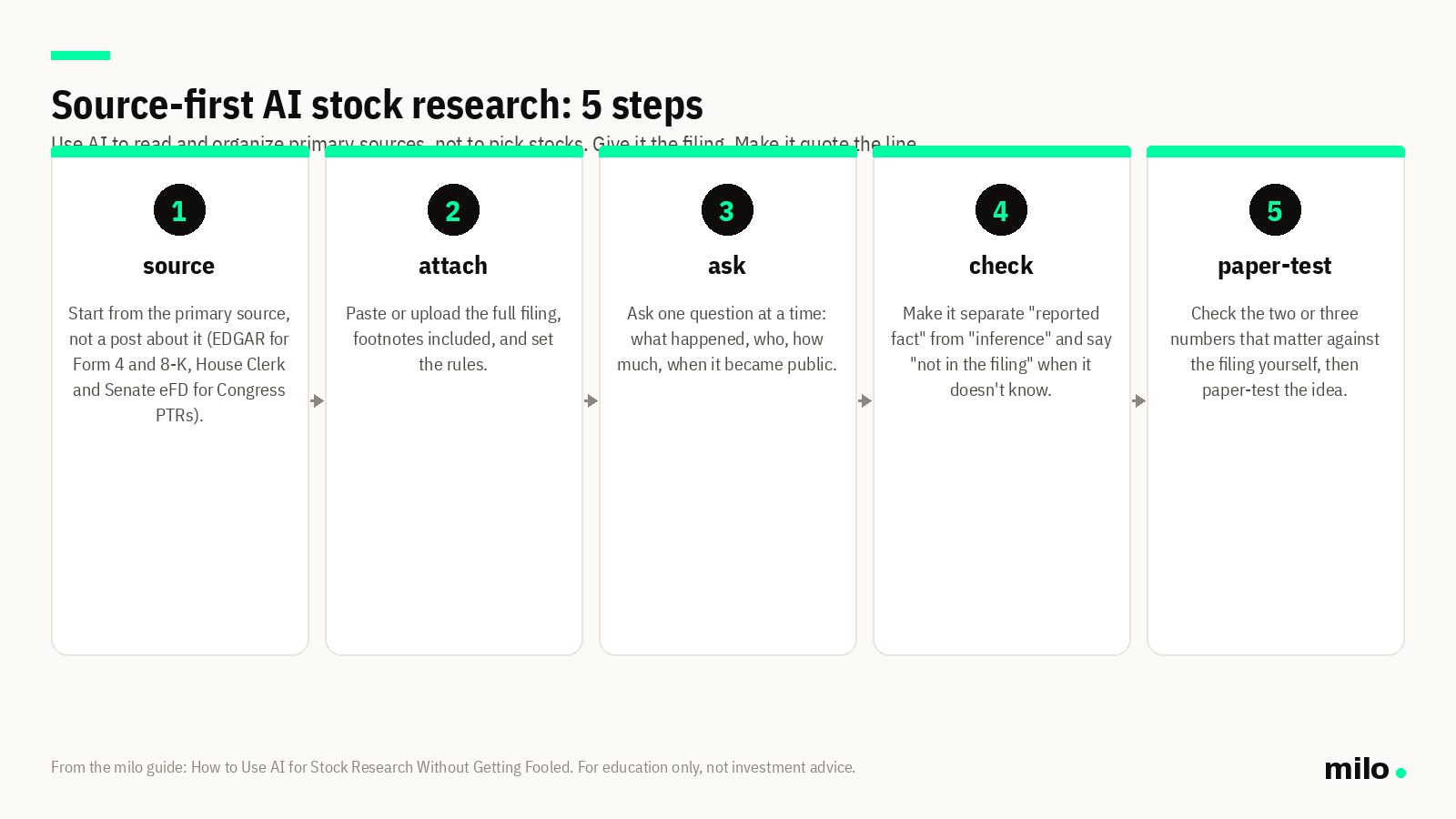
- Source. Start from the primary document, not a post about it. Use EDGAR for Form 4 and 8-K filings. Use the House Clerk and Senate eFD sites for Congress PTRs.
- Attach. Paste or upload the full filing, footnotes included, and set the rules (prompts below).
- Ask. One question at a time: what happened, who, how much, and when it became public.
- Check. Make the model separate “reported fact” from “inference,” and say “not in the filing” when it does not know.
- Paper-test. Verify the two or three numbers that matter against the filing yourself, then test the idea on paper before real money.
Worked example: the $23.7M PepsiCo “buy”
On Oct 14, 2026, PepsiCo ($PEP) director Robert C. Pohlad filed four code P rows at $128.28: 84,507 + 45,075 + 45,075 + 9,989 = 184,646 shares, about $23.7M (184,646 × $128.28 = $23,686,388.88). The filing was accepted Oct 16, 2026 at 16:02:53 ET (accession 0001061272-26-000004). If you have never walked a Form 4 box by box, start with how to read a Form 4.
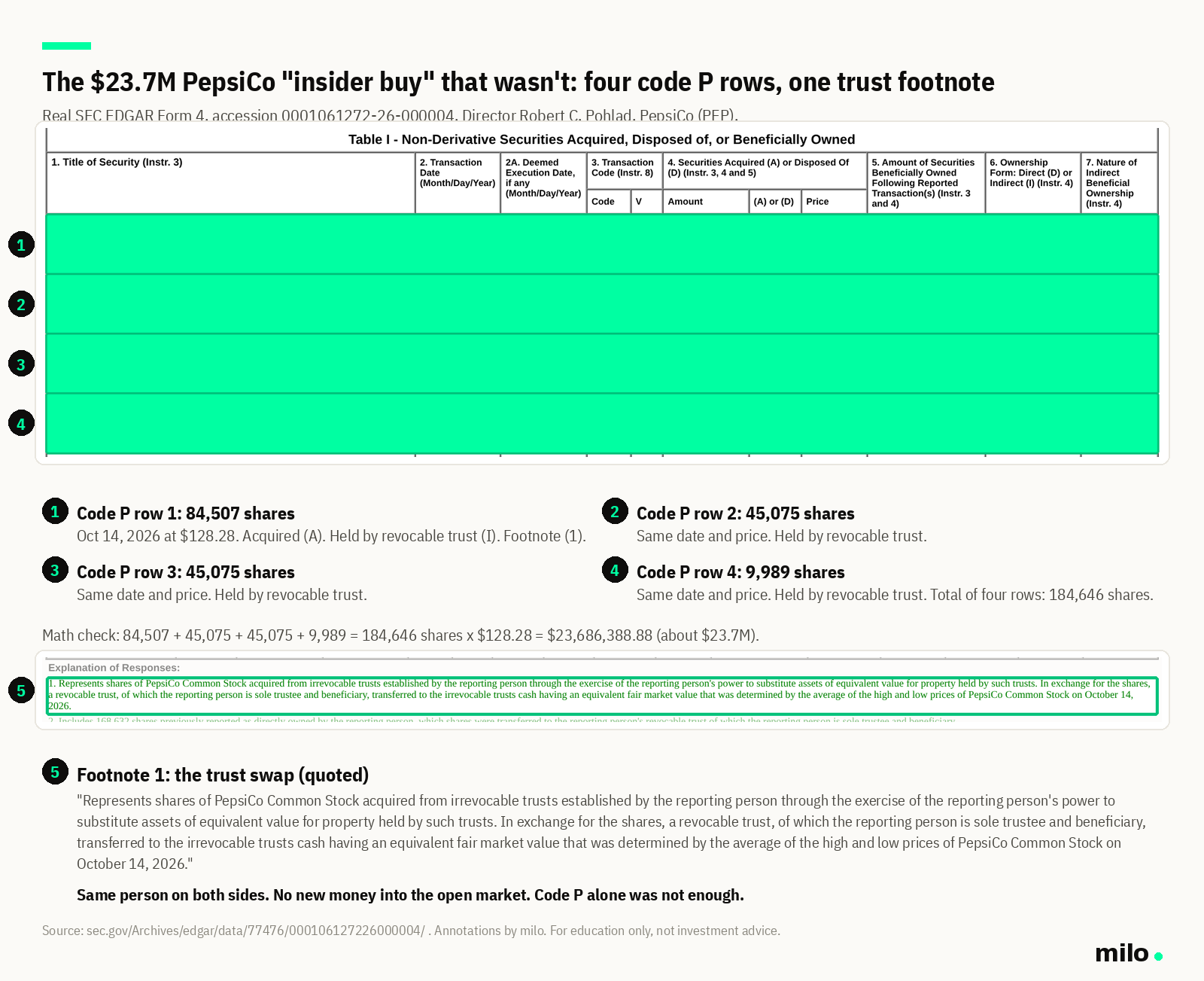
Automated feeds, milo’s included, list this filing as a purchase because the code is P. That is honest to the form. It is also incomplete. Footnote F1 says:
Represents shares of PepsiCo Common Stock acquired from irrevocable trusts established by the reporting person through the exercise of the reporting person’s power to substitute assets of equivalent value for property held by such trusts. In exchange for the shares, a revocable trust, of which the reporting person is sole trustee and beneficiary, transferred to the irrevocable trusts cash having an equivalent fair market value that was determined by the average of the high and low prices of PepsiCo Common Stock on October 14, 2026.
Same person on both sides. Shares moved between his own trusts. No new money into the open market. Code P alone was not enough.
What the headline said vs what the filing says
- Headline framing: a $23.7M PepsiCo insider “buy.”
- Filing fact: four code P rows totaling 184,646 shares at $128.28, filed as of Oct 16, 2026.
- Footnote fact: shares came from irrevocable trusts via a power of substitution; his revocable trust paid cash of equivalent fair market value.
- What that means: a trust-to-trust move by the same reporting person, not an open-market purchase with fresh capital.
What a real open-market buy looks like
Contrast that with Oracle ($ORCL) director Stephen H. Rusckowski. On Sep 29, 2026 he bought 25,000 shares at a weighted average of $139.352, about $3.48M, filed around Oct 1 (accession 0001341439-26-000099). After the trade he held 25,390 shares indirectly through The Stephen H. Rusckowski Living Trust. The only footnote is a weighted-average price range of $138.96 to $139.74. There is no trust-to-trust transfer story. Holding through a living trust is common and is different from Case 1, where the seller was also his own trust. For a quieter way to track insider buying without the noise, start with the filing link, then the footnotes.
milo pulls Form 4 insider buys, 8-Ks, and Congress trade disclosures into one place with links to the original filing, and lets an AI agent follow ideas in a paper portfolio. You can link a brokerage, but real buying isn’t switched on for regular US stocks yet, so stock trades are paper only and milo places no real orders for regular US stocks (tokenized stocks and crypto are real). Open milo with this link, or browse the research page at andmilo.com/stocks.
Picking a research tool
If you want a ready-made feed of options flow, Congress trades, or insider buys instead of pasting filings by hand, compare alternatives to Unusual Whales and Quiver Quantitative. Any feed still needs the footnote check from the PepsiCo example. The tool shows the row. You still open the filing.
The same trap with Congress trades
Congress disclosures have the same headline problem, plus lag and fuzzy sizes. Rep. Cleo Fields (LA-06) reported three separate NVIDIA ($NVDA) purchase rows dated Oct 1, 2026, each in the $1,001 to $15,000 range, across three accounts (E*TRADE #2, Fields Law Firm 2 LLC, and an IRA). The House PTR was digitally signed Oct 22, 2026 (Filing ID 20035669).
So “a congressman just bought $15k of NVDA” is wrong on both counts. The amounts are ranges, not exact dollars, and the disclosure arrived weeks after the trade. Under the STOCK Act, members can take up to 45 days. Our Congress stock trade trackers comparison is built around that lag.
Copy-paste prompts
Use these with the filing attached. Do not ask the model to invent a thesis from memory.
Session rules:
Use only the attached filing. Quote the exact line for every claim, including footnotes. Label each point as "reported fact" or "inference." If something is missing, say "not in the filing." Do not give buy or sell recommendations.

Form 4:
List every row with its transaction code, shares, price, and the footnote attached to it. Is this an open-market purchase by the insider with new money? Quote the footnote that answers it.

8-K:
Which item numbers are in this 8-K and what does each one mean in plain words?
(Keep our 8-K item cheat sheet open while you check: https://blog.pumpparade.com/blog/8-k-filing-alerts-item-cheat-sheet/)

Congress PTR:
What is the transaction date, the disclosure date, and the amount range? How many days passed between them?

Sanity check:
What would make this signal less meaningful than it looks?
Where milo fits
milo is built for the workflow above: pull the Form 4, 8-K, or Congress row, open the original filing, then paper-test the idea. It will still show code P rows like the PepsiCo trust move, because the form says P. The edge is having the filing one click away so you can read the footnote before you act.
FAQ
How do I use AI for stock research?
Give the AI the primary source (a filing or disclosure), ask it to quote the exact line behind each claim including footnotes, check key numbers yourself, and paper-test any idea before using real money.
Can ChatGPT read SEC filings?
Yes, if you paste or upload the filing. From memory it may be out of date or wrong, so always give it the document.
Can AI tell me which stocks to buy?
It can organize research, but it can’t reliably predict returns. Treat its output as notes to check, not a recommendation.
Does code P on a Form 4 always mean an open-market buy?
Usually, but read the footnotes. In an Oct 2026 PepsiCo filing, about $23.7M of code P rows were shares moving between the director’s own trusts.
How do I check a Congress stock trade with AI?
Open the House or Senate disclosure, then ask the AI for the transaction date, disclosure date, and amount range. Trades can be disclosed up to 45 days later, and amounts are ranges.
What’s the best prompt for stock research?
One that limits the AI to the document you gave it, makes it quote sources, and makes it say “not in the filing” instead of guessing.
Make the model show its work
Headlines compress. Filings do not. Hand the AI the document, force the quote, check the two numbers that matter, then paper-test. Open milo when you want the filing next to a paper portfolio, or browse andmilo.com/stocks.
For education only. Not investment advice. milo agents and research are not registered investment advice. milo places no real orders for regular US stocks (tokenized stocks and crypto are real); stock trades are paper only for now. Sources: SEC EDGAR Form 4 accession 0001061272-26-000004 (PepsiCo / Pohlad); SEC EDGAR Form 4 accession 0001341439-26-000099 (Oracle / Rusckowski); House PTR Filing ID 20035669 (Fields / NVDA); SEC Form 4 instructions (sec.gov/files/form4.pdf). Checked Nov 4, 2026.