If you trade on-chain across multiple networks, you have probably watched a token launch on Ethereum while a Solana pump happens in parallel, and felt the friction of juggling two or three different bots. Banana Gun built its entire 2026 product cycle around solving exactly that problem, and the numbers behind the platform are no longer small. According to its own disclosures, the bot has now processed more than $16 billion in cumulative trading volume across 24 million trades, with over 1.2 million registered users running snipes, swaps, and copy trades from inside a single Telegram session.
So the question is not whether Banana Gun is a real product. It clearly is. The question is whether it deserves a slot in your trading stack in 2026, especially next to Solana-native names like Photon, GMGN, and BullX, and Telegram veterans like BonkBot and Maestro. This review breaks down the speed, the fees, the BANANA token revenue share, the security history, and the honest weak spots. By the end, you should know exactly whether Banana Gun fits your style.

Quick Verdict: Banana Gun Review 2026
Rating: 4.2 / 5
Banana Gun is still one of the strongest multi-chain Telegram trading bots in 2026. It is the right choice for traders who actively rotate between Ethereum, Solana, BNB Chain, Base, and MegaETH, and for anyone who wants exposure to a real revenue-share token without dealing with another DeFi protocol. It is not the right choice if you trade Solana memecoins exclusively, in which case Solana-native UIs will likely feel snappier.
Best for: Multi-chain sniper-traders, copy-trade enthusiasts, BANANA holders who want fee revenue.
Skip if: You only trade Solana memecoins and prefer a polished web UI over Telegram.
What Is Banana Gun?
Banana Gun launched in 2023 as a Telegram-native Ethereum sniping bot. The early product was narrow on purpose: get into a new ERC-20 token in the first block after liquidity is added, before retail traders can catch up. That narrow focus paid off. Banana Gun consistently topped the Ethereum sniping leaderboards through 2024 and built a reputation as one of the fastest first-block bots on mainnet.
What changed in 2026 is the surface area. The March 2026 update consolidated five chains, Ethereum, Solana, BNB Chain, Base, and MegaETH, into a single Telegram session. Users can now snipe on Ethereum, swap on Solana, and run a copy-trade strategy on Base, all from the same wallet keys and the same chat. The platform also rolled out a web companion called Banana Pro, aimed at traders who want a chart-driven dashboard alongside the Telegram interface.
Banana Gun is built and marketed under the brand-friendly tagline “for degens, by degens,” but the architecture under the hood has matured into something closer to a full DeFi execution layer.
Platform Stats and Traction
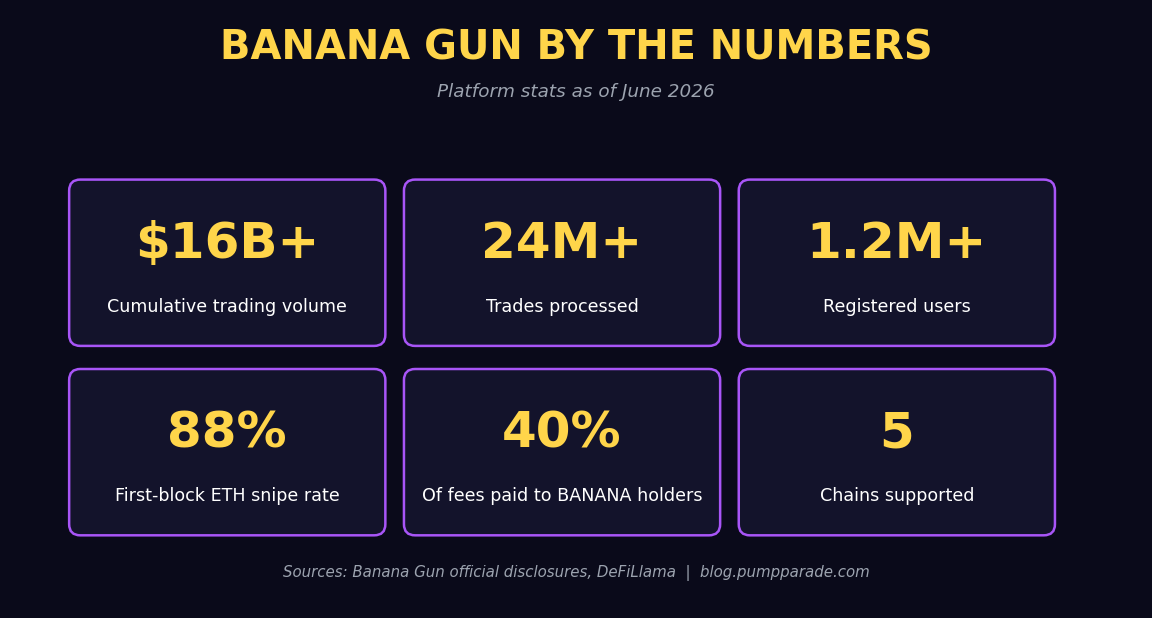
Numbers matter more than narrative in this category. Here is where Banana Gun sits as of June 2026:
- Cumulative volume: over $16 billion across all chains since 2023
- Total trades processed: more than 24 million
- Registered users: over 1.2 million
- Chains supported: Ethereum, Solana, BNB Chain, Base, MegaETH
- Lifetime protocol fees (per DefiLlama): roughly $87 million
- 30-day fees (per DefiLlama, as of writing): approximately $27,400
The 30-day fee number is worth context. Crypto trading bot revenue compresses hard outside of active memecoin cycles. During peak market activity in late 2025, Banana Gun was generating over $92,000 in weekly fees. The March 2026 consolidation phase saw weekly fees stay above $17,000 even with much quieter on-chain conditions. That floor under quiet conditions is one of the cleaner indicators that real, recurring trading is happening on the platform.
Key Features Deep Dive
Multi-Chain Sniping From One Session
The flagship 2026 feature is unified session management. You connect once, configure your gas and slippage defaults per chain, and then snipe or swap on any of the five supported networks without re-importing keys or switching bots. Copy trading works the same way: a single mirror configuration can replicate a wallet across multiple chains simultaneously if that wallet trades across them.
For ETH sniping specifically, Banana Gun reports an 88% first-block success rate, meaning when a new token launches, the bot lands the snipe in the first block 88 times out of 100 attempts. That number comes from the platform itself and should be treated accordingly, but it is consistent with the bot’s track record in third-party sniper leaderboards over the last two years.
The Banana Simulator (Pre-Trade Honeypot Check)
Before any swap or snipe is sent on-chain, the Banana Simulator runs the transaction against live state and checks the sell function. If the sell check fails, suggesting a honeypot or hidden mint, the trade is blocked automatically. This is one of the more useful safety primitives in the trading bot space, because honeypot detection at the bot layer means a user can be aggressive on new tokens without manually scanning every contract.
MEV Protection By Default
MEV protection is on by default with no toggle, no upcharge, and no manual configuration. Transactions are routed through private mempool flows on Ethereum, through Jito bundles on Solana, and through the rebuilt engine on MegaETH. For traders who have been sandwiched on a public mempool before, this is a meaningful default.
BANANA Token Revenue Share
This is where Banana Gun stands out economically. The protocol redistributes 40% of all platform trading fees directly to BANANA token holders. To be eligible, a wallet has to hold a minimum of 50 BANANA tokens. Distributions happen every four hours, six times per day, automatically, and are paid in the native asset of the chain that generated the fee (ETH or SOL, in most cases).
Putting that in concrete terms: weekly fees of $70,000 to $115,000 during early 2026 translated to $28,000 to $46,000 per week flowing back to BANANA holders. During the quieter March 2026 phase, payouts dropped to roughly $7,000 per week. The revenue share is real and verifiable on-chain, but it scales directly with market activity. Holders are effectively long crypto trading volume.
Banana Pro Web Dashboard
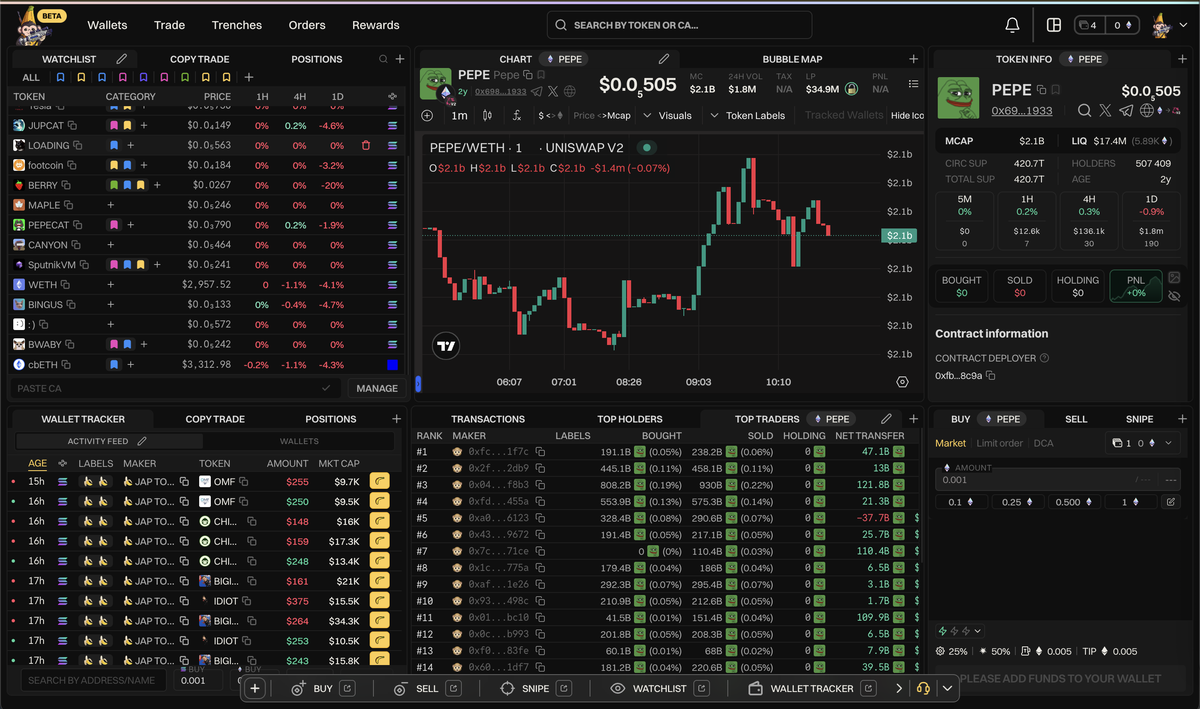
For traders who want a chart-and-clicks experience instead of slash commands, Banana Pro is the companion web app. It surfaces token charts, wallet positions, P&L tracking, and one-click trades to the same backend that powers the Telegram bot. The two interfaces share state, so positions opened in Telegram appear in Pro, and vice versa.
Fees and Pricing
Banana Gun runs a flat fee model. There is no monthly subscription, no premium tier, and no token-gated discount layer.
| Action | Fee | Notes |
|---|---|---|
| Ethereum manual trades and limit orders | 0.5% | Lower than BonkBot’s 1% baseline |
| Ethereum sniper | 1% | Standard sniper bot rate |
| All other chains (SOL, BNB, Base, MegaETH) | 1% | Flat across non-ETH networks |
| Stablecoin swaps | 0% | No fee on stable-to-stable |
| Subscription | None | Pay-per-trade only |
For comparison: BonkBot charges 1% across the board, Maestro charges 1% with a premium tier, and Trojan sits around 0.9% on Solana with feature-gated tiers. Banana Gun’s Ethereum manual fee of 0.5% is genuinely one of the cheapest flat rates on a major trading bot, and the 0% stablecoin swap policy is a nice touch for traders who park between trades.
Security and Trust
This is the section where balance matters most. Banana Gun has a complicated security history.
The 2024 exploit. In September 2024, Banana Gun suffered an exploit linked to a Telegram message oracle vulnerability. Roughly $3 million was drained from 11 users before the team paused the bot and patched the issue. The exploit was a message-layer weakness rather than a breakdown of the core trading or wallet engine, but it is still on the public record and any honest review needs to flag it. The team did publish a post-mortem and reimbursed affected users.
Current security stack. Since the 2024 incident, Banana Gun has hardened sessions and added several pre-trade safeguards. The current safety surface includes:
- Pre-trade honeypot simulation (the Banana Simulator)
- Anti-rug monitoring that tracks contract changes in real time
- Reorg protection against block reorganization attacks
- MEV protection routed via private mempools and Jito
- Session hardening and additional 2FA-style controls for high-value wallets
Audits. The platform has not published a full third-party security audit covering its entire 2026 stack. For a product moving billions in volume, this remains a fair criticism. Competing products like Photon and BullX also operate without publicly visible audits, but that is an industry-wide gap, not a defense.
Bottom line: Banana Gun is meaningfully more secure than it was in 2024, but it is still a custodial-style Telegram bot, and traders should size positions accordingly.
User Experience
The Telegram bot interface is what it is. Slash commands, callback buttons, and a stack of recent token messages. If you have used BonkBot, Trojan, or Maestro, the muscle memory transfers directly. New users should expect a 30 to 60 minute learning curve to get comfortable with the per-chain settings, gas presets, and slippage defaults.
The Banana Pro web dashboard is the bigger UX upgrade for 2026. Charts are usable, position tracking is clean, and one-click trades feel responsive. It is not as feature-rich as a dedicated terminal like Photon or Axiom on Solana, but it solves the biggest historical complaint about Telegram bots: no native chart context.
There is no dedicated mobile app outside of Telegram itself. For users who already live in Telegram on mobile, this is a non-issue. For users who want a standalone iOS or Android app, it is a gap.
Pros and Cons
Pros
- True multi-chain coverage from a single Telegram session (ETH, SOL, BNB, Base, MegaETH)
- 88% first-block Ethereum snipe rate, one of the highest in the industry
- 40% of platform fees redistributed to BANANA token holders, paid in ETH and SOL every four hours
- Pre-trade honeypot simulator blocks bad contracts before funds move
- MEV protection on by default across all chains
- Competitive Ethereum fee at 0.5% on manual trades, 0% on stablecoin swaps
- Banana Pro web dashboard adds real chart and position UX
- Real, verifiable revenue and usage history (over $16B cumulative volume)
Cons
- 2024 exploit history is on the public record, even if patched and reimbursed
- No published full third-party audit of the current 2026 stack
- Custodial wallet model (your keys live inside the Telegram session)
- Solana memecoin traders may find Solana-native UIs faster and snappier
- No dedicated standalone mobile app outside Telegram
- BANANA token revenue share scales directly with market activity, so payouts are volatile
- Occasional reports of slow or failed transactions during peak congestion
How Banana Gun Compares
If you are weighing Banana Gun against Solana-native bots, two of our recent reviews are worth reading side by side: Photon vs BullX and GMGN vs Trojan. Both compare Solana-only trading tools that go deeper on memecoin-specific features but lack Banana Gun’s multi-chain reach. For pure Solana speed, those tools usually edge out a multi-chain bot. For a single interface across Ethereum, Solana, and EVM L2s, Banana Gun is the clearest leader in its category in 2026.
Final Verdict
Rating: 4.2 / 5
Banana Gun in 2026 is no longer the narrow Telegram sniper it was in 2023. It is a full multi-chain execution layer with a real revenue-share token, real defaults around MEV and honeypot protection, and real on-chain volume to back it up. The 2024 exploit and the lack of a current public audit are fair concerns, and any user should size positions to what they would be comfortable losing if a Telegram session was ever compromised.
For multi-chain traders, BANANA holders, and anyone who values a single execution surface across Ethereum, Solana, and emerging EVM chains, Banana Gun is the most complete option available in its category right now.
Frequently Asked Questions
Is Banana Gun safe to use in 2026?
Banana Gun has hardened its session and message layer significantly since the September 2024 exploit, and it now ships with pre-trade honeypot simulation, MEV protection, and reorg protection by default. It is still a custodial Telegram bot, however, and users should treat the in-bot wallet as a hot wallet only. Do not store long-term holdings there.
What chains does Banana Gun support?
As of mid-2026, Banana Gun supports Ethereum, Solana, BNB Chain, Base, and MegaETH from a single unified Telegram session. Copy trading and sniping work across all five.
How much does Banana Gun cost?
Banana Gun charges 0.5% on Ethereum manual trades and limit orders, 1% on the Ethereum sniper and all other supported chains, and 0% on stablecoin swaps. There is no monthly subscription and no premium tier.
How does the BANANA token revenue share work?
The protocol redistributes 40% of all platform trading fees to BANANA token holders. To be eligible, a wallet must hold a minimum of 50 BANANA. Distributions happen every four hours and are paid in ETH or SOL depending on which chain generated the fee.
Is Banana Gun better than BonkBot or Maestro?
It depends on what you trade. For pure Solana memecoins, BonkBot’s Solana-native UX is slightly faster. For EVM-heavy traders and multi-chain rotators, Banana Gun has the cleaner multi-chain experience and a cheaper Ethereum manual fee. Maestro is a closer fight, and the answer there comes down to whether you value Banana Gun’s revenue share token over Maestro’s premium tier features.
Disclaimer: This article is for informational and educational purposes only and should not be construed as financial, investment, or trading advice. Cryptocurrency markets are highly volatile, and past performance does not guarantee future results. Always conduct your own research (DYOR) and consult with a qualified financial advisor before making any investment decisions. Pump Parade and its authors do not assume liability for financial losses incurred based on information provided in this article.