If you trade Solana memecoins, you have almost certainly run into both of these names. GMGN and Trojan are two of the most used trading tools in the ecosystem, but they solve the problem from opposite ends. One started as a research and analytics terminal that grew teeth. The other started as a Telegram sniper that grew a full web app. So which one actually deserves a spot in your workflow in 2026? We put them head to head on fees, speed, features, and trust.
Quick Verdict (TL;DR)
Both bots charge a 1% trade fee and both are non-custodial, so the decision comes down to how you trade. If you want the deepest research, wallet tracking, and multi-chain reach, GMGN is the stronger all-in-one terminal. If you want the fastest, most battle-tested execution on Solana with a real third-party security audit and generous cashback, Trojan wins.
- Best for research and multi-chain trading: GMGN (rating 4.3/5)
- Best for fast Solana execution and security: Trojan (rating 4.5/5)
Product Overviews
What is GMGN?
GMGN (the name is shorthand for “good morning, good night”) began life as a multi-chain token scanner and gradually turned into a full trading terminal. It supports Solana, Ethereum, BSC, and Base, and it pairs a browser-based terminal with a Telegram bot. The platform is built around discovery: new token monitoring, holder analysis, smart money wallet tracking, profit and loss analytics, and built-in token security checks. Daily trading volume routinely sits in the multi-million dollar range, and the user base spans every chain it touches. For traders who treat finding the next play as half the battle, GMGN packs a lot into one screen.
What is Trojan?
Trojan launched in early 2024, built by the team that previously ran “Unibot on Solana” before splitting off into its own independent project. It is Solana-first and Telegram-native, with a web terminal added later that shares the same core engine. By 2026 Trojan has processed well over $20 billion in lifetime volume and serves roughly 1.7 million users, which makes it one of the largest trading bots in the entire Solana ecosystem. Its reputation rests on raw execution speed and a no-nonsense feature set aimed at active on-chain traders.
Features Deep Dive
On paper the two tools overlap heavily. Both offer market, limit, and DCA orders, copy trading, token audits, and self-custodial wallets. The differences show up in emphasis.
GMGN leans into intelligence. Its smart money tracking lets you watch profitable wallets and mirror their entries, and its security monitor scores token risk before you ape in. Anti-sandwich and MEV protection are baked in, and power users can run custom automated scripts rather than relying on preset buttons. The catch reported by active traders is copy-trade latency: mirrored buys can lag the original wallet by roughly 2 to 5 seconds, which matters a lot on fast Solana launches.
Trojan leans into speed. Its BOLT execution engine targets sub-2-second fills, and it supports private transaction routing to reduce front-running and sandwich attacks. Copy trading comes with customizable risk parameters and auto-exit settings, and the limit and DCA tools let you automate recurring buys over time. There is less emphasis on research dashboards and more on getting your order filled before the candle moves.
It is worth being honest about what each tool gives up. GMGN asks you to learn a busy interface in exchange for its depth, and its multi-chain breadth means features sometimes land on Solana first and other chains later. Trojan keeps things narrow on purpose: you will not find sprawling analytics or cross-chain support, but the trade-off is a tool that does one thing, fast Solana trading, very well. Knowing which compromise you are comfortable with usually settles the choice faster than any feature checklist.
Fees and Pricing
This is closer than you might expect. Both platforms charge a 1% fee per trade, applied to buys and sells, with no monthly subscription. The nuance is in the discounts:
- GMGN: 1% base fee, reducible to roughly 0.7% to 0.9% using a referral code. The default priority fee sits around 0.006 SOL per transaction, which is on the higher side, so watch your settings during congestion.
- Trojan: 1% base fee, reducible to 0.9% with a referral code. On top of that, Trojan runs an “Arena” loyalty system that pays SOL cashback after every completed trade, starting near 10% at the entry “Degen” rank and climbing toward 45% at the top “Titan” rank. For high-volume traders, that cashback can meaningfully lower the effective cost.
Bottom line: headline fees are identical, but Trojan’s cashback program gives heavy traders a real edge, while GMGN’s value is in the data you get alongside the trade.
GMGN vs Trojan: Side-by-Side Comparison
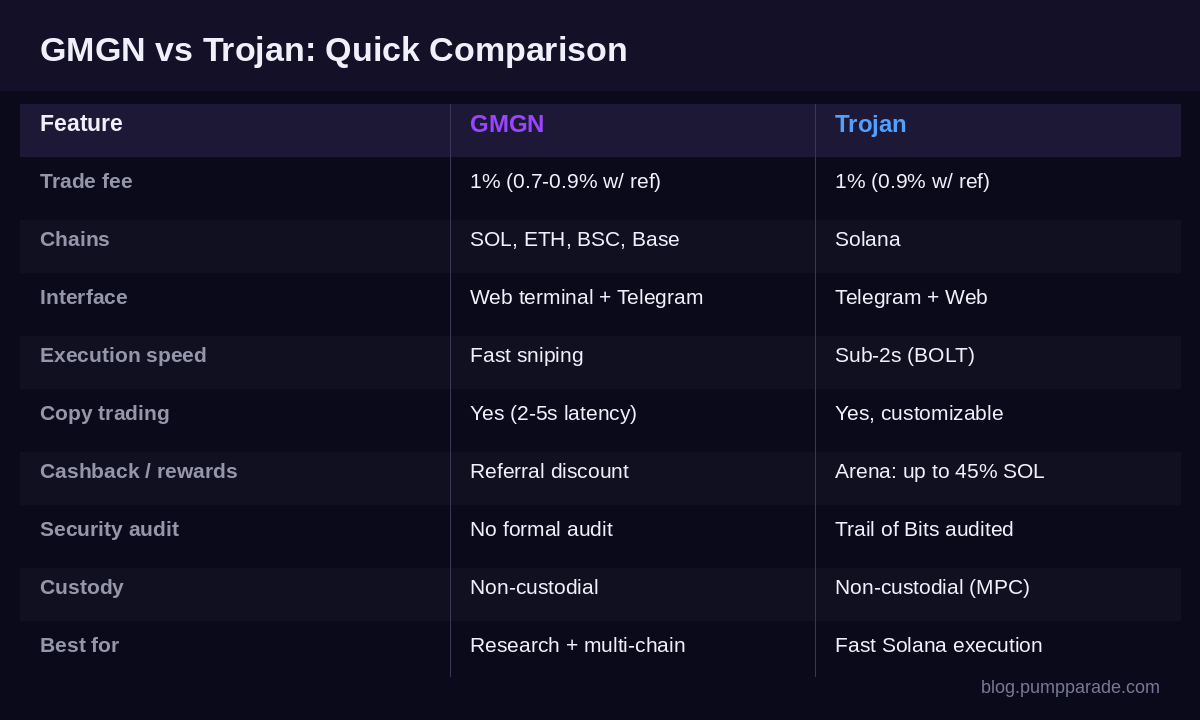
The table above sums up where each tool pulls ahead. GMGN is the wider net; Trojan is the sharper spear.
Pros and Cons
GMGN
Pros: Multi-chain support across Solana, Ethereum, BSC, and Base; excellent wallet tracking and smart money discovery; built-in token security scoring; web terminal plus Telegram; custom scripting for advanced users.
Cons: Copy-trade latency of 2 to 5 seconds; higher default priority fee; no formal smart contract audit, with a CertiK code-security score around 57/100 (a BBB rating).
Trojan
Pros: Sub-2-second BOLT execution; Trail of Bits security audit; generous Arena SOL cashback up to 45%; private transaction routing for MEV protection; massive proven volume and user base.
Cons: Solana only, so no cross-chain trading; lighter on research and analytics dashboards; the loyalty tiers reward volume, which can nudge overtrading.
Security and Trust
Security is where the gap is widest, and it favors Trojan. Trojan has a public audit from Trail of Bits, one of the most respected names in software security, and it uses a non-custodial setup with an MPC-based wallet design that keeps funds under user control while reducing friction. With over $20 billion in lifetime volume and no major reported incidents, it has a long track record to point to.
GMGN is also non-custodial and has no history of security breaches, which is reassuring. However, it lacks a formal smart contract audit, and third-party security scanners give its codebase a middling score. That does not make it unsafe, but it does mean you are trusting reputation and uptime rather than a published audit. For traders moving large size, that distinction is worth weighing. If you are new to bot security in general, our Axiom review covers the same custody questions in more depth.
User Experience
GMGN’s web terminal is dense. The screen is packed with new pairs, migration status, holder counts, and smart money flags, which is fantastic once you learn it and overwhelming on day one. Most users research on the web app and execute through the Telegram bot for speed.
Trojan feels lighter and faster. The Telegram interface is clean and quick to navigate, the web terminal mirrors it, and the whole experience is built around getting in and out of a position with minimal taps. New traders tend to find Trojan easier to start with, while data-hungry traders gravitate to GMGN’s wall of information.
Verdict and Rating
There is no single winner here, because these tools are optimized for different jobs. If your edge comes from finding tokens early and following smart money across multiple chains, GMGN is the better home base, and you can always route execution elsewhere when speed is critical. If your edge comes from fast, reliable fills on Solana and you value a published security audit plus cashback, Trojan is the safer, faster choice.
Plenty of serious traders use both: GMGN for discovery, Trojan for execution. Try each with a small wallet before committing real size. For another close matchup in this category, see our Photon vs BullX comparison.
- GMGN: 4.3 / 5
- Trojan: 4.5 / 5
Visit the official sites to confirm current fees and features: GMGN and Trojan. You can also cross-check ecosystem data on CoinGecko and DeFiLlama.
Frequently Asked Questions
Is GMGN or Trojan cheaper?
Both charge a 1% base fee, reducible with referral codes. Trojan can end up cheaper for active traders thanks to its Arena cashback, which pays back up to 45% of fees in SOL at the highest tier.
Are GMGN and Trojan safe to use?
Both are non-custodial, so your funds stay in wallets you control. Trojan has a public Trail of Bits audit, while GMGN has no formal smart contract audit but a clean incident history. Always use a dedicated trading wallet and never store more than you are willing to risk.
Does GMGN support chains other than Solana?
Yes. GMGN supports Solana, Ethereum, BSC, and Base, which is a key advantage over Trojan, which is Solana only.
Which bot is faster for sniping new launches?
Trojan’s BOLT engine targets sub-2-second execution and is generally considered faster for fills. GMGN is strong for spotting launches early but can lag on copy trades by a few seconds.
Can I use both at the same time?
Yes, and many traders do. A common setup is using GMGN for research and wallet tracking, then executing through Trojan for speed. They are separate, non-custodial tools, so there is no conflict in running both.
Disclaimer: This article is for informational purposes only and is not financial advice. Crypto trading carries significant risk. Always do your own research.