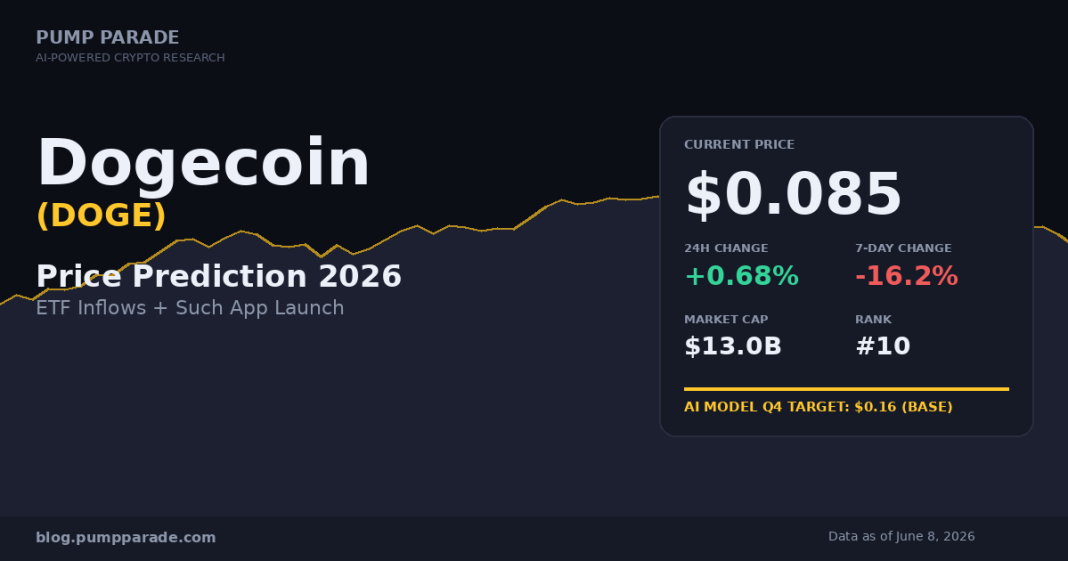
Dogecoin is trading near $0.085 at time of writing. The price is down 16% over the past 7 days, but something strange is happening underneath the chart. Spot DOGE ETFs just logged their longest inflow streak since launch, three straight weeks of positive flows. And on June 5, DOGE broke a 7-month downtrend that had capped every rally since November.
That divergence matters. Retail is panicking. Institutions are quietly buying. Add a freshly launched payments app and a clean regulatory classification, and the setup for the back half of 2026 looks very different from the chart most traders are watching.
Here is the data, both sides of the trade, and our AI model’s price targets for the rest of the year and beyond.
Dogecoin at a Glance: Price, Market Cap, and Where It Sits
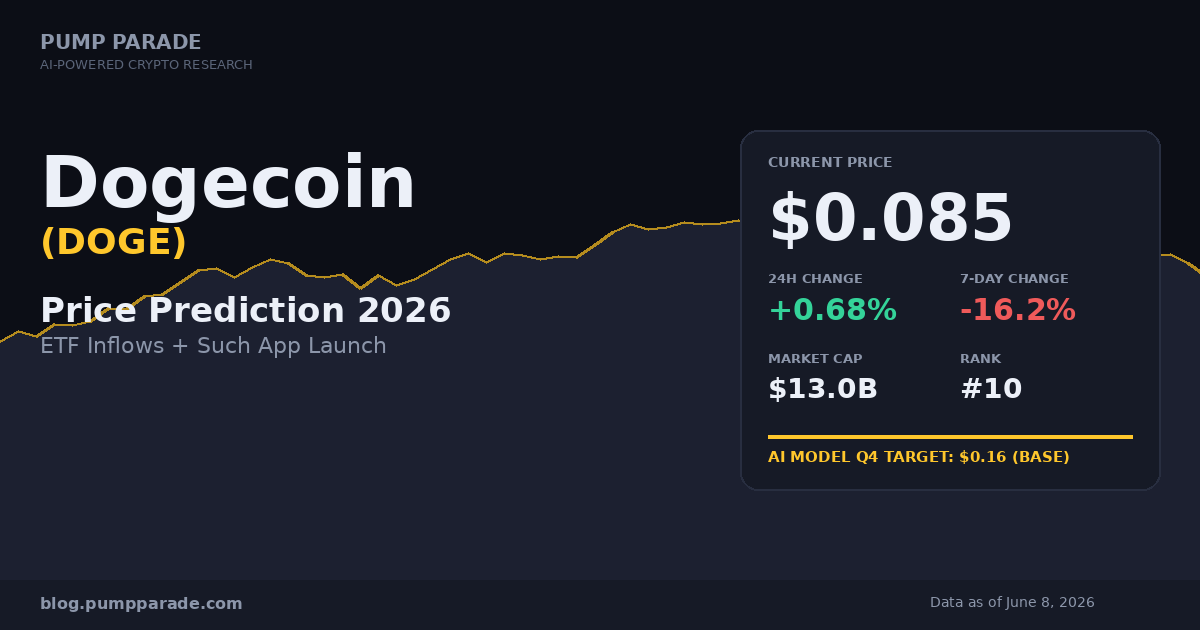
DOGE is the original memecoin, but in 2026 it is closer to a top-tier crypto than a joke. Here are the numbers that matter today:
- Price: ~$0.085
- Market cap: ~$13.0 billion
- Rank: #10 to #11 across major trackers
- 24-hour change: +0.68%
- 7-day change: -16.2%
- All-time high: $0.7316 (May 2021)
- Distance from ATH: -88.5%
Source data is pulled from CoinGecko and CoinMarketCap as of June 8, 2026.
The 16% weekly drop tracks the broader crypto pullback. Bitcoin slid from $72,840 to roughly $64,100 over the past week. Most majors followed. DOGE bled with them. But the underlying story is no longer about retail-driven hype cycles.
The Three Catalysts Driving Dogecoin in 2026
To understand where DOGE could go, you need to know what changed in the last six months. Three things matter most.
1. Spot DOGE ETFs Are Quietly Stacking
The REX-Osprey DOJE ETF and the 21Shares TDOG ETF are both live in the United States. TDOG is the first DOGE product with Dogecoin Foundation backing and direct spot exposure. DOJE was the first spot DOGE ETF to launch on a U.S. exchange.
Over the past three weeks, these products have run their longest positive inflow streak since launch. That is happening while spot price is falling. In plain terms: ETF buyers are accumulating into weakness. That is the opposite of a typical memecoin trade.
This pattern echoes what happened with Bitcoin and Ethereum ETFs in early 2024. Quiet institutional inflows during a price chop preceded a multi-month rally. There is no guarantee DOGE follows the same path. But the structural setup is closer to a real asset than a meme.
2. The Such App Just Went Beta
On May 27, 2026, House of Doge and Brag House Holdings launched the Such app beta. Such is a self-custodial DOGE wallet bundled with merchant tools. The feature called Hustles lets independent vendors accept DOGE through invoicing or in-person QR codes.
This is the first credible push to turn DOGE into a working payments rail since Elon Musk’s 2021 hype cycle. The difference now is that the Dogecoin Foundation itself is backing the build. The team is twenty engineers based in Melbourne. Full public launch is targeted for the first half of 2026, with a wider rollout expected through Q3.
If Such gains real merchant adoption, the supply-demand dynamic shifts. DOGE stops being only a speculative chip. It starts becoming useful.
3. DOGE Is Now Legally a Commodity
In March 2026, a joint SEC and CFTC framework classified DOGE as a digital commodity. That removed the regulatory cloud that hung over most large-cap altcoins through 2024 and 2025. It also cleared the runway for the ETF products that are now buying.
Combined, these three catalysts represent the most fundamental shift DOGE has ever had. The question is whether the chart agrees.
Dogecoin Technical Analysis: What the Chart Says
DOGE just printed a meaningful technical event. On June 5, price broke above the descending trendline that had capped every rally since November 2025. That is a 7-month downtrend resolved to the upside.
Here is what to watch:
- Immediate support: $0.075 to $0.080
- Key support: $0.065 (the May low)
- Immediate resistance: $0.10 to $0.11
- Major resistance: $0.14 (200-day moving average)
- RSI (14): hovering near 41, which is neutral leaning oversold
The setup is not screaming bullish. But it is no longer screaming bearish either. Neutral RSI plus a broken downtrend is what a base usually looks like before a real move. Whether that move is up or down depends on Bitcoin and on whether ETF inflows continue.
One pattern worth flagging: DOGE has historically led the altcoin recovery in the second half of bull cycles. In 2017 and 2021, DOGE moved last and moved hardest. If the broader market stabilizes into Q4 2026, DOGE is structurally positioned to be a late-cycle outperformer.
Dogecoin Price Prediction 2026: AI Model Targets
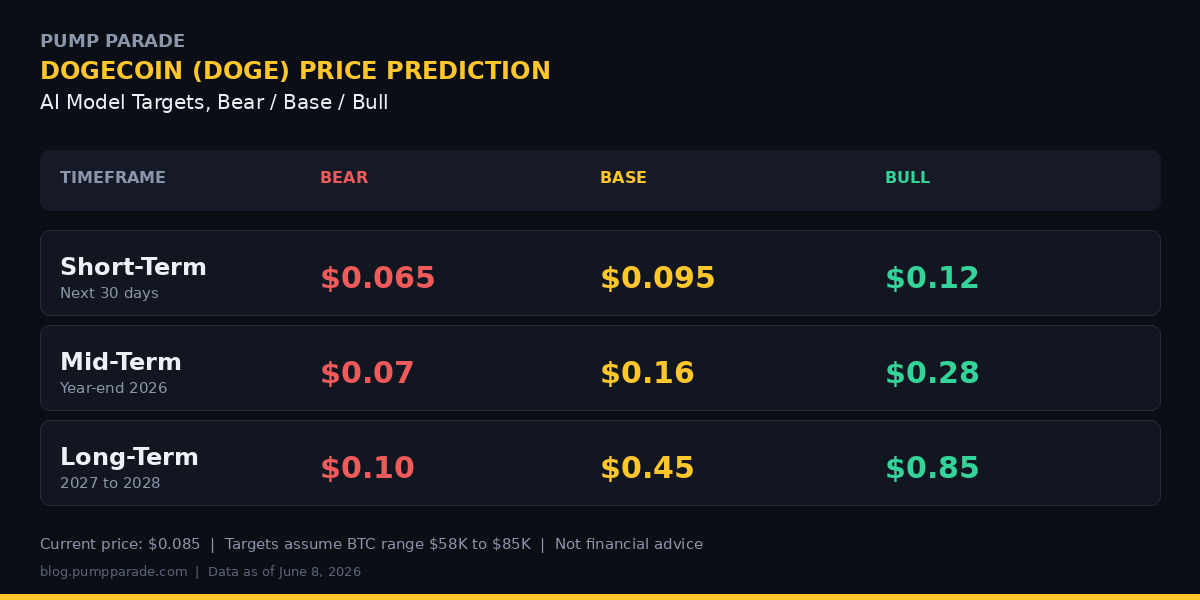
Our AI model blends technical indicators, on-chain flow data, ETF inflow trends, and macro sentiment. Here is what it outputs for DOGE across three timeframes, with explicit bear, base, and bull targets.
Short-Term (30 days)
- Bear case: $0.065 (retest of May lows if BTC breaks $60K)
- Base case: $0.095 (range continuation, ETF flows steady)
- Bull case: $0.12 (reclaim of 200-day MA on a BTC bounce)
The short-term path is mostly a Bitcoin proxy. If BTC holds above $63K and ETF inflows stay positive, the base case wins. If macro deteriorates, $0.065 is the line.
Mid-Term (6 months, year-end 2026)
- Bear case: $0.07 (Bitcoin enters a deeper correction, ETF flows reverse)
- Base case: $0.16 (Such app gains traction, ETFs continue accumulating)
- Bull case: $0.28 (a fourth-quarter altcoin rotation, similar to Q4 2024)
The mid-term outlook is where the Such app and ETF data matter most. Adoption metrics from Such by Q3 will tell us a lot. So will the cumulative ETF inflow number by September.
Long-Term (2027 to 2028)
- Bear case: $0.10 (DOGE underperforms a flat-to-down crypto cycle)
- Base case: $0.45 (next halving cycle plus mature payments use case)
- Bull case: $0.85 (new all-time high on payments adoption plus ETF flywheel)
The long-term bull case requires two things: Bitcoin reaching a new all-time high in the next cycle, and the Such app delivering measurable merchant adoption. Both are plausible but neither is certain.
The Bear Case for Dogecoin: What Could Go Wrong
Every price prediction needs the other side of the trade. Here is what would invalidate the bull thesis.
ETF inflows reverse. The three-week positive streak is fresh. A sharp reversal would signal that institutions are not committed. DOGE would lose its strongest structural support.
Such app fails to gain merchants. Payment apps live or die on adoption. If Such hits 2026 year-end with under 10,000 active merchants, the utility narrative dies. DOGE goes back to being just a memecoin.
A broader memecoin rotation. Capital that would flow into DOGE could instead chase newer plays. We have already covered the ETF setup risk for newer memecoin ETFs in our Pudgy Penguins price prediction. The same dynamic could pull liquidity away from DOGE.
Bitcoin keeps bleeding. If BTC breaks $58K and trends toward $50K, no altcoin survives the rotation back to cash. DOGE would likely lose another 30 to 40 percent in that scenario.
Regulatory reversal. The digital commodity classification is administrative, not statutory. A new SEC chair or a court ruling could reopen the question. Low probability, but not zero.
The Bull Case for Dogecoin: Why This Cycle Is Different
Here is what could send DOGE materially higher.
ETF flywheel kicks in. Spot Bitcoin ETFs took six months to reach steady inflows. DOGE ETFs are at the start of that curve. If TDOG and DOJE accumulate $500M to $1B by year end, DOGE has a hard supply floor.
Such app gets real users. Even modest merchant adoption, say 25,000 vendors by end of 2026, would change the conversation. DOGE would have its first measurable utility metric outside trading volume.
Late-cycle altcoin rotation. History suggests DOGE moves last in a crypto bull cycle. If 2026 ends with BTC at new highs, DOGE could see the kind of 5x to 10x rally that defined Q1 2021.
Elon resurfacing. Wildcard, but worth naming. Musk has been quieter on DOGE since 2024, but any X integration or new payments rail announcement would move price hard.
What to Watch in the Next 30 Days
Three signals will tell us whether the DOGE base is real or whether the bounce fails.
- Weekly ETF flow data. If the inflow streak extends to four or five weeks, that is a strong signal. If it breaks, reassess.
- Such app merchant count. Watch for any official updates from House of Doge on beta sign-ups and active merchants.
- The $0.10 reclaim. A daily close above $0.10 confirms the trend break. A failure to reclaim it within 30 days suggests range continuation.
The smart move here is patience. DOGE looks technically interesting and fundamentally improved, but it still trades like a beta play on Bitcoin. Position size accordingly.
Final Take: DOGE Has Better Bones Than the Chart Suggests
For the first time in years, Dogecoin has more than a meme behind it. Two live spot ETFs are accumulating. A real payments app just shipped a beta. A regulator classification removed the legal cloud. And the chart just broke a 7-month downtrend that had capped every rally since November.
That does not mean DOGE goes straight up. It means the structural floor is higher than it was a year ago. Our base case puts DOGE at $0.16 by year end and $0.45 by the next halving cycle. Our bull case stretches to $0.85. The bear case caps downside near $0.07.
If you are looking at DOGE today, you are not buying the 2021 meme. You are buying a top-10 asset with institutional ETF flows, a working payments rail in beta, and clear regulatory status. The risk is still real. So is the asymmetry.
Disclaimer: This article is for informational and educational purposes only and should not be construed as financial, investment, or trading advice. Cryptocurrency markets are highly volatile, and past performance does not guarantee future results. The price predictions and analyses presented here are based on AI models, technical indicators, and available data at the time of writing, they are not guarantees. Always conduct your own research (DYOR) and consult with a qualified financial advisor before making any investment decisions. Pump Parade and its authors do not assume liability for financial losses incurred based on information provided in this article.