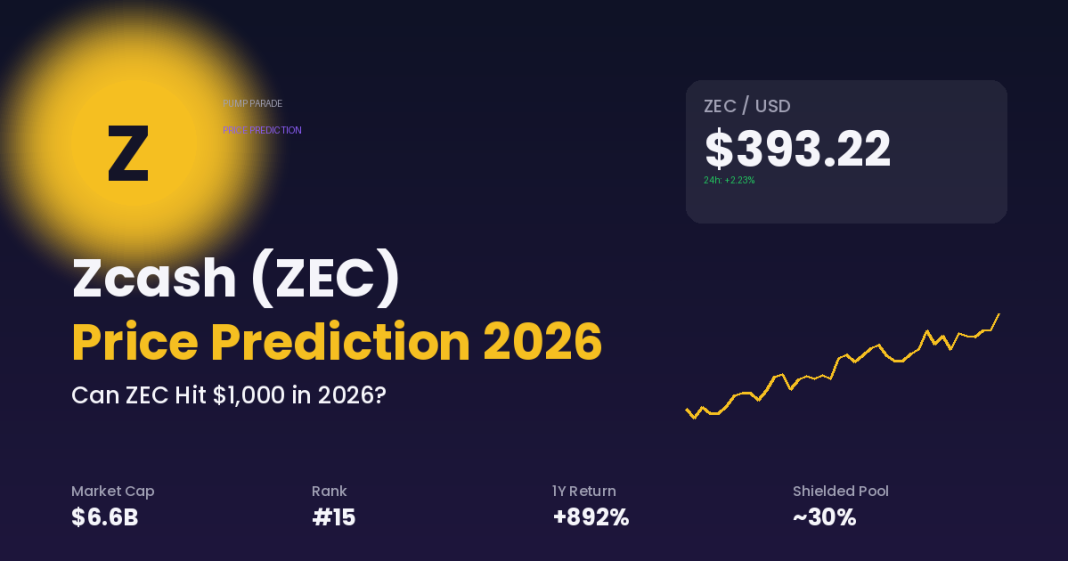
Zcash trades at $393 at time of writing, up 2.2% on the day but down 7% on the week and roughly 30% off its May 2026 peak of $642. The 12 month picture matters more: ZEC is up 892% year over year, the strongest one year return in the entire top 20. Zcash price prediction 2026 just stopped being a niche debate. It is now a top of the leaderboard altcoin trade with a Grayscale ETF in the pipeline and a major protocol upgrade in late stage testing.
That rally was driven by Multicoin Capital disclosing a significant ZEC position, Grayscale filing to convert its Zcash Trust into a spot ETF, and the SEC closing its long running investigation into the Zcash Foundation in January 2026. Can ZEC reclaim $642 and run to $1,000, or does the pullback signal a deeper correction? Both sides of the trade, as always.
- ZEC trades at $393 with a market cap of $6.6B and is up 892% year over year, the best one year return in the top 20.
- Grayscale filed to convert its $137M Zcash Trust into a spot ETF on NYSE Arca in November 2025. Two S-3/A amendments have already been filed in 2026.
- The Crosslink upgrade, which adds a proof of stake finality layer and turns ZEC into a yield bearing asset, is in Milestone 4. Workshop 3 is tentatively scheduled for July 23.
- Roughly 30% of ZEC supply is now locked in shielded pools, up from 8% in 2024. That is a structural supply squeeze.
- Our base case targets $480 to $650 by year end 2026. The bull case opens $1,000 on ETF approval plus Crosslink testnet activation. The bear case revisits $220 if MiCA delistings escalate.
Where Zcash Stands Today
Let’s look at the numbers before we talk narrative.
| Metric | Value |
|---|---|
| Price (USD) | $393.22 |
| 24h change | +2.23% |
| 7d change | -7.15% |
| 30d change | -29.6% |
| 1y change | +892% |
| Market cap | $6.61B |
| Rank | #15 |
| 24h volume | $357M |
| Circulating supply | 16.79M ZEC |
| Max supply | 21M ZEC |
| All time high | $3,191 (Oct 2016) |
| 2026 cycle high | $642 (May 2026) |
A few things jump out. First, supply: ZEC mirrors Bitcoin’s 21M cap, with 16.79M already circulating. The next halving is late 2028, so there is no near term supply shock from issuance.
Second, the on-chain story. Roughly 30% of circulating supply now sits in shielded pools, up from 8% in 2024. That is approximately 4.5 million ZEC effectively removed from trading liquidity. Think of it as the privacy coin version of staking lockup.
Third, ZEC’s 892% one year return is the highest in the top 20 by market cap. That kind of move triggers profit taking by early holders alongside FOMO inflows from late buyers, which keeps volatility elevated.
Why Is Zcash Pulling Back Right Now?
ZEC rallied to $642 in mid May 2026 on the back of three converging stories: Multicoin Capital’s disclosed position, accelerating ETF timelines after the SEC cut review periods from 240 to 75 days, and shielded pool growth crossing 25% of supply. Then it gave back about 39% of that move in six weeks.
The pullback structure looks orderly. Daily volume compressed from $1.2B at the May peak to roughly $360M today, and exchange inflows have not spiked, which is what you would expect if holders were dumping. The Coinbase, Robinhood, and Phemex listings remain intact.
Two near term headwinds explain the cooling. The European Union’s MiCA framework continues to pressure regional exchanges to delist privacy coins, and several smaller European venues followed through in May. And Arkham Intelligence published research in late 2025 showing that 53% of historical ZEC transactions could be de-anonymized by tracing transparent address activity. That research resurfaced in May and dented the “ZEC is private by design” narrative.
The base interpretation: ZEC’s run got ahead of fundamentals, and the market is waiting for the next catalyst (Grayscale ETF decision, Crosslink testnet activation) before it commits fresh capital.
What Is the Bull Case for ZEC in 2026?
Grayscale ZCSH ETF Conversion
Grayscale filed to convert its existing $137M Zcash Trust into a spot ETF (ticker ZCSH) on NYSE Arca on November 26, 2025. The trust already holds roughly 5% of circulating supply. Two amendments to the S-3/A registration statement have been filed (January 30 and April 2, 2026), and the renaming to “Grayscale Zcash Trust ETF” is queued for execution at effectiveness.
If approved, this would be the first U.S. spot ETF for a privacy coin. The 75 day decision window means a definitive yes or no should arrive in Q3 2026. The parallel is the spot Ethereum ETF approval in 2024, which preceded a 30% rally in ETH. ZEC has a much smaller free float, so an equivalent inflow profile would hit price harder.
Crosslink Proof of Stake Finality
The Crosslink upgrade is in Milestone 4 as of mid 2026. It adds a proof of stake finality layer on top of Zcash’s existing proof of work chain. In plain terms, validators stake ZEC to finalize blocks, the chain becomes more resistant to 51% attacks, and ZEC becomes a yield bearing asset for the first time in its history.
Shielded Labs has completed two FeatureNet workshops and is prototyping a slashing tool. Workshop 3 is tentatively scheduled for July 23. Mainnet activation is not yet dated, but each FeatureNet milestone tightens the market’s expected timeline. Yield bearing supply is the most reliable way to convert speculators into long term holders.
Shielded Pool Supply Squeeze
Shielded pool adoption has gone from 8% of supply in 2024 to roughly 30% in mid 2026. Combine that with an ETF absorbing another 5% to 10%, and the float available for active trading shrinks quickly. Tight float and rising demand is the textbook setup for upside volatility.
Tushar Jain at Multicoin Capital framed the thesis directly: as governments push to scrutinize visible crypto holdings for tax and KYC purposes, demand for compliant confidentiality grows. That is institutional positioning, not a meme.
What Is the Bear Case for ZEC in 2026?
European Regulatory Tightening
MiCA’s Article 78 effectively bans anonymity enhancing services from EU regulated exchanges. Several smaller European venues delisted ZEC in May 2026, and the larger ones are running risk reviews. If a major venue like Bitstamp or Kraken EU follows, the regional liquidity hit would be significant. ZEC is already excluded from most U.K. exchanges. The U.S. listings are intact, but a coordinated European delisting cycle would compress order book depth meaningfully.
Crosslink Complexity Risk
Former ECC CEO Josh Swihart has publicly raised concerns about Crosslink’s complexity, citing the risks of layering proof of stake finality on a proof of work base. Bugs in hybrid consensus designs are notoriously hard to find in testnets and often only surface under adversarial mainnet conditions. A delayed Crosslink rollout, or a botched activation, would invalidate one of the largest 2026 catalysts.
ETF Rejection or Delay Risk
The Grayscale ZCSH approval is not a done deal. The SEC has approved spot ETFs for Bitcoin and Ethereum, but a privacy coin presents a different regulatory profile. A rejection, or a delay past 2026, would force a rerating. ZEC has front loaded a lot of approval expectation into current price levels.
Zcash Price Prediction 2026: Targets by Timeframe
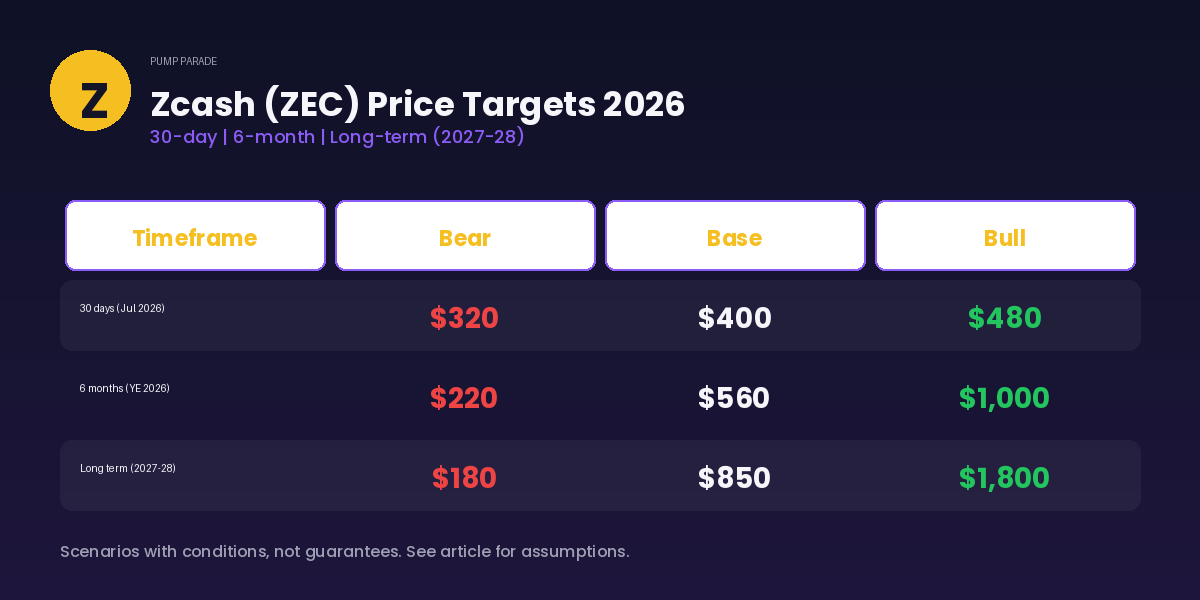
Our model output, combined with technical levels and the catalyst calendar, points to the following ranges. As with every Pump Parade price prediction, these are scenarios with conditions, not promises.
30 Day Outlook (July 2026)
Bear: $320. Base: $400. Bull: $480.
The next 30 days are dominated by positioning ahead of the Q3 ETF decision and Crosslink Workshop 3. We expect range trading between $360 and $460. The $360 zone is the 200 day moving average, which has acted as dynamic support throughout the 2026 rally.
6 Month Outlook (Year End 2026)
Bear: $220. Base: $560. Bull: $1,000.
The base case assumes the ETF gets approved with modest first month inflows, Crosslink testnet activates on schedule, and shielded pool share grows past 35%. The bull case requires all three of those plus a renewed broader privacy narrative. The bear case assumes ETF delay plus a European delisting cascade.
For comparison, Changelly’s 2026 forecast projects an average of $662 with a high of $769. CoinCodex’s technical model sees a range of $376 to $532. Our bull case is more aggressive, reflecting the leverage an ETF approval creates on a tight float.
Long Term (2027 to 2028)
Bear: $180. Base: $850. Bull: $1,800.
The 2 to 3 year window is dominated by Crosslink mainnet activation and the next ZEC halving in late 2028. If yield bearing mechanics take hold, the bull case opens a new all time high. The bear case assumes a hostile global regulatory environment for privacy assets.
How Does Zcash Compare to Monero?
Privacy is a two horse race in 2026. Here is the comparison.
| Metric | Zcash (ZEC) | Monero (XMR) |
|---|---|---|
| Price (USD) | $393 | $310 |
| Market cap | $6.6B | $5.8B |
| Rank | #15 | #17 |
| Privacy default | Optional (shielded) | Mandatory |
| Major exchanges | Coinbase, Kraken, Robinhood | Mostly delisted on regulated venues |
| Yield bearing | Coming via Crosslink | No, pure PoW |
| ETF pipeline | Grayscale ZCSH filed | None |
| Max supply | 21M (Bitcoin parity) | Tail emission, no cap |
The framing: Monero is the purer privacy coin. ZEC is the more institutionally tradeable one. After Arkham’s 2025 de-anonymization work, the gap on privacy purity widened in Monero’s favor. But ZEC has spent 2026 widening the gap on capital access. See our Monero (XMR) price prediction 2026 for the other side of the trade.
For 2026 specifically, the ETF, Crosslink, and continued exchange access make ZEC the higher conviction privacy trade. Past 2026, that calculus could flip.
What Would Change Our View
Three explicit triggers. If any of these happen, our base case shifts.
First, Grayscale ZCSH gets approved before October 1, 2026. We move the base case to $720 and the bull case to $1,200. Approval timing matters because Q3 inflows have historically been stronger than Q4 for newly approved spot ETFs.
Second, Crosslink mainnet activation gets a confirmed Q4 2026 date. We move the base case to $620 even without ETF approval. A dated mainnet upgrade is one of the most reliable catalysts in crypto.
Third, a major U.S. exchange delists ZEC under regulatory pressure (low probability but non zero). We move the base case to $260 and the bear to $150. U.S. liquidity loss would be much more damaging than European delistings because of the institutional flow exposure.
Frequently Asked Questions
Will Zcash reach $1,000 in 2026?
Possibly, but it requires the Grayscale ZCSH ETF to be approved, Crosslink testnet to activate on schedule, and shielded pool share to keep growing past 35%. Our bull case targets $1,000 by year end. The base case is $560. ZEC’s tight float of 16.8M coins and rising institutional demand creates leverage on positive catalysts, but the path to $1,000 is conditional, not guaranteed.
Is Zcash a good investment in 2026?
Zcash is a high conviction trade for investors who want exposure to the privacy coin narrative and can tolerate sharp volatility. The ETF and Crosslink catalysts are real and dateable. The risks (EU delistings, ETF rejection, Crosslink delay) are also real. Position sizing matters. ZEC should not be a portfolio anchor. It is a thematic bet within a broader crypto allocation.
What will Zcash be worth in 2030?
Our long term model output ranges from $400 (bear) to $2,800 (bull), with a base case near $1,100. The bull case assumes ETF inflows mature, Crosslink yields create durable holder commitment, and the privacy narrative scales globally. The bear case assumes regulatory hostility, technical setbacks, or competition from newer privacy systems compresses ZEC into a niche role.
Why is Zcash going down right now?
ZEC pulled back roughly 30% from its May 2026 peak of $642 as the market consolidates after a 892% one year run. Two specific headwinds are weighing on price: continued European exchange delistings under MiCA, and lingering effects from Arkham Intelligence’s 2025 de-anonymization research. Neither is structural enough to invalidate the bull thesis, but both have slowed momentum into the summer.
Is Zcash better than Monero?
It depends on what you value. Monero offers stronger default privacy and mandatory shielding on every transaction. Zcash offers optional shielding, easier exchange access, an ETF pipeline, and yield bearing supply mechanics via the coming Crosslink upgrade. For 2026 trade setup, ZEC has more dateable catalysts. For pure privacy use, XMR remains the technical leader.
Has the Grayscale Zcash ETF been approved?
Not yet as of late June 2026. The Grayscale ZCSH conversion was filed November 26, 2025, with two amendments filed in 2026 (January 30 and April 2). The SEC’s accelerated 75 day review framework means a definitive decision is expected in Q3 2026. The renaming to “Grayscale Zcash Trust ETF” is queued to take effect at registration effectiveness.
The Honest Take
Zcash in mid 2026 is one of the cleanest narrative-meets-fundamentals setups in the altcoin market. You have a dateable ETF decision, a dateable protocol upgrade, a structural supply squeeze, and a 892% trailing return that has only modestly cooled. That is rare.
But the price has already moved a lot. ZEC is not a deep value play. It is a trade on whether the catalysts land in the next six months. If they do, $1,000 is reachable. If they slip, the next leg down could be sharp. The 30 day pullback is the market pricing in that uncertainty, not the end of the move.
Our framework: watch the $360 zone as the line in the sand. Hold above it and the bull case stays intact. Lose it on a daily close, and the trade needs to be reassessed. Beyond that, the Q3 ETF decision is the single highest impact event on the 2026 calendar. Size positions accordingly.
The privacy narrative is not going away. The question for ZEC specifically is whether it captures the institutional flow that the narrative deserves. Through mid 2026, the answer is leaning yes. We will keep you posted.
For broader context on how the ETF backdrop is reshaping major altcoins, see our analyses of the Litecoin (LTC) ETF test and the Cardano (ADA) ETF window.
Disclaimer: This article is for informational and educational purposes only and should not be construed as financial, investment, or trading advice. Cryptocurrency markets are highly volatile, and past performance does not guarantee future results. The price predictions and analyses presented here are based on AI models, technical indicators, and available data at the time of writing; they are not guarantees. Always conduct your own research (DYOR) and consult with a qualified financial advisor before making any investment decisions. Pump Parade and its authors do not assume liability for financial losses incurred based on information provided in this article.