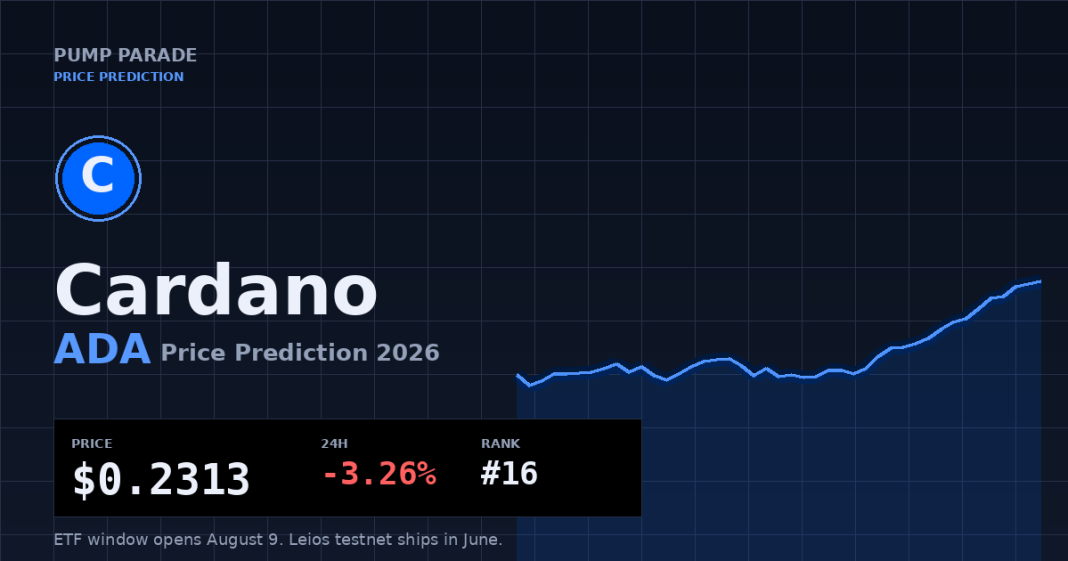
Cardano (ADA) is trading at $0.23 at the time of writing. The token is down 7% on the week, down 6% on the month, and sitting more than 92% below its 2021 all-time high of $3.09. On paper, it looks like a sleepy mid-cap. The setup tells a different story.
But three catalysts converge between now and year-end. A spot ADA ETF decision window opens August 9. The public Leios testnet ships in June. The Midnight privacy sidechain is already live on its Kūkolu mainnet phase. The chart says exhaustion. The fundamentals say something is loading.
Let’s break down what the data shows, what could go right, what could go wrong, and where our AI model sees ADA by 2028.
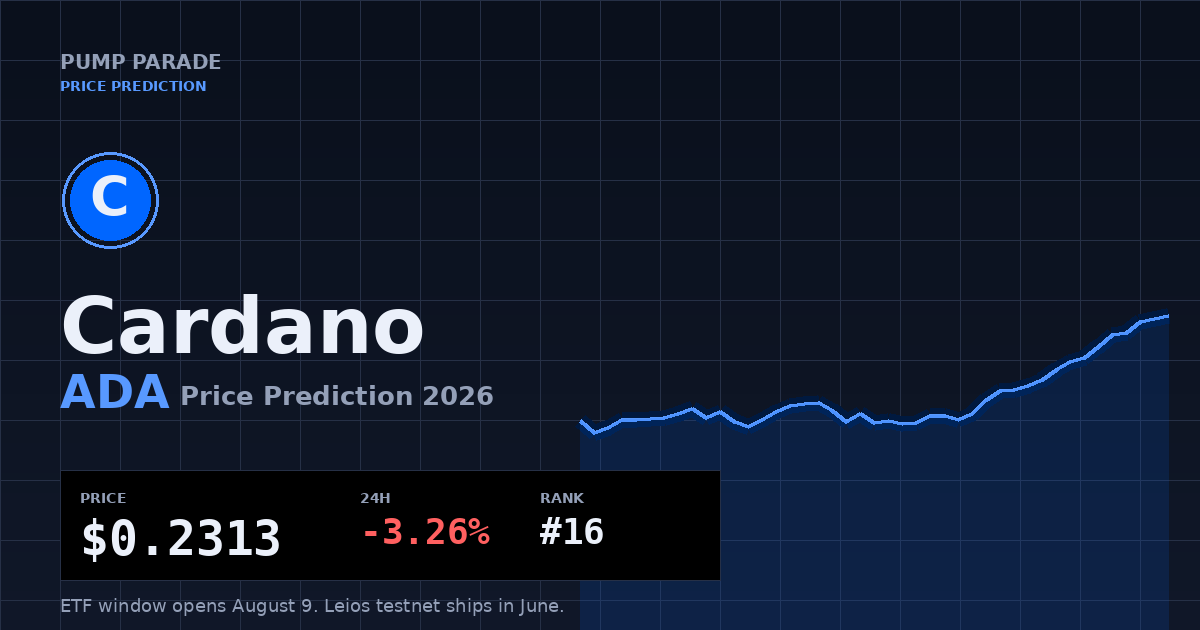
Cardano (ADA) Price Today: Where ADA Stands Right Now
Here are the numbers as of writing:
- Price: $0.2313
- Market cap: ~$8.56 billion (rank #16)
- 24-hour volume: ~$467 million
- 24h change: -3.26%
- 7d change: -7.33%
- 30d change: -5.98%
- 1y change: -69.21%
- Circulating supply: 37.01 billion of 45 billion max
ADA spent most of the past 30 days bleeding against Bitcoin. Bitcoin dominance is sitting near 60% and the CMC Altcoin Season Index is at 39 out of 100. Large-cap alts without a fresh narrative have been quietly distributed. Cardano fits that profile on the surface.
Look closer and the picture flips. The token is consolidating into a zone that has held three times since late 2024. Funding is neutral. Open interest on CME Cardano futures, live since February 9, is climbing. Something has to give.
What Is Cardano? The 30-Second Refresher
Cardano is a proof-of-stake layer-1 blockchain founded in 2017 by Charles Hoskinson, one of the original co-founders of Ethereum. It uses the Ouroboros consensus protocol, the first peer-reviewed PoS algorithm in production. Translation: every consensus change goes through formal academic review before it ships.
That research-first approach is why Cardano ships slowly. It is also why institutions take the chain seriously. The CME Group does not list futures on hobby projects.
The Three Catalysts That Matter for ADA Price in 2026
Catalyst 1: The Spot ADA ETF Window Opens August 9
This is the headline event. The SEC-CFTC joint framework now classifies ADA as a digital commodity, and CME Cardano futures have been live since February 9, 2026. That matters because August 9 marks the six-month threshold under generic listing standards. After that date, spot ADA ETFs can be listed without separate 19b-4 rule changes for each issuer.
The filings are stacked and waiting. Grayscale filed S-1 forms in August 2025 under the ticker GADA, targeting NYSE Arca. VanEck, Bitwise, 21Shares, and Canary Capital have all filed or signaled intent. After the August 9 trigger, the SEC has up to 75 days to issue a final decision on activated filings. That puts the realistic launch window inside late Q3 or Q4 2026.
For reference, spot XRP ETFs have pulled in roughly $1.32 billion since their November 2025 launch. ADA does not need XRP-tier inflows to re-rate. Even a modest $200 to $400 million of inflows in the first 90 days would absorb a meaningful chunk of float at current prices.
Catalyst 2: Ouroboros Leios Public Testnet in June
Leios is Cardano’s scaling upgrade. The target is between 1,000 and 10,000 transactions per second, up from roughly 250 today. It does this through input endorsers and parallel transaction processing, a design that has been in academic review for over two years.
The public testnet is scheduled for June 2026. If it ships on time and holds throughput under realistic load, the narrative changes overnight. Cardano stops being a “slow chain that thinks too much” and starts being a credible competitor to Solana on raw throughput. Mainnet deployment is targeted for late 2026.
Compare this to the playbook on other L1 upgrades. Solana’s Alpenglow upgrade narrative drove most of SOL’s positioning into 2026, and Cardano is now setting up the same kind of scaling-led re-rating window.
Catalyst 3: Midnight Is Already Live
The Midnight sidechain transitioned to its Kūkolu mainnet phase in late March 2026. Midnight is a privacy-first chain that uses zero-knowledge smart contracts, designed for enterprise use cases where compliance and confidentiality both matter. Think medical records, payroll, supply chain data.
This is the catalyst the market is sleeping on. Privacy-compliant smart contract platforms have been a missing piece for enterprise adoption since 2017. Midnight is now in production. If even one Fortune 500 deployment surfaces this year, ADA gets a fundamental story it has never had. Real corporate users, real revenue, settled to the Cardano parent chain.
Cardano Technical Analysis: What the Chart Says
The technical setup is mixed, leaning constructive.
Support and resistance: ADA has triple-bottomed in the $0.22 to $0.24 range over the past six months. That zone has now absorbed three distribution attempts. A loss of $0.20 on weekly close would invalidate the base. On the upside, the first real resistance is at $0.32, followed by $0.45, the pre-cycle high of this leg.
The Relative Strength Index, or RSI, which measures whether an asset is overbought or oversold, is sitting at 38 on the daily and 41 on the weekly. Both readings are in the lower third, which historically has marked accumulation rather than capitulation in ADA’s price history.
The 50-day moving average is below the 200-day, so the medium-term trend is technically still down. But the gap is narrowing, and a bullish crossover in the next 8 to 12 weeks is plausible if ADA holds the $0.22 floor.
On-chain activity is the quiet tell. According to public Cardano explorer data and aggregators like CoinGecko, daily active addresses have been climbing for six straight weeks even as price has dropped. Holders are accumulating into weakness.
Bull Case: Why ADA Could Re-Rate Hard
The bull case stacks like this:
- ETF approval by Q4 2026. Inflows of $300M to $700M in the first six months pull ADA back toward $0.55 to $0.75.
- Leios testnet ships clean in June. Throughput narrative shifts. ADA gets a second-leg re-rate as developers start announcing Leios-native projects.
- Midnight lands a major enterprise pilot. Fundamental story unlocks. Mid-cycle target moves to $1.00.
- Macro turn. Bitcoin dominance peaks in Q3, capital rotates into majors. ADA participates with its higher beta.
If three of those four hit, $1.00 by mid-2027 is in range. If all four hit, $1.50 to $2.00 is the upper bound the model assigns meaningful probability to.
Bear Case: What Could Go Wrong
This is the part most ADA coverage skips. Here is the honest list:
- ETF gets delayed or denied. The SEC has wider latitude than people remember. A denial or 240-day delay would crater the catalyst calendar and push ADA toward $0.15 to $0.18.
- Leios testnet slips or breaks. Cardano has slipped roadmap dates before. A delay past Q3 2026 kills the throughput narrative for this cycle.
- Midnight stays niche. Privacy-compliant smart contracts have failed to find product-market fit on every previous chain that has tried. The base rate is bad.
- Macro breakdown. If Bitcoin loses $58K and the broader risk environment turns, ADA’s beta works against it. The 2022 retest of $0.24 happened in a similar setup.
- Unlock pressure. Roughly 8 billion ADA remain to enter circulation through staking rewards over the long tail. That is mild dilution per quarter, but it caps the upside in a weak demand environment.
The level that invalidates the bull thesis cleanly is a weekly close below $0.20.
Cardano Price Prediction: Short, Mid, and Long-Term
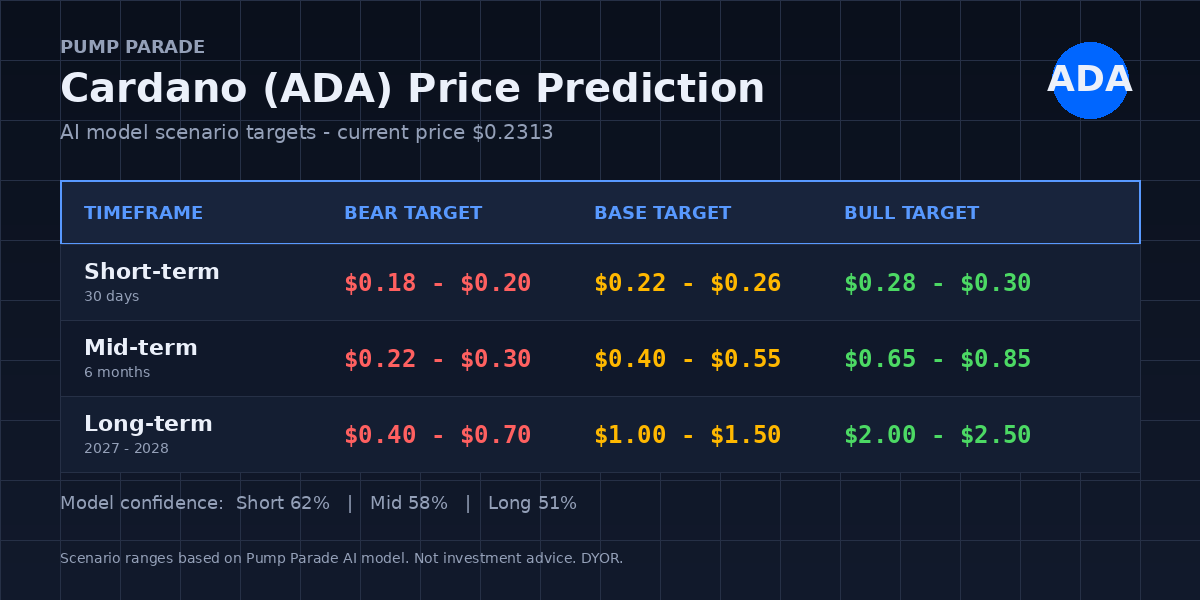
Here is how our AI model sees it. These are scenario ranges, not guarantees. Confidence scores reflect model output, not certainty about the future.
Short-Term (Next 30 Days): $0.20 to $0.28
Base case is $0.22 to $0.26 as the market digests the macro and waits for the Leios testnet announcement window. Bear case is a flush to $0.18 if BTC loses $65K. Bull case is a squeeze to $0.30 on an early ETF headline. Model confidence: 62%.
Mid-Term (6 Months, By Late Q4 2026): $0.30 to $0.65
This is where the catalysts cluster. Leios testnet results, the ETF window opening August 9, and any Midnight enterprise news all land inside this window. Base case is $0.40 to $0.55 assuming the ETF gets approved and inflows are moderate. Bear case is $0.22 to $0.30 if the ETF slips and Leios disappoints. Bull case is $0.65 to $0.85 on a clean catalyst sweep plus macro tailwind. Model confidence: 58%.
Long-Term (2027 to 2028): $0.40 to $2.50
Bear case is $0.40 to $0.70, the path where ADA gets its catalysts but never escapes mid-cap purgatory. Base case is $1.00 to $1.50, the path where ETFs pull in steady institutional flows and Leios delivers measurable adoption. Bull case is $2.00 to $2.50, which requires Midnight to deliver real enterprise revenue plus a full crypto cycle peak in 2027 or 2028. The all-time high of $3.09 is not in our central range. Model confidence: 51%.
What to Watch From Here
Three concrete things on the calendar:
- June 2026: Leios public testnet launch. Watch for actual TPS numbers under load, not marketing.
- August 9, 2026: Spot ADA ETF window opens. Watch for which issuers activate filings first.
- Q3 to Q4 2026: First Midnight enterprise deployments. Watch the news flow, not the price.
The setup worth monitoring is straightforward. ADA is consolidating in a multi-month base with three concrete catalysts inside the next six months and one cyclical catalyst beyond. The risk-reward favors patient accumulators only if the $0.20 floor holds on weekly close. Break that, and the whole thesis needs to be re-evaluated.
The Bottom Line
Cardano is one of the cleanest mid-cap setups in the market right now. Beaten-down price, accumulating holders, climbing on-chain activity, and three real catalysts on the calendar before year-end. The bear case is real and worth respecting, but the asymmetry has gotten interesting after a year of underperformance.
The smart move is to watch the catalyst calendar, mark $0.20 as your invalidation level, and let the data drive the decision. Not the hype. Not the cope.
Disclaimer: This article is for informational and educational purposes only and should not be construed as financial, investment, or trading advice. Cryptocurrency markets are highly volatile, and past performance does not guarantee future results. The price predictions and analyses presented here are based on AI models, technical indicators, and available data at the time of writing, they are not guarantees. Always conduct your own research (DYOR) and consult with a qualified financial advisor before making any investment decisions. Pump Parade and its authors do not assume liability for financial losses incurred based on information provided in this article.