Liquid staking is the biggest, quietest business in crypto. It turns idle proof-of-stake tokens into productive collateral, and the two undisputed leaders of that market sit on different chains. Lido rules Ethereum. Marinade rules Solana. If you hold ETH or SOL and want yield without giving up liquidity, you will almost certainly end up in one of these two products. So which one actually deserves your deposit in 2026?
This review puts them side by side: how each protocol works, what the fees really cost, what yield you can expect to net out, how safe they are, and which one wins for which type of user. Data is from DeFiLlama, project docs, and public dashboards as of August 2026.
Quick Verdict
If you hold ETH: Lido is still the default. It has the deepest liquidity, the widest DeFi integrations, and stETH is basically ETH-with-a-yield across every major money market. The 10 percent fee is not the cheapest, but the ecosystem depth is worth it for most users.
If you hold SOL: Marinade is the better pick. It pays substantially higher gross yield than any Solana LST alternative once you factor in MEV, its fee is 6 percent versus Lido's 10, and its Marinade Native option lets you stake directly to 130+ validators with zero protocol fee.
Rating: Lido 4.4/5 for ETH users. Marinade 4.5/5 for SOL users. They are not really substitutes because they operate on different chains, but the frameworks for judging them are the same, and both earn their leadership.
What Liquid Staking Actually Is
Traditional staking locks your tokens. You get yield, but you cannot move, trade, or use them as collateral until you unstake, and unstaking has a delay (about two days on Solana, up to several days on Ethereum). Liquid staking removes that tradeoff. You deposit ETH or SOL, the protocol stakes it for you across a set of validators, and you receive a receipt token (stETH or mSOL) that represents your position. That receipt token accrues yield in the background and is fully liquid: you can sell it, use it as collateral in lending markets, or provide liquidity with it in DEXes.
The catch: you are trusting the protocol's smart contracts, its validator set, and, in some designs, its governance. That is why the choice of protocol matters as much as the choice of asset.

Marinade Overview
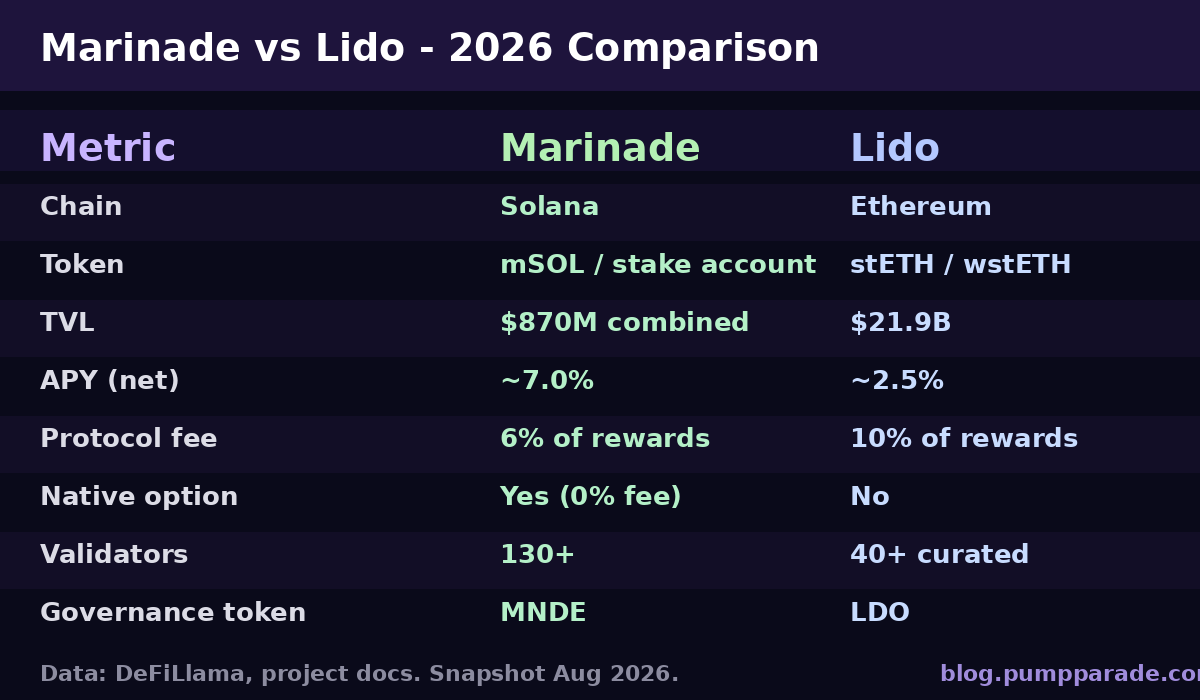
Marinade launched in August 2021 as the first liquid staking protocol on Solana. Today it offers two products: Marinade Liquid, the original mSOL token, and Marinade Native, a non-custodial native staking product introduced in 2023 that stakes directly to validators without wrapping the position in an LST token. Combined TVL is around $870 million as of August 2026, split roughly $620M in the liquid pool and $250M in native, according to DeFiLlama.
Marinade's edge on Solana is its validator selection algorithm. It automatically stakes across 130+ vetted validators, prioritizing performance, decentralization, and MEV revenue capture. That routing is why Marinade's realized APY consistently beats simple staking with a single validator.
Governance token: MNDE. It is used for validator delegation strategy votes and protocol parameter changes. It is not required to use the product.
Lido Overview
Lido launched in December 2020 and has been the dominant Ethereum liquid staking protocol ever since. It currently holds around $21.9 billion in TVL, roughly 50 percent of all ETH liquid staking, and stETH is one of the most widely integrated assets in DeFi. You can supply it on Aave, use it on Curve, wrap it into wstETH for cross-chain deployment, or hold it in almost any Ethereum wallet.
Lido uses a curated set of professional node operators, currently around 40, selected by the Lido DAO. That concentration is Lido's biggest ongoing criticism (see the Security section below), but it is also why the operational track record is strong: no slashing events large enough to materially dent stETH value.
Governance token: LDO. It controls the node operator set, fee changes, and treasury spending. Like MNDE, it is optional for users.
Fees and Real Yield
Fees on liquid staking sound small until you compound them over years. Marinade takes 6 percent of staking rewards. Lido takes 10 percent, split evenly between node operators and the DAO treasury. Both fees are already deducted from the APY you see on their dashboards, but the raw number matters because it directly determines how much of the underlying chain's issuance flows to you.
Here is what that looks like today:
- Marinade Liquid (mSOL): ~7.0 percent net APY
- Marinade Native: ~7.5 percent net APY (0 percent protocol fee, only validator commissions)
- Lido stETH: ~2.5 percent net APY
The APY gap is mostly a function of the underlying chain, not the protocol. Solana's inflation schedule and MEV yield are higher than Ethereum's. But even chain-adjusted, Marinade's lower fee gives it a meaningful edge over what Lido would earn on a per-dollar basis.
Comparison Table
Pros and Cons
Marinade
Pros:
- Highest realized APY of any major Solana LST, thanks to validator selection and MEV capture
- Lower fee (6 percent) than every direct competitor
- Marinade Native offers 0 percent protocol fee for users who do not need the mSOL receipt token
- Broad DeFi integrations across Kamino, marginfi, Drift, Orca, and Raydium
- Non-custodial by design; you keep control of your validator delegation in Native mode
Cons:
- mSOL trades at a small discount to SOL during volatile periods, sometimes 20 to 50 basis points
- Solana LST market is more fragmented, so mSOL liquidity is thinner than stETH
- Jito's JitoSOL has taken meaningful market share and is a real competitor for validator-level MEV
Lido
Pros:
- Deepest liquidity of any staking derivative in crypto; stETH is a de-facto ETH equivalent in DeFi
- Integrated in nearly every major Ethereum protocol: Aave, Compound, Curve, Balancer, Morpho
- wstETH wrapper enables clean use on L2s (Arbitrum, Optimism, Base) and other rollups
- Long operational track record with no material slashing losses
- Institutional-grade infrastructure and audit history
Cons:
- 10 percent fee is the highest among major ETH LSTs (Rocket Pool is 14 percent but distributes differently, Frax and others are lower)
- Node operator concentration; the DAO controls a small, curated set which raises centralization concerns
- stETH depeg risk during severe market stress (see May 2022 for a historical example)
Security and Trust
Marinade has been live since August 2021 with no exploits. It is audited by Kudelski, Ackee, and Neodyme, three respected Solana-specialized firms. Marinade Native, launched in 2023, does not custody your SOL at all; the protocol just routes your stake to validators, which meaningfully reduces smart contract surface area. Governance is decentralized through the MNDE token.
Lido is one of the most-audited protocols in DeFi, with reviews by Sigma Prime, MixBytes, StateMind, Certora, and Oxorio. It has been live since late 2020 with no material exploits on the core staking contract. The primary security concern is not smart contract risk but validator-set centralization: because the DAO chooses node operators, a governance capture attack could theoretically direct staking behavior. This has been the subject of intense community debate for years, and Lido has taken steps to add DVT (distributed validator technology) to reduce single-operator risk.
User Experience
Marinade's app is clean and simple. Connect a Phantom, Backpack, or Solflare wallet, deposit SOL, receive mSOL. Or choose Marinade Native for validator delegation without a wrapper token. Unstaking is either delayed (about two days to redeem SOL) or instant via a small fee that routes through the mSOL/SOL pool. Mobile support is fine through wallet browsers.
Lido's app is minimal, arguably the most minimal in DeFi. Connect an EVM wallet (MetaMask, Rabby, Ledger), deposit ETH, receive stETH. The wstETH wrapping flow is one extra click. Unstaking has a queue that has been running under a week in normal conditions but can extend during high withdrawal periods. Mobile support is excellent via WalletConnect.
Both are functionally boring in the best way. Deposits and withdrawals are the whole product.
Which Chain, Which Protocol
The framing you should use is not "Marinade or Lido" but "what am I optimizing for."
Use Marinade if: you hold SOL and want yield that composes with Solana DeFi. If you do not need the receipt token and just want to stake, use Marinade Native for the zero-fee experience.
Use Lido if: you hold ETH and want the LST with the deepest liquidity and broadest integration set. If the 10 percent fee bothers you and you can tolerate a smaller network of node operators, look at Rocket Pool or Frax as alternatives.
Use both if: you diversify across ETH and SOL and want the market-leading LST on each chain. That is actually the most common answer among sophisticated on-chain users.
Verdict
Marinade wins on its home turf because Solana's economics favor it and because it has quietly kept fees below competitors while adding a genuinely differentiated Native product. Lido wins on Ethereum because ecosystem depth is the whole game at that scale, and no one is close on integrations or liquidity. Neither protocol is trying to eat the other's market, and that is why both are still the answer in their respective chains four to six years after launch.
If you are picking one to start with today, follow the token you already hold. Do not bridge to chase yield. The extra one to two percent APY difference between chains does not compensate for bridge risk and slippage. Stake where your capital already lives.
FAQ
Is mSOL always worth the same as SOL?
No. mSOL accrues yield, so 1 mSOL is worth slightly more than 1 SOL and that ratio grows over time. In stressed markets mSOL can briefly trade at a discount to its underlying value in secondary markets, but the redemption ratio through Marinade itself is always fair.
Is stETH the same as ETH?
Not exactly. stETH is a receipt token that represents staked ETH plus accrued rewards. Its price tracks ETH closely, and it is redeemable 1:1 for ETH through Lido's withdrawal queue, but in secondary markets it can trade at a small discount. Most DeFi protocols price stETH at its redemption value.
Can I lose money staking with these protocols?
Yes, in a few scenarios: smart contract exploit (low probability but nonzero), severe validator slashing (mitigated by curation and diversification), or secondary-market depeg during a crisis. For everyday holders the risk profile is comparable to holding the underlying asset.
Why is Solana's staking APY so much higher than Ethereum's?
Solana has higher inflation and captures more MEV revenue relative to its staked supply. That is a chain-level design choice, not a protocol advantage. Ethereum's lower yield reflects a much larger and more mature staked base.
Do I need to hold MNDE or LDO to use these products?
No. They are governance tokens, not required for staking. You only need them if you want to vote on protocol decisions.