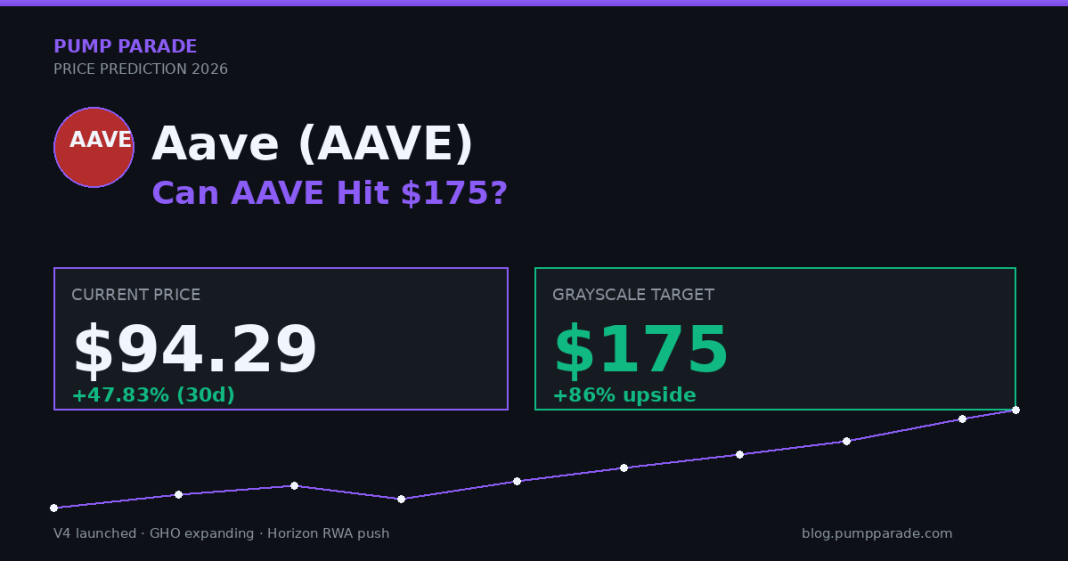
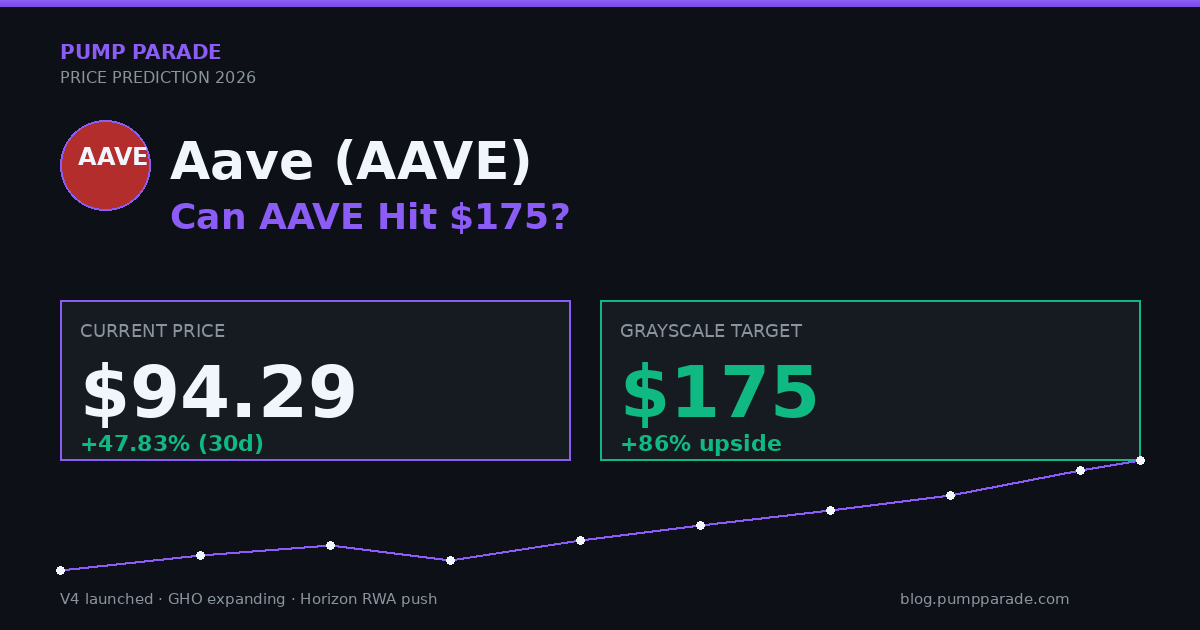
Every Aave price prediction 2026 model has been rewritten in the last six weeks, and for good reason. AAVE trades near $94.29 as of July 7, 2026, up 47.83% over 30 days and 5.9% on the week. In a market where ETH is still trying to reclaim $1,800 and most large caps are bleeding, that kind of relative strength is worth stopping for.
The move is not random. Aave V4 went live on Ethereum mainnet on March 30, 2026, deposits into the new hub-and-spoke architecture crossed $200 million in three months, and Grayscale just tagged AAVE as “undervalued” with a one-year target of $175. Horizon is quietly onboarding institutional RWA borrowers, and GHO has expanded to roughly $583 million.
This is a full Aave price prediction 2026 breakdown: where the token stands today, what is driving the rally, the bull and bear cases, timeframe targets, and the triggers that would change the thesis. Data and argument, no hopium.
Key Takeaways
- Current price: AAVE trades at $94.29, up 47.83% in 30 days and down 85.8% from its 2021 all-time high of $661.69.
- V4 catalyst is real: Aave V4 has crossed $200M in deposits three months post-launch. TVL across all versions sits near $14.5B after peaking above $30B late in 2025.
- Grayscale target: Fair value modelled at $80 to $100, with a $175 bull case tied to clearer RWA regulation. That is a 133% upside from mid-2026 levels if the bull path plays out.
- GHO and Horizon are the flywheel: $583M GHO supply plus $501M average TVL on Horizon push protocol revenue toward Grayscale’s $60M full-year estimate.
- Base case for end-2026: $110 to $145 range if V4 migration continues and macro cooperates. Bear case is a retest of $65. Bull case is a full re-rating into the $175 to $200 zone.
- Biggest risk: DeFi lending is commoditising. Morpho, Spark, and Compound are all fighting for the same deposit share. Aave has the brand and the balance sheet, but that gap is narrower than it looks.
Where AAVE Stands Today
Before making price predictions, look at the actual numbers. This is the AAVE snapshot as of July 7, 2026.
| Metric | Value |
|---|---|
| Price | $94.29 |
| 24h change | +3.55% |
| 7-day change | +5.90% |
| 30-day change | +47.83% |
| 1-year change | -67.07% |
| Market cap | $1.43B |
| Market cap rank | #54 |
| 24h volume | $285M |
| Circulating supply | 15.18M AAVE |
| Max supply | 16M AAVE |
| All-time high | $661.69 (May 2021) |
| % from ATH | -85.8% |
The 30-day move stands out. Most large-cap DeFi tokens are flat to negative over the same window. AAVE is up almost 48%. That usually means a catalyst is being priced in or a large buyer is accumulating. Here it is both. Grayscale published the $175 report on June 20, and on-chain data from DeFiLlama shows deposits into V4 keep accelerating through Q2.
Also worth noting: AAVE has a hard 16 million supply cap and 94.9% of that is already circulating. There is no meaningful inflation overhang. Every new dollar of protocol revenue lands on a fixed float.
Why is AAVE Rallying Right Now?
Three things converged at once. First, product: V4 shipped on schedule, which almost never happens in DeFi. Second, narrative: Grayscale published a report modelling AAVE with discounted cash flow, not vibes. Third, mechanics: Aave activated Umbrella, a new staking system that replaces the Safety Module and makes protocol revenue capture cleaner for AAVE holders.
Layered on top is the wider RWA narrative. Tokenised treasuries and credit funds are the fastest-growing crypto sub-category by TVL, and Aave Horizon is one of the few permissioned venues asset managers can actually use. When BlackRock’s BUIDL and JPMorgan’s Kinexys show up as counterparties, DeFi stops being a hobby.
The counter-signal: AAVE is still 85.8% below its 2021 peak. This rally is a bounce off a multi-year base, not a breakout to new highs. Whether the base holds is the whole question.
The Bull Case
Aave V4 Hub-and-Spoke Architecture Is Working
V4 is the biggest structural change Aave has made since launch. The hub-and-spoke design centralises liquidity into one main pool per network and lets specialised spokes plug in for fixed-rate credit, isolated pools for exotic collateral, and permissioned institutional pools. In plain terms, Aave can add features and asset classes without diluting the safety of the core pool.
The early data supports the design. Deposits into V4 crossed $200M in three months, per The Defiant. Total protocol TVL is $14.5B. Grayscale’s model assumes V4 keeps total TVL in the $15B to $20B range through year-end, which anchors the $80 to $100 base case.
GHO Stablecoin Is a Revenue Machine
GHO is Aave’s overcollateralised stablecoin. Users mint GHO by locking assets and paying a borrow rate. The protocol collects the spread as revenue. It is a native stablecoin that doubles as an interest-bearing product for the DAO.
Supply is around $583 million, up from $514M in March. Every dollar of GHO in circulation is a dollar earning yield for the Aave treasury. If GHO grows into a $1B to $2B stablecoin over the next 12 months (still small versus DAI or USDe), the revenue impact scales linearly. Combined with V3’s ~$73M in trailing 30-day fees, protocol revenue could clear $200M annualised by late 2026.
Horizon Turns Aave Into Institutional Plumbing
Aave Horizon is the permissioned RWA market. Average institutional loan size is $1.118M, roughly 16x the protocol average. Average TVL sat at $501.55M in March 2026 with about $550M in net deposits. Horizon is targeting more than $1 trillion in addressable institutional assets.
This is the piece Grayscale weighted heavily. Its $175 bull case assumes clearer regulation opens the RWA floodgates. If even 1% of that $1T market ends up on Horizon rails, that is $10B in incremental TVL. Enough alone to justify the base-case fair value.
The Bear Case
DeFi Lending Is Commoditising
Aave is not the only game in town. Morpho, Spark, Euler, and Compound are fighting for the same deposits, and Morpho in particular has grown aggressively by offering isolated markets and better supplier rates. When lending is a race to the tightest spread, incumbents lose pricing power. Aave still leads on brand and integrations, but the moat is narrower than the market cap suggests.
The bear case is not that Aave disappears. It is that Aave grows TVL 20% while a competitor grows 200%, and the multiple compresses. That is how Grayscale’s $65 to $80 downside scenario plays out.
Macro and Regulatory Headwinds Are Still Live
ETH sits at $1,781 and BTC at $63,359. Neither has reclaimed key resistance. If crypto beta rolls over in H2 2026, DeFi tokens will not be immune. AAVE’s 30-day rally is partly a rotation trade, and rotation trades unwind fast when risk appetite turns.
On regulation, the $175 target explicitly requires “clearer legal frameworks around tokenised real-world assets.” That is a US-specific catalyst that has been “18 months away” for three years. If it slips again, the bull case slips with it.
Governance Is a Real Concern
Aave has had a bumpy governance year. Disputes over the fee switch, Umbrella parameters, and cross-chain deployments. Nothing catastrophic, but active DAO participation has dropped and voter apathy has crept in. In a system where the token earns revenue via governance decisions, a distracted DAO is a valuation drag.
AAVE Price Prediction 2026: Targets by Timeframe
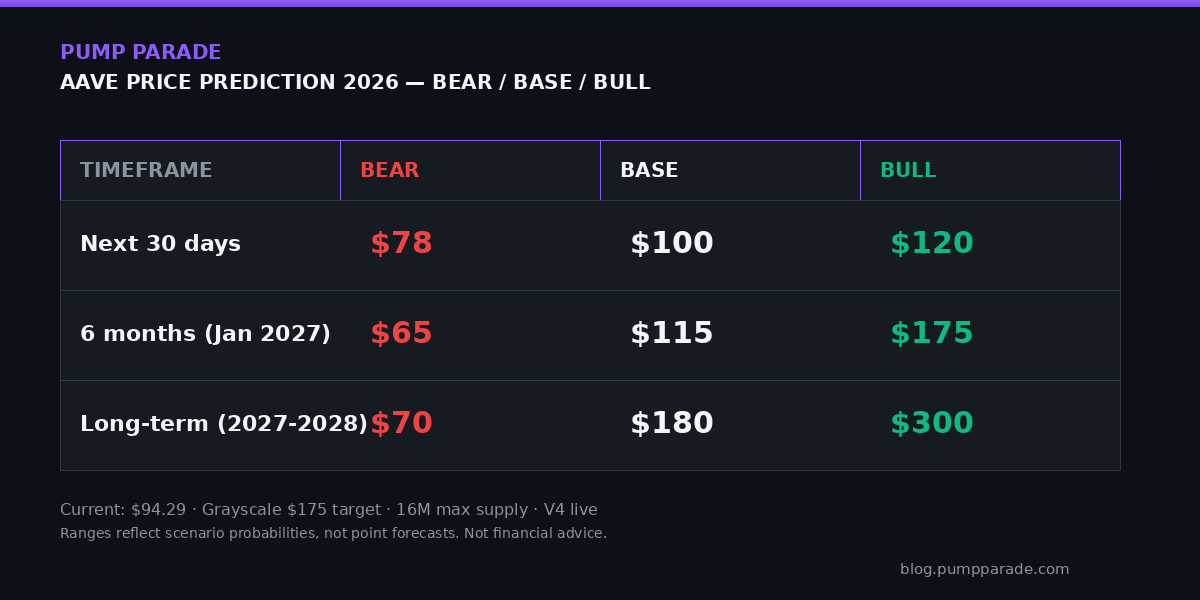
Below are our AAVE price prediction targets for the rest of 2026, broken out by timeframe. Ranges reflect scenario probabilities, not point forecasts. We show the bear, base, and bull cases and note the conditions each requires.
| Timeframe | Bear | Base | Bull |
|---|---|---|---|
| Next 30 days | $78 | $100 | $120 |
| 6 months (Jan 2027) | $65 | $115 | $175 |
| Long-term (2027-2028) | $70 | $180 | $300 |
30-Day Outlook: $78 to $120
The near-term chart favours consolidation, not a vertical extension. After a 48% run, daily RSI has printed above 65 for two weeks. A pullback to $85 or even $78 (the 30-day moving average) would be normal, not bearish. Base case is a hold around $95 to $105 as V4 migrates liquidity and the protocol preps its Q3 governance calendar.
6-Month Outlook: $65 to $175
By January 2027, three things will be knowable: the pace of V4 adoption, whether GHO has broken $1B, and whether US RWA rules have moved forward. If all three land positively, Grayscale’s $175 becomes the anchor. For context: Changelly forecasts an average of $266 for 2026, CoinCodex models $110 to $140. Our base case splits the difference around $115.
Long-Term (2027-2028): $70 to $300
Long-term AAVE targets hinge on whether Aave becomes the “AWS of on-chain credit” or gets outpaced by Morpho, an institutional CeDeFi player, or a new architecture. In the bull scenario (Aave is the default RWA lending venue and GHO clears $3B), $300 is defensible on standard fintech multiples. In the bear scenario (V4 stalls, competitors take share), a slow bleed to $70 is what a saturating market looks like.
How Does AAVE Compare to Compound and Morpho?
Aave sits inside a competitive DeFi lending market. Here is how it stacks up against its two closest peers on the metrics that actually matter.
| Metric | Aave (AAVE) | Compound (COMP) | Morpho (MORPHO) |
|---|---|---|---|
| Price | $94.29 | ~$38 | $2.01 |
| Market cap | $1.43B | ~$340M | $1.30B |
| TVL | ~$14.5B | ~$1.6B | ~$4.5B |
| Native stablecoin | GHO ($583M) | None | None |
| Institutional product | Horizon | Compound III institutional | Morpho Blue vaults |
| Governance activity | High but contentious | Low | High and pragmatic |
| Chain coverage | 13+ chains | 7 chains | Ethereum plus Base |
The read: Aave leads on TVL, chain coverage, and product surface. Morpho leads on capital efficiency and momentum. Compound is a legacy player struggling to keep up. If DeFi consolidates around 2 or 3 winners next cycle, Aave is one of them. If the market fragments across specialised protocols, AAVE’s premium multiple gets pressure tested.
What Would Change Our View?
Three specific scenarios would force us to rewrite this article.
1. AAVE breaks and holds above $130. That would confirm the current move is not a bounce, it is a trend reversal, and it would open the door to the Grayscale $175 target on a faster timeline than base case.
2. A meaningful US RWA rule ships. Something concrete from Congress or the SEC that gives banks and asset managers a clear path to tokenise. That is the single biggest unlock for Aave Horizon and the whole DeFi lending stack.
3. Morpho or a new challenger takes 20% of Aave’s TVL in 90 days. That would signal that the moat is more fragile than the market currently prices in, and would push us toward the $65 bear case.
Frequently Asked Questions
Is Aave a good investment in 2026?
AAVE offers exposure to one of the most established DeFi protocols with a real product moat, a working revenue model, and a clear institutional angle via Horizon. That makes it a credible large-cap DeFi holding. It is not a low-risk asset. Whether it is “good” depends on your horizon and risk tolerance. The setup favours patient buyers, not traders chasing the last leg.
Will AAVE reach $175 in 2026?
Grayscale’s $175 target is a bull case. It assumes clearer US regulation on tokenised RWAs, continued V4 migration, and GHO growing past $1B. If all three align in 12 months, $175 is achievable. If any slip, $110 to $130 is a more realistic year-end range. Probability favours the base case.
What is the Aave V4 upgrade?
Aave V4 is a redesigned protocol architecture that launched on Ethereum mainnet on March 30, 2026. It uses a “hub-and-spoke” model: one main liquidity pool per network, with specialised spokes for fixed-rate credit, RWAs, and permissioned institutional pools. Deposits crossed $200M in three months. The design lets Aave scale without fragmenting liquidity.
Why has AAVE gone up 48% in 30 days?
Three catalysts converged: Aave V4 shipping on time and hitting deposit milestones, Grayscale publishing a $175 fair-value report, and Umbrella staking going live. Combined with a rotation into DeFi tokens after months of underperformance, that pulled AAVE out of a multi-year base.
Is AAVE undervalued?
Grayscale’s model puts fair value between $80 and $100 using cash flow discounting and 20x to 25x multiples on projected 2026 revenue near $60M. AAVE trades near the top of that base range. Not obviously cheap, not obviously expensive. Upside requires revenue compounding faster than the model assumes, which depends on Horizon adoption and GHO growth.
How does AAVE compare to Compound and Morpho?
Aave leads on TVL, chain coverage, and product breadth. Morpho leads on capital efficiency and growth rate. Compound is losing ground on both. In a market that consolidates around 2 or 3 winners, Aave is one. In a fragmented outcome, Aave keeps the brand but loses margin.
The Honest Take
AAVE has the cleanest fundamental setup in DeFi lending right now. Working V4, growing stablecoin, institutional product, fixed 16M cap, and a respected sell-side analyst with a specific price target. That is a lot of catalysts stacked in one direction.
The problem is that the market knows this. The 48% run in 30 days is the setup being priced in, not missed. Chasing here means paying for a story already partly in the tape. Better trade: patience. Watch for a pullback to $80 to $85, watch V4 migration through Q3, watch Horizon for actual institutional loan volume. If those three trend up, the base case pays. If any wobble, the trade unwinds fast.
For long-term holders, the story is more compelling. Aave is one of maybe three DeFi protocols that will still matter in five years. AAVE at $95 with $175 upside and $65 downside is not bad risk-reward. Sizing matters more than timing. Do not confuse a 48% rally with a permission slip to chase.
Related reading on Pump Parade: our take on the Aave Review 2026: Fees, Features and Verdict, our Ondo (ONDO) Price Prediction 2026 for the wider RWA thesis, and our Uniswap (UNI) Price Prediction 2026 as a DeFi blue-chip comparison.
Disclaimer: This article is for informational and educational purposes only and should not be construed as financial, investment, or trading advice. Cryptocurrency markets are highly volatile, and past performance does not guarantee future results. The price predictions and analyses presented here are based on AI models, technical indicators, and available data at the time of writing. They are not guarantees. Always conduct your own research (DYOR) and consult with a qualified financial advisor before making any investment decisions. Pump Parade and its authors do not assume liability for financial losses incurred based on information provided in this article.