Picking between Kraken and Bitget is one of those choices that looks simple until you actually try to do it. Both are tier-one centralized exchanges. Both have been around long enough to mean something. Both will happily take your USDT. But they sit at opposite ends of the spectrum: Kraken is the conservative, US-regulated veteran built around security and Pro-grade tools, while Bitget is the aggressive, derivatives-heavy newcomer that has quietly become the largest copy trading venue in the world.
In this 2026 head-to-head we break down fees, supported coins, security posture, regional access, and the features that actually matter when you are choosing a primary exchange. By the end you will know exactly which one fits your style.
Quick Verdict (TL;DR)
Choose Kraken if: you are a US trader, you prioritize regulatory clarity and security, or you want a no-nonsense spot exchange with deep liquidity on majors.
Choose Bitget if: you live outside the US, you want lower default spot fees, you trade derivatives, or you want to follow elite copy traders from inside a single account.
For most non-US traders we lean Bitget on pure value and product breadth. For US traders or anyone who treats an exchange like a bank, Kraken is the safer pick. Read on for the full breakdown.


Kraken Overview
Kraken launched in 2011 out of San Francisco and is one of the longest-running crypto exchanges in continuous operation. It serves clients in 190+ countries, supports more than 500 cryptocurrencies, and is regulated across multiple US states as well as in the UK, the EU and Australia.
The big selling point has always been the same: Kraken has never suffered a platform-wide hack across its 14+ year history, which is a claim very few exchanges can make. The platform offers spot trading, margin, futures, on-chain staking, NFTs, and a separate Pro interface with full order-book depth and advanced order types.
Bitget Overview
Bitget launched in 2018 and is now headquartered in Seychelles. It serves users in over 150 countries (with the notable exception of the United States) and lists more than 1,300 cryptocurrencies, including a long tail of new-issue tokens that Kraken will not touch.
Bitget’s identity in 2026 is built around two things: derivatives and copy trading. It hosts more than 190,000 verified elite traders with 800,000+ followers and has processed over 100 million copy trades. It also runs a $300 million on-chain Protection Fund, one of the largest insurance pools in the industry, and publishes monthly Proof-of-Reserves reports.
Features Deep Dive
Spot Trading
Both exchanges cover the spot basics well, but the experience is different. Kraken splits its product into a friendly retail app and Kraken Pro, which is where serious traders actually live. Pro gives you full order books, advanced order types (stop-limit, trailing stop, OCO, iceberg), TradingView charts, and conditional close orders.
Bitget runs a unified interface that already includes a Pro-style trading view by default, plus a Unified Trading Account that lets one balance act as collateral across spot, margin and futures. If you bounce between products, that single-account model is genuinely useful.
Derivatives
This is where the gap widens. Bitget is, first and foremost, a derivatives exchange. It offers USDT perpetuals, coin-margined perpetuals, and now CFD copy trading across forex, commodities and indices. Leverage on crypto perps goes up to 125x on majors. Daily derivatives volume regularly exceeds $10 billion.
Kraken offers futures too, but the product is narrower, leverage is capped lower (50x on majors), and the focus is clearly on regulated, institutional-friendly access rather than the kind of high-leverage degen trading Bitget caters to.
Copy Trading
Bitget effectively invented modern crypto copy trading as a first-class product, and it shows. You browse a leaderboard of elite traders ranked by ROI, drawdown, win rate, and follower P&L. Click follow, set your allocation, and your account mirrors their trades in real time. Profit-sharing fees range from 8% to 10% of profits paid to the lead trader.
Kraken does not currently offer native copy trading. If that workflow matters to you, Bitget wins by default.
Staking and Earn
Kraken offers on-chain staking on roughly 20+ assets (SOL, ETH, ADA, DOT, ATOM and others), with rewards paid out twice weekly. Yields on major proof-of-stake assets sit roughly in line with native network rates. US users have lost access to some staking products following past SEC settlements, so check your region.
Bitget runs PoolX, Launchpool and Shark Fin structured products alongside flexible and locked savings. Yields on stablecoins tend to be higher than Kraken’s, but the products are also more variable and less standardized.
Mobile Apps
Both apps are polished. Kraken Pro mobile is one of the cleaner pro-grade trading apps in the market and is the same product as desktop. Bitget’s mobile app is the most-used surface on the platform and ships frequent updates, including in-app copy trading management, which is hard to find anywhere else.
Fees and Pricing
On paper Bitget is dramatically cheaper for new traders. Default spot fees on Bitget are 0.10% maker / 0.10% taker versus Kraken’s entry tier of 0.25% maker / 0.40% taker. That is more than 2x the cost on Kraken before any volume discounts.
The picture changes at higher volumes. Both exchanges drop fees aggressively as 30-day volume climbs:
- Kraken top tier: 0.00% maker / 0.05% taker (requires >$10M monthly volume on the public schedule; institutional desks can do better).
- Bitget VIP7: 0.00% maker / 0.030% taker, falling to 0.024% taker for BGB token holders.
For futures, Bitget charges 0.020% maker / 0.060% taker on USDT perps at the standard tier. Kraken Futures is broadly competitive but most retail users will find Bitget’s schedule lower out of the gate.
Hidden costs to watch: Kraken’s instant-buy widget (the simple buy/sell flow inside the app) applies a 1.5% convenience fee plus a 0.9% spread for stablecoins or 1.5% for crypto, which adds up fast if you do not use Pro. Bitget’s “Quick Buy” similarly carries a wider spread than the order book. In both cases, the fix is to use the actual trading interface rather than the one-click buy flow.
Comparison Table
Here is the head-to-head at a glance:
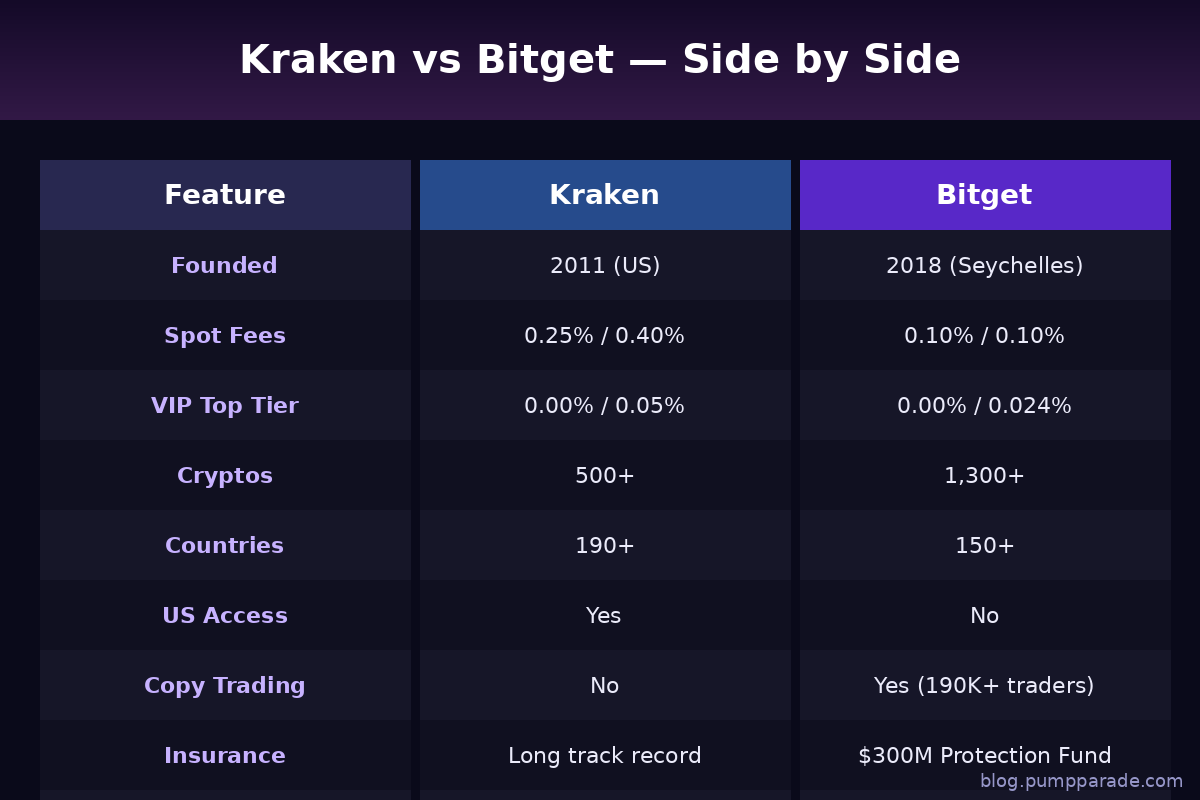
And in full text form:
| Feature | Kraken | Bitget |
|---|---|---|
| Founded | 2011 (San Francisco) | 2018 (Seychelles) |
| Spot fees (entry tier) | 0.25% / 0.40% | 0.10% / 0.10% |
| Spot fees (top tier) | 0.00% / 0.05% | 0.00% / 0.024% |
| Cryptos listed | 500+ | 1,300+ |
| Countries supported | 190+ | 150+ |
| US access | Yes (most states) | No |
| Max leverage (perps) | 50x | 125x |
| Copy trading | No | Yes (190K+ elite traders) |
| Insurance / Protection | No platform-wide hack since 2011 | $300M Protection Fund |
| Proof of Reserves | Yes (semi-annual Merkle audits) | Yes (monthly) |
| Native token | None | BGB (20% fee discount) |
Security and Trust
Kraken’s pitch is simple: a 14+ year track record with no platform-wide hack. The company holds the bulk of customer assets in air-gapped cold storage, runs continuous third-party security audits, and publishes semi-annual Merkle-tree Proof-of-Reserves attestations. It is also one of the few exchanges that maintained operational continuity through every major crypto winter without freezing withdrawals.
Bitget’s security model is more modern: $300 million on-chain Protection Fund, monthly Proof-of-Reserves with collateralization typically above 150% on top assets, cold-wallet majority storage, mandatory 2FA, and withdrawal whitelists. It does not have Kraken’s decade-plus track record, but it has not suffered a major exchange-level breach either.
Net: both pass the “would I keep meaningful balances here” test. Kraken edges Bitget on raw history and regulatory standing; Bitget edges Kraken on transparency cadence and the size of its explicit insurance pool.
User Experience
Kraken is the better choice for traders who want clean, conservative tooling and don’t need a dozen tabs of products. Kraken Pro’s charting, hotkeys, and order workflow are first-rate. The downside is the split between the simple app and Pro, which can confuse beginners about which they should actually be using.
Bitget’s UI is busier. There is more product to expose: spot, margin, perps, copy trading, launchpad, earn, P2P, and a Web3 wallet. Once you adjust to it, the unified account model is a real ergonomic win, especially if you frequently move between spot and perps. The mobile app in particular is best-in-class for derivatives.
Pros and Cons
Kraken
Pros:
- 14+ years with no platform-wide hack
- Regulated in the US, UK, EU, Australia
- Excellent Pro trading interface
- Deep liquidity on major pairs
- Transparent, no-token business model
Cons:
- Higher default spot fees
- Smaller coin selection (500 vs 1,300)
- No copy trading
- Confusing split between Kraken and Kraken Pro
- US users have reduced staking access
Bitget
Pros:
- Lower default spot fees (0.10% flat)
- 1,300+ tokens including long-tail listings
- Best-in-class copy trading product
- $300M Protection Fund
- Unified Trading Account across spot, margin, perps
Cons:
- Not available in the US
- Younger track record (since 2018)
- Aggressive UI can overwhelm beginners
- High leverage products invite risk
- BGB token tied into fee discounts adds complexity
Verdict and Use-Case Ratings
Best for US traders: Kraken. There is no contest here because Bitget does not serve US customers. If you want Bitget-style features in the US, look at Coinbase Advanced or wait for compliant alternatives.
Best for low-fee spot trading: Bitget. The flat 0.10% schedule beats Kraken’s default fees by a wide margin, and Bitget’s top tier is also slightly cheaper.
Best for derivatives traders: Bitget. Deeper futures liquidity, higher leverage, and a more complete product surface.
Best for copy trading: Bitget. Kraken does not compete in this category at all.
Best for security-first long-term storage: Kraken. The longer track record and regulatory clarity matter when you are holding for years rather than weeks.
Best for altcoin hunters: Bitget. With more than 1,300 listings and a launchpad, you will find tokens here that Kraken simply does not list. If your alt-hunting also extends to Solana memecoins, you may want to pair an exchange with a dedicated bot. Our Photon vs BullX comparison covers the on-chain side.
Overall: For non-US traders, Bitget is the better all-rounder in 2026 thanks to lower fees, broader product range, and the copy trading moat. For US users and security-conscious holders, Kraken remains the safest pick. Many active traders end up using both: Kraken for cold-stored majors, Bitget for active trading and altcoin exposure.
Ready to open an account? Visit Kraken or Visit Bitget to see current promotions and fee schedules in your region.
FAQ
Is Bitget available in the US?
No. Bitget does not accept US-based customers and geo-restricts access. Using a VPN to bypass this is a violation of terms of service and could result in account closure or seizure of funds.
Is Kraken or Bitget cheaper?
For most retail traders, Bitget is meaningfully cheaper out of the gate (0.10% flat versus Kraken’s 0.25% / 0.40% entry tier). At very high volumes the two converge, with Bitget VIP7 still slightly cheaper than Kraken’s top public tier.
Which exchange has better security?
Kraken has the longer track record (no platform-wide hack since 2011) and stronger regulatory positioning. Bitget has a larger explicit insurance pool ($300M Protection Fund) and more frequent Proof-of-Reserves reporting. Both are in the top tier of CEX security in 2026.
Can I copy trade on Kraken?
No. Kraken does not offer native copy trading. If copy trading is important to you, Bitget is the obvious pick, with 190,000+ elite traders and 800,000+ followers on the platform.
Which has more coins listed?
Bitget lists 1,300+ cryptocurrencies versus Kraken’s 500+. Bitget’s listings include more new-issue and long-tail altcoins, which is a feature if you trade them and a risk if you don’t.
For more reviews and head-to-heads of the platforms shaping crypto in 2026, browse the rest of the Pump Parade reviews section. We publish a new review or comparison twice a week.