If you’ve ever swapped tokens on-chain and wondered whether you actually got a fair price, you’ve already met the problem that DEX aggregators were built to solve. They scan dozens of pools across multiple decentralized exchanges, split your order, and route it for the best execution. Two names dominate that category in 2026: Jupiter, the undisputed king of Solana, and 1inch, the long-running heavyweight of Ethereum and EVM chains. Both have evolved far beyond simple swap routers. So which one should you actually use this year?
This in-depth comparison breaks down fees, supported chains, MEV protection, UX, security, and real volume data so you can pick the right aggregator for your wallet, your size, and your chain.
Quick Verdict (TL;DR)
- Best for Solana traders: Jupiter wins by a mile. Lowest all-in cost, deepest Solana liquidity, and a full DeFi superapp around the swap router.
- Best for EVM users and large size: 1inch still has the deepest Ethereum and L2 liquidity, plus Fusion mode that makes swaps gasless and MEV-resistant.
- Cross-chain power user: 1inch added native Solana support in 2025, so it’s the more flexible single dashboard if you trade across ecosystems.
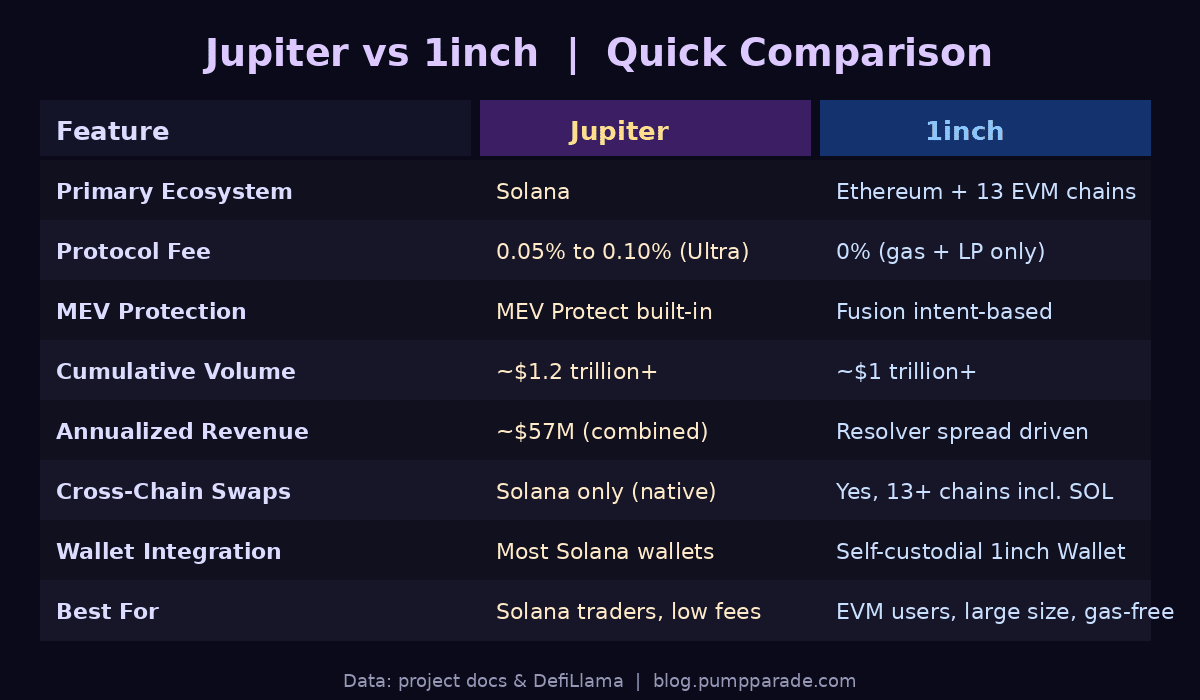
- Lowest sticker fee: 1inch dApp charges 0% protocol fee. Jupiter Ultra charges 5 to 10 bps. But total cost depends on chain gas, slippage, and MEV, not just the headline fee.
Verdict: Jupiter for Solana. 1inch for everywhere else. If forced to pick one tool for 2026, Jupiter has the stronger product velocity and the cheaper overall execution, but only if you live on Solana.
Product Overviews
Jupiter: Solana’s DeFi Superapp
Jupiter launched in October 2021 as a humble swap router and has since grown into the most important application on Solana. It handles roughly 95% of all aggregator volume on the network and well over half of total Solana DEX volume. Cumulative aggregator volume has now crossed $1.228 trillion.
What used to be a single swap page is now a full DeFi stack: Ultra mode aggregation, limit orders, DCA and value averaging, perpetuals with leverage up to 250x on select pairs, a lending market (Jupiter Lend), liquid staking (JupSOL), a native stablecoin (JupUSD), and integrated prediction markets via a Polymarket partnership that went live in February 2026. Combined annualized revenue across these surfaces sits near $57M, with TVL across the broader ecosystem in the multi-billion range when you add Jupiter Lend, JupSOL, and the perps exchange together.
For the average trader, the key piece is the swap interface at jup.ag, which routes orders across every meaningful Solana DEX including Raydium, Orca, Meteora, Phoenix, Lifinity, and dozens more.
1inch: The EVM Aggregator Standard

1inch launched in 2019 and has spent six years building what might be the most battle-tested aggregator stack in crypto. By 2026 it has processed over $1 trillion in cumulative volume across Ethereum, BNB Chain, Polygon, Arbitrum, Optimism, Base, Gnosis, and several more, plus a fresh native Solana integration that lets users swap between Solana and EVM chains without using a separate bridge.
The product surface is broad: the classic Aggregation Protocol (Pathfinder), Fusion (intent-based gasless swaps), Fusion+ (cross-chain intents), a Limit Order Protocol that powers conditional and TWAP orders, a self-custodial mobile wallet, a portfolio tracker, and 1INCH-token-governed parameters.
Volume has cooled in 2026. The flagship Aggregation Protocol saw a 60.3% volume decline between December 2025 and March 2026, and 1inch slipped from the #1 to #4 aggregator by market share over the same window. Fusion has held up better, down only 26.5%, which is why 1inch is leaning hard into the intent-based mode.
Features Deep Dive
Jupiter’s Ultra Mode
Ultra is Jupiter’s flagship execution layer. Instead of a fixed routing algorithm, Ultra dynamically picks the best path across Solana pools and private market maker liquidity, then quotes a single all-in price. It also wraps in MEV Protect, which obfuscates orders so sandwich bots can’t see them in the public mempool. The user just clicks swap and pays a small dynamic fee, typically 5 to 10 basis points of the trade.
Beyond Ultra, Jupiter has Limit Order V2 (with front-running protection), DCA, Value Averaging, perps, and a developer API that powers a huge chunk of Solana frontends. If you’ve used Phantom’s in-wallet swap, you’ve used Jupiter underneath.
1inch’s Pathfinder and Fusion
Pathfinder is the original 1inch routing algorithm. It splits trades across multiple AMMs and PMM venues to minimize price impact, and is what 1inch is famous for. The 1inch dApp itself charges 0% protocol fee, so you pay only the underlying LP fees and gas.
Fusion takes a different approach. You sign an off-chain order, professional resolvers compete to fill it, and the winning resolver pays the gas on your behalf. This makes Fusion effectively gasless for the user and provides implicit MEV protection because the order is filled atomically against the resolver’s inventory. The trade-off: resolvers bake a small spread into the quoted output (usually a few basis points), so the “0% fee” headline is technically accurate but not the full story. Fusion+ extends the model to cross-chain swaps across 13+ networks in a single signed intent.
Fees and Pricing Comparison
Headline fees can mislead. What matters for traders is total cost: protocol fee + LP fee + gas + slippage + MEV loss. Here is how the two stack up.
Jupiter (Solana)
- Protocol fee: 5 to 10 bps on Ultra. 0% on legacy routing.
- LP fees: Vary by pool, typically 25 to 30 bps on Raydium/Orca v2 pools.
- Gas: Fractions of a cent on Solana. Effectively free.
- MEV cost: Near zero with Ultra’s MEV Protect.
1inch (Ethereum + EVM)
- Protocol fee: 0% on the dApp.
- LP fees: 5 to 30 bps depending on venue.
- Gas: Variable. Ethereum mainnet swaps still cost real money (often $5 to $30+). L2s like Base and Arbitrum bring this down to cents.
- Fusion spread: A few bps baked into the resolver quote. Gas is paid by the resolver, not you.
- MEV cost: Material on classic Aggregation Protocol if you don’t use Fusion. Negligible on Fusion.
In practice, Jupiter is almost always cheaper for trades under $10,000 because Solana’s base layer is so cheap. For very large EVM trades where you need to minimize slippage on illiquid pairs, 1inch’s deeper aggregated liquidity can sometimes win even after accounting for gas.
Comparison Table
Security and Trust
Both protocols have track records measured in years and trillions of cumulative volume, which is the strongest security signal you can get in DeFi. 1inch’s smart contracts have been audited by multiple top firms (OpenZeppelin, ABDK, MixBytes, Hacken) and have a public bug bounty. The protocol has never suffered a contract-level exploit on its core router.
Jupiter has been audited by OtterSec and Halborn across its various surfaces. The aggregator itself has run since 2021 without a protocol-level hack. Its newer products (Perps, Lend, JupUSD) have shorter track records but use audited code and have bounties in place.
One nuance worth flagging: both are non-custodial. You connect a wallet and sign transactions. Neither service can move your funds, freeze your account, or KYC you. That’s the entire point of DEXs. Counterparty risk is limited to smart contract risk on the routing contracts themselves, plus the underlying liquidity venues.
User Experience
Jupiter wins on speed. Solana finality is around 400ms, swaps confirm in roughly a second, and the UI is the cleanest in DeFi. It works with every major Solana wallet (Phantom, Solflare, Backpack, Glow) and has a slick mobile experience.
1inch is heavier but more feature-rich. The dApp at app.1inch.io handles multiple chains in one interface, and the 1inch Wallet (iOS and Android) is one of the better self-custodial mobile wallets if you live in the EVM world. The downside is that switching between chains and bridging assets still requires more clicks than Jupiter’s single-chain simplicity, and Ethereum gas spikes can make small trades feel painful.
Newcomers will probably find Jupiter easier. Power users will appreciate 1inch’s deeper feature set, especially Fusion+ for cross-chain.
Pros and Cons
Jupiter: Pros
- Cheapest all-in execution on Solana, period.
- Ultra mode + MEV Protect handle complexity for you.
- Full DeFi superapp (perps, lending, DCA, prediction markets).
- Used by virtually every Solana frontend, so liquidity is unmatched on the chain.
- Sub-second finality and near-zero gas.
Jupiter: Cons
- Solana only. No EVM swaps.
- 5 to 10 bps Ultra fee adds up for high-frequency strategies vs 0% legacy mode.
- JUP token volatility can make tokenomics noisy.
- Some newer products (JupUSD, prediction markets) are still maturing.
1inch: Pros
- 0% protocol fee on the dApp.
- Fusion mode is effectively gasless and resists MEV.
- Supports 13+ chains including Solana via cross-chain intents.
- Mature, audited stack with a six-year track record.
- Strong portfolio tracker and self-custodial wallet bundled in.
1inch: Cons
- Ethereum gas still hurts on small trades.
- Aggregation Protocol volume down 60% in Q1 2026; market share slipping.
- Fusion resolver spread is real cost not always obvious in the UI.
- More complex UX for newcomers.
Verdict and Use-Case Recommendations
There is no single right answer. The two products optimize for different worlds, and the smart move is to use both depending on the chain.
- Solana traders of any size: Use Jupiter. Ultra mode is the cheapest, fastest path to good execution on Solana, and the surrounding superapp gives you everything else you need without leaving the tab.
- EVM users with small to medium trades on L2s: Use 1inch Fusion. Gasless, MEV-resistant, and the resolver spread is competitive with anything else on EVM.
- Large EVM swaps ($10k+): Use 1inch classic Aggregation Protocol. Deepest liquidity, cleanest price impact.
- Cross-chain power users: 1inch Fusion+ is the cleanest single-signature cross-chain experience available right now, including Solana <> EVM.
- DeFi power user who wants one app: Jupiter, if you’re willing to commit to Solana as your home chain.
Rating: Jupiter 4.7/5. 1inch 4.4/5. Jupiter takes the slight edge in 2026 because of product velocity, lower friction, and dominant ecosystem position. 1inch remains the better tool the moment you leave Solana.
FAQ
Is Jupiter better than 1inch?
On Solana, yes. Jupiter has deeper liquidity, lower gas, and a more polished single-app experience. On EVM, 1inch is better because Jupiter does not operate there.
Does 1inch work on Solana?
Yes, as of 2025 1inch supports native Solana swaps and cross-chain intents between Solana and EVM via Fusion+. However, for Solana-only swaps, Jupiter’s native routing is still tighter.
Which has lower fees, Jupiter or 1inch?
1inch has a lower headline protocol fee (0% vs Jupiter’s 5 to 10 bps on Ultra). But once you factor in Ethereum gas, Jupiter is usually cheaper for trades under roughly $10,000. On L2s the gap narrows.
Are Jupiter and 1inch safe?
Both are non-custodial smart contract protocols with multiple audits, public bug bounties, and multi-year track records. Neither has suffered a router-level exploit. Standard DeFi caveats apply: smart contract risk and liquidity venue risk are non-zero.
What is the difference between Jupiter Ultra and 1inch Fusion?
Both are MEV-resistant execution modes, but they work differently. Ultra dynamically routes across Solana liquidity with built-in MEV protection and charges a small explicit fee. Fusion uses off-chain intents and competing resolvers who pay gas on your behalf and bake their spread into the price. Different mechanics, similar end goal: better execution without surprise sandwich attacks.
Related Reading on Pump Parade
- Raydium vs Orca: Best Solana DEX 2026. The two AMMs Jupiter routes most of its volume through.
- MetaMask vs Rabby: Best EVM Wallet 2026. Pair either with 1inch for the full EVM stack.
- Binance vs Coinbase: Best Crypto Exchange 2026. When you need a CEX before going on-chain.
Data sources: project documentation, DefiLlama (Jupiter Aggregator), and CoinGecko market data, as of June 2026. This article is for informational purposes only and does not constitute financial advice.