
Two giants. Two very different bets on what a crypto exchange should be. Binance grew up offshore, optimizing for global reach, deep order books, and razor-thin trading fees. Coinbase grew up in San Francisco, optimizing for U.S. regulators, listed equities, and the kind of compliance story that institutions actually trust. In 2026, both still dominate, but they dominate in different worlds.
So which one should you actually use? That depends on where you live, how often you trade, and how much you care about cheap fees versus regulatory comfort. We pulled the latest CoinGecko numbers, dug through official fee schedules, and compared every meaningful feature side by side. Here is the full breakdown.
TL;DR — The Quick Verdict
If you trade often, want the lowest fees, and live outside the United States, Binance is almost always the cheaper, more feature-rich choice. Spot maker and taker fees start at 0.10%, drop further with BNB, and the platform supports hundreds more tokens, advanced derivatives, copy trading, and a deep ecosystem of bots and APIs.
If you are based in the United States, value strong consumer protections, or want a publicly listed company custodying your assets, Coinbase is the safer, more regulated pick. Fees are higher on the simple app, but Coinbase Advanced Trade brings them down to 0.40% maker and 0.60% taker, and the company is a SEC-registered public entity listed on NASDAQ as COIN.
Short version: Binance wins on cost and selection, Coinbase wins on trust and U.S. access. Most active traders end up using both for different things.

Binance and Coinbase: Quick Snapshots
Binance

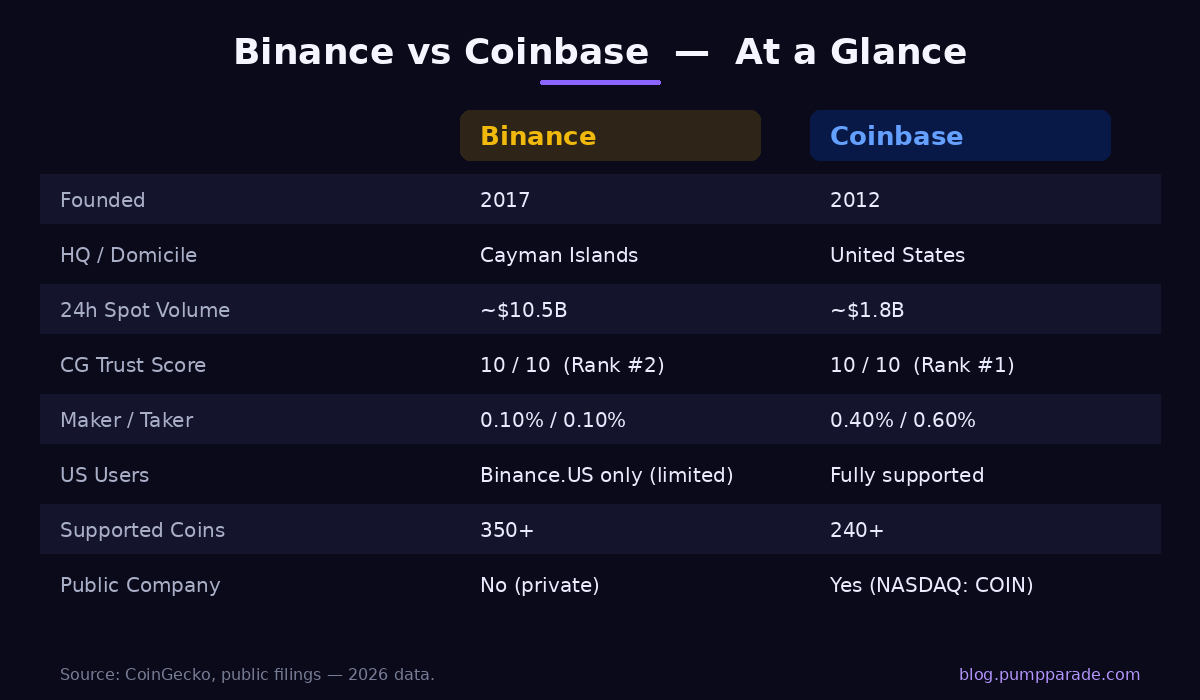
Founded in 2017 by Changpeng Zhao, Binance grew from a scrappy Shanghai startup into the largest crypto exchange in the world by daily volume. According to CoinGecko data, Binance currently processes roughly 143,000 BTC of spot volume per 24 hours, or about $10.5 billion in dollar terms at current prices. It supports more than 350 listed coins and offers spot, margin, futures, options, copy trading, launchpad, savings, and an in-house Layer 1 chain (BNB Chain).
Binance is incorporated in the Cayman Islands and operates a separate, more restricted entity in the U.S. called Binance.US. CoinGecko gives the main Binance exchange a 10 of 10 Trust Score and ranks it #2 globally for reliability and liquidity metrics.
Coinbase

Founded in 2012 by Brian Armstrong and Fred Ehrsam, Coinbase is the largest U.S.-headquartered crypto exchange and became a public company in 2021 (NASDAQ: COIN). CoinGecko tracks roughly 24,800 BTC of daily spot volume on Coinbase Exchange (about $1.8 billion), and ranks it #1 globally on Trust Score with a 10 of 10 rating.
Coinbase offers a beginner-friendly retail app, the more advanced Coinbase Advanced platform (formerly Coinbase Pro), Coinbase Wallet for self-custody, an institutional desk (Coinbase Prime), staking, and Base, its own Ethereum Layer 2. It is one of the most heavily audited and compliance-focused exchanges in the world, with full SEC reporting obligations as a listed company.
Binance vs Coinbase: At a Glance
Fees: The Single Biggest Difference
For most active traders, fees are the deciding factor, and this is where the gap between the two exchanges is widest.
Binance fees
Binance uses a standard maker / taker model with VIP tiers based on 30-day volume and BNB holdings:
- Regular spot users start at 0.10% maker and 0.10% taker.
- Paying fees in BNB gets you a 25% discount, dropping the effective rate to around 0.075%.
- USDC trading pairs have zero fees on many markets.
- VIP 9 tier (institutional volume) goes down to roughly 0.012% maker / 0.024% taker on spot.
- Futures fees start at 0.020% maker / 0.040% taker.
Binance also offers a free internal transfer system between its sub-accounts, and stablecoin deposits via networks like TRC-20, BSC, and Polygon are free or near-free.
Coinbase fees
Coinbase has two fee tracks, and which one you see matters a lot:
- Coinbase (simple app): a spread plus a flat fee or percentage that often works out to 1.5% to 2.5% per trade for small amounts. This is the version that retail users see by default.
- Coinbase Advanced: starts at 0.40% maker and 0.60% taker, with volume-based discounts down to 0.00% maker / 0.05% taker at the highest tier.
- Deposits via wire or ACH (U.S.) are free, but stablecoin off-ramps and certain instant withdrawals can carry meaningful fees.
The takeaway: on a typical $1,000 trade, you might pay $1 on Binance versus $4 to $25 on Coinbase, depending on whether you use the simple or Advanced interface. For active traders, that gap compounds fast.
Supported Coins, Pairs, and Products
Binance lists significantly more assets than Coinbase. Binance currently supports 350+ tradable coins and over 1,400 spot pairs, including most major altcoins, meme tokens, and freshly launched assets via its Launchpool and Launchpad programs. It also offers:
- Spot, margin (up to 10x), and isolated margin trading.
- USDT-margined and coin-margined perpetual futures, plus quarterly futures.
- Options, copy trading, dual investment, and structured products.
- Earn products including flexible savings, locked staking, dual-asset yield, and DeFi-style vaults.
Coinbase lists roughly 240+ coins. The selection is narrower because Coinbase reviews assets through a stricter legal lens, especially after the 2023 SEC litigation that pushed it to delist or pause certain tokens. Coinbase Advanced offers spot trading, perpetual futures on the international entity (Coinbase International Exchange), staking on select PoS chains, and a small set of structured products. There is no margin trading on the U.S. spot product, and derivatives access is mostly geofenced.
Security, Audits, and Trust
Both exchanges score 10 of 10 on CoinGecko's Trust Score and rank in the top two globally. But the underlying stories are very different.
Binance security
Binance maintains the Secure Asset Fund for Users (SAFU), a $1 billion+ self-insurance pool that reimbursed users after the 2019 hack. The exchange publishes Merkle-tree proof-of-reserves reports for major assets (BTC, ETH, USDT, USDC, BNB) and supports two-factor authentication, withdrawal whitelisting, and hardware key support. CZ stepped down as CEO in late 2023 as part of the $4.3 billion U.S. settlement with the DOJ and FinCEN, and Richard Teng now runs the company under a court-supervised compliance monitor.
Coinbase security
Coinbase has never been hacked at the protocol level since its founding in 2012, an unusually long clean record in this industry. As a U.S. public company, it files quarterly 10-Q reports, undergoes annual financial audits by Deloitte, and provides FDIC pass-through insurance on USD balances up to $250,000 per user (held at partner banks). About 98% of customer crypto is held in geographically distributed offline cold storage, with the remaining hot wallet portion covered by a commercial crime insurance policy.
For most non-U.S. users, the practical security difference is small. For U.S. users worried about regulatory enforcement actions, Coinbase's public-company status is a real advantage.
User Experience and Mobile
Coinbase has the smoother onboarding by a clear margin. The retail app is one of the most polished products in crypto: ID verification typically completes in minutes, the interface explains every action in plain English, and you can buy Bitcoin in three taps. This is one reason Coinbase remains the default on-ramp for first-time U.S. buyers.
Binance's app is more powerful but also more cluttered. The home screen shows charts, futures funding rates, copy-trading leaderboards, and a dozen earn products simultaneously. Power users love it; newcomers can find it overwhelming. The Binance Lite mode helps, but the default mode assumes you already know what perp funding is.
If your priority is "buy some BTC, see the price, sleep," Coinbase wins. If your priority is "route a complex trade across spot, futures, and an earn product," Binance wins.
Regional Access and Regulation
This is one place the two exchanges are not really comparable.
Coinbase is available in over 100 countries and is fully licensed and operational in all 50 U.S. states (where local law allows). It holds money transmitter licenses, a BitLicense in New York, and an EU MiCA license through its Irish subsidiary.
Binance's global entity is not available to U.S. residents. U.S. users have to use Binance.US, which has a much smaller selection of coins (around 100), no futures, and lower liquidity. Binance has also exited or restricted service in several jurisdictions, including the Netherlands, Canada (Ontario), and the UK retail market, and operates under specific regulatory regimes in places like France, Italy, Spain, and the UAE.
For more on how regulatory shifts are reshaping the exchange landscape, see our piece on recent crypto regulation news.
Staking, Earn, and Passive Income
Both exchanges offer staking on Ethereum and several PoS networks, but with very different mechanics.
Coinbase's staking is straightforward and conservative: you stake ETH, SOL, ADA, MATIC, ATOM, and a handful of others, Coinbase takes a 25% to 35% commission on the rewards, and you get the rest with no lockup tricks beyond protocol-level unbonding. The compliance perimeter is tight, but the yields are honest.
Binance Earn is much broader: flexible savings on dozens of assets, locked products with higher APYs, dual investment (which has option-like payoffs), DeFi staking integrations, and Launchpool, where you stake BNB or stablecoins to earn newly listed tokens. The yields are often substantially higher, but the products are also more complex. Read the terms before parking serious size.
Pros and Cons
Binance Pros
- Lowest spot fees among major exchanges (0.10% base, lower with BNB).
- Massive coin selection (350+) and the deepest liquidity in the industry.
- Full suite of derivatives, copy trading, and earn products.
- Best-in-class API for bots, traders, and quant strategies.
Binance Cons
- Not available to U.S. users; Binance.US is a watered-down alternative.
- UI can overwhelm new users.
- Past regulatory issues (2023 DOJ settlement) still color institutional perception.
- Customer support response times are inconsistent.
Coinbase Pros
- Most trusted brand for U.S. and institutional users; publicly listed company.
- Cleanest UX for beginners and one of the smoothest fiat on-ramps.
- Strong security track record with insured cold storage.
- Tight regulatory standing, including MiCA license in the EU.
Coinbase Cons
- Simple-app fees are extremely high (often 1.5% to 2.5%).
- Smaller coin selection and stricter listing process.
- Limited derivatives access for retail users.
- Staking rewards are reduced by a 25% to 35% commission.
Verdict: Which One Should You Use?
Choose Binance if you live outside the United States, you trade more than once a week, you want access to the broadest coin selection and derivatives, or you want to use API trading or copy trading. The fee savings alone justify it for anyone running real volume.
Choose Coinbase if you live in the United States, you are new to crypto, you value the security of a publicly listed and audited company, or you want a clean fiat on-ramp without learning order types. Just remember to use Coinbase Advanced rather than the simple app to avoid the higher fees.
Use both if you are a power user. Many active traders buy USDC on Coinbase with a free wire deposit, withdraw it to Binance for cheap trading, and bring profits back through Coinbase for cleaner tax reporting. It is more work, but it gives you the best of both worlds.
For more reviews like this, check out our Bybit vs OKX comparison covering the next tier of CEXs, or our Phantom vs Backpack wallet breakdown if you also need a self-custody option for your withdrawals.
FAQ
Is Binance available in the United States?
The main Binance global exchange is not available to U.S. residents. U.S. users can access Binance.US, a separate entity with around 100 listed coins, lower liquidity, and no futures or margin trading.
Which is cheaper, Binance or Coinbase?
Binance is significantly cheaper. Standard Binance spot fees are 0.10% maker and taker (lower with BNB), while Coinbase Advanced starts at 0.40% maker and 0.60% taker. The simple Coinbase app charges 1.5% to 2.5% per trade.
Is Coinbase safer than Binance?
Both score 10 of 10 on CoinGecko Trust Score. Coinbase has a stronger regulatory profile as a SEC-registered public company with annual Deloitte audits, while Binance maintains a $1 billion+ SAFU insurance fund and publishes proof-of-reserves. For U.S. users, Coinbase's compliance story is generally seen as a meaningful advantage.
Can I use both Binance and Coinbase?
Yes, and many active traders do. A common workflow is to deposit USD on Coinbase via free wire transfer, convert to USDC, withdraw to Binance for cheaper trading, then send profits back to Coinbase for off-ramping and tax reporting.
Does Binance or Coinbase offer better staking yields?
Binance Earn generally offers higher yields across more assets, but with more product complexity. Coinbase staking yields are more conservative and predictable, with a 25% to 35% commission taken from rewards. For a strictly passive U.S. user, Coinbase is simpler; for yield hunters, Binance is more competitive.
This article is for informational purposes only and is not financial advice. Always do your own research before depositing funds on any exchange.