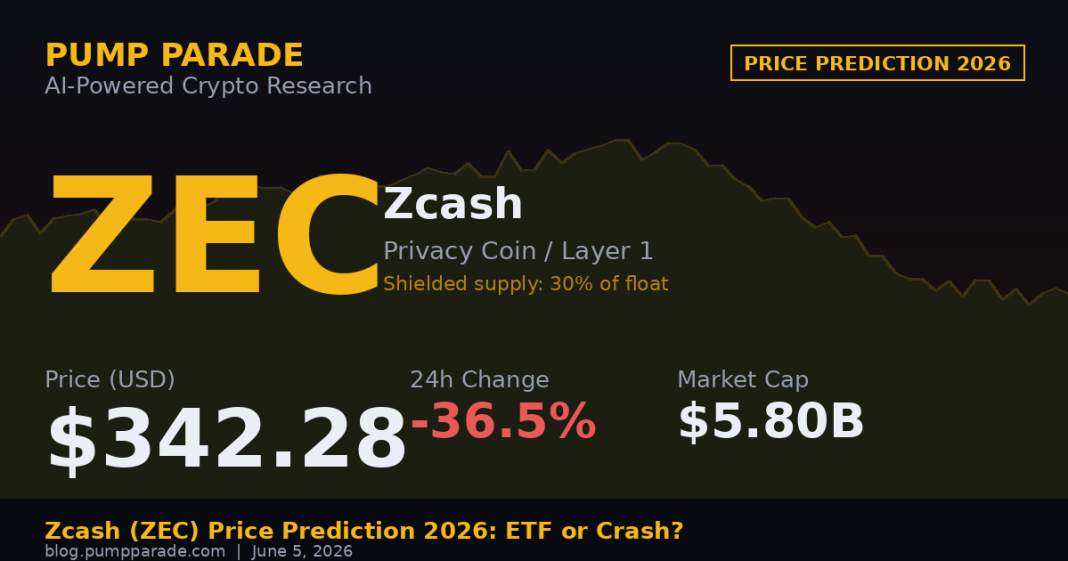
Zcash (ZEC) is trading at $342.28 after a brutal 24 hours. The privacy coin is down 36.5% on the day and 36.8% on the week. Yet it is still up more than 585% over the past year. Volume just printed $2.5 billion, the highest in years.
So what just happened? On June 4, Zcash founder Zooko Wilcox disclosed a critical soundness bug inside the Orchard shielded pool. The flaw could have let an attacker mint unlimited counterfeit ZEC. Developers patched it through an emergency soft fork on June 2 and a hard fork (NU6.2) on June 3. The fix worked. The market still freaked out.
This article breaks down where ZEC goes from here. We cover the current setup, the Grayscale spot ETF filing, the bull and bear catalysts, the key technical levels, and our price targets across three timeframes.
Zcash Snapshot: A Privacy Coin Having a Moment
Zcash is a privacy-focused Layer 1 that uses zero-knowledge proofs (zk-SNARKs) to shield transaction data. Users can send funds two ways. Transparent transfers look like Bitcoin. Shielded transfers hide sender, receiver, and amount. The shielded pool is the network’s killer feature, and demand for it has surged in 2026.
The core data points as of today, June 5, 2026, per CoinGecko:
- Price: $342.28
- Market cap: $5.80 billion (rank #18)
- 24h volume: $2.50 billion
- Circulating supply: 16.75 million ZEC
- Max supply: 21 million ZEC
- 60-day return: +34.6%
- 1-year return: +585.6%
- Drawdown from peak: roughly 50% off the recent $688 high
Roughly 5.1 million ZEC, more than 30% of circulating supply, now sits inside shielded pools. That is a record. It also means the truly liquid float is much smaller than the headline number suggests.
What Happened: The Orchard Bug Crash
The story starts on May 29. Security researcher Taylor Hornby found a soundness flaw in the Orchard zk-SNARK circuit. Soundness is the property that lets a verifier trust the math. If it breaks, a node can accept transactions that should be invalid. Hornby built a working exploit in a local test environment and was able to mint counterfeit ZEC out of nothing. He responsibly disclosed instead of running it on mainnet.
The Zcash team treated it as a five-alarm fire. The response came in two phases:
- Phase 1 (June 2): A temporary soft fork activated at block 3,363,426 around 02:00 UTC. It disabled Orchard actions network-wide while a fix was prepared.
- Phase 2 (June 3): The NU6.2 hard fork activated at block 3,364,600 near 00:05 EDT. It re-enabled Orchard with a corrected circuit.
The good news: no exploit was detected, and shielded transactions are working again. The bad news is the part traders cannot stop thinking about. Because Orchard transactions are private by design, there is no way to cryptographically prove nobody used the bug during the four years it existed. Shielded Labs has already proposed a follow-up upgrade to verify ZEC supply on-chain and close that gap.
This is the cleanest version of the privacy-coin paradox you will ever see. The same feature that gives Zcash its edge also makes it impossible to fully audit. Markets repriced for that risk, hard.
The Bull Case: Why ZEC Could Reclaim $600
The selloff did not erase the catalysts that drove the rally in the first place. Several remain very much alive.
1. Grayscale Spot ETF Filing
On May 12, Grayscale filed a Form S-3 with the SEC to convert its existing Zcash Trust into a spot ETF. Proposed ticker: ZCSH. Listing venue: NYSE Arca. Underlying benchmark: The Zcash Price Index (ZCX). If approved, this would be the first regulated spot vehicle for a privacy coin in the United States. That is a meaningful narrative shift.
2. Shrinking Liquid Supply
Roughly 30% of supply sits inside shielded pools and is rarely traded. Combine that with Zcash’s Bitcoin-style fixed cap of 21 million coins, and the available float for active traders is genuinely tight. Tight float plus rising demand is a textbook setup for sharp moves, in either direction.
3. Institutional Accumulation
The April-May rally was driven by real flows, not retail hype. Grayscale added roughly $46 million in ZEC. Foundry USA launched a dedicated Zcash mining pool. The ZODL initiative closed a $25 million funding round to bootstrap institutional treasury holdings of ZEC. None of those flows have publicly reversed.
4. Privacy Narrative Tailwind
Privacy coins are having a broader moment. Stablecoin surveillance, on-chain compliance tooling, and AI-driven blockchain forensics are pushing some users toward shielded options. We covered this trend in our recent Monero (XMR) price prediction, where similar dynamics drove a sustained breakout. Zcash has a parallel setup with a regulated ETF wrapper on top.
5. Technical Upgrades Are Real
The NU5 upgrade activated the Orchard shielded protocol and moved Zcash to the Halo proving system. Halo 2 removed the old trusted setup and brought recursive proofs. Translation: smaller proofs, cheaper verification, and a credible path to rollups and Layer 2 designs. The June bug does not change that roadmap.
The Bear Case: Why ZEC Could Slide to $200
A balanced read needs the other side. Here are the live risks.
1. The Audit Trust Problem
The Orchard bug is patched, but the bigger question is harder. If Orchard’s privacy makes it impossible to prove no counterfeit ZEC was ever created, what is the true supply? Until the Shielded Labs supply-proof upgrade ships and gets audited, this concern will sit in the back of every institutional buyer’s mind. ETF reviewers will likely care a lot about it too.
2. ETF Approval Is Not Guaranteed
Spot ETFs for privacy assets face a tougher path than Bitcoin or Ethereum did. The SEC closed its investigation into Zcash Foundation in January 2026 without enforcement, which helps. But approval timelines stretch quarters, not weeks. A delay or rejection would knock a major leg out of the bull thesis.
3. Macro Risk-Off
ZEC is a high-beta asset. In risk-off periods, it tends to drop faster than Bitcoin. If equities wobble or rates stay sticky, expect amplified downside. The June median Bitcoin return is +2.58%, but that does not always translate to altcoins, especially ones nursing a 36% one-day drawdown.
4. Concentration Risk
Much of the recent rally came from a small number of large buyers. If one or two of them decide the bug changed the risk profile, they exit. The order book is thin enough that the impact would be ugly.
5. Regulatory Tail Risk
Privacy coins remain a soft target for regulators worldwide. Several EU jurisdictions have already restricted exchange listings for shielded assets. A US-led action could hit US-based liquidity hard, ETF or no ETF.
Technical Outlook: The Levels That Matter
The chart tells a clear story. ZEC rallied roughly 6x from January lows near $115 to a peak above $688 in late May. The Orchard disclosure broke that uptrend in one session.
The levels worth tracking:
- $300: First major horizontal support. Lines up with the prior breakout zone from April. A clean hold here keeps the higher-time-frame trend technically intact.
- $245: The 200-day moving average sits around this region. If $300 fails, this is the next logical buyer zone.
- $420: First resistance on any bounce. It is the breakdown level from June 4.
- $520: The 50-day moving average and the volume-weighted average price for the recent rally. Reclaim here would suggest the move is back on.
- $688: Prior cycle high. A break above confirms the cup-and-handle pattern many analysts have flagged, with measured targets near $928.
The Relative Strength Index (RSI, a momentum indicator that runs from 0 to 100) is sitting near 30 on the daily after the crash. Historically, ZEC has bounced from that zone about 70% of the time on a two-week window. That does not guarantee anything, but it is the kind of setup short-term traders watch.
Price Predictions: Three Timeframes
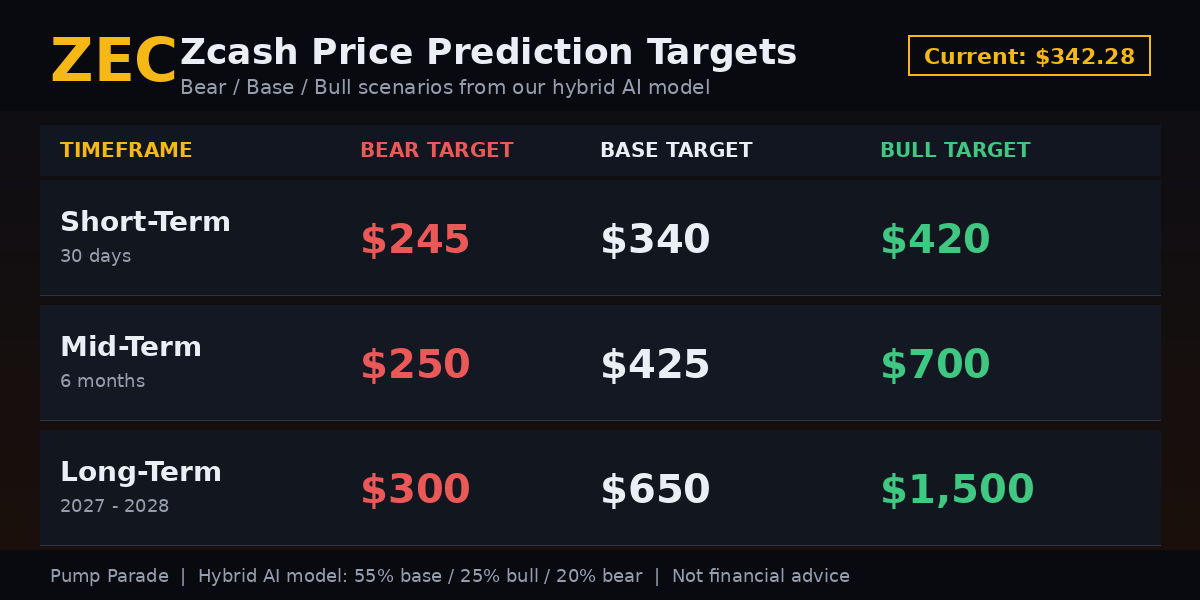
Our hybrid model blends technical signals, on-chain shielded pool activity, ETF-flow analogs from BTC and ETH approvals, and macro risk inputs. Here is what it currently points to:
Short-Term (Next 30 Days)
The base case is a choppy stabilization. Expect a range of $280 to $400, with the midpoint near $340. If $300 holds and the supply-proof upgrade is announced with a credible timeline, a snap-back toward $420 is the probability-weighted upside. A breakdown below $245 opens $200 quickly.
Medium-Term (6 Months)
The Grayscale ETF decision window dominates this horizon. In a base scenario, ZEC trades between $300 and $550. If the ETF gets approved and shielded-pool growth continues, the upside extends to $700 to $850. If the ETF is delayed beyond Q4 2026, expect a grind in the $250 to $400 range and rotation into other narratives.
Long-Term (2027 to 2028)
This is where the math gets interesting. ZEC has a Bitcoin-style halving cycle. The next halving is expected in late 2028. Combine that with potential ETF flows, continued shielded-pool growth, and a maturing Halo 2 ecosystem, and a bull target of $1,200 to $1,800 is reachable. A neutral case lands closer to $500 to $800. A bear case where the trust problem is never fully resolved keeps ZEC capped under $300.
Our model assigns roughly 55% probability to the base path, 25% to the bull path, and 20% to the bear path. Those numbers will move as more information about the supply-proof upgrade, ETF review, and macro backdrop comes in.
What to Watch Next
Three things will tell you which path ZEC is on. First, the Shielded Labs supply-proof upgrade. A specific shipping date and a respected auditor would meaningfully repair the trust damage. Second, ETF review activity. Any 19b-4 publication or comment period start on the Grayscale conversion is a signal. Third, the $300 level on the daily chart. If it cracks on volume, the bounce thesis is out the window. If it holds for two weeks, the higher-time-frame trend gets its second chance.
The honest read on Zcash right now: the bull case is intact but bruised. The bear case got sharper teeth. The path forward depends on developers and regulators more than chart patterns. That is the setup. Watch it, do not trade the emotion.
Disclaimer
Disclaimer: This article is for informational and educational purposes only and should not be construed as financial, investment, or trading advice. Cryptocurrency markets are highly volatile, and past performance does not guarantee future results. The price predictions and analyses presented here are based on AI models, technical indicators, and available data at the time of writing, they are not guarantees. Always conduct your own research (DYOR) and consult with a qualified financial advisor before making any investment decisions. Pump Parade and its authors do not assume liability for financial losses incurred based on information provided in this article.