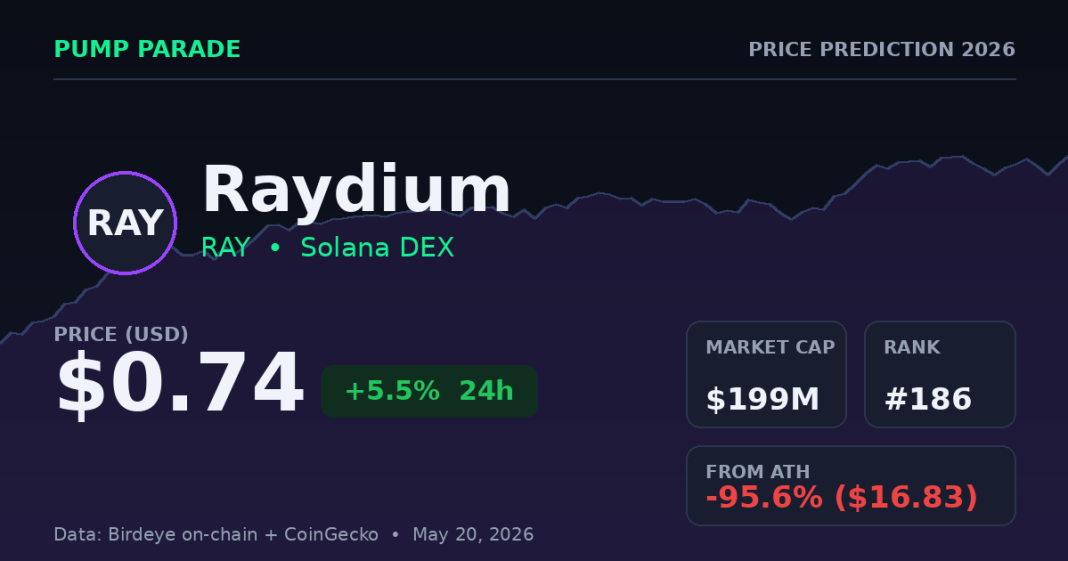
Raydium (RAY) is trading near $0.74 at the time of writing. The token is up about 5.5% in the last 24 hours. But the picture is more mixed over a longer window. RAY is up roughly 15% over the past 30 days, yet down about 10% over the past 7 days. In short: a strong month, with a recent cooling-off.
So why look at Raydium right now? Two reasons. First, RAY has a real, working business behind it. Raydium is one of the largest decentralized exchanges (a DEX, meaning a place to trade tokens without a middleman) on Solana. Second, it has a buyback program that has already retired a large chunk of its supply. That mix of cash flow and shrinking supply is rare in crypto.
This article breaks down where RAY stands today, what is driving it, and where the price could go. We will cover the bull case and the bear case. Then we will give clear price targets by timeframe. Let’s look at the numbers.
Raydium (RAY) Price Today: The Current Setup
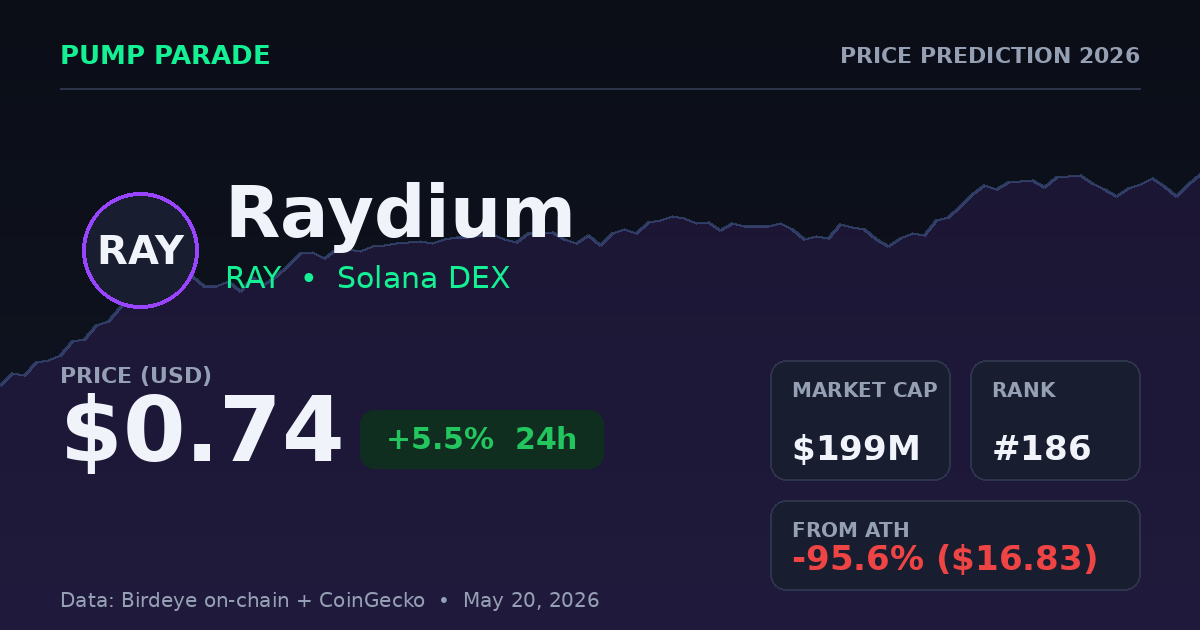
Here is the snapshot as of May 20, 2026:
- Price: about $0.74
- Market cap: roughly $199 million (rank #186)
- 24-hour change: +5.5%
- 7-day change: -10%
- 30-day change: +15%
- 24-hour trading volume: about $23 million across all venues
- Circulating supply: roughly 269 million RAY (max supply 555 million)
One number stands out. RAY sits about 95% below its all-time high of $16.83, set back in September 2021. That is a steep fall. For some traders, that gap looks like risk. For others, it looks like room to run. According to CoinGecko market data, the token has bounced hard off its 2022 low near $0.13, but it has a long way back to its peak.
What Is Raydium? A Quick Primer
Raydium is a decentralized exchange built on Solana. In plain terms, it lets people swap one token for another and earn fees by providing liquidity. It launched in 2021 and has stayed a core piece of Solana’s DeFi (decentralized finance) world ever since.
The token, RAY, does a few jobs. Holders can stake it, provide liquidity, and benefit from the protocol’s buyback program. The more the platform is used, the more fees it earns. Some of those fees flow back to RAY through buybacks. We will get to why that matters in a moment.
The Buyback Catalyst: Why RAY Is Different
Here’s the thing that makes Raydium worth a closer look. The protocol runs a programmatic buyback. It uses 12% of its protocol fees to buy RAY off the open market. This is automatic, not a one-time PR move.
The scale is large for a token this size. Raydium has spent more than $190 million on cumulative buybacks. That adds up to around 69 million RAY, or roughly 25% of the circulating supply. Translation: a quarter of the float has been bought back over time. When supply shrinks and demand holds, price tends to feel upward pressure.
The fuel behind this is LaunchLab, Raydium’s token launch platform. It went live in April 2025 and quickly became a top revenue driver for the protocol. More launches mean more fees. More fees mean bigger buybacks. That is the flywheel the bulls are watching.
Raydium (RAY) Technical Analysis
Let’s look at what the chart is telling us. RAY had a solid month but pulled back over the past week. That recent dip put the price back near a key zone.
Support levels to watch: The first real support sits around $0.65. Below that, the $0.55 area comes into play. A deeper flush could test $0.48, which lines up with recent swing lows.
Resistance levels to watch: The first hurdle is near $0.88, a level RAY has struggled to clear in 2026. Above that, $1.00 is the big psychological line. A clean break there opens the path toward $1.65.
Momentum is mixed. The 30-day trend is up, which is bullish. But the 7-day slide shows buyers took a breather. The RSI (Relative Strength Index, a tool that measures whether an asset is overbought or oversold) has cooled from its recent highs. That is not bearish on its own. It often signals healthy consolidation before the next move.
The Bull Case for RAY
The bull case rests on real fundamentals, not hype. Here is the core of it.
First, the buyback. If LaunchLab keeps generating fees, the protocol keeps buying back RAY. That steady demand can put a floor under the price. Few small-cap tokens have this kind of built-in buyer.
Second, Solana’s growth. Raydium earns more when Solana activity rises. If trading, farming, and token launches climb on Solana in 2026, RAY benefits directly. It is a leveraged bet on the broader Solana ecosystem. For more on the network itself, see our Jupiter (JUP) price prediction, which covers another major Solana DEX token and the same demand trends.
Third, the discount. RAY trades 95% below its peak. If the market rotates back into DeFi, tokens with real revenue could lead. RAY fits that profile.
The Bear Case for RAY
Now the other side of the trade. A balanced view means taking the risks seriously.
First, competition is fierce. Jupiter, Orca, and other Solana platforms all fight for the same users. If Raydium loses market share, fee revenue drops. Smaller fees mean smaller buybacks. The flywheel can spin in reverse.
Second, the buyback depends on volume. LaunchLab revenue is tied to memecoin and token launch activity. That activity is cyclical. When the launch frenzy cools, so does the cash flow that funds buybacks.
Third, broad market risk. Some analysts expect a crypto market correction in 2026. In a downturn, small-cap DeFi tokens often fall harder than majors. A drop below $0.48 would invalidate the near-term bull thesis and could open the door to lower levels.
Fourth, security. Solana DeFi has seen frontend hacks and exploits. A serious incident involving Raydium or a key partner could hit confidence fast.
Raydium (RAY) Price Prediction 2026 and Beyond
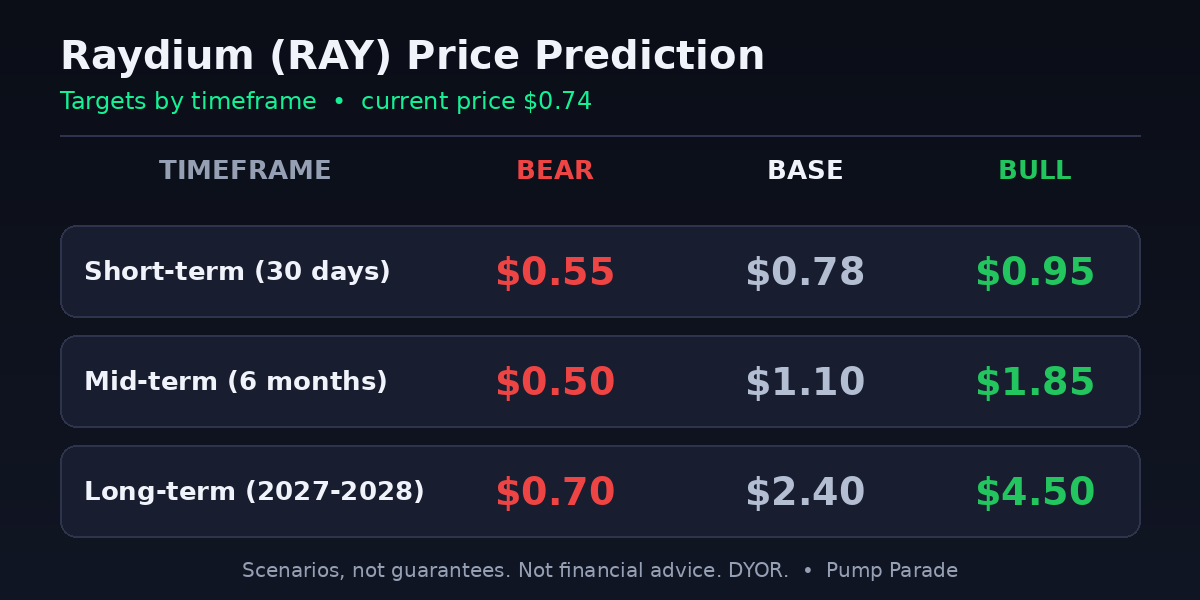
So where could RAY go? Below are our scenarios by timeframe. These are based on current data, technical levels, and the buyback dynamic. They are not guarantees. Each timeframe shows a bear, base, and bull target.
Short-Term Price Prediction (Next 30 Days)
Expect range-bound action while the market digests the recent pullback. If support holds, RAY could grind back toward resistance.
- Bear target: $0.55
- Base target: $0.78
- Bull target: $0.95
Mid-Term Price Prediction (6 Months)
This window depends on Solana activity and LaunchLab fees. Strong on-chain demand could push RAY through $1.00. Weak demand could send it back toward the lows.
- Bear target: $0.50
- Base target: $1.10
- Bull target: $1.85
Long-Term Price Prediction (2027-2028)
Over a longer horizon, the buyback could meaningfully shrink supply. If Solana DeFi keeps growing and RAY holds its share, the upside is real. But a prolonged bear market would cap gains.
- Bear target: $0.70
- Base target: $2.40
- Bull target: $4.50
For context, several analyst models put RAY’s 2026 range between roughly $0.62 and $2.71. Our base case sits inside that band. Our long-term bull case assumes sustained buybacks plus a healthy Solana cycle.
What to Watch Next
Keep an eye on a few signals. They will tell you which scenario is playing out.
- LaunchLab revenue: Rising fees support bigger buybacks. Falling fees do the opposite.
- The $0.88 resistance: A clean break above it would be a bullish signal. Rejection keeps RAY range-bound.
- The $0.48 support: A break below it would flip the near-term outlook bearish.
- Solana activity: More network usage tends to lift RAY. Watch overall DEX volume on Solana.
The Bottom Line
Raydium is one of the few small-cap tokens with a real business and a working buyback. That is its edge. The data points to a token with strong fundamentals trading at a steep discount to its peak. The risk is competition and a possible market correction.
Our base case sees RAY near $0.78 in the short term and around $1.10 over six months. The bull case needs sustained buybacks and a healthy Solana cycle. The bear case needs only a market downturn or a drop in LaunchLab fees. As always, the smart move is to watch the levels and let the data guide you, not the hype.
Analysis dated May 20, 2026. Prices reference Birdeye on-chain data and CoinGecko market data at the time of writing.
Disclaimer: This article is for informational and educational purposes only and should not be construed as financial, investment, or trading advice. Cryptocurrency markets are highly volatile, and past performance does not guarantee future results. The price predictions and analyses presented here are based on AI models, technical indicators, and available data at the time of writing. They are not guarantees. Always conduct your own research (DYOR) and consult with a qualified financial advisor before making any investment decisions. Pump Parade and its authors do not assume liability for financial losses incurred based on information provided in this article.