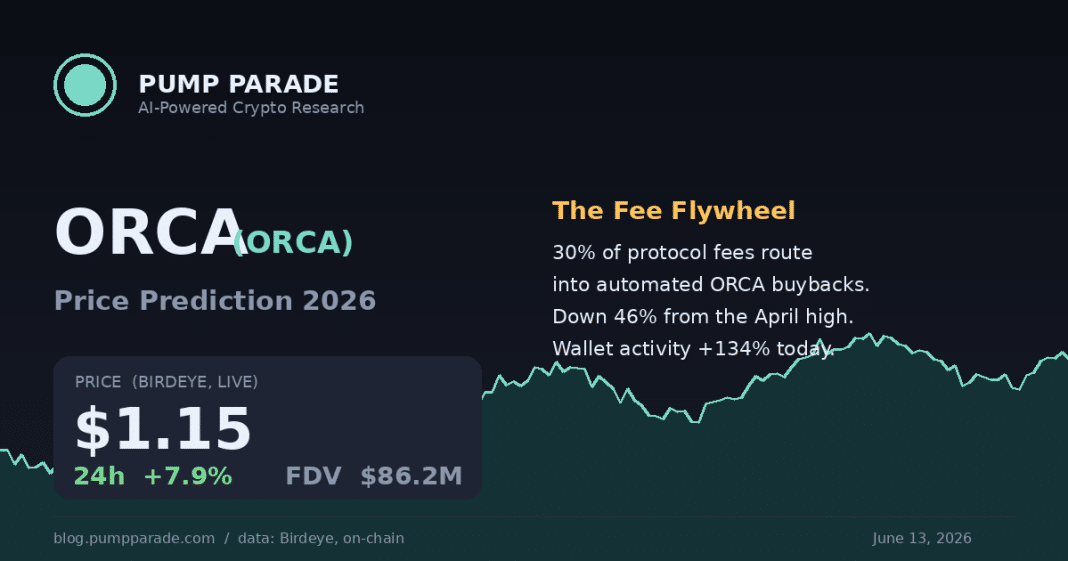
Orca (ORCA) is having a curious week. The Solana DEX token is trading at $1.15 at the time of writing, up 7.9% in the last 24 hours and ranked the third trending token on Birdeye’s Solana leaderboard. Unique active wallets touching the token are up 134% day over day, with 2,191 wallets in the last 24 hours.
Here is the catch. ORCA is also down 46% from its April 30 high of $2.15. The asset that was supposed to be the cleanest fundamentals play in Solana DeFi has spent six weeks bleeding. So which signal is right, the rebound or the drawdown? Let’s look at the data.
ORCA at a Glance: The Numbers Right Now
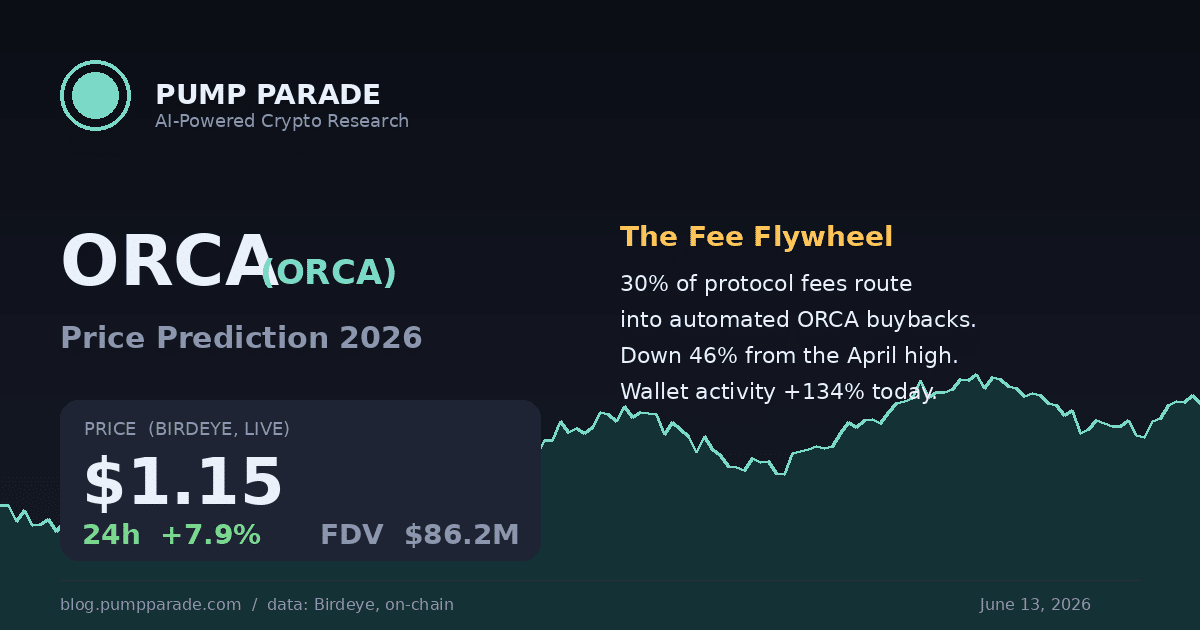
Pulling live data from Birdeye, here is where ORCA sits as of June 13, 2026:
- Price: $1.15
- 24h change: +7.9%
- Market cap: $69.9M
- Fully diluted valuation: $86.2M
- Circulating supply: 60.8M ORCA
- Max supply: 100M ORCA
- Holders: ~90,000
- Liquidity on Solana DEXs: $2.72M
For context, Solana itself is at $67.41 today, well off the $89 range it held earlier this spring. That is a key bear case input. ORCA’s revenue is denominated in fees on a chain that is currently soft.
What Orca Actually Does
Orca is a concentrated liquidity AMM on Solana. Its flagship product is Whirlpools, which lets liquidity providers concentrate capital around specific price ranges, similar to how Uniswap V3 works on Ethereum. In plain terms: you get more fees per dollar of liquidity, because your capital is doing more work in the narrow band where most trades happen.
The numbers back this up. Orca runs roughly $300M in TVL but turns over capital at a 26x ratio, the highest among major Solana DEX venues. In April, Orca printed a 30-day trading volume of $6.76B, the highest on Solana. Fee tiers range from 1 basis point on stable pairs to 100 basis points on volatile long-tail pairs.
That makes Orca a real cash-flow business, not a narrative token. And that matters for the next section.
The Fee Flywheel: Why This Catalyst Is Different
This is the part most retail traders miss. In August 2025, the Orca DAO passed a governance proposal that did three things:
- Authorized the use of up to 55,000 SOL from the treasury for a 24-month buyback program
- Routed 30% of protocol fees into ORCA buybacks
- Capped daily purchases at 2% of the 30-day average trading volume, to avoid distorting the market
In January 2026, the Council went further. It bumped the share of protocol fee revenue funding xORCA staker rewards from 20% to 40%. In other words, if you stake ORCA, you now collect a larger share of every swap fee the protocol earns. Source: SolanaFloor.
Translation: Orca is one of the few Solana DeFi tokens with a structural, automated bid. Every time someone swaps through a Whirlpool, a portion of that fee becomes a market buy of ORCA. It is not promotional, it is mechanical.
This is the same playbook another Solana DEX is running, and we covered the parallel setup in our Raydium (RAY) price prediction. The difference is scale. Orca’s capital efficiency is higher, but Raydium has the memecoin volume firehose. Both flywheels work, just at different volume regimes.
Technical Analysis: Where the Chart Is Right Now
Over the last 90 days, ORCA has traded in a range from $0.83 (April 3 low) to $2.15 (April 30 high). The April rally was driven by the news that fee buyback rewards were going up. The selloff since has tracked Solana’s broader softness, plus profit-taking from traders who timed the catalyst news perfectly.
Key technical levels to watch:
- Support 1: $1.05 to $1.07 (the level ORCA defended on Wednesday’s wick)
- Support 2: $0.83 (April 3 low, the line in the sand for the bull thesis)
- Resistance 1: $1.35 (the 50-day moving average, which has been rejecting price for three weeks)
- Resistance 2: $1.80 to $2.15 (the supply zone where the April rally died)
Today’s 7.9% bounce on rising wallet activity is the first sign that the downtrend may be exhausted. But a single green candle does not make a reversal. The chart needs to close above $1.35 with conviction before momentum traders get involved.
The Bull Case
The bull case for ORCA rests on three pillars.
One: the buyback is real and it compounds. Unlike speculative tokens that depend on narrative cycles, ORCA’s bid scales with how much trading happens on Orca. If Solana activity recovers, 30% of every fee dollar becomes ORCA demand. The 2% daily volume cap means buybacks are stretched, not front-loaded, which keeps the bid present for months.
Two: capital efficiency is a moat. Orca’s 26x turnover ratio is hard to copy. Other AMMs can fork the code, but they cannot fork the LP relationships and the deep concentrated liquidity that took years to build. As long as Orca keeps fee revenue per dollar of TVL above peers, it earns its multiple.
Three: low float, high holder count. 60.8M tokens circulating against 89,993 holders is a tight distribution for a $70M cap asset. There are no large unlock events looming, and the buyback is actively removing supply from circulation through xORCA staking.
If Solana volumes recover toward Q1 levels and the buyback program continues unchanged, our base case sees ORCA retesting the $1.80 to $2.20 range over the next six months. A more bullish scenario, with Solana DEX volumes rallying alongside a broader risk-on rotation, opens the door to $2.50 to $3.20 by early 2027.
The Bear Case
The bear case is equally legible. Three risks stand out.
One: Solana revenue is soft. Solana DApp revenue recently hit an 18-month low. If users are not swapping, Orca is not earning fees, and 30% of zero is zero. The buyback program only works as advertised if volume returns.
Two: competition for liquidity. Raydium has a deeper memecoin pipeline. Jupiter aggregates routing across every DEX, which means LPs do not need to commit to a single venue. Meteora is winning on dynamic vault strategies. Orca’s CLMM lead is not infinite.
Three: $0.83 is closer than it looks. If the broader Solana market rolls over and BTC retests $58K, ORCA’s $1.05 to $1.07 support is thin. A break invites a flush back to $0.83. A break of $0.83 likely targets $0.65 to $0.70, where the early-2025 accumulation range sits.
The bear case is not catastrophic. It is a slow grind, not a wipeout. But traders sizing positions need to model it.
ORCA Price Predictions by Timeframe
Here is how we are modeling ORCA based on current data, the buyback flywheel, and Solana macro context.
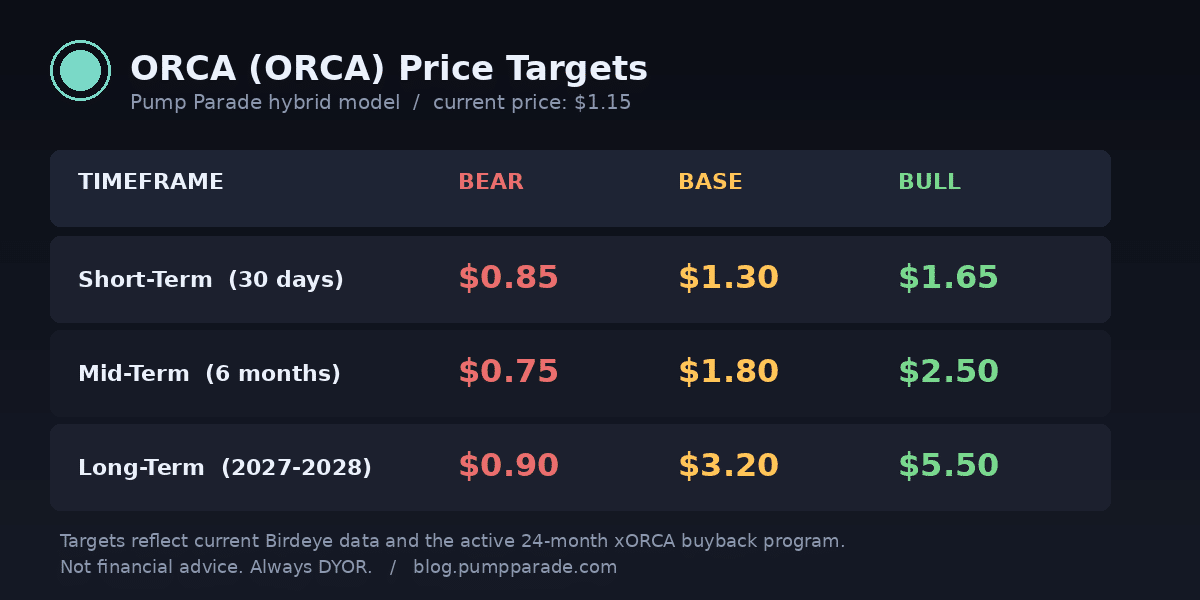
Short-Term (30 Days, July 2026)
- Bear: $0.85
- Base: $1.30
- Bull: $1.65
The next 30 days are about whether $1.05 holds and whether today’s wallet activity bounce extends. Watch the $1.35 level for a momentum confirmation.
Mid-Term (6 Months, December 2026)
- Bear: $0.75
- Base: $1.80
- Bull: $2.50
By year-end, the cumulative effect of the 24-month buyback will start to show up in float dynamics. If Solana volumes recover, the base case is a retest of April highs. If Solana stays soft, expect another quarter of range-trading.
Long-Term (2027 to 2028)
- Bear: $0.90
- Base: $3.20
- Bull: $5.50
Two scenarios drive the long-term case. The bull path assumes Solana DEX volumes scale with new use cases (RWA settlement, AI agent micropayments, on-chain treasuries), Orca holds its capital efficiency lead, and the buyback completes its full 24-month run. The bear path is a slow erosion of fee share to competitors. Reference benchmark data is available at CoinGecko’s ORCA page.
What to Watch
Three things will tell you which path ORCA is on before the chart does.
- Solana DEX volume. Track aggregate Solana DEX volume on Birdeye or DefiLlama. If weekly volume reclaims $50B, the fee flywheel re-engages quickly.
- Quarterly buyback reports. The Orca Council committed to publishing quarterly reports with token purchases, average buy prices, and treasury balances. The next one is due in mid-July. Read it.
- xORCA staking ratio. The higher the share of supply staked into xORCA, the tighter the effective float. If staking participation climbs above 40% of circulating supply, the buyback’s price impact compounds.
The Bottom Line
ORCA is not a meme. It is a cash-flow asset with a structural bid, trading at a 46% discount to its recent high, on a chain that is currently underperforming. That combination produces a setup worth watching, not a guaranteed trade.
If you believe Solana volume recovers in the second half of 2026, the math behind ORCA gets interesting fast. If you do not, $0.83 is still in play. Pick your side, size accordingly, and let the data update your view.
Disclaimer: This article is for informational and educational purposes only and should not be construed as financial, investment, or trading advice. Cryptocurrency markets are highly volatile, and past performance does not guarantee future results. The price predictions and analyses presented here are based on AI models, technical indicators, and available data at the time of writing, they are not guarantees. Always conduct your own research (DYOR) and consult with a qualified financial advisor before making any investment decisions. Pump Parade and its authors do not assume liability for financial losses incurred based on information provided in this article.