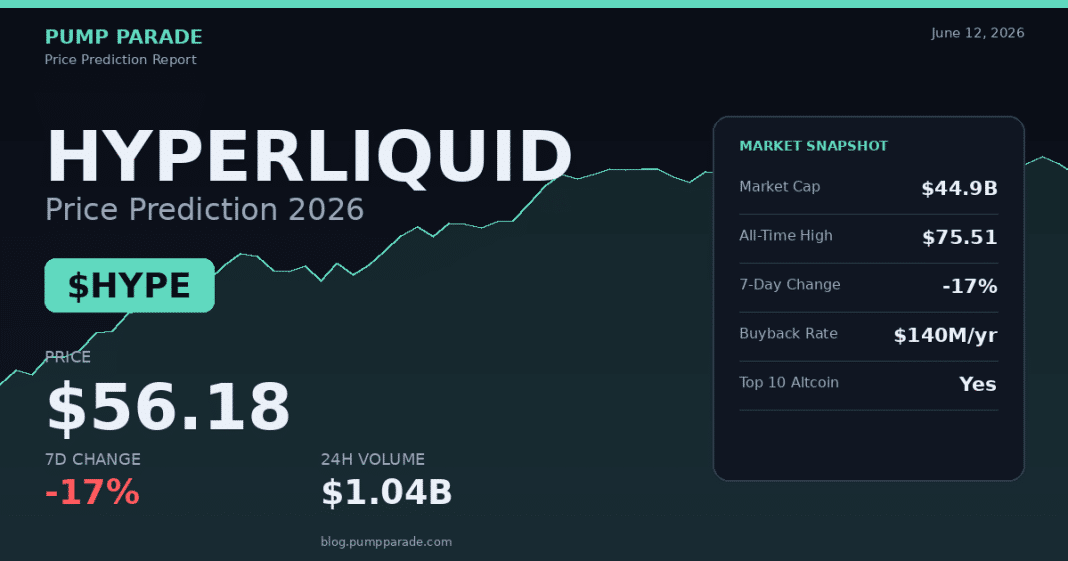
Hyperliquid (HYPE) is trading near $56.18 at the time of writing. That is roughly 17% below the $68.83 print from a week ago and about 25% off the $75.51 all-time high set on June 2, 2026. Yet trading volume is still humming at $1.04 billion in the last 24 hours, and HYPE just elbowed its way into the top 10 by market cap on CoinMarketCap, leapfrogging both Cardano and Dogecoin.
So why the pullback, and why does it matter now? Two reasons. First, Kalshi just filed for regulated HYPE perpetuals on June 10. Second, the buyback engine that quietly props this token up keeps grinding through one of the most active order books in crypto. Let’s break down both paths.
What Is Hyperliquid and Why HYPE Matters
Hyperliquid is a layer-1 blockchain built around a fully on-chain perpetual futures exchange. In plain terms, it is a decentralized version of Binance Futures, except every order, fill, and liquidation runs on its own chain. HYPE is the native token. It is used for staking, fee discounts, and governance, but the real story is what the protocol does with its revenue.
Roughly 99% of platform fees are routed to the Assistance Fund (AF). The AF bids HYPE on the open market and sends the bought tokens to a null address. In December 2025, a validator vote made that null-address routing a formal burn. Translation: nearly every dollar of fee revenue gets converted into permanent supply reduction.
That alone would be notable. The mechanic gets more interesting when you add the USDC reserves. About $5B of USDC sits on the platform earning 3.5% to 4% yield. Ninety percent of that yield also flows to the AF for buybacks. CoinShares estimates the reserve layer alone contributes $140M to $160M per year to HYPE buybacks at current rates.
Key Metrics at a Glance
- Price: ~$56.18
- Market cap: ~$44.9B
- 24h volume: ~$1.04B
- ATH: $75.51 (June 2, 2026)
- Annual buyback run-rate (reserve yield alone): $140M-$160M
- Monthly contributor unlocks: 9.92M HYPE
Current Price Action and Technical Setup
The chart tells a tidy story. HYPE ran from the mid-$30s in March to $75 on June 2. That is a 100% move in under three months. The pullback since is a fairly textbook bull-market correction, not a structural break.
HYPE is currently trading below both its 50-day and 200-day simple moving averages. The RSI sits near 51, which is dead neutral. That combination tells us momentum has cooled, but selling pressure has not turned into outright distribution.
Three levels matter from here:
- Near-term support: $50-$52. This zone caught two pullbacks in May and aligns with the 100-day moving average.
- Major support: $42-$45. The April breakout zone. A break below this would invalidate the bullish structure for the rest of 2026.
- Resistance: $68-$70 (the level that capped last week), then $75.50 (the ATH).
The 24h volume holding above $1B during a 17% pullback is a quietly bullish signal. It means real buyers are still showing up. Compare that to last week’s data from CoinGecko, where volume actually rose into the dip.
The Bull Case for HYPE
1. Kalshi Files for HYPE Perpetuals
On June 10, 2026, regulated U.S. prediction market Kalshi filed for HYPE perpetual futures. If approved, that opens HYPE exposure to U.S. retail and institutional traders who currently cannot touch the Hyperliquid native exchange. This is the same playbook that pushed SOL futures volume past $1B/day after CME listed them. Kalshi is not CME, but the directional read is the same: regulated derivatives expand the buyer base.
2. The Buyback Flywheel Actually Works
Most “deflationary” tokens are deflationary on paper. HYPE is deflationary in practice. Citrini Research recently called it a “compelling idea” specifically because the cash flow is real, not promised. Even with monthly contributor unlocks of 9.92M HYPE, the AF has been net-burning enough to keep float pressure manageable. If volumes stay near current levels through Q3 2026, the buyback math gets aggressive fast.
3. Institutional Flows Are Rotating
On June 1, HYPE-linked products attracted $1.28M in net inflows while spot Bitcoin and Ether ETFs both saw heavy outflows. That is a small number in absolute terms, but the relative signal matters. Capital is starting to look past the majors for productive crypto assets with actual revenue.
4. Coinbase USDC Deal
Coinbase took over as the official Aligned Quote Asset deployer for USDC on Hyperliquid earlier this year. That partnership locks in the USDC reserve base that powers the buybacks. The native USDH stablecoin from Native Markets is being wound down, but the Coinbase deal more than replaces it. The buyback engine is now backed by the deepest, most liquid dollar reserve in crypto.
The Bear Case for HYPE
The bull case is strong. The bear case is real too.
1. The FDV Problem
HYPE has a massive fully diluted valuation overhang. Monthly contributor unlocks of 9.92M tokens equate to roughly $560M of supply hitting the float every month at current prices. The buybacks are real, but they need to keep pace with the unlocks. If volume drops 40% in a broader risk-off move, the math flips bearish quickly.
2. Macro Conditions Are Tight
The crypto Fear and Greed Index sits at 12 right now, which is “extreme fear” territory. Bitcoin is trading at $63K, off its recent highs. The total crypto market cap is at $2.25T. If macro keeps deteriorating, HYPE will not escape the gravity, no matter how good the cash flow is.
3. Concentrated Exchange Risk
The entire HYPE thesis depends on Hyperliquid the exchange staying dominant in perpetuals. dYdX, Aevo, and a half-dozen other competitors are not going away. Any sustained loss of market share would cut directly into the fee revenue that powers the buybacks.
4. Regulatory Tail Risk
A fully on-chain perpetuals venue is exactly the kind of product U.S. regulators love to hate. Kalshi getting approval for HYPE perps is bullish if it happens. If the CFTC blocks it, or worse, takes a broader enforcement stance against the protocol itself, the entire thesis takes damage.
HYPE Price Predictions by Timeframe
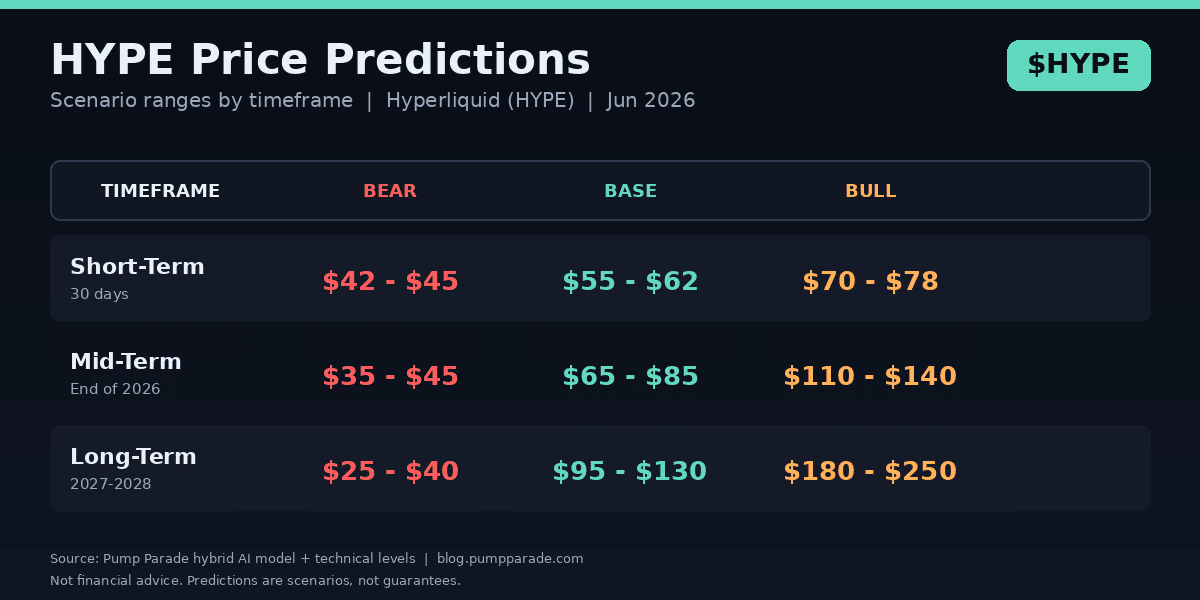
These are scenario ranges based on our hybrid AI model, current technicals, and the catalysts above. They are not guarantees.
Short-Term (Next 30 Days)
- Bear target: $42-$45 (broader market shake-out, Kalshi rejection)
- Base target: $55-$62 (consolidation, modest rebound)
- Bull target: $70-$78 (Kalshi approval, ATH retest)
Our model assigns roughly a 55% probability that HYPE finishes July in the $55-$72 range.
Mid-Term (6 Months, End of 2026)
- Bear target: $35-$45
- Base target: $65-$85
- Bull target: $110-$140
The base case assumes volumes hold above $1B/day and the buyback math continues to absorb unlock pressure. Arthur Hayes has publicly called for $150 by August 2026. That is the very upper edge of our bull case, and requires both Kalshi approval and a broader risk-on rally.
Long-Term (2027-2028)
- Bear target: $25-$40
- Base target: $95-$130
- Bull target: $180-$250
The long-term thesis comes down to one question: does Hyperliquid become the default venue for on-chain derivatives the way Uniswap became the default venue for spot DEX trading? If yes, HYPE has triple-digit potential. If no, the unlocks will grind the price down regardless of buybacks.
What to Watch
Three things will determine which scenario plays out:
- The Kalshi filing decision. Approval is the cleanest near-term bullish catalyst. Rejection would cap upside at the recent ATH for months.
- Weekly volume trend. Sustained $1B+ daily volumes keep the buyback engine running hot. Drops below $600M would be the first real warning sign.
- The $50 level. This is the line that decides whether the current pullback is a healthy reset or the start of something worse. Hold $50, the bull case stays intact. Lose $50 with conviction, and we reassess.
For comparison on how other layer-1 plays are setting up, see our recent breakdown of Jupiter vs 1inch DEX aggregator economics. The fee-capture thesis there mirrors what makes HYPE interesting here.
The Bottom Line
HYPE is one of the few crypto tokens with a real cash flow story attached. The buyback flywheel is not theoretical, it is running, and the Coinbase USDC deal cements the dollar base that powers it. The Kalshi filing adds a clean near-term catalyst.
But the FDV math is real, the monthly unlocks are large, and the broader market is in extreme fear. A token at $56 with a $45B market cap is not a small bet. The risk-reward favors the long side if you believe in the on-chain derivatives thesis, but position sizing matters more than usual here.
The smart play is to watch the $50 level, the Kalshi decision, and the volume trend. The setup is interesting. The conviction comes from the data, not the noise.
Disclaimer: This article is for informational and educational purposes only and should not be construed as financial, investment, or trading advice. Cryptocurrency markets are highly volatile, and past performance does not guarantee future results. The price predictions and analyses presented here are based on AI models, technical indicators, and available data at the time of writing, they are not guarantees. Always conduct your own research (DYOR) and consult with a qualified financial advisor before making any investment decisions. Pump Parade and its authors do not assume liability for financial losses incurred based on information provided in this article.