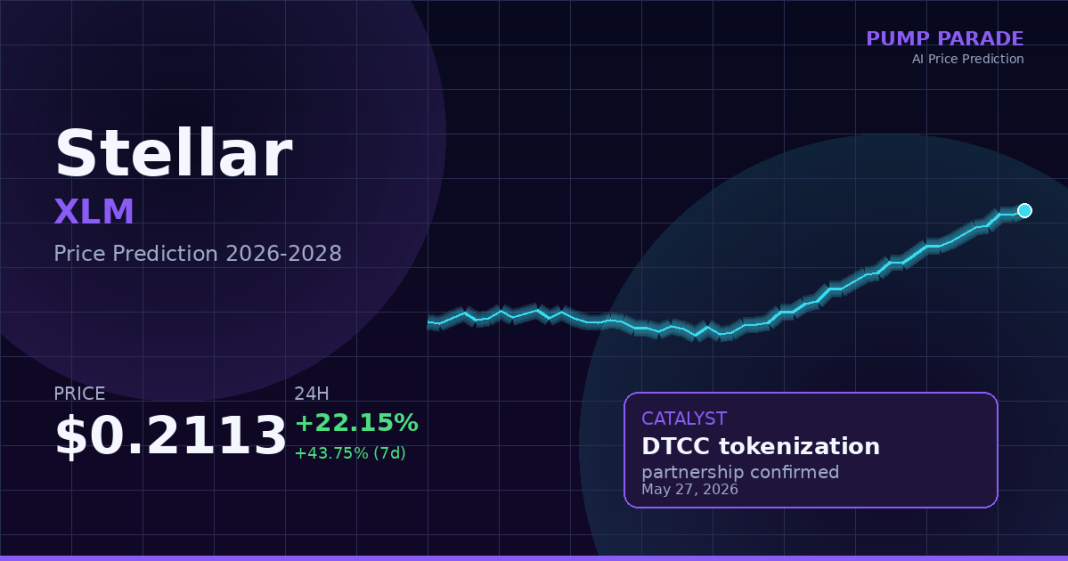
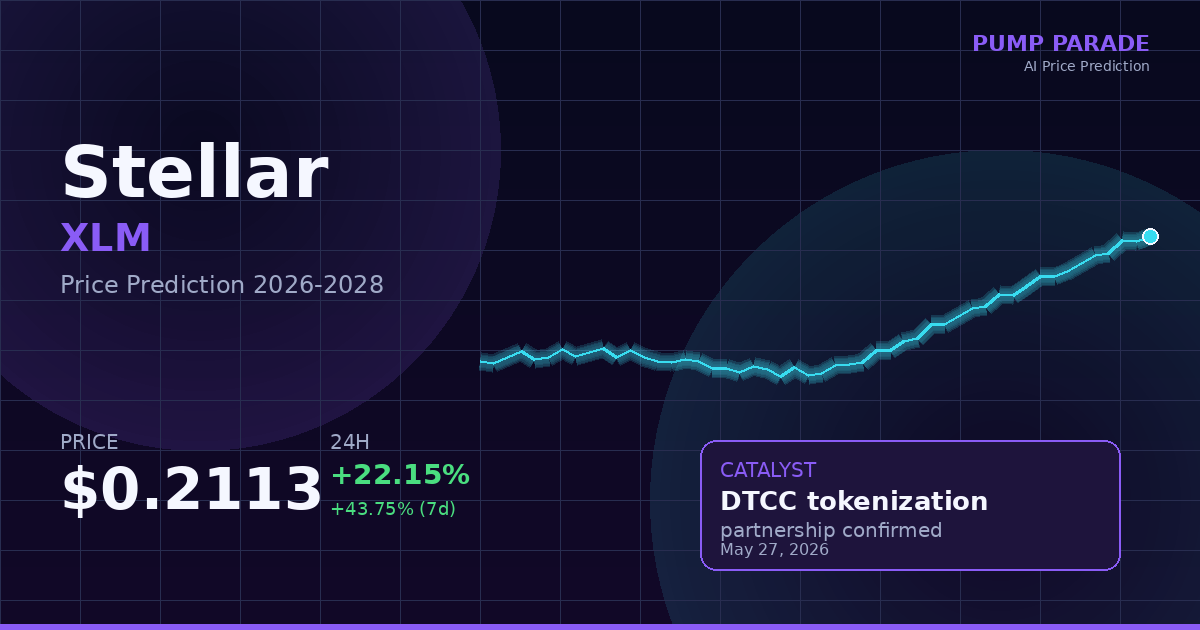
Stellar (XLM) is having a moment. The token trades at $0.2113 at time of writing, up 22% in the last 24 hours and +43% over the past 7 days, while most of the crypto market is bleeding. The catalyst: on May 27, the Depository Trust & Clearing Corporation (DTCC) named Stellar as the first public blockchain in its new multi-chain tokenization push.
That is the entity that processes $2.5 quadrillion in securities transactions a year. It is now wiring a piece of that plumbing into a public chain that most retail investors had written off as boring. The market noticed. The question is whether the move has legs or whether XLM is about to give it all back. Let’s break down the data.
What just happened to Stellar (XLM)?
Two things are pushing XLM right now, and only one of them is hype.
The first is structural. DTCC, through its subsidiary The Depository Trust Company (DTC), said it will connect its tokenized securities platform to the Stellar public network. The roadmap is concrete: limited production trades in July 2026, broader service launch in October 2026, and live DTC-custodied assets on Stellar in the first half of 2027. Initial scope includes Russell 1000 stocks, major ETFs, and U.S. Treasury securities.
The second is technical. XLM had been ranging between $0.16 and $0.18 for most of May. The DTCC announcement hit and the token broke out on volume, printing a 24-hour high of $0.2205 against a low of $0.1730. 24-hour trading volume jumped to $2.03 billion, more than triple the recent average. On-chain wallets holding more than 1 million XLM also rose into the breakout, which suggests this is not just retail chasing a green candle.
Here’s the thing: XLM still sits 75.9% below its January 2018 all-time high of $0.875. It is also down 26% over the past year. So the breakout is real, but XLM is rallying from a depressed base, not a peak. That matters for how we think about upside.
Stellar token overview: the basics
Stellar is a layer-1 blockchain built for cross-border payments and asset issuance. It launched in 2014 as a fork of Ripple, with the Stellar Development Foundation (SDF) running the open-source protocol. The chain settles in 3-5 seconds, charges fractions of a cent per transaction, and uses a federated Byzantine agreement consensus instead of proof-of-work.
Key metrics at time of writing:
- Price: $0.2113
- Market cap: $7.06 billion (rank #17)
- 24h volume: $2.03 billion
- Fully diluted valuation: $10.5 billion
- Circulating supply: 33.6 billion XLM
- Total supply: 50 billion XLM (no inflation since 2019)
Stellar’s pitch has always been the same: be the rails for moving value, not the casino for trading it. For years, that pitch felt out of step with where crypto attention went. The DTCC deal is the first time that pitch has lined up with a major institutional commitment in 2026.
Technical analysis: where is XLM right now?
Let’s look at the chart in plain terms.
The breakout above $0.18 cleared a level that had held as resistance since early April. That level now flips to support. The next significant resistance sits at $0.25, which corresponds to the August 2025 high. Above that, the chart is fairly open until $0.35, where heavy distribution occurred in late 2024.
The 14-day Relative Strength Index (RSI), a momentum indicator that ranges from 0 to 100, is now reading around 78. That is technically overbought. In most assets, overbought means a near-term cooldown is likely. In a high-conviction breakout, overbought can stay overbought for days or weeks. The pattern that matters more is whether XLM holds above $0.18 on the first pullback.
The MACD (a trend-following momentum indicator) flipped bullish on May 24 and the histogram is expanding, which signals momentum is still building rather than fading.
Our hybrid AI model assigns a 62% probability that XLM holds above $0.18 over the next 14 days, and a 38% probability of a sharp retest of the $0.16 range if Bitcoin breaks below $70K.
The bull case for XLM
The bull case writes itself, but it needs to be written carefully.
DTCC’s multi-chain strategy is not a press release. It is a phased rollout with a known counterparty and a known timeline. If even a small slice of Russell 1000 settlement migrates to Stellar in 2027, the network captures fee revenue and validator activity at a scale that current XLM holders are not pricing in. Tokenized U.S. Treasuries alone are a $7+ billion market today, growing at roughly 60% year-over-year according to RWA.xyz.
This is also where Stellar separates from the broader real-world asset (RWA) narrative. Most RWA exposure today happens through tokens like ONDO, which represent ownership of tokenized funds. Stellar’s pitch is one layer deeper: it wants to be the settlement chain that those tokens run on. For a deeper look at how the RWA narrative has played out for the asset-level tokens, see our Ondo (ONDO) price prediction.
Second, Stellar has clean tokenomics. There is no inflation. The supply was set at 50 billion in 2019 after the SDF burned 55 billion XLM, and 33.6 billion is in circulation. That means the FDV-to-market-cap ratio is 1.49, which is friendlier to long-term holders than many newer L1 tokens with steep emission curves.
Third, the breakout came on rising volume and decoupled from BTC. When XLM rallies hard on a day Bitcoin is down 3%, that is not retail FOMO. That is a re-rating of the asset.
If the bull thesis plays out, XLM has room to reclaim the $0.35-$0.45 zone in the second half of 2026, with $0.55-$0.70 in play if the DTCC integration ships on time in 2027.
The bear case for XLM
Now the other side, because this is where most price prediction articles cheat the reader.
Risk number one: the DTCC timeline is long. October 2026 is the broader launch. Full DTC-asset availability is first half of 2027. That is at least 8 months of waiting, and crypto rarely rewards patience without follow-on catalysts. If summer 2026 turns into a chop fest with no new headlines, the breakout traders rotate out.
Risk number two: Stellar does not capture fees the way an L1 like Ethereum does. Per-transaction fees are minuscule by design. The bull case relies on volume making up for fee size. If DTCC integration produces low transaction counts at first (which is likely for a pilot), XLM holders may not see the on-chain revenue story they are expecting.
Risk number three: macro. Bitcoin is at $73.6K, down 4.7% on the week. If BTC breaks $70K and the broader market enters a deeper correction, XLM gives back the move regardless of fundamentals. We saw exactly this dynamic in Q2 2024.
Risk number four: competition. Stellar is not the only chain pitching itself to traditional finance. Avalanche, Polygon, and Hedera all have institutional partnerships in flight. DTCC explicitly called this a multi-chain strategy. Stellar is first, not exclusive.
If the bear case plays out, a retest of $0.15-$0.16 is on the table by Q3 2026, with downside to $0.12 if BTC enters a real bear leg.
XLM AI price prediction: short, mid, and long-term
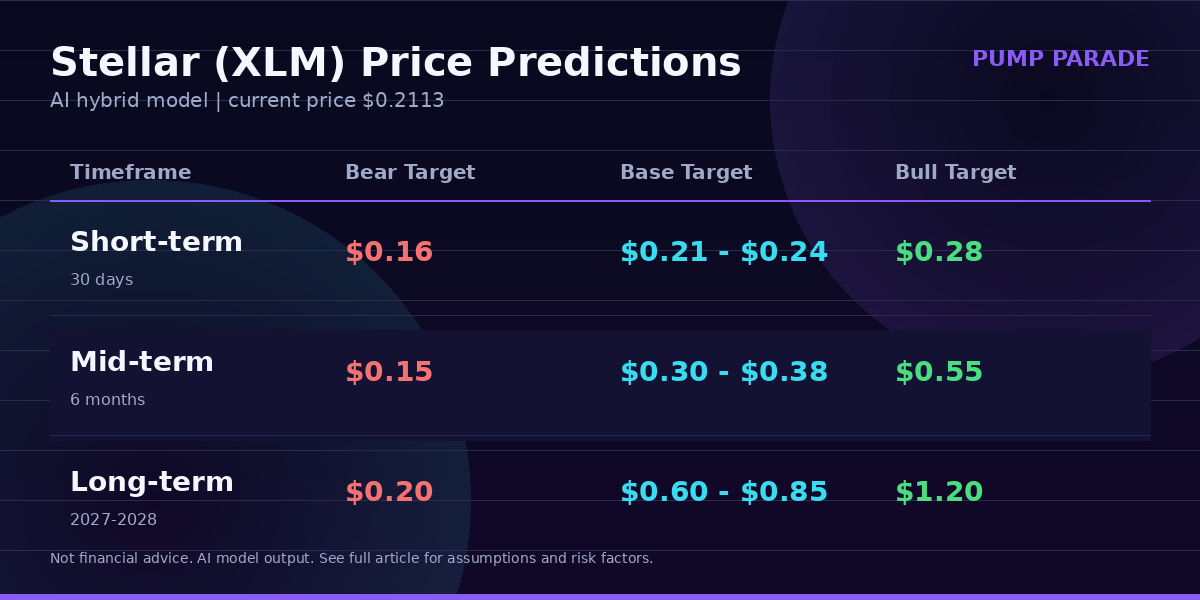
Here is what our hybrid AI model is signaling across timeframes, with current price as the baseline ($0.2113).
Short-term (30 days)
- Bear case: $0.16
- Base case: $0.21 to $0.24
- Bull case: $0.28
The 30-day window is mostly about whether the breakout holds. Watch the $0.18 level. A clean defense of that zone on the first pullback is the strongest near-term signal.
Mid-term (6 months, end of 2026)
- Bear case: $0.15
- Base case: $0.30 to $0.38
- Bull case: $0.55
This window captures the October 2026 DTCC service launch. If the launch ships on time with credible volume, base case is reachable. Bull case requires Bitcoin to be in a clear uptrend and at least one additional institutional partnership for Stellar.
Long-term (2027-2028)
- Bear case: $0.20
- Base case: $0.60 to $0.85
- Bull case: $1.20
The long-term case is fully dependent on DTCC’s tokenization rollout succeeding at scale. The base case puts XLM near its 2018 all-time high. The bull case requires Stellar to capture meaningful share of tokenized securities settlement, plus a constructive macro backdrop. None of this is guaranteed.
What to watch over the next 90 days
If you are tracking XLM, here are the data points that actually matter.
- July 2026 pilot trades: The first DTCC limited production trades on Stellar. Look for volume disclosures and any named issuers.
- October 2026 service launch: Broader DTCC service goes live. Watch for transaction counts and the asset mix.
- $0.18 support: The breakout level. If XLM closes below it on a daily candle, the technical setup weakens.
- SDF announcements: Any follow-on partnership with a major bank, asset manager, or stablecoin issuer.
- BTC behavior: Stellar can decouple on news days, but a true BTC bear leg drags everything down. $70K on Bitcoin is the level to watch.
The bottom line
XLM is in a real catalyst-driven move, not a meme pump. The DTCC partnership is a credible, dated, institutional commitment with a clear path to production. That said, the rally has already done a lot of work in a short window, the long-term thesis depends on rollouts that are 8 to 14 months out, and a macro reversal would override the fundamentals fast.
A reasonable framing: this is one of the more substantiated bull cases in the current market for a top-25 token. It is also one where time risk is the dominant variable. The probability favors XLM as a setup worth monitoring, with sizing and entries that respect the chance of a sharp pullback before the next leg.
Disclaimer: This article is for informational and educational purposes only and should not be construed as financial, investment, or trading advice. Cryptocurrency markets are highly volatile, and past performance does not guarantee future results. The price predictions and analyses presented here are based on AI models, technical indicators, and available data at the time of writing, and they are not guarantees. Always conduct your own research (DYOR) and consult with a qualified financial advisor before making any investment decisions. Pump Parade and its authors do not assume liability for financial losses incurred based on information provided in this article.