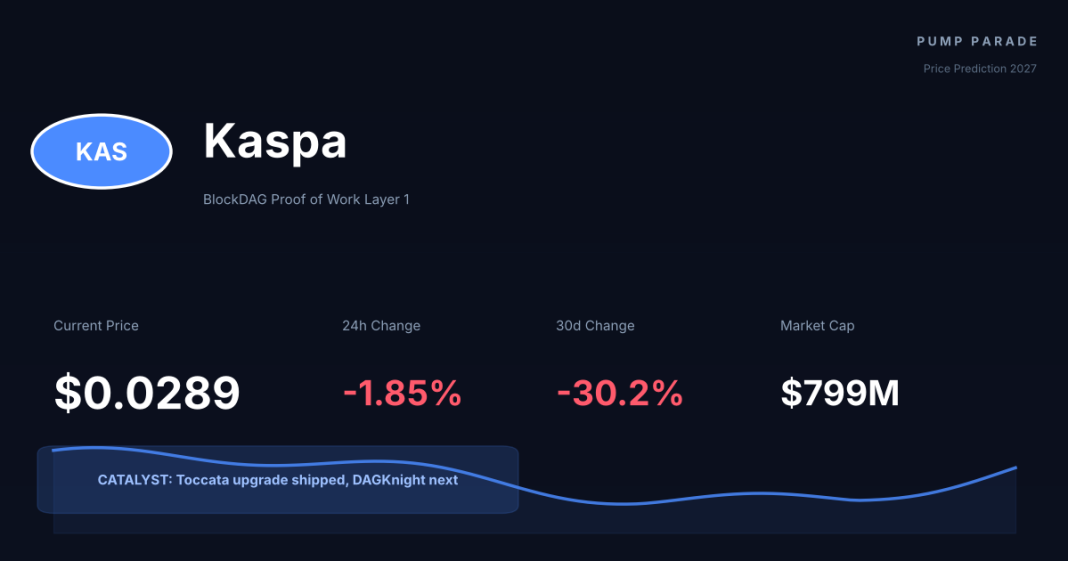
Kaspa (KAS) trades at $0.0289 at time of writing, down 1.85% in the last 24 hours and down roughly 30% over the past month. The Kaspa price prediction 2027 question keeps getting asked because the token sits 86% below its 2024 all-time high of $0.207, yet the network just shipped its biggest upgrade in years. The Toccata hardfork went live on June 30, 2026, adding programmability, covenants, and native token support to a chain that had never run smart contracts before.
The strange part is that the price went the wrong way. Market cap fell 3.8% on activation day. Unique sending addresses stayed in the low thousands rather than climbing. The upgrade worked, but the usage numbers did not follow. That is the tension inside every serious Kaspa thesis right now: real tech, real catalysts ahead, and a market that is punishing the chain anyway.
This is the setup our analysts think about carefully. Below we work through what the on-chain data says, the two catalysts that could change the picture (DAGKnight consensus and verifiable programs), the bull and bear cases with specific price levels, and a comparison with Bitcoin on throughput and energy. The 30-day, 6-month, 2027 and 2028 targets are at the end.
Key Takeaways
- KAS trades at $0.0289, down 30% over 30 days and 86% below its 2024 all-time high of $0.207.
- Toccata hardfork shipped June 30, 2026, adding programmability, native assets, and covenants to Kaspa for the first time.
- Usage lags the upgrade. Unique sending addresses stayed in the low thousands; tracked fees over seven days post-fork totaled about $367.
- DAGKnight consensus and VProgs (verifiable programs) are the next scheduled upgrades, with a stated throughput target near 30,000 TPS.
- 95.4% of KAS supply is already circulating, which limits future supply-side dilution risk.
- Our scenario work puts 2027 targets at $0.028 (bear), $0.055 (base), and $0.105 (bull), contingent on L2 adoption and consensus upgrade delivery.
Where Kaspa Stands Today
KAS is a proof-of-work Layer 1 built on the GHOSTDAG consensus protocol, a BlockDAG design that processes blocks in parallel rather than in the single chain Bitcoin uses. The project launched in November 2021 with no premine and no insider allocation. Yonatan Sompolinsky, the researcher behind the original GHOSTDAG paper and now the chain’s lead scientist, has guided the roadmap since inception. Michael Sutton authored the 2026 Covenants++ outlook that set the Toccata milestone.
Here is where the token sits right now:
| Metric | Value |
|---|---|
| Current price | $0.0289 |
| 24-hour change | -1.85% |
| 7-day change | -11.3% |
| 30-day change | -30.2% |
| Market cap | $799 million |
| 24-hour volume | $9.57 million |
| Market cap rank | #79 |
| All-time high | $0.2074 (Jul 2024) |
| Distance from ATH | -86.1% |
| Circulating supply | 27.8B KAS (95.4%) |
Price data sourced from CoinGecko. The read: KAS is deep in a drawdown, trading below both its 50-day and 200-day moving averages, with 24-hour volume well below the $25M to $40M averages seen in healthier months. In plain terms, the chart tells you traders are sitting on their hands.
Why Is Kaspa Down So Much Right Now?
Three things are weighing on KAS at the same time. First, the Toccata catalyst traded as an event, not a repricing. Reflexivity Research and on-chain trackers showed spot volume spiking into the fork, then fading. Open interest in KAS futures stayed below its 30-day average, which usually means short-term traders took profit rather than longer-term positioning building up.
Second, usage is thin. The post-fork week showed about 329,000 tracked transactions across all Kaspa protocols, with roughly 91% of that activity routed through Igra L2, an EVM-compatible rollup. Kasplex L2 and Kasia accounted for small five-figure transaction counts. Tracked fees over seven days post-fork came to about 12,247 KAS, or roughly $367. A programmable chain with a $367 weekly fee economy is still waiting for its first killer app.
Third, macro. The broader crypto market has been in extreme fear territory, with a Fear and Greed index reading near 25. Small-cap proof-of-work alternatives tend to underperform in these conditions because speculative capital leaves first and comes back last.
What’s the Bull Case for Kaspa in 2027?
1. DAGKnight consensus upgrade
DAGKnight is the next planned consensus upgrade after Toccata, and it is the one that could materially move throughput. The design is an adaptive, parameterless successor to GHOSTDAG, with 50% Byzantine fault tolerance and a stated goal of sub-second finality. If delivered, Kaspa’s roadmap targets 25 blocks per second during the staged rollout, then 100 blocks per second by 2027. The chain’s throughput goal with VProgs sits near 30,000 transactions per second, placing it alongside Solana and Sui on paper.
The timing is loose. Developer teasers point to the DAGKnight rollout bundled with VProgs, with no confirmed mainnet date. In similar setups, a hardfork being talked about as “soon” by the lead scientist historically precedes mainnet activation by six to twelve months. Traders tracking Kaspa should watch testnet stability reports rather than Twitter teasers.
2. VProgs (verifiable programs)
VProgs are Kaspa’s version of Layer 1 smart contracts. The architecture is different from Ethereum’s EVM: VProgs are described as verifiable programs that support atomic, privacy-preserving transactions and synchronous cross-dApp calls. Think of it like an off-chain compute layer where each program’s output is verified on-chain with zero-knowledge proofs. If the L1 can keep block times fast and push heavy computation off-chain, Kaspa could run high-frequency applications that choke slower chains.
The honest caveat: the toolchain is still research-stage. The developer experience, bridging, and liquidity have to be built, and competing L1s like Monad and Sei already have mainnet-ready EVM alternatives. For a look at how one of those chains is tracking, see our Sui price prediction for 2027. For another PoW alternative in the same market cap band, our Litecoin price prediction for 2027 has the supply math and halving context for comparison.
3. Supply dynamics approaching the emission cliff
Kaspa reached 95% of its max supply by mid-2026. New issuance from mining is now very small, and will approach zero into 2027. Historically, hard-money proof-of-work assets have re-rated once new supply drops below 1% of circulating. The pattern suggests that buyer and seller sides become more reflexive once new daily issuance is a rounding error. Bitcoin showed a version of this after each halving. KAS is not Bitcoin, but the mechanic is similar: fewer sellers forced to dump freshly minted coins every day.
What Could Break the Kaspa Thesis?
1. Usage never arrives
The simplest bear case is that Kaspa ships upgrade after upgrade and nobody builds on it. The post-Toccata address count stayed in the low thousands versus the July 2024 peak near 753,000. If VProgs ship in 2027 and daily active addresses still sit below 50,000, the “programmable BlockDAG” thesis starts to look structurally weaker than EVM alternatives, which already have liquidity and tooling.
2. L2 cannibalization, not L1 demand
Ninety-one percent of post-Toccata transaction activity routed through Igra, an EVM-compatible L2 built on Kaspa. If the real traction keeps going to an EVM rollup, the KAS token captures fees but not developer mindshare. The L2 may thrive while L1 KAS trades like gas, not like equity.
3. Spot liquidity remains thin
$9.5M in daily volume on a top-80 asset is a thin book. Thin books break both ways. The risk is that a $500k to $1M sell order in a bad tape cascades through the order book, triggering stop losses and liquidations in futures. This is less about Kaspa specifically and more about any mid-cap PoW asset in a bear tape.
Kaspa Price Prediction 2027: Targets by Timeframe
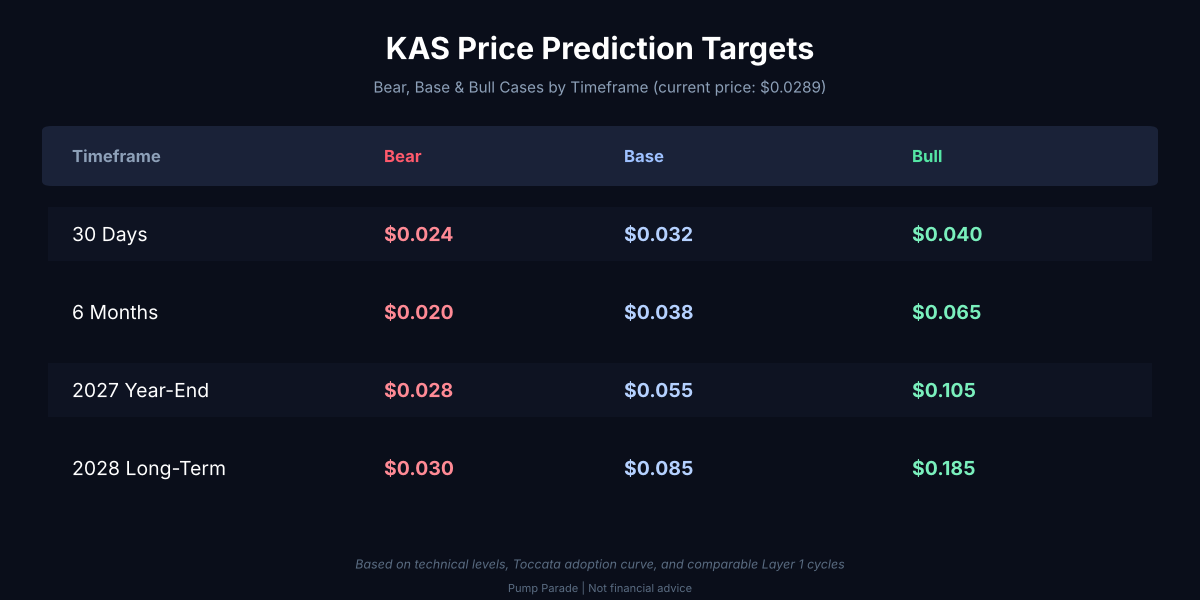
Our Kaspa price prediction 2027 model blends three inputs: technical levels on the daily chart, Toccata and DAGKnight adoption curves, and comparable Layer 1 cycles from 2021 and 2024. The result is three scenarios per timeframe, not a single point forecast.
30-day outlook
Bear case: $0.024. A break below the 200-day moving average on volume takes KAS into air pocket territory with next support near $0.022. Base case: $0.032. A bounce off the $0.027 to $0.029 band back into the 50-day moving average. Bull case: $0.040. Requires a broader crypto risk-on move and an exchange listing or product announcement.
6-month outlook
Bear case: $0.020, if VProgs slip to late 2027 and address growth stagnates. Base case: $0.038, consistent with a normal seasonal recovery and DAGKnight testnet signals. Bull case: $0.065, assumes a credible DAGKnight mainnet date and L2 TVL growth into the hundreds of millions.
2027 year-end outlook
Bear case: $0.028, essentially flat, if the chain ships but adoption disappoints. Base case: $0.055, roughly doubling from current, aligned with the CoinCodex model’s 2027 highs. Bull case: $0.105, the $0.10 round-number target the market talks about, which requires DAGKnight live, VProgs usable, and at least one top-20 centralized exchange listing. For context, Changelly’s model tops out near $0.046 for 2027, and crypto.news caps its 2027 bull at $0.056. Our bull case is ahead of both because it prices in one meaningful tier-1 listing event.
Long-term (2028)
Bear case: $0.030. Base case: $0.085. Bull case: $0.185. A 2028 bull case clearing the 2024 ATH of $0.207 is possible only in a cycle top scenario with Bitcoin trading well above its own ATH.
How Does Kaspa Compare to Bitcoin?
Kaspa positions itself as a scalable generalization of Nakamoto consensus. It is proof-of-work, but the BlockDAG design processes many blocks in parallel rather than forcing a single chain. Here is the side-by-side on the metrics that matter:
| Metric | Bitcoin (BTC) | Kaspa (KAS) |
|---|---|---|
| Consensus | Nakamoto PoW | GHOSTDAG BlockDAG PoW |
| Block time | 10 minutes | 0.1 seconds (10 BPS) |
| Confirmation | 10 to 60 minutes | ~10 seconds |
| Max supply | 21M BTC | 28.7B KAS |
| Circulating | ~95% | ~95.4% |
| Smart contracts | Script (limited) | Covenants (live), VProgs (coming) |
| Market cap | $1.49T | $799M |
| Launch style | Fair launch 2009 | Fair launch 2021 |
Translation: Kaspa is a faster, newer proof-of-work design with a supply curve that looks like Bitcoin’s but a block structure built for application load. The trade-off: Bitcoin has institutional adoption, spot ETFs, and deep liquidity. Kaspa has speed, programmability, and a $799M market cap sitting below a $20B network like Zcash. Whether you want to pay for maturity or for upside is the trade-off. For a view on what institutional accumulation looks like on the other side, see our Bitcoin price prediction for 2027.
What Would Change Our View
The base case in this article is not static. Here are three explicit triggers that would move the model.
Trigger 1 (bull revision): DAGKnight lands on mainnet with public benchmarks confirming sub-second finality and 25+ BPS stable throughput. A tier-1 centralized exchange adds KAS to its spot and perpetual futures book. Combined, these would push our 2027 bull case toward $0.15 instead of $0.105.
Trigger 2 (bear revision): Twelve months post-Toccata, daily active addresses on Kaspa and its L2s combined stay below 20,000 and tracked fees stay under $5,000 weekly. In that world, the chain has shipped the plumbing but failed to attract builders, and our 2027 base case moves down to $0.030.
Trigger 3 (regulatory shift): A clear U.S. regulatory classification of GHOSTDAG-style PoW chains, especially around mining rewards and energy accounting, would materially change institutional appetite. Favorable language reopens the door to listed mining operators holding KAS as a treasury asset.
Frequently Asked Questions
Will Kaspa reach $0.10 in 2027?
Our bull case puts KAS at $0.105 by year-end 2027. Reaching $0.10 requires three things: DAGKnight consensus live on mainnet, VProgs usable by developers, and at least one top-20 centralized exchange listing. Without those, the base case of $0.055 is more realistic given current adoption metrics.
Is Kaspa a good investment in 2027?
Kaspa is a high-beta, high-conviction trade. The tech is credible and the supply curve is tight, but adoption is early and liquidity is thin. It fits a small-cap allocation for traders who can monitor upgrade delivery. It does not fit investors who need a mature, liquid, regulated asset. Position sizing matters more here than entry timing.
Is Kaspa dead?
No. The chain shipped the Toccata hardfork on schedule in June 2026, the dev team continues to publish research, and 95% of supply is already in the hands of holders rather than new issuance. The price is painful, but the fundamental delivery track record is intact. Dead chains do not ship on-time hardforks.
What is Kaspa’s smart contract roadmap?
Toccata is live and enables covenants, native asset issuance, and KRC-20 tokens at the base layer. Next is the DAGKnight consensus upgrade bundled with VProgs, Kaspa’s zero-knowledge-based programmable layer. Throughput goals climb from 10 to 25 to 100 blocks per second, with a stated target near 30,000 TPS at full capability.
How does Kaspa differ from Bitcoin?
Both are proof-of-work with fair launches and capped supply. Kaspa uses BlockDAG consensus (GHOSTDAG) to process blocks in parallel instead of in sequence, which brings block times from 10 minutes down to 0.1 seconds. Kaspa also adds programmability via Toccata and will add smart contracts via VProgs. Bitcoin stays intentionally minimal; Kaspa pushes PoW into application territory.
Why did KAS drop after the Toccata upgrade?
The upgrade traded as an event rather than a repricing. Spot volume spiked into fork day, then faded as short-term traders took profit. Post-fork address growth and fees stayed muted, which gave trend followers reason to exit. Broader crypto fear conditions amplified the move. The upgrade worked, but the market wanted immediate usage, not a future roadmap.
The Honest Take
Kaspa is in the awkward phase every serious Layer 1 goes through: the tech is ahead of the adoption, and the market punishes that gap. If you believe GHOSTDAG and DAGKnight represent a real advance over Nakamoto consensus, and you can accept that the next twelve months may stay choppy, KAS at $0.029 is a different asset than KAS at $0.20. If you need usage to lead price, you probably want to wait for DAGKnight mainnet and VProgs testnet with real developer activity.
The setup worth monitoring is this: the $0.027 to $0.029 band is holding as support, the 200-day moving average is sloping flat rather than down, and the supply overhang from mining is shrinking every week. Those are the ingredients of a base, not a top. Whether a base turns into a breakout depends on things that have not happened yet. Watch the testnets, not the tweets.
Disclaimer: This article is for informational and educational purposes only and should not be construed as financial, investment, or trading advice. Cryptocurrency markets are highly volatile, and past performance does not guarantee future results. The price predictions and analyses presented here are based on AI models, technical indicators, and available data at the time of writing, they are not guarantees. Always conduct your own research (DYOR) and consult with a qualified financial advisor before making any investment decisions. Pump Parade and its authors do not assume liability for financial losses incurred based on information provided in this article.