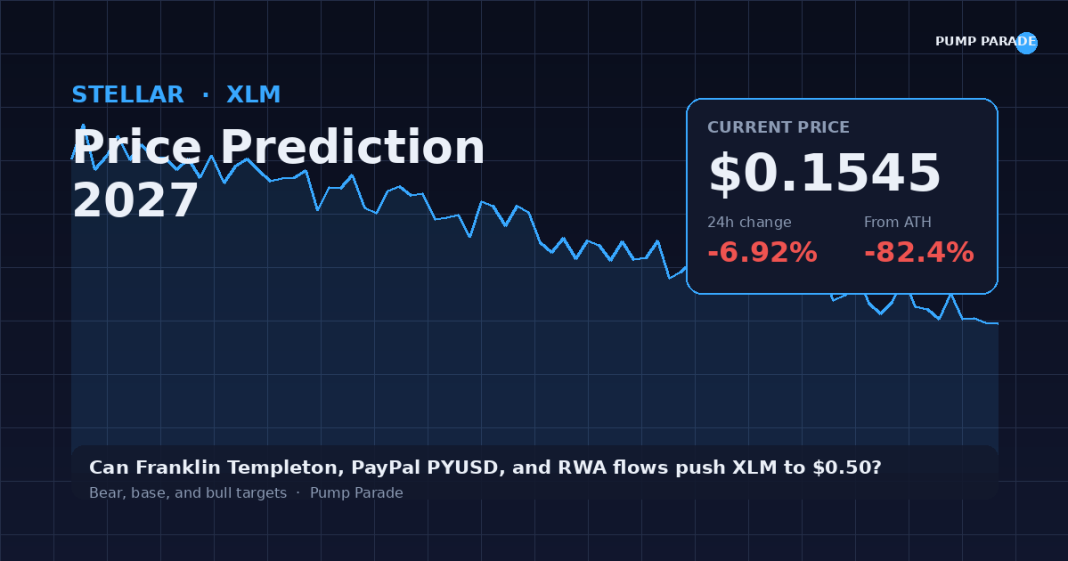
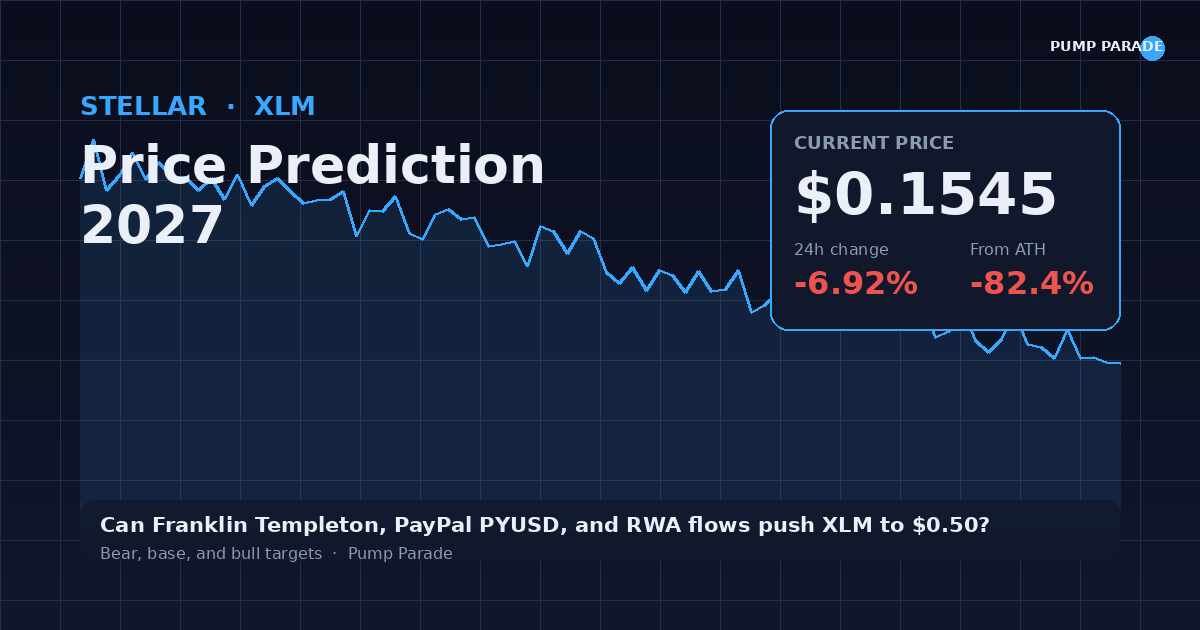
Stellar’s XLM is a strange token to cover right now. The price just closed at $0.1545, down 6.9% on the day and off a brutal 82.4% from its 2018 all-time high of $0.8756. On the chart, it looks like a dog that has forgotten how to run.
On the fundamentals, it looks like one of the most important payment rails in the world. This Stellar price prediction for 2027 has to reconcile both. Franklin Templeton’s BENJI tokenized money market fund now exceeds $1.9 billion in assets, five years running on Stellar. The network hosts over $660 million in tokenized US Treasuries. PayPal has committed to bringing PYUSD to Stellar for 170-plus-country cross-border payments. DeFi TVL on Soroban just set a fresh all-time high of $273 million on October 2.
Here is the core question for 2027: does XLM finally price in the institutional traction it has been building, or does it keep bleeding while BENJI holders take all the economics? Below, we lay out the data, the three catalysts that actually matter, the two risks that could invalidate the thesis, and three target bands. Then we tell you exactly what would change our view.
Key Takeaways
- XLM trades at $0.1545, down 82% from its 2018 ATH and 24% over the past 30 days.
- Franklin Templeton’s BENJI fund on Stellar now tops $1.9B in AUM, the largest US-registered tokenized money market fund, and five years old on the network.
- Stellar carries $660M+ in tokenized US Treasuries. Cost comparison: 50,000 transactions run $75,000 on traditional rails vs $1.13 on Stellar, per Franklin Templeton.
- PayPal announced PYUSD on Stellar in June 2025, targeting cross-border remittances, merchant services, and PayFi in 170+ countries.
- Our 2027 base case: $0.50. Bull: $1.00. Bear: $0.09. The spread reflects real uncertainty around whether RWA traction translates to token price.
Where Stellar (XLM) Stands Today
Before the catalysts, the raw numbers. XLM is the native asset of the Stellar network, originally designed for cross-border payments and now increasingly the plumbing for tokenized real-world assets. Here is the snapshot as of this writing.
| Metric | Value |
|---|---|
| Price | $0.1545 |
| 24h change | -6.92% |
| 7d change | -6.87% |
| 30d change | -24.12% |
| 1y change | -43.29% |
| Market cap | $5.46B |
| 24h volume | $193.9M |
| Market cap rank | #19 |
| All-time high | $0.8756 (Jan 2, 2018) |
| % from ATH | -82.36% |
| Circulating supply | 35.35B XLM |
| 24h range | $0.1517 to $0.1660 |
Two things jump out. First, the volume-to-market-cap ratio of roughly 3.5% is thin. That tells you a lot of XLM is parked rather than traded, which is both a bull signal (less sell-side float) and a bear signal (shallow books). Second, the gap between on-chain fundamentals and token price is the widest in the top 20. We will come back to that.
Why is XLM falling right now?
Mostly, risk-off. Bitcoin is down 5.3% on the day. Ethereum is off 7.6%. XRP, Stellar’s closest cousin by narrative, is bleeding 9.5%. XLM’s 6.9% drop is middle-of-pack. Lower-float, lower-volume alts almost always underperform in broad drawdowns, and XLM fits that profile.
The 24% drop over 30 days is more notable. Part of it is the broader altcoin correction, part is specific to XLM’s supply dynamics. The Stellar Development Foundation (SDF) holds a meaningful share of circulating supply and periodically distributes to ecosystem partners, which can weigh on near-term price even when the long-term thesis is healthy. On the chart, the $0.15 level is the cleanest horizontal support dating back to Q4 2024. Lose that and the next meaningful shelf is around $0.11.
Can Stellar’s Real-World Asset Lead Actually Price In?
1. Franklin Templeton BENJI: the $1.9B anchor
BENJI is the Franklin OnChain US Government Money Fund, the first US-registered tokenized money market fund, and it has been running on Stellar for five years. As of the most recent disclosures the fund exceeds $1.9 billion in assets. This is not a pilot program. This is a Wall Street brand running real custody, real compliance, and real investor dollars on a public blockchain. Franklin Templeton’s own cost comparison is striking: 50,000 transactions cost roughly $75,000 on traditional rails versus about $1.13 on Stellar, per Sandy Kaul of Franklin Templeton. For context on how this fits into the broader tokenization race, see Franklin Templeton’s reported BENJI growth above 100% YTD.
2. PayPal PYUSD on Stellar
PayPal announced in June 2025 that PYUSD would come to Stellar, pending New York State Department of Financial Services approval. The use cases are the ones that actually matter for payment networks: cross-border remittances, merchant settlement, micro-financing, and what PayPal calls PayFi, real-time working capital for small businesses. PayPal frames the target reach as 170+ countries. The read-through for XLM: more PYUSD volume means more Stellar operations, means more demand for XLM as the network fee asset, per the Stellar Development Foundation’s official release.
3. Soroban DeFi TVL at a fresh high
Soroban, Stellar’s smart contract platform, activated on mainnet in February 2024 through the Protocol 20 upgrade. On October 2, 2026, Stellar DeFi TVL hit an all-time high of $273 million. That is small next to Ethereum or Solana, but it is three-plus years of compounding from zero. The important part: Soroban opens Stellar to lending protocols, AMMs, and structured RWA products that the original Stellar consensus layer could not host. If even a fraction of the $660M in on-chain Treasuries moves into Soroban DeFi strategies, TVL compounds fast.
What Could Break the Stellar Thesis?
1. The “institutions use the rails, token does nothing” risk
This is the real bear case, and it is subtle. Franklin Templeton can run $1.9 billion in BENJI assets while XLM sits at $0.15, because BENJI holders do not need to hold XLM. They hold the fund. Payment flows pay fees in fractions of a penny. The volume of actual XLM demand generated by institutional RWA activity is small relative to total supply. If this dynamic holds, XLM becomes a utility token that never really prices in the network it powers. We give this scenario real weight, which is why our bear case is below spot.
2. Competition is heavy
XLM is not the only payment chain pitching institutions. Ripple’s XRP has deeper banking relationships and its own stablecoin push, which we broke down in our XRP price prediction for 2027. Hedera (HBAR) has Google, IBM, and Boeing on its governing council. Algorand, SUI, and Solana are all courting the same tokenization flow with their own enterprise angles. The RWA pie is huge, but the slice XLM captures is far from guaranteed. For the broader macro backdrop that shapes altcoin flow allocation in 2027, see our Bitcoin price prediction for 2027.
3. Structural supply overhang
35.35 billion XLM circulate today. The SDF holds a sizable pool it distributes over time for ecosystem development. Every distribution event is latent sell pressure, even when the recipients deploy the tokens productively. Price appreciation needs either demand to outrun those distributions or the SDF to tighten the pipe. Neither is guaranteed.
Stellar (XLM) Price Prediction 2027: Targets by Timeframe
30-day outlook
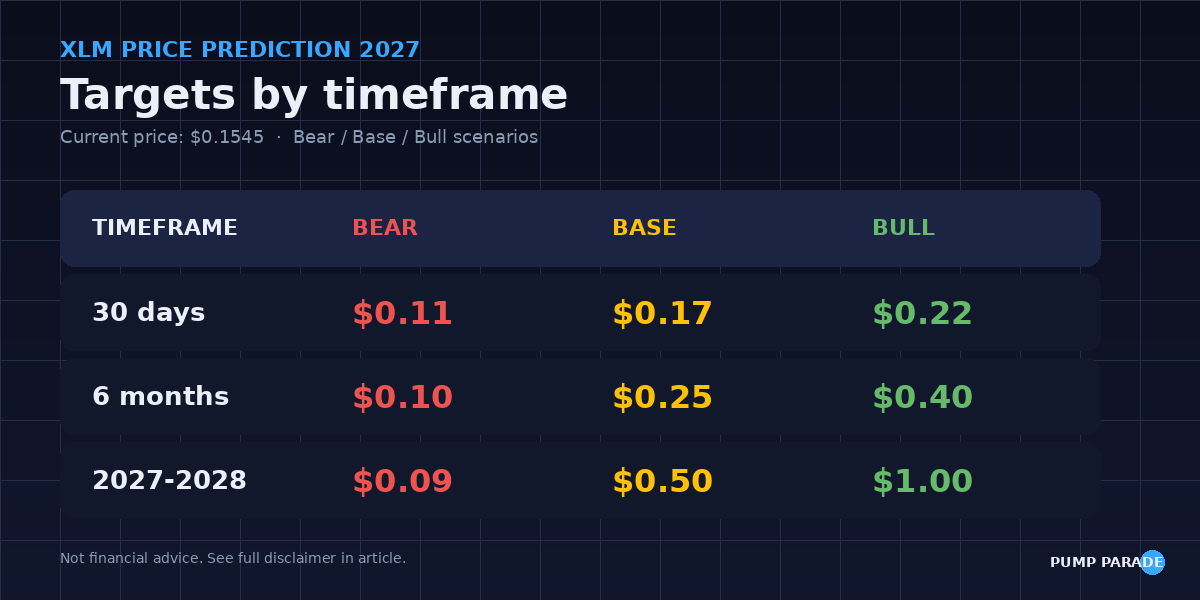
Short-term, the decisive level is $0.15. Hold it, and XLM probably mean-reverts toward $0.17-$0.22 on any macro bounce. Lose it, and $0.11 (the 2024 breakout zone) comes into play fast. Bear $0.11, base $0.17, bull $0.22. The risk-reward is fine but nothing you want to lever.
6-month outlook
By Q2 2027 we expect clarity on three things: PYUSD on Stellar going fully live under NYDFS approval, Soroban TVL either breaking $500M or stalling, and BENJI’s growth curve. A base case $0.25 price would reflect modest multiple expansion on improving fundamentals. The bull case at $0.40 requires PYUSD volume to be meaningful AND a broader altcoin recovery. Bear $0.10, base $0.25, bull $0.40.
Long-term (2027-2028)
Our 2027-2028 base case is $0.50, which is a 3.2x from current spot and roughly the level several mainstream aggregators like Traders Union have published as their 2027 target. The thesis behind that number: tokenized RWA on Stellar crosses $3-5B, PYUSD does meaningful daily volume, Soroban TVL reaches $750M-$1B, and the whole crypto market enjoys a cycle tailwind. The bull case at $1.00 would require Stellar to capture noticeably more of the tokenization race than its current trajectory implies, roughly on par with Jeffrey Kendrick’s style of targets for high-adoption plays. The bear case at $0.09 would mean the institutional traction never translated. Some aggregator forecasts from sources like CoinGecko’s community predictions cluster between $0.30 and $0.80 for 2027, which brackets our base.
XLM vs XRP: Which Payment Token Wins by 2027?
Every XLM conversation eventually becomes an XRP conversation. They share origin DNA (Jed McCaleb co-founded both), they target overlapping use cases, and they trade on similar narratives. Here is the honest head-to-head.
| Metric | Stellar (XLM) | Ripple (XRP) |
|---|---|---|
| Price | $0.1545 | $1.19 |
| Market cap | $5.46B | $75.8B |
| Market cap rank | #19 | #5 |
| Core focus | Tokenized RWA, remittances | Bank cross-border, stablecoin |
| Flagship RWA | Franklin Templeton BENJI ($1.9B) | RLUSD stablecoin |
| Smart contracts | Soroban (live Feb 2024) | XRPL EVM sidechain |
| US spot ETFs | Filings in review | Multiple live |
| Main governance body | Stellar Development Foundation | Ripple Labs |
| Supply model | 50B issued, 35B circ, no max cap | 100B cap, 60B circ |
The read-through: XRP has 14x the market cap and a bigger institutional footprint. XLM has the better RWA story by brand name (BENJI is a Franklin Templeton product, not a startup) and a cheaper entry price. If you believe the whole payments-plus-RWA category gets re-rated, you probably want some XRP for size and some XLM for upside convexity. If you only pick one, XRP wins on liquidity and XLM wins on asymmetry.
What Would Change Our View
Three concrete triggers. If any of these fire, revise the above.
Upgrade to bull in a hurry: Tokenized assets on Stellar (BENJI plus Treasuries plus any new issuance) crosses $5 billion before end of Q2 2027. That would be strong evidence the RWA pipeline actually translates to Stellar-native growth, and $0.75-$1.00 becomes the operative zone.
Downgrade to bear: A six-month stretch where DeFi TVL on Soroban plateaus below $300M AND PYUSD on-chain volume disappoints. That would signal institutions are using Stellar as cheap settlement but not as a platform, and the token lags indefinitely.
Thesis break: A credible competitor, most likely an EVM L2 or an XRPL EVM product, captures a meaningful BENJI-style anchor tenant. The RWA narrative is not permanent. If institutions standardize on EVM for compliance reasons, XLM structurally derates.
Frequently Asked Questions
Will XLM reach $1 in 2027?
Our bull case puts XLM at $1.00 in the 2027-2028 window, which would be a roughly 6.5x from current spot. That is not inside our base case. It requires tokenized assets on Stellar to cross $5B, PYUSD volume to be meaningful, Soroban TVL to reach $750M-$1B, and the broader market to cooperate. Possible, not probable.
Is Stellar a good investment in 2027?
Depends on your risk tolerance and your view on real-world asset tokenization. XLM offers asymmetric upside if the RWA thesis plays out, backed by the strongest institutional anchor in the space (Franklin Templeton BENJI). It also carries real risk that the token never captures the economics of the network it powers. Position size accordingly.
What is the Stellar price prediction for 2027?
Our 2027 range: bear $0.09, base $0.50, bull $1.00. The base case assumes continued BENJI growth, PYUSD going live under NYDFS approval, and Soroban DeFi TVL compounding from today’s $273M to roughly $750M. The bear case triggers if RWA traction fails to generate XLM-level demand.
What is BENJI and why does it matter for XLM?
BENJI is Franklin Templeton’s OnChain US Government Money Fund, the first US-registered tokenized money market fund, and it has run on Stellar for five years with over $1.9B in assets. It matters for XLM because it is proof that top-tier US asset managers are willing to use Stellar for real regulated products, which validates the RWA narrative that drives most of the bull case.
How does Stellar make money?
Stellar itself is a non-profit network. The Stellar Development Foundation funds development from its XLM reserves. Transaction fees are tiny by design (fractions of a cent), which is a feature for payment use cases but means XLM does not accrue value from fee burn the way some chains do. XLM’s value capture comes from utility demand (holding XLM for network access and settlement), scarcity from SDF policy, and speculative premium tied to the RWA story.
What is Soroban?
Soroban is Stellar’s smart contract platform, activated on mainnet in February 2024 as part of the Protocol 20 upgrade. It brought general-purpose programmability to Stellar for the first time, enabling lending protocols, AMMs, structured products, and other DeFi applications. As of October 2026, Soroban DeFi TVL set a fresh ATH of $273M.
The Honest Take
Stellar is the most interesting asymmetric payments bet in the top 20 right now, and we say that fully aware of the risks. The institutional footprint is real and growing. Franklin Templeton, PayPal, and the tokenized Treasury story are not vaporware. On the other hand, the token has been one of the worst performers among top-20 assets over the past year, and the gap between network traction and price has not closed.
Our honest read: XLM looks like a token where the probability modestly favors upside into 2027, but the path is choppy and the downside is real. If the RWA thesis plays out and BENJI, PYUSD, and Soroban all keep scaling, $0.50 by 2027 is reasonable and $1.00 is in reach. If the token-vs-network disconnect stays stuck, you can hold for 18 months and still be at $0.15. Size for both outcomes.
Watch three numbers. Franklin Templeton BENJI AUM (we want to see it holding above $2B). Soroban DeFi TVL (we want to see $500M before mid-2027). And PYUSD on-chain volume once NYDFS approval lands. Those three metrics tell you more about where XLM goes next than any chart pattern will.
Disclaimer: This article is for informational and educational purposes only and should not be construed as financial, investment, or trading advice. Cryptocurrency markets are highly volatile, and past performance does not guarantee future results. The price predictions and analyses presented here are based on AI models, technical indicators, and available data at the time of writing, they are not guarantees. Always conduct your own research (DYOR) and consult with a qualified financial advisor before making any investment decisions. Pump Parade and its authors do not assume liability for financial losses incurred based on information provided in this article.