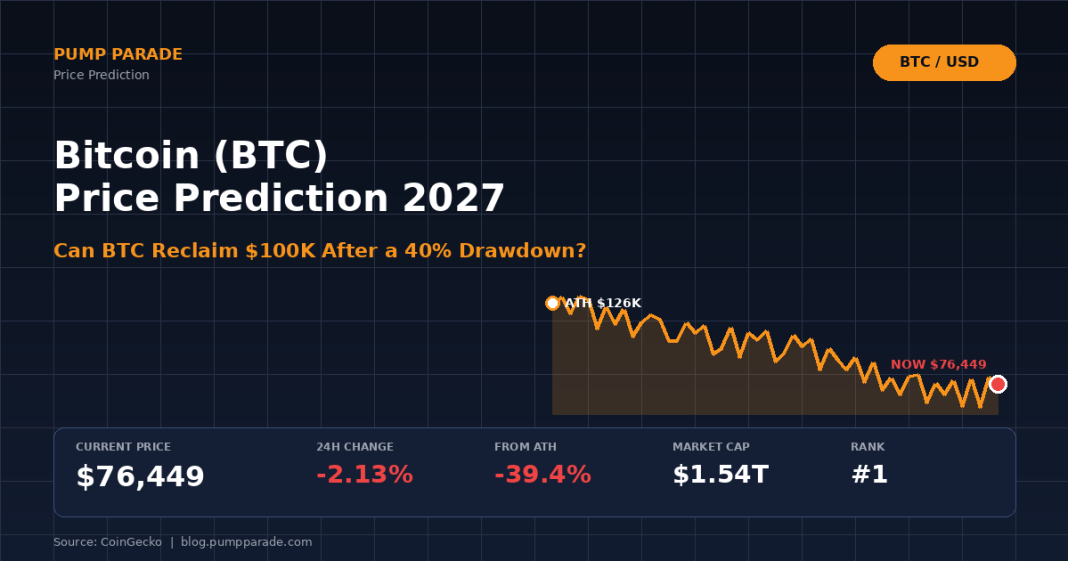
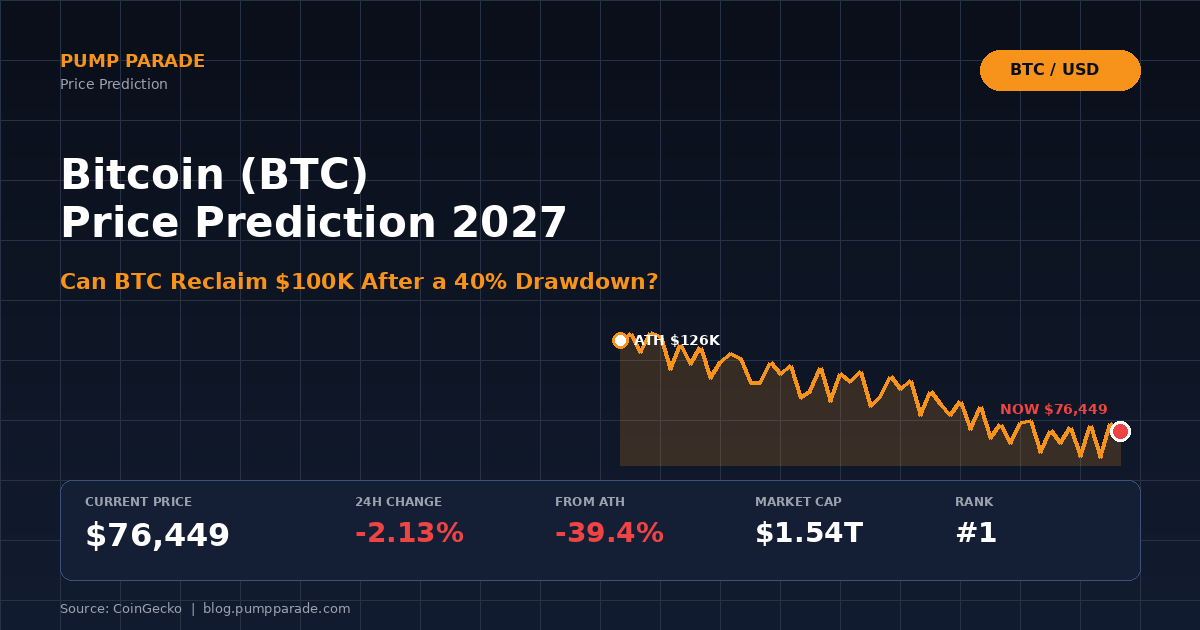
Bitcoin is trading at $76,449 at the time of writing, down roughly 39% from its October 2025 all-time high of $126,080 and off almost 29% over the past year. For anyone trying to make a credible bitcoin price prediction 2027 call right now, that drawdown is the whole conversation. The post-ETF, post-halving rally that defined 2024 and most of 2025 has broken, spot ETF outflows have ripped through the market, and the four-year cycle is getting a serious stress test.
Here’s the thing: a 40% drawdown is painful, but it is not historically unusual for Bitcoin. The same asset that just lost two-fifths of its market cap also still prints a $1.54 trillion market value and clears $27 billion a day in volume. The question for 2027 isn’t whether Bitcoin survives. It’s whether it reclaims $100,000, pushes to new highs, or spends another year grinding sideways.
This piece walks through where BTC stands today, the bull case, the bear case, three target scenarios for 2027, and the honest answer to the question people keep asking: is Bitcoin a good investment heading into 2027?
Key takeaways
- Bitcoin trades at $76,449, down 39.4% from its October 2025 ATH of $126,080.
- U.S. spot Bitcoin ETFs have shed billions since October, led by BlackRock’s IBIT, draining a key marginal buyer.
- Bear case targets $55,000 if the $70K zone breaks. Base case puts BTC in a $85,000 to $110,000 band by end of 2027.
- Bull case for 2027: $150,000 to $180,000, consistent with Galaxy Digital’s $250K path and Standard Chartered’s $500K-by-2028 trajectory.
- The 2028 halving (expected April or May 2028) is the main cyclical catalyst between now and the end of the forecast window.
Where Bitcoin Stands Today
Before any bitcoin price prediction 2027 is worth reading, you need the current snapshot. Here is where BTC sits as of November 2026, using live data from CoinGecko:
| Metric | Value |
|---|---|
| BTC Price | $76,449 |
| 24h Change | -2.13% |
| 7d Change | -3.90% |
| 30d Change | -10.08% |
| 1-Year Change | -28.90% |
| Market Cap | $1.537 trillion |
| 24h Volume | $26.95 billion |
| Market Cap Rank | #1 |
| All-Time High | $126,080 (Oct 6, 2025) |
| % From ATH | -39.36% |
| Circulating Supply | 20.11M / 21M max |
Two numbers in that table deserve a second look. First, the drawdown. A 39% pullback is the deepest Bitcoin has posted since the 2022 cycle bottom. Second, the circulating supply. BTC is now 95.8% of the way to its 21 million hard cap, and the next halving in 2028 will cut new issuance in half again. In plain terms: supply is scarce and getting scarcer, even as the marginal buyer disappears.
Why Is Bitcoin Falling Right Now?
The current correction has three overlapping drivers. None of them are mysterious, and all three can reverse.
ETF outflows. U.S. spot Bitcoin ETFs have seen multi-billion-dollar monthly outflows since the October 2025 peak, with BlackRock’s IBIT absorbing the biggest hits. According to SoSoValue data cited across industry trackers, cumulative outflow pressure has drained a key marginal buyer that drove the 2024 to mid-2025 rally.
Fading rate-cut hopes. After the Fed signaled a slower pace of easing, risk assets re-rated lower. Bitcoin’s correlation to the Nasdaq remains high during stress periods, and when traders mark down tech, BTC marks down with it.
Cycle fatigue. The four-year halving cycle has delivered a top in late 2017, late 2021, and now (if the pattern holds) late 2025. The October 2025 ATH fits the script. The question isn’t whether the cycle delivered. It’s whether the bear phase that followed each prior top plays out again, which historically meant 70% to 80% drawdowns. A 40% drawdown so far is milder than that, suggesting either the cycle is softening or there’s more pain ahead.
What’s the Bull Case for Bitcoin in 2027?
Reclaiming $100,000 and pushing past the prior ATH requires catalysts, not hope. Three real ones are stacking up.
1. The Fed finally pivots
If U.S. inflation data cooperates, the Fed resumes cutting through 2027, and real yields fall, Bitcoin is the clearest beneficiary among liquid assets. The 200-week moving average, a level that has historically marked bear-market floors, sits well below current price and acts as a shock absorber. A sustained easing cycle would be the first major macro tailwind since 2024.
2. ETF flows flip back positive
BlackRock’s IBIT, Fidelity’s FBTC, and the rest of the spot ETF complex still hold over $100 billion in net assets even after the outflow streak. If flows turn and institutional allocators rebalance back toward the 1% to 3% Bitcoin weight that became common in late 2024, the marginal buyer returns. That alone can absorb available supply quickly, because Michael Saylor’s Strategy and other corporate holders have shown no appetite to sell.
3. The 2028 halving sets up a Q4 2027 front-run
The next Bitcoin halving is expected in April or May 2028. Historically, markets front-run halvings by 6 to 12 months. That puts the mechanical bid roughly in the second half of 2027. Alex Thorn and the research team at Galaxy Digital have modeled a $250,000 BTC price by end of 2027, calling 2026 “chaotic” but reaffirming the longer target. Standard Chartered’s Geoff Kendrick, meanwhile, has publicly projected $500,000 by 2028. Both forecasts assume a resumption of institutional flow and treat the current drawdown as cycle churn, not structural rejection.
What’s the Bear Case? Could BTC Fall Below $60,000?
A balanced read requires the other side. These are the risks that would push BTC into the $50,000s or lower.
1. ETF flows don’t come back
The 2024 to mid-2025 rally was built almost entirely on ETF demand. If allocators decide Bitcoin’s correlation to tech makes it a poor diversifier, net flows can stay negative or flat for the entire forecast window. Without that marginal buyer, there is no obvious catalyst to absorb supply from miners (who still produce 450 BTC per day until the 2028 halving) and tactical sellers.
2. The macro doesn’t cooperate
If inflation reaccelerates, the Fed stays hawkish, and real yields climb, Bitcoin loses its primary macro bid. In that world, a retest of the $55,000 to $60,000 zone, which marked the 2024 pre-ATH consolidation range, becomes the base case rather than the bear case.
3. The four-year cycle plays out normally
In 2018 and 2022, the post-top bear phase lasted 12 to 18 months and bottomed 70% to 80% below the cycle high. Applied to the October 2025 ATH of $126,080, a textbook cycle would put the bear-market low somewhere between $25,000 and $38,000. Nothing in the current price action rules that out yet. The 40% drawdown so far could be the start, not the end.
Bitcoin Price Prediction 2027: Targets by Timeframe

Here is how the setup resolves across three horizons, with explicit conditions for each path.
30-day outlook (short term)
Short-term, BTC is a battle over the $75,000 to $80,000 range. A clean weekly close back above $80K opens a path to $85K to $87K, which is the September 2025 breakout level now acting as resistance. A weekly close below $72,000 risks a quick move to the $65,000 to $69,000 support zone. Base case 30-day: $72K to $82K chop. Bear: $65K retest. Bull: $85K reclaim.
6-month outlook (through Q2 2027)
By mid-2027, two things resolve: the Fed’s trajectory and whether ETF flows flipped positive. If both go the right way, BTC can reclaim $95,000 to $105,000, closing the gap to the prior ATH. If neither cooperates, a longer base-build in the $55,000 to $75,000 band is more likely. Our base case for Q2 2027 is $80,000 to $95,000.
Long-term outlook (end of 2027)
This is where the real range opens up.
| Scenario | End-2027 Target | Required Conditions |
|---|---|---|
| Bear | $45,000 to $60,000 | Macro worsens, ETF outflows persist, cycle plays out textbook |
| Base | $85,000 to $110,000 | Fed eases moderately, ETF flows stabilize, pre-halving bid starts |
| Bull | $150,000 to $180,000 | Macro tailwinds return, ETF flows flip positive, 2028 halving front-run accelerates |
For context: Galaxy Digital’s Alex Thorn pegs $250,000 by end of 2027 as his central case, which sits above our bull range. Changelly’s aggregated forecast clusters around $130,000 to $160,000 for 2027. Standard Chartered’s longer path targets $500,000 by 2028, which implies BTC crosses $200,000 at some point in 2027 to stay on schedule. Our base case is deliberately more conservative than the sell-side consensus because the current ETF outflow regime has to resolve first.
How Bitcoin Compares to Ethereum
Any serious Bitcoin discussion right now has to sit alongside Ethereum, the second-largest crypto asset and BTC’s closest institutional competitor. Here’s the head-to-head.
| Metric | Bitcoin (BTC) | Ethereum (ETH) |
|---|---|---|
| Price | $76,449 | $2,241 |
| Market Cap | $1.54T | $272B |
| 24h Volume | $26.9B | $9.8B |
| 30d Change | -10.1% | -16.8% |
| 1y Change | -28.9% | Deeper |
| Supply Model | Fixed cap, 21M max | No cap, variable issuance |
| Primary ETF | BlackRock IBIT | BlackRock ETHA |
| Yield | None (holding) | ~3% staking |
Bitcoin is still the deeper, more institutional vehicle. Ethereum offers yield and L2 exposure but has fallen harder in this correction. For a pure macro, store-of-value, “digital gold” thesis, BTC remains the primary expression. For an application-layer bet, ETH’s own 2027 setup is a different trade with a different risk profile.
What Would Change Our Bitcoin View?
Three triggers would move us meaningfully off the base case.
Bullish shift: A monthly close back above $95,000 paired with two consecutive weeks of net positive ETF inflows would move the base case toward the bull case. That combination has historically preceded 60%-plus rallies in BTC.
Bearish shift: A weekly close below $65,000, which would break the 2024 range low, would open the bear case to the $45,000 to $55,000 zone and keep us there until price proves otherwise.
Regime change: A credible policy shock, such as new U.S. legislation changing the tax treatment of crypto or a strategic reserve expansion from the Trump administration, would reset the probability tree entirely. We’d re-rate the bull targets higher within 48 hours of confirmation.
Frequently Asked Questions
Will Bitcoin reach $100,000 in 2027?
Our base case puts BTC in the $85,000 to $110,000 band by end of 2027, meaning a $100,000 reclaim is plausible but not guaranteed. It depends on ETF flows turning positive, the Fed cooperating on rates, and no further macro shocks. A fresh ATH above $126,080 is possible in the bull case, not the base case.
Is Bitcoin a good investment in 2027?
Risk-reward from current levels ($76,449, 40% below ATH) looks more favorable than it did at the top. That said, “good investment” depends on your horizon and position size. Our view: a measured allocation makes more sense here than at $126K, but anyone sizing above 5% of net worth should price in a bear case down to $45,000.
When is the next Bitcoin halving?
The next halving is expected in April or May 2028, when the block reward drops from 3.125 BTC to 1.5625 BTC. Markets historically start front-running halvings 6 to 12 months out, which puts the mechanical bid roughly in the second half of 2027.
Will Bitcoin hit $200,000 by 2027?
Our bull-case range is $150,000 to $180,000 for end of 2027, so $200,000 within the forecast window is possible but requires everything to break right: Fed easing, ETF flows resuming, and the pre-halving front-run arriving early. Standard Chartered’s path to $500,000 by 2028 implies $200K is crossed during 2027.
Is the Bitcoin bull cycle over?
Based on the four-year cycle, the October 2025 ATH is likely the cycle top. “Over” is a strong word though. Prior cycles saw deep bear phases followed by new highs on the next halving cycle. The structural trend (new ATH every cycle) has not been invalidated. The short-term direction is clearly down. The long-term direction is a separate question.
What is the best way to buy and hold Bitcoin safely?
For large holdings, cold storage on a hardware wallet is standard. See our comparison of Ledger vs Trezor for the two main options. For exposure through a brokerage, spot Bitcoin ETFs (IBIT, FBTC) are the cleanest path if you don’t want to manage keys. If you prefer a direct-exchange route, our breakdown of Binance vs Bybit covers fees, custody, and spot pairs on the two largest venues.
The Honest Take
Here’s where we land. Bitcoin at $76,449 is a different trade than Bitcoin at $126,000. The thesis didn’t change, the price did. Supply is still capped at 21 million. ETF rails still exist. The next halving is still coming. What changed is sentiment, flow, and the macro backdrop.
Our base case for end-2027 is $85,000 to $110,000, which reclaims the psychological $100K level without demanding a fresh ATH. Our bull case ($150K to $180K) requires three things to break right simultaneously. Our bear case ($45K to $60K) requires the four-year cycle to play out textbook-style, which it hasn’t done fully yet.
If you’re looking for a confident, one-number prediction, go read the shills. If you want a framework: current risk-reward favors accumulation over distribution for anyone with a 2-year-plus horizon. The volatility is a feature, not a bug. The question isn’t whether Bitcoin ends 2027 at $85K or $180K. The question is whether you can hold it either way.
Disclaimer: This article is for informational and educational purposes only and should not be construed as financial, investment, or trading advice. Cryptocurrency markets are highly volatile, and past performance does not guarantee future results. The price predictions and analyses presented here are based on AI models, technical indicators, and available data at the time of writing. They are not guarantees. Always conduct your own research (DYOR) and consult with a qualified financial advisor before making any investment decisions. Pump Parade and its authors do not assume liability for financial losses incurred based on information provided in this article.