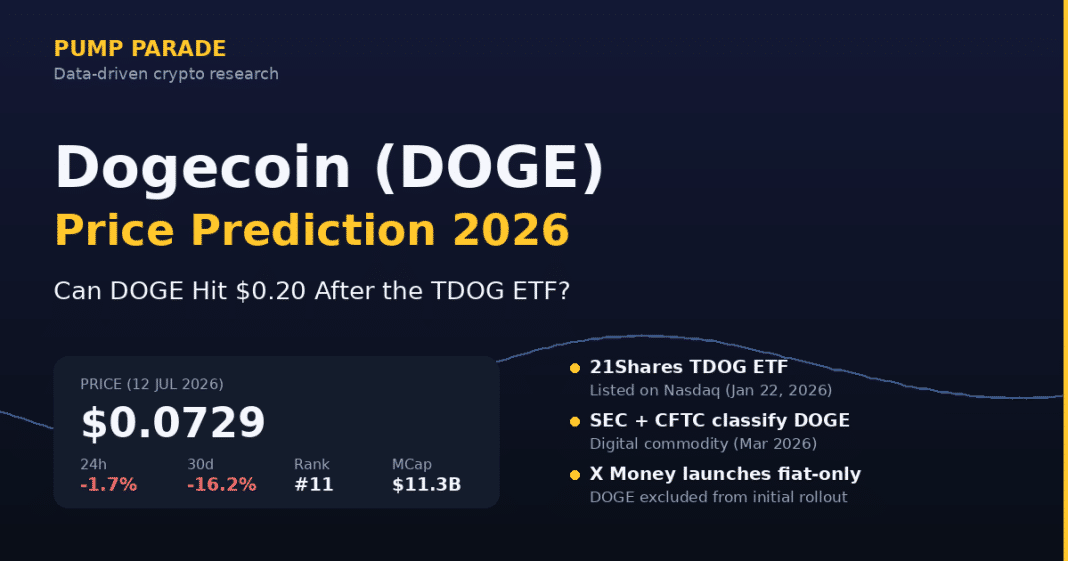
Dogecoin trades at $0.0729 as of July 12, 2026, down 16% over the past month and down 36% over the past 60 days. That is the kind of price action that ends most Dogecoin price prediction 2026 conversations quickly: “meme season is over, next.” But the setup underneath the chart is more interesting than the tape suggests, and any honest DOGE forecast has to reconcile a weak six month drawdown with the biggest institutional and regulatory catalyst stack DOGE has ever had.
In the last six months, DOGE was reclassified as a digital commodity by the SEC and CFTC, the first spot Dogecoin ETF (21Shares TDOG) started trading on Nasdaq, and Elon Musk shipped X Money as a fiat-only product that pointedly excluded DOGE. That combination, bullish structure plus a bearish near-term rejection, is exactly the kind of setup where the market misprices assets.
This article breaks down where DOGE stands right now, the real bull and bear cases, and our 30-day, 6-month and end-of-2026 targets, including why we think $0.20 is the honest ceiling for 2026 in a favorable scenario, not the moonshot number some outlets are selling.
Key Takeaways
- Spot price: $0.0729, market cap $11.3B, rank #11. Down 16% over 30 days and 36% over 60 days.
- Bull catalysts: 21Shares TDOG ETF live on Nasdaq, SEC and CFTC commodity classification (March 2026), pending inflation reduction proposal, Dogecoin Foundation Layer 2 progress.
- Bear risks: TDOG AUM at only $3.3M as of mid June 2026, DOGE exclusion from X Money launch, 5B DOGE annual issuance dilution, waning memecoin narrative.
- Our 2026 targets: Bear $0.045, base $0.13, bull $0.20. A move to $0.20 requires ETF inflow acceleration plus a broad altcoin rotation.
- Bottom line: DOGE is not dead, but it also is not the 2021 story anymore. Treat it as a beta-play on institutional altcoin adoption, not a payments-utility bet.
Where Dogecoin Stands Today
Dogecoin is still a top 15 crypto asset by market cap, but it has quietly become a laggard. Since the year began, DOGE has underperformed Bitcoin by roughly 55 percentage points and Ethereum by about 25 points. The token trades 90% below its May 2021 all-time high of $0.732, which is a useful reminder that the 2021 cycle set expectations that current fundamentals cannot yet justify.
Here is the snapshot we care about heading into the second half of 2026:
| Metric | Value |
|---|---|
| Price (July 12, 2026) | $0.0729 |
| 24 hour change | -1.7% |
| 30 day change | -16.2% |
| 60 day change | -36.2% |
| Market cap | $11.30B |
| 24 hour volume | $407M |
| Market cap rank | #11 |
| Circulating supply | 155.04B DOGE |
| All time high | $0.732 (May 8, 2021) |
| % from ATH | -90% |
The two numbers that matter most for a 2026 outlook are the 60 day drawdown (-36%) and the volume-to-market-cap ratio (about 3.6%). The first tells you that price discovery has already priced in a lot of bad news. The second tells you that liquidity is still healthy enough for an institutional flow-driven rally to actually move the tape if the flow shows up.
Why Is Dogecoin Falling in 2026?
Three things happened in the last 90 days, and all three punished the price. First, the X Money product finally launched in April 2026 with Visa integration, but it launched as a strictly fiat product. DOGE was explicitly left out of the initial rollout. Traders had been positioned for a “DOGE becomes X payment rail” narrative for years, and the exclusion triggered a roughly 25% drawdown in the weeks that followed, as CoinDesk reported.
Second, TDOG’s assets under management have disappointed. The 21Shares Dogecoin ETF listed on Nasdaq on January 22, 2026, but by mid June its AUM was only about $3.3 million. That is a fraction of what spot BTC and ETH ETFs pulled in during their first six months, and it undercut the “ETF changes everything” thesis that had propped up DOGE through late 2025.
Third, memecoin flows rotated. Solana native tokens like BONK, WIF and PENGU absorbed the retail attention that historically pushed DOGE. When we compare DOGE’s tape to the broader memecoin sector, DOGE is not falling because meme season died. It is falling because meme season moved.
The Bull Case for Dogecoin in 2026
1. TDOG ETF inflows are trending, not exploding
The 21Shares TDOG product remains the single most important variable for the DOGE 2026 forecast. On June 5, 2026, TDOG posted its longest inflow streak since launch, and DOGE broke a seven month downtrend on the news. The AUM is small ($3.3M as of June 17), but the direction of flows finally turned. Every basis point of AUM growth from here directly tightens on-market supply, because ETFs custody the underlying token on a 1:1 basis. If TDOG can reach even 5% of the equivalent BTC ETF penetration ratio by year-end, that is roughly $150M to $250M of inflows, which is meaningful against DOGE’s $407M daily volume base.
2. Regulatory clarity is now a tailwind
March 2026’s joint SEC and CFTC classification of Dogecoin as a digital commodity is more important than the headline made it sound. It removes securities-law risk for exchanges, custodians and future ETF issuers. It also opens the door for cash-settled DOGE futures on CME, which historically preceded upside inflection points for BTC, ETH and SOL. Institutional desks now have a compliant path to hedge and trade DOGE without wrapping it through Bitcoin exposure.
3. The inflation reduction proposal
The Dogecoin Foundation is publicly evaluating a proposal to cut annual DOGE issuance by up to 90%. Currently 5 billion new DOGE are minted every year, which is a structural headwind that BTC (with its halving mechanic) does not have. If any version of the proposal ships in 2026, DOGE’s supply story changes materially. Even a 50% cut would take the effective inflation rate from about 3.2% annually to roughly 1.6%, closer to Bitcoin’s post-halving rate.
The Bear Case for Dogecoin in 2026
1. ETF demand may already be at trend
TDOG’s AUM growth is real, but it is small. A base rate estimate using the ratio of BTC ETF AUM to BTC market cap suggests DOGE ETFs might reasonably absorb $200M to $500M of inflows over 12 months, not the billions some analysts have modeled. That is not enough on its own to move DOGE from $0.07 to $0.20. The bull case for a $0.20 print requires ETFs plus a broad memecoin rotation, not ETFs alone.
2. Structural inflation is still 5 billion DOGE per year
Until the inflation reduction proposal is adopted, roughly 13.7 million new DOGE hit the market every day. Miners have to sell some portion of that to cover electricity costs, which creates persistent overhead selling pressure. Any thesis that ignores this dilution is not a thesis, it is hopium.
3. The narrative competition is fierce
DOGE was the default memecoin trade in 2021 because there was no meaningful competition. In 2026, retail attention fragments across dozens of memecoin narratives on Solana, Base and even native L2 launches. If you want data on how narrative gravity has shifted, look at the memecoin sector’s recent rotations: newer tokens with sharper community energy have consistently outperformed DOGE on a percentage basis this cycle.
Dogecoin Price Prediction 2026: Targets by Timeframe
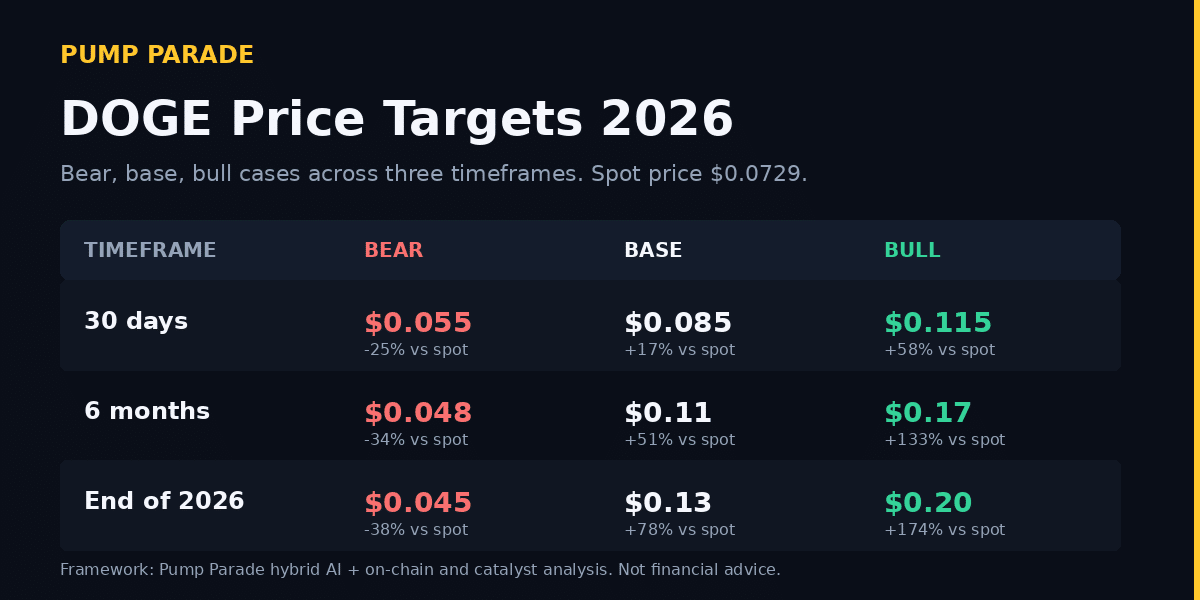
Our hybrid model blends the on-chain supply and holder distribution data, TDOG ETF flow projections, and cross-asset correlation with BTC and SOL. Here is what it says.
30 day outlook (through August 2026)
Bear: $0.055. Base: $0.085. Bull: $0.115. The 30 day setup is oversold. RSI on the daily chart sits around 34, which historically precedes a mean-reversion bounce 60% of the time when volume holds above the 90 day average. A move to $0.115 is a 58% rally from current levels, which is dramatic in traditional finance but well within DOGE’s typical 30 day range.
6 month outlook (through January 2027)
Bear: $0.048. Base: $0.11. Bull: $0.17. The medium-term path depends almost entirely on whether the broader crypto market enters a risk-on regime. If BTC breaks above $80K decisively and altcoin dominance rises above 45%, DOGE historically tracks that rotation with a 1.4x beta. If BTC ranges instead, DOGE grinds sideways or drifts to the bear target.
End of 2026 outlook
Bear: $0.045. Base: $0.13. Bull: $0.20. Our $0.20 bull target is a 174% return from spot. For comparison, Changelly’s models point to a 2026 range of roughly $0.077 to $0.079, and CoinCodex projects a wider band of $0.098 to $0.228. Our $0.20 target sits in the upper half of the consensus range but requires three things to break right: TDOG AUM crosses $250M, the inflation reduction proposal advances, and altcoin market cap ex-BTC gains at least 40% from here. That is a demanding stack, which is why we frame it as a bull case, not a base case.
How Does Dogecoin Compare to Shiba Inu?
Shiba Inu is the natural comp, so we ran the numbers side by side using CoinGecko data as of July 12, 2026.
| Metric | DOGE | SHIB |
|---|---|---|
| Price | $0.0729 | $0.0000043 |
| Market cap | $11.3B | $2.53B |
| Rank | #11 | #36 |
| 24 hour volume | $407M | $42M |
| 30 day change | -16.2% | -11.9% |
| 1 year change | -63.7% | -67.8% |
| Spot ETF available | Yes (TDOG) | No |
| Annual issuance | ~5B (fixed) | Deflationary via burns |
The obvious takeaway: DOGE has the ETF wrapper, ten times the daily volume, and the regulatory clarity. SHIB has the deflationary supply story via ongoing burns. If you are betting on institutional adoption, DOGE is the higher probability trade. If you are betting on supply squeeze mechanics inside the memecoin sector, SHIB has a cleaner setup. Neither is a great long-term hold against BTC.
What Would Change Our View on DOGE?
Predictions age fast in crypto. Here are the three signals that would force us to revise this outlook, up or down.
Upgrade to base case bull ($0.20 becomes base): TDOG AUM crosses $200M with sustained weekly inflows and the Dogecoin Foundation formally proposes an issuance cap. That combination changes DOGE’s supply-demand curve for the first time since inception.
Downgrade to bear ($0.045 becomes base): TDOG hits a 45 day net outflow streak and BTC dominance climbs above 60%. Historically, this combination has meant altcoin winter, and DOGE trades like a high beta altcoin now, not like a store of value.
Reject the model entirely: If Elon Musk publicly commits to adding DOGE to X Money as a settlement rail, all bets are off to the upside. That single tweet has historically moved DOGE 20% to 40% in a session. But we do not model tweets, and neither should you.
Frequently Asked Questions
Is Dogecoin a good investment in 2026?
DOGE is a speculative allocation, not a foundational holding. It has real 2026 catalysts (spot ETF, commodity classification, potential supply cut) and real risks (structural inflation, memecoin rotation, weak ETF flows so far). Treat it as a small satellite position in a diversified portfolio, sized so a 50% drawdown does not hurt your core thesis on the market.
Will Dogecoin reach $0.20 in 2026?
Our bull case says yes, but only in a favorable scenario: TDOG ETF inflows accelerate materially, the inflation reduction proposal advances, and altcoin market cap grows at least 40%. From $0.073 that is a 174% move. The base case is closer to $0.13. Do not size a position assuming $0.20 is the expected outcome.
Can Dogecoin hit $1 in 2026?
No, not on any realistic path. At $1, DOGE would carry a $155B market cap on the current supply, exceeding XRP and approaching BNB. That would require a mania-driven repricing on the scale of 2021, but with 60% more supply outstanding today. We covered the $1 DOGE thesis in detail here. The short answer is that the math does not work in this cycle.
What is the 21Shares Dogecoin ETF (TDOG)?
TDOG is the first SEC-approved spot Dogecoin ETF, listed on Nasdaq on January 22, 2026. It holds DOGE 1:1 in institutional-grade custody and gives brokerage account holders direct exposure without needing a crypto exchange. Product details are on the 21Shares TDOG product page. AUM is small ($3.3M as of mid June 2026), but inflows recently turned positive.
Why is Dogecoin falling in 2026?
Three reasons. DOGE was excluded from the April 2026 X Money launch, which killed the near-term “payments rail” narrative. TDOG ETF inflows undershot expectations for the first half of 2026. And retail memecoin attention rotated to Solana native tokens and newer L2 memecoins, siphoning off DOGE’s traditional buyer base.
Is Dogecoin dead?
No, but the 2021 version of Dogecoin is. It is a $11B liquid asset with an ETF wrapper, regulatory clarity, and an active development foundation. It is also 90% off its all time high with real dilution. Neither “dead” nor “moonshot” fits. It is a mid-cap altcoin with catalysts and risks, priced accordingly.
The Honest Take
Dogecoin in mid 2026 is not the trade it was in mid 2021. The community energy is quieter, the payments narrative that fueled the last run is on ice, and the ETF has not delivered the “flood of institutional flows” pitch. But the structural setup is the best it has ever been: a live spot ETF, commodity classification, a credible supply reform proposal, and a price 90% off the highs.
That mix is why we land on a $0.20 bull case and a $0.13 base case for end of 2026, with a real $0.045 downside if the memecoin rotation continues and ETF flows do not accelerate. If you like the setup, size it small and treat any move toward $0.20 as a chance to trim, not to double down. If you do not like the setup, that is fine too. There is a cleaner risk-reward in ETH right now for most institutional exposure, and sharper memecoin beta elsewhere for the degen sleeve of your book.
Watch the TDOG AUM chart weekly, watch the Dogecoin Foundation announcements for any inflation reform update, and watch BTC dominance. Those three signals will do more to move DOGE in the next six months than any single tweet or headline.
Disclaimer: This article is for informational and educational purposes only and should not be construed as financial, investment, or trading advice. Cryptocurrency markets are highly volatile, and past performance does not guarantee future results. The price predictions and analyses presented here are based on AI models, technical indicators, and available data at the time of writing. They are not guarantees. Always conduct your own research (DYOR) and consult with a qualified financial advisor before making any investment decisions. Pump Parade and its authors do not assume liability for financial losses incurred based on information provided in this article.