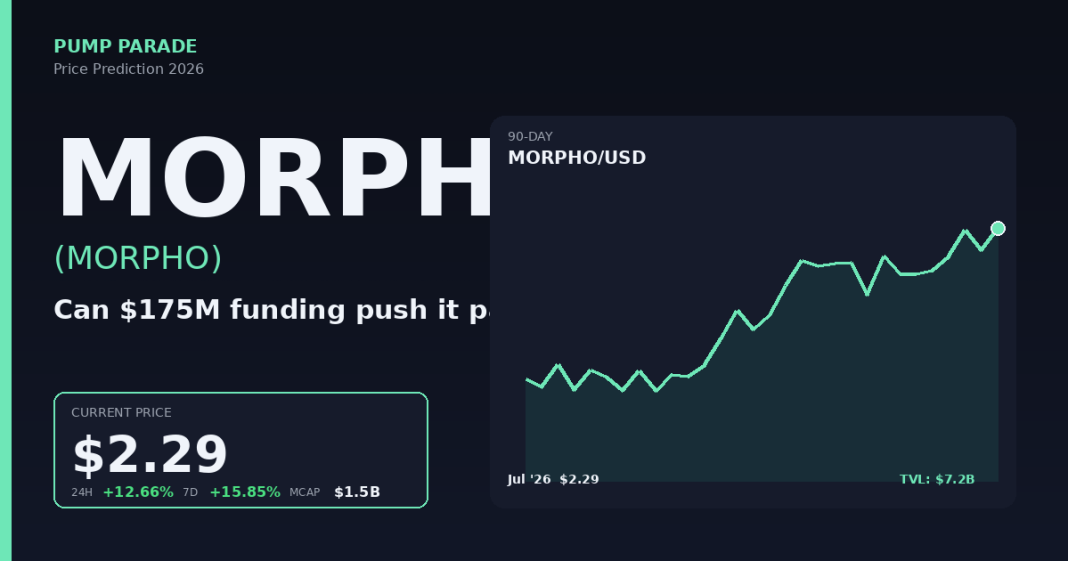
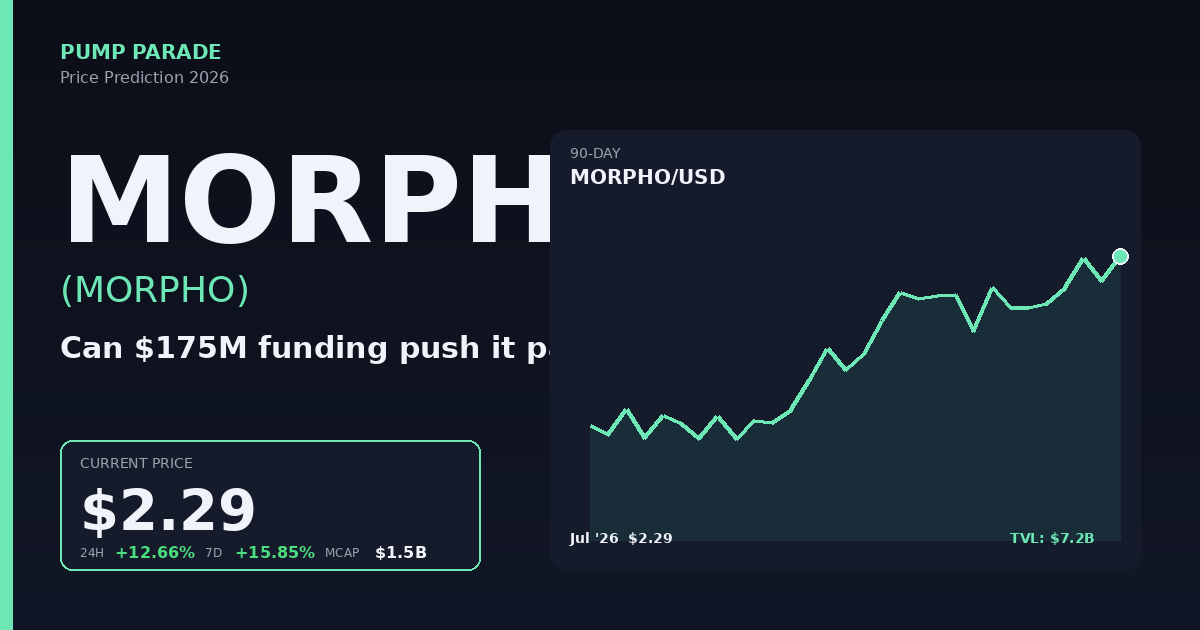
Morpho (MORPHO) is trading at $2.29 at time of writing, up 12.66% in the last 24 hours and 15.85% over the past week. That is not a random pump. On June 9, 2026, the Morpho Association closed a $175 million funding round co-led by Paradigm, a16z Crypto, and Ribbit Capital at a reported $2 billion valuation. Three weeks later, Robinhood switched on its Earn product routed through Morpho vaults. Total value locked crossed $7.2 billion in May and has stayed there since.
The question every trader is asking right now is simple: does a Morpho (MORPHO) price prediction 2026 above $5 hold up under scrutiny, or is this another DeFi token that runs into vesting supply and gives it all back?
Below, we walk through the current setup, the bull case, the bear case, timeframe-specific targets, and how Morpho stacks up against Aave. Bring skepticism. That is the point.
- MORPHO trades at $2.29, +12.66% in 24h, +15.85% in 7d, and about 45% below its January 2025 all-time high of $4.17.
- Morpho TVL crossed $7.2 billion in May 2026, making it the second-largest DeFi lending protocol behind Aave.
- Recent catalysts: $175M Paradigm/a16z/Ribbit funding round, Robinhood Earn integration going live July 1, Coinbase Loans routing $1.6B+ in collateral through Morpho Blue.
- Standard Chartered has floated a long-term $60 target by 2030, implying substantial upside if adoption keeps compounding.
- Bear case centers on 36% of supply still locked and vesting through 2027, plus fee-switch uncertainty.
- Our base case for 2026: $2.60 to $3.40 range, with a stretch scenario toward $5.10 if TVL breaks $12 billion.
Where Morpho Stands Today
Morpho is a permissionless, modular lending protocol on Ethereum and Base. In plain terms, it is credit market infrastructure that other apps plug into, not a consumer product you log into and lend from. That distinction matters more than most crypto media give it credit for, because it is exactly why Coinbase, Robinhood, MetaMask, and Apollo have built on top of it.
Here is the current stat snapshot:
| Metric | Value |
|---|---|
| Price (USD) | $2.29 |
| 24h change | +12.66% |
| 7-day change | +15.85% |
| 30-day change | +14.83% |
| Market cap | $1.5B |
| 24h volume | $32.7M |
| CoinGecko rank | #51 |
| All-time high | $4.17 (Jan 17, 2025) |
| % from ATH | -45.1% |
| Circulating supply | 653.8M (65.4% of max) |
| Protocol TVL | $7.2B+ (2nd largest lender) |
Data pulled from CoinGecko and DeFiLlama at time of writing.
Why is Morpho rising right now?
Three things stacked on top of each other in the space of five weeks.
First, the funding round. When Paradigm, a16z Crypto, and Ribbit Capital write a joint $175M check at a $2B valuation, that is not a bet on hype. It is a bet that the on-chain credit stack is going to look a lot like the fintech stack, and Morpho is a plausible middle layer. That announcement alone re-rated the token from around $1.70 to above $2.00.
Second, real revenue and real integrations. Coinbase Loans, MetaMask Money accounts, Apollo’s tokenized credit products, and now Robinhood Earn all route deposits or collateral through Morpho. This is what serious analysts mean when they say “distribution moat.” The token is not the product. The token captures fees from a lending network that already reaches more than a million users.
Third, sentiment. Standard Chartered’s crypto research desk initiated coverage with a striking long-run target, which pulled attention from generalist investors who had never looked at a DeFi lending token before. In an environment where Bitcoin is trading in a range and traders are hunting for narrative-driven mid-caps, Morpho fit the bill.
What could push MORPHO past $5?
Catalyst 1: Robinhood Earn distribution
Robinhood’s Earn product launched July 1, 2026, routing user deposits through Morpho vaults. The addressable audience is roughly 25 million Robinhood users. Even a low single-digit percentage participation would meaningfully expand Morpho’s stablecoin deposit base, drive protocol fees, and, if the fee switch is activated by governance, translate into MORPHO holder revenue.
Catalyst 2: V2 upgrade and fixed-term loans
Morpho V2 introduces market-driven rates and fixed-term loans. In practice, this expands the protocol beyond variable-rate crypto lending into territory that looks a lot like traditional credit markets. Fixed-term loans are the specific feature institutional treasuries have been asking for. If V2 lands cleanly this year, expect Morpho to start showing up in more institutional pilots.
Catalyst 3: TVL compounding at $7B and above
TVL grew from around $5B in early 2026 to $7.2B in May. The trajectory implies a run at $10B before year-end is plausible if Robinhood ramps and Base network activity holds. Historically, DeFi lending tokens have re-rated when their protocols cross round-number TVL thresholds. There is no fundamental reason $10B would be different, but market participants respond to visible milestones.
What could send MORPHO back below $2?
Risk 1: Supply overhang through 2027
About 36.4% of MORPHO’s total supply is still locked. Vesting continues through 2027 and includes early investor and team allocations. This is the single biggest headwind. Even in a strong bull market for the protocol, persistent sell pressure from unlocked tokens can cap price appreciation. Check the Tokenomist vesting schedule before sizing any long-term position.
Risk 2: Fee switch and value accrual uncertainty
MORPHO is a governance token. The protocol earns fees, but whether and how those fees flow to token holders is a governance decision that has not been fully activated. If governance chooses to keep reinvesting fees into growth rather than routing them to holders, the token’s fundamental value case weakens even as the protocol succeeds. This is the classic DeFi trap: great protocol, mediocre tokenomics.
Risk 3: Aave competition and moat questions
Aave still commands more than three times the TVL of Morpho, has GHO as an integrated stablecoin, and just shipped its own V4 architecture. Morpho’s edge is modularity and better rates on isolated markets. That edge is real but not permanent. If Aave introduces isolated risk markets natively at scale, Morpho’s differentiation narrows quickly.
Morpho (MORPHO) Price Prediction 2026: Targets by Timeframe
30-day outlook: $1.85 to $3.20
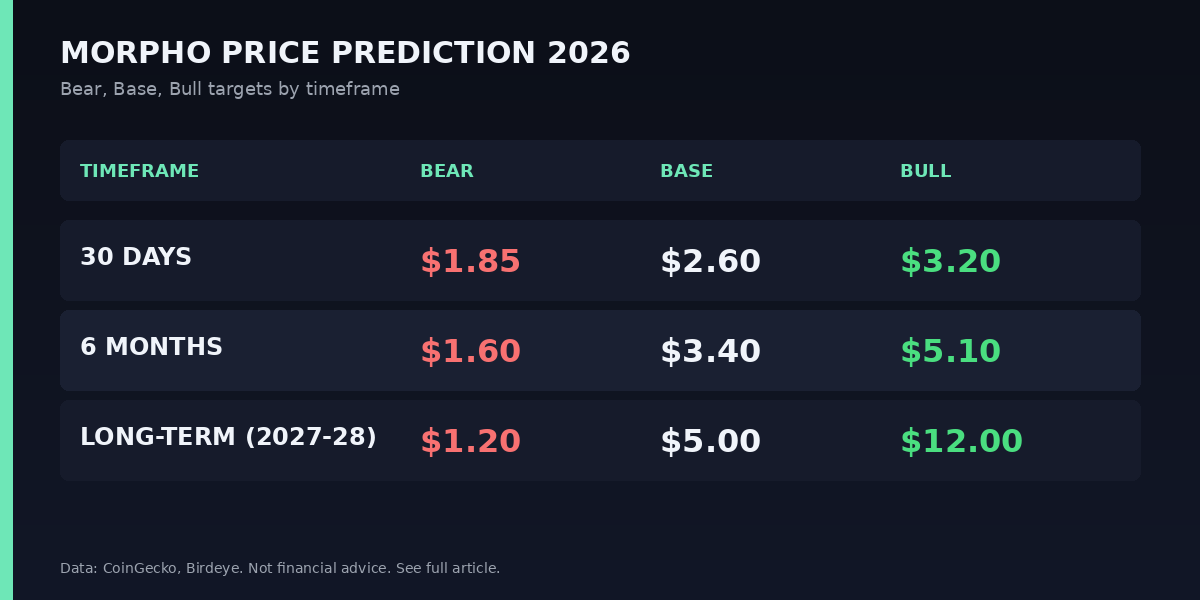
Momentum is strong but the daily RSI is already stretched into overbought territory after this week’s move. Base case for the next 30 days is consolidation between $2.10 and $2.80, with a reasonable shot at $3.20 if V2 receives a firm launch date and Robinhood volume prints better than expected. The bear scenario: a sharp reset to $1.85 on any broader risk-off move, especially if Bitcoin loses the $60K level. Our AI model assigns roughly 55% probability to the $2.10 to $2.80 base range.
6-month outlook: $1.60 to $5.10
By the end of 2026, the fair-value range widens considerably. If TVL crosses $10B and the fee switch is meaningfully activated, we see a base case of $3.40 with a bull target of $5.10. This aligns with the more optimistic end of analyst ranges, including projections that put MORPHO in the $2.30 to $5.00 zone by year-end. The bear case is $1.60, driven by supply unlocks and DeFi rotating out of favor. For context, our Aave 2026 outlook uses a similar framework and lands at a wider spread because AAVE has deeper liquidity to absorb noise.
Long-term (2027 to 2028): $1.20 to $12.00
Long-term MORPHO is a bet on on-chain credit becoming a normal part of fintech infrastructure. Standard Chartered’s $60 by 2030 target is directionally interesting but requires assumptions that break outside the standard DeFi lens. A more grounded 2027 to 2028 range is $5 to $12 in the bull case, with $12 requiring TVL parity with Aave and an active fee switch. The bear case at $1.20 assumes supply unlocks overwhelm demand and Aave defends its lead. Long forecasts are noisy. Weight them accordingly.
How does Morpho compare to Aave in 2026?
| Metric | Morpho | Aave |
|---|---|---|
| TVL | $7.2B | $24B+ |
| Market cap | $1.5B | $3.7B |
| Architecture | Isolated markets, modular vaults | Pooled liquidity |
| USDC supply APY (typical) | 4% to 8% | 3% to 6% |
| Native stablecoin | None | GHO |
| Big-name integrations | Coinbase, Robinhood, MetaMask, Apollo | Multi-chain, wide DeFi presence |
| Risk model | Isolated per-market parameters | Governance-vetted, shared pools |
| Best fit | Sophisticated users, curators, integrators | Default DeFi lender for most users |
Translation: Aave is the safer bet on the whole category. Morpho is the higher-beta play on the specific thesis that on-chain credit gets increasingly modular and institutional. Different trades.
What Would Change Our View
Three things would materially shift the analysis.
Bullish trigger: TVL crosses $10 billion before December 2026 and governance activates a real fee switch. If both happen, our base case moves toward $5 and the bull case toward $8 for year-end 2026.
Bearish trigger: A cluster of major unlocks meets a broader DeFi selloff, and MORPHO breaks below $1.60 on high volume. That level was the 90-day low and has acted as accumulation support. Losing it opens the door to a retest of the $0.90 to $1.20 zone.
Regime-change trigger: Aave ships isolated markets at parity with Morpho Blue and captures Morpho’s differentiation. In that world, Morpho becomes an execution-only story rather than an architecture story, and the multiple compresses.
Frequently Asked Questions
Is Morpho a good investment in 2026?
Morpho has strong fundamentals: $7.2B TVL, tier-one integrations, and a $175M funding round at $2B valuation. That said, 36% of supply is still locked, and value accrual to the token depends on future governance decisions. It suits investors who want DeFi lending exposure and can tolerate supply-driven volatility.
Will Morpho reach $5 in 2026?
$5 is the upper end of our base-to-bull scenario for 2026. Getting there likely requires TVL near $10 billion, an active fee switch, and a broader risk-on backdrop. It is achievable but not the median outcome. Our base case for year-end is closer to $3.40.
What is the Morpho price prediction for 2027?
For 2027, we model a range of $2.50 to $8.00. The base case sits around $4.50, contingent on Morpho holding its second-place TVL position and V2 adoption continuing. Long-run analyst targets from firms like Standard Chartered stretch above $10 by 2028, but those depend on aggressive institutional adoption assumptions.
What is Morpho and how does it differ from Aave?
Morpho is a modular lending protocol on Ethereum and Base that lets anyone create isolated lending markets with custom risk parameters. Aave uses shared pools and unified governance-set risk. Morpho typically offers better rates on stablecoins and supports more specialized markets. Aave offers broader multi-chain reach and integrated products like the GHO stablecoin.
Where can I buy MORPHO?
MORPHO trades on major centralized exchanges including Coinbase, Binance, Kraken, and OKX, plus decentralized exchanges on Ethereum and Base. Liquidity is deepest on the top CEXs. Always check exchange fees and slippage on smaller venues before executing large orders.
What are the biggest risks to MORPHO price?
The three main risks are ongoing token unlocks through 2027, uncertainty around whether governance will activate a fee switch that routes revenue to holders, and competitive pressure from Aave if it ships isolated markets at scale. A broader DeFi drawdown would amplify all three.
The Honest Take
Morpho is one of the cleanest fundamental stories in DeFi right now. A real protocol, real integrations, real revenue, real institutional backers. That is rare, and it justifies interest at current levels.
But you are also buying a token where more than a third of the supply has not hit the market yet, and where the mechanism by which protocol success becomes token value is still being negotiated in governance. Both can be true at once.
The trade setup we would watch: an accumulation zone in the $1.85 to $2.20 range, a base case exit near $3.40 into year-end 2026, and a willingness to hold a smaller position toward the $5 to $8 target if V2 lands and TVL keeps compounding. This is a framework, not a recommendation. If you are looking for a lower-beta way to play DeFi lending, revisit our Aave 2026 outlook. For a stablecoin yield angle, our Ethena analysis covers a different corner of the same market. And if you want to see how the lending model plays out on Solana, our Kamino vs marginfi comparison is worth a read.
Disclaimer: This article is for informational and educational purposes only and should not be construed as financial, investment, or trading advice. Cryptocurrency markets are highly volatile, and past performance does not guarantee future results. The price predictions and analyses presented here are based on AI models, technical indicators, and available data at the time of writing, they are not guarantees. Always conduct your own research (DYOR) and consult with a qualified financial advisor before making any investment decisions. Pump Parade and its authors do not assume liability for financial losses incurred based on information provided in this article.